

Nature of Electromagnetic (EM) Waves:
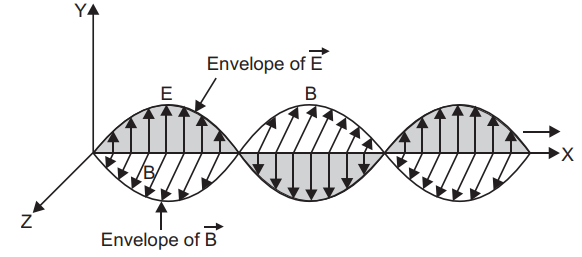
- Transverse Nature: Electric and magnetic fields in EM waves are perpendicular to each other and to the direction of propagation.
- Self-Sustaining Oscillations: EM waves are self-sustaining oscillations of electric and magnetic fields in free space, requiring no material medium for propagation.
- Electromagnetic Spectrum: It encompasses all EM waves based on frequency, wavelength, or energy.
- Constant Speed: EM waves travel at the speed of light, c = 3.00×10^8 m/s in a vacuum, with a lower speed in other mediums.
- Energy Transmission: Crucial for transmitting energy, facilitating communication, and sustaining life by enabling processes like sunlight reaching Earth.
- Wave-Particle Duality: Exhibits wave-like and particle-like properties according to quantum mechanics.
- Photons: All electromagnetic radiation is quantized into finite “bundles” of energy called photons.
- Interaction with Matter: Can interact with matter through absorption, reflection, and refraction, essential for applications in spectroscopy, imaging, and remote sensing.
The acronym SONAR stands for SOund Navigation And Ranging. Sonar is a device that uses ultrasonic waves to measure the distance, direction and speed of underwater objects.
The depth of the sea is determined using reverberation range by measuring the time it takes for an echo to return to a ship.
Sonar consists of a transmitter and a detector and is installed in a boat or a ship,
- The transmitter sends out ultrasonic waves.
- These waves go through water, hit an object on the seabed, bounce back, and are picked up by the detector.
- The detector changes the ultrasonic waves into electrical signals.
- The distance of the object that reflected the sound wave can be calculated by knowing the speed of sound in water and the time interval between transmission and reception of the ultrasound.



