

The phenomenon of microgravity, also known as weightlessness, is responsible for the floating pictures of astronauts in space stations.
- In a satellite orbiting the Earth, every component experiences an acceleration towards the centre of the Earth, equivalent to the Earth’s gravitational acceleration at that position.
- As a result, everything inside the satellite is in a state of free fall, but instead of falling towards Earth, they are falling around it.
- Because all objects inside the satellite are falling at the same rate, they appear to float in a state of weightlessness.
- Without gravity defining the vertical direction, all directions appear the same to them, eliminating the distinction between horizontal and vertical directions.
| Aspect | Gravitational Force | Electrostatic Force |
| Nature of Force | Attractive only | Can be attractive or repulsive |
| Source | Mass of objects | Electric charge (positive or negative) |
| Law | Newton’s Law of Universal Gravitation | Coulomb’s Law |
| Force Range | Acts at all distances (long-range force) | Acts at a distance (long-range, but depends on charge size) |
| Strength | Weak force compared to electrostatic force | Stronger force than gravitational force |
| Dependence on Medium | Always acts the same in any medium | Depends on the medium (weaker in air, stronger in dielectric) |
| Effect on Objects | Affects objects with mass | Affects objects with electric charge |
| Direction of Force | Always attractive | Can be attractive or repulsive |
| Example | Earth pulling objects toward its center (gravity) | Force between charged particles (positive repels positive, negative repels negative) |
Both forces are fundamental, but gravitational force is weak and always attractive, while the electrostatic force is stronger and can be both attractive and repulsive.
Kepler’s laws of planetary motion are a set of three fundamental principles formulated by the German astronomer Johannes Kepler in the early 17th century. These laws describe the motion of planets around the Sun and are as follows:
- Law of Elliptical Orbits:
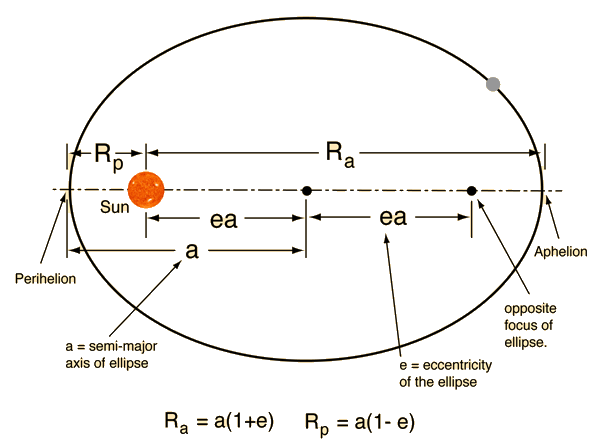
- “Planets orbit the Sun in elliptical paths, with the Sun at one of the two foci.”
- Explanation → motion under inverse square force of gravitation (central force ) → planet perform BOUND motion, which gives eccentricity less than 1 ⇒ Elliptical orbit
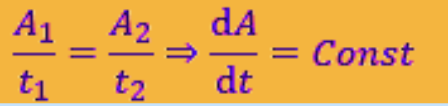
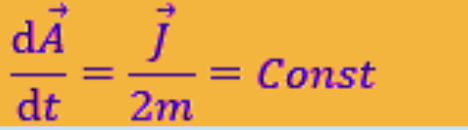
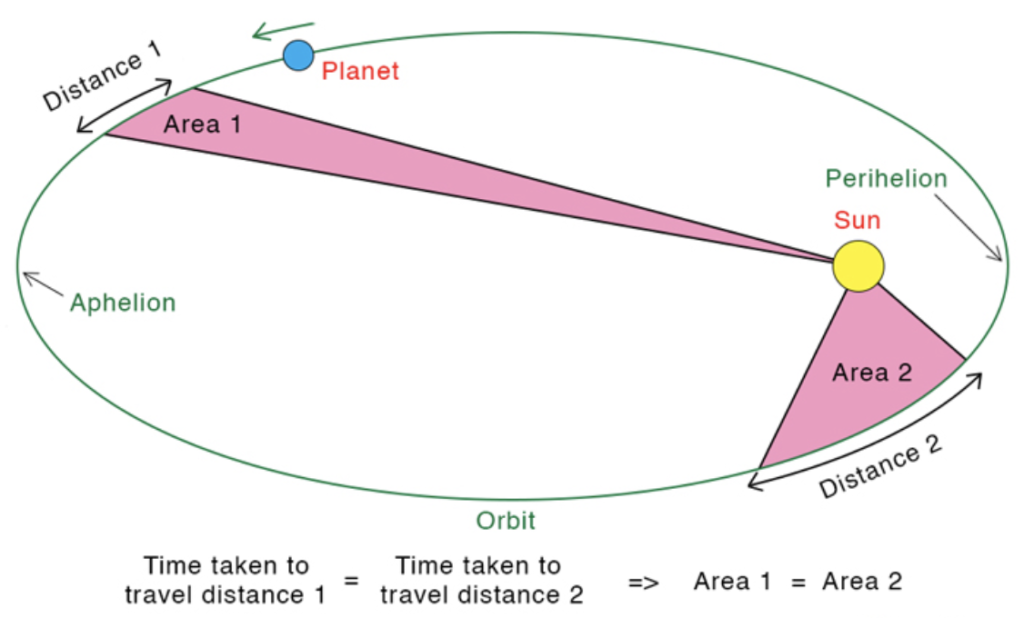
- Law of Equal Areas: “A line segment joining a planet and the Sun sweeps out equal areas during equal intervals of time as the planet travels along its elliptical orbit.”
- Explanation → consequence of conservation of angular momentum
- When the planet is closer to the sun,it moves faster, sweeping through a longer path in a given time.
- Law of Harmonies (or Law of Periods): “The square of the orbital period of a planet is directly proportional to the cube of the semi-major axis of its orbit.”
- This law arises from the law of gravitation. Newton first formulated the law of gravitation from Kepler’s 3rd law.
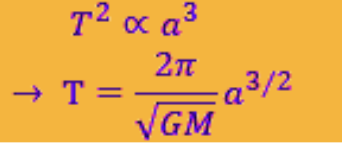
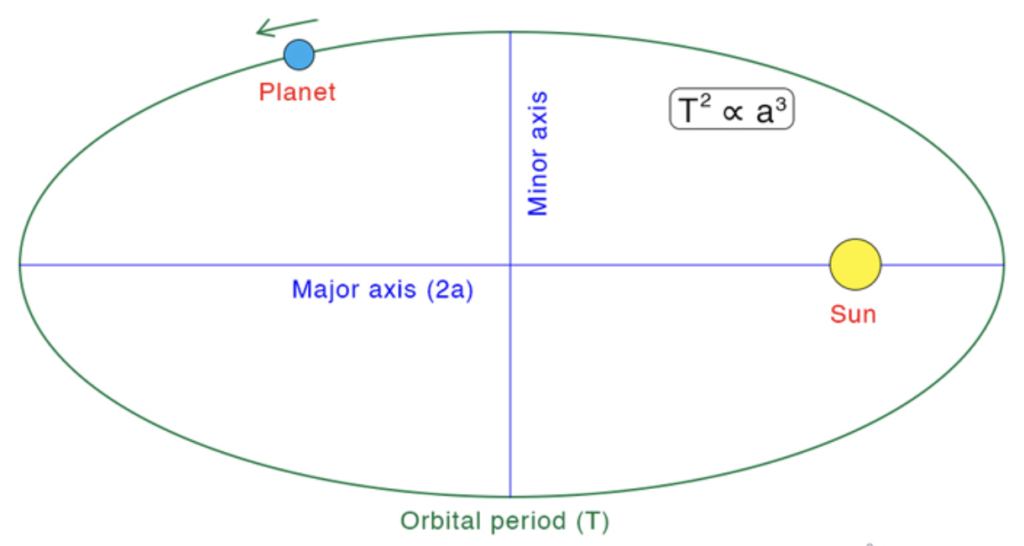

Although Kepler could not give a theory to explain the motion of planets yet Kepler’s laws were crucial in advancing our understanding of planetary motion and laid the groundwork for Isaac Newton’s law of universal gravitation.
Gravitational Force and Satellite Motion –
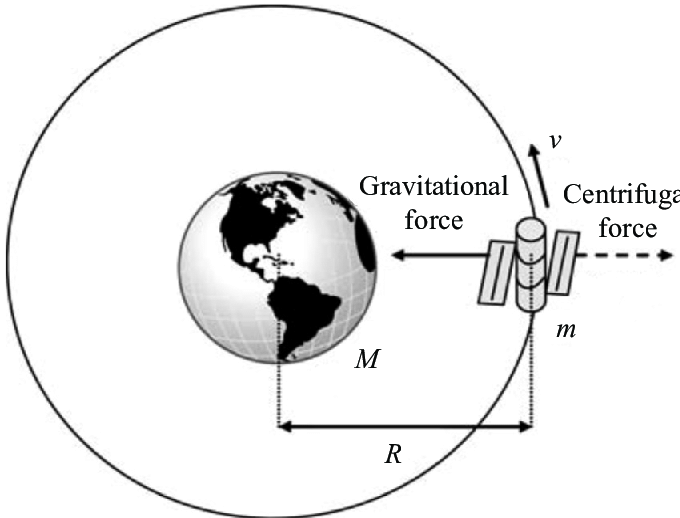
- A satellite in orbit around the Earth experiences a centripetal force required to maintain its circular or elliptical path. This centripetal force is provided by Earth’s gravitational attraction.
- The satellite moves in a curved trajectory because its tangential velocity is perpendicular to the gravitational force pulling it inward, resulting in a stable orbital motion.
- From a frame of reference, the satellite is in continuous free fall, but because of its tangential speed, it perpetually “falls around” the Earth rather than toward it.
- Thus, lower orbits (smaller rrr) require higher velocities, while satellites in higher orbits move more slowly.
| Feature | Geostationary Satellite | Polar Satellite |
| Orbit Direction | Orbits above the equator, in the same direction as Earth’s rotation, maintaining a fixed position relative to the Earth’s surface. | Orbits in a north-south direction, passing over both the poles, covering the entire Earth in a series of passes. |
| Altitude | Approximately 35,786 km above the Earth’s surface. | Approximately 500 to 800 km above the Earth’s surface. |
| Orbital Period | 24 hours, synchronized with the Earth’s rotation. | Approximately 90 to 100 minutes per orbit. |
| Position Relative to Earth | Remains stationary relative to a specific point on Earth, providing continuous coverage of the same region. | Passes over different areas of the Earth during each orbit, ensuring global coverage over time. |
| Coverage | Offers constant coverage of a fixed region on Earth (primarily the equatorial belt). | Covers the entire Earth in successive orbits, ensuring global observation. |
| Resolution | Lower resolution due to higher altitude and broader field of view. | Higher resolution due to closer proximity to the Earth, enabling detailed imaging. |
| Applications | Primarily used for communication, television broadcasting, and weather forecasting. | Primarily used for Earth observation, environmental monitoring, resource management, and surveillance. |
| Examples | INSAT series (India), GOES (USA), EUTELSAT (Europe). | IRS (India), NOAA (USA), Landsat series (USA), RADARSAT (Canada). |



