

Cloud computing refers to the delivery of computing services, such as servers, databases, software, and applications, over the internet on a pay-as-you-go basis. It allows users to access and utilize a wide range of computing resources without the need for on premises infrastructure.
Service Model | Details | Examples |
Infrastructure as a Service (IaaS) |
| Amazon Web Services (AWS) Elastic Compute Cloud (EC2), Microsoft Azure Virtual Machines, Google Compute Engine (GCE), IBM Cloud Virtual Servers |
Platform as a Service (PaaS) |
| Heroku, Google App Engine, AWS Elastic Beanstalk, Adobe Commerce |
Software as a Service (SaaS) |
| Google Workspace, Microsoft Office 365, Salesforce, Dropbox, Slack |
Advantages:
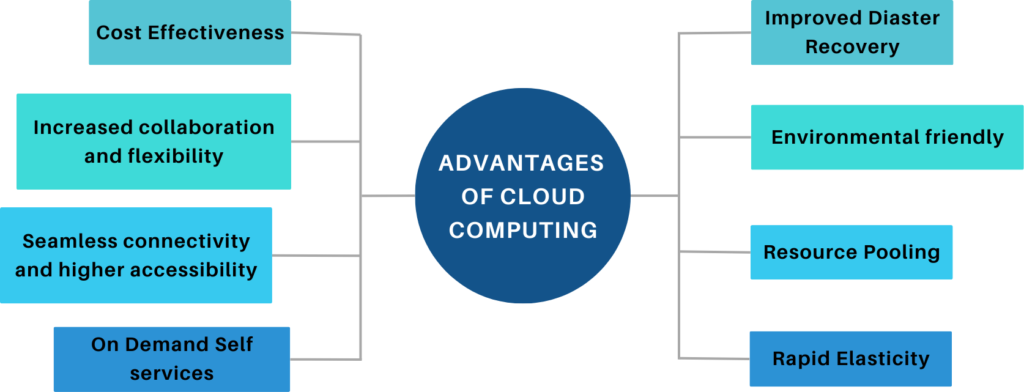
(For 2 Marker : IaaS provides virtualized infrastructure resources, PaaS offers a platform for application development and deployment, and SaaS delivers software applications over the internet on a subscription basis.)
Service Models of Cloud Computing
| Aspect | Infrastructure as a Service (IaaS) | Platform as a Service (PaaS) | Software as a Service (SaaS) |
| Target Audience | IT admins, developers needing control | Developers focusing on app development | End users needing ready-to-use tools |
| Control Level | High (infrastructure control) | Medium (app control, no infrastructure) | Low (provider manages everything) |
| Scalability | Highly scalable | Scalable, but within platform limits | Limited to the software’s features |
| Setup Time | Medium | Low | Immediate |
| Customization | High | Medium | Low |
| Cost | Pay-per-use (based on resources used) | Pay-per-use (platform usage) | Subscription-based |
| Maintenance | User-managed | Shared between user and provider | Provider-managed |
| Examples | Amazon EC2, Microsoft Azure VMs, Google Compute Engine | AWS Elastic Beanstalk, Google App Engine, Microsoft Azure App Service | Google Workspace, Zoho CRM, Microsoft Office 365 |



