

| Aspect | 5G Network | 6G Network |
| Speed | Up to 20 Gbps | Upto 1 Tbps |
| Latency | Around 1 ms | Between 1 millisecond to 1 microsecond |
| Frequency Bands | for low band – sub-6 GHz (Gigahertz) and for high band frequencies -above 24.25 GHz | Higher frequency bands, such as terahertz95 GHz to 3 THz (Terahertz) |
| Network Intelligence | Limited AI integration | Edge Computing and Heavy AI integration for network operations |
| Advanced Applications | Limited advanced applications supported | More advanced applications, including holographic communications and advanced AR/VR and seamless IoT connectivity. |
| Global Coverage | Limited global coverage | Truly global coverage, including remote areas |
| Energy Efficiency | Moderate energy efficiency | Expected to be more energy-efficient |
| Device Connectivity | Limited scope and scale | may also connect ten times more devices per square kilometer |
| Reliability / Security | Limited user centric | expected to address the increasing demands for secure and robust communication, especially in critical applications. |
The concept of mobile telephony was developed first in 1970’s and it was fully implemented in the following decade.
- Cell Division : Service areas are divided into cells, each served by a base station.
- Cells are typically arranged in a hexagonal pattern to maximize coverage and minimize interference.
- Each cell covers a specific geographic area, usually a few square kilometers.
- Base Stations : are equipped with low-power transmitters to communicate with mobile devices within their coverage area.
- Radio Waves: Used to communicate between devices and base stations.
- Mobile telephony operates within the Ultra High Frequency (UHF) range, typically between 800 and 950 MHz.
- Handover Process
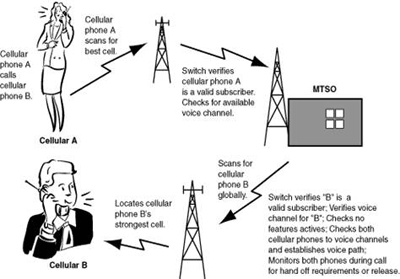
- As mobile devices move between cells, the handover process ensures seamless connectivity.
- It involves transferring the connection from one base station to another without interrupting communication.
- The Mobile Telephone Switching Office (MTSO) coordinates the handover process and manages the overall operation of the cellular network.
5G, the fifth generation of mobile networks, marks a significant leap over 4G in terms of speed, latency, connectivity, and reliability. It enables next-generation digital services and supports India’s vision of a digital economy.
Key Technologies Behind 5G
- New Radio (NR): 5G introduces a new radio interface, known as New Radio (NR). It supports both Sub-6 GHz and millimeter-wave (mmWave) frequencies for high-speed data transfer.
- Millimeter-Wave Bands (mmWave): Operates in 24–100 GHz range, offering ultra-fast speeds and higher bandwidth, though with limited range.
- Small Cells: Dense network of Low-power, short-range base stations that improve coverage in dense urban areas.
- Massive MIMO (Multiple Input, Multiple Output): Uses a large number of antennas to increase the spectral efficiency and capacity of a wireless network.
- Beamforming: Directs focused signals to devices, enhancing signal strength and reducing interference.
- OFDM (Orthogonal Frequency Division Multiplexing): Base waveform for uplink/downlink, enabling efficient spectrum use and better interference management.
- Network Slicing: Allows creation of virtual networks tailored for specific applications like healthcare, smart cities, IoT, autonomous vehicles.
- Dynamic Spectrum Sharing (DSS): Enables 4G and 5G to share spectrum, ensuring smooth transition and efficient spectrum use.
- Edge Computing : Processes data closer to the user. Reduces latency and enables real-time services.
5G is not just an upgrade in speed but a foundational technology for Industry 4.0, smart cities, and digital governance. Its successful implementation will be crucial for India’s socio-economic transformation.



