
Feature | Analog telecommunication | Digital telecommunication |
Signal | Makes us of analog signal (Time varying sine wave form) 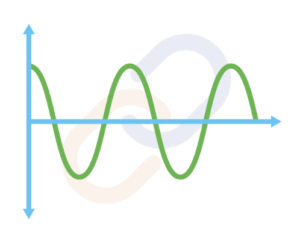 | Use of discrete signal (amplitude is of two levels i.e 0 or 1) 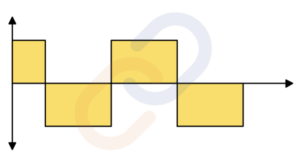 |
Noise immunity | More susceptible to noise and interference | Less susceptible to noise and interference |
Transmission Range | Limited range without significant degradation | Can maintain signal integrity over longer distances |
Multiplexing | FDM is used (frequency division multiplexing ) | TDM is used (time division multiplexing ) |
Broadcasting | only a limited number of channels can be broadcasted simultaneously. | can broadcast a large number of channels simultaneously. |
Coding | coding is not possible. | Different coding techniques can be used to detect and correct errors |
bandwidth | Bandwidth required is low | Higher bandwidth required |
Power consumption | High | Low |
Examples | AM/FM radio, TV, telephone | Music CDs, DVDs, smartphones |
Block diagram | 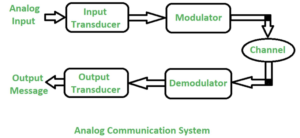 | 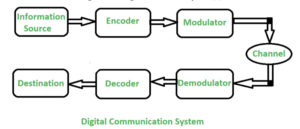 |
- 3.0, also known as Web3, represents the third generation of the World Wide Web. it will be a decentralized internet built on an open blockchain network that is not owned and controlled by large entities.
- Gavin Wood, founder of Ethereum, used the term Web3 first in 2014.
Earlier versions | Web 3.0 |
|
|
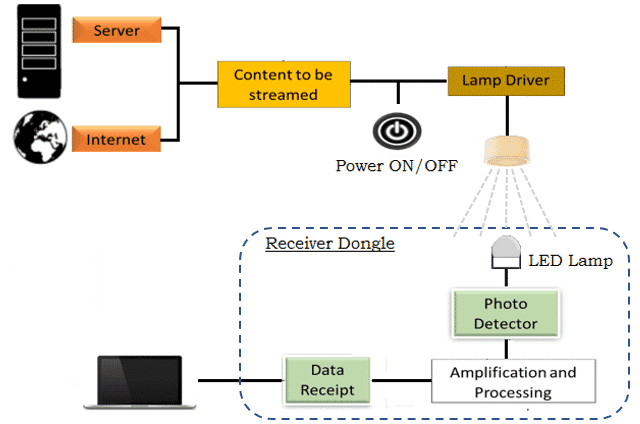
Li-Fi (Light Fidelity) is a wireless communication technology that uses visible light instead of radio waves (like Wi-Fi) to transmit data.
Working principle of Li-Fi technology
- Light Source (Transmitter): A LED (Light Emitting Diode) acts as the transmitter.
- Data Encoding: Data is encoded into binary signals (0s and 1s).
- Data Transmission: The modulated light is transmitted through the visible light spectrum.
- Data Reception: A photodiode or light sensor receives the light signal and decodes it back into electrical data.
Modulation is essential because it allows the baseband signal (original information) to be transmitted efficiently over a communication medium. By altering a carrier wave’s amplitude, frequency, or phase it reduces interference and allows multiple signals to share the same channel.
- Analog Communication : Amplitude Modulation (AM), Frequency Modulation (FM), Phase Modulation (PM).
- Digital Communication : ASK (Amplitude Shift Keying), FSK (Frequency Shift Keying), PSK (Phase Shift Keying).
| Property | Ground wave propagation | Sky wave propagation | Space wave propagation |
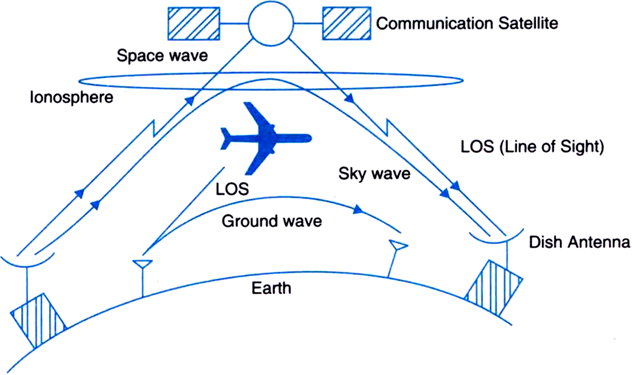
| Mode of Propagation | Surface wave propagation, wave glides over the surface of the Earth | Ionospheric reflection of radio waves back towards the Earth | Line-of-sight propagation, travels in straight lines |
| Frequency range | Nearly 2 KHz to 2 MHz | 3 MHz – 30 MHz | 30 MHz – 400 MHz |
| Terrain Dependency | –Affected by obstacles and terrain features, such as hills and buildings–Attenuation increases rapidly with increase in frequency | Less affected by terrain, but influenced by ionospheric conditions | Line-of-sight, requires unobstructed path between transmitter and receiver |
| Distance Covered | Short to medium range (up to a few hundred kilometers) | Long range (thousands of kilometers) | Medium to long range (up to several hundred kilometers), limited by the curvature of the Earth |
| Antenna Placement | Located on or very near to the ground | – | Placed at heights of many wavelengths above the ground |
| Application | AM broadcast, limited range communication | Short wave broadcast services, long range communication | Television broadcast, radar, microwave links, satellite communication |
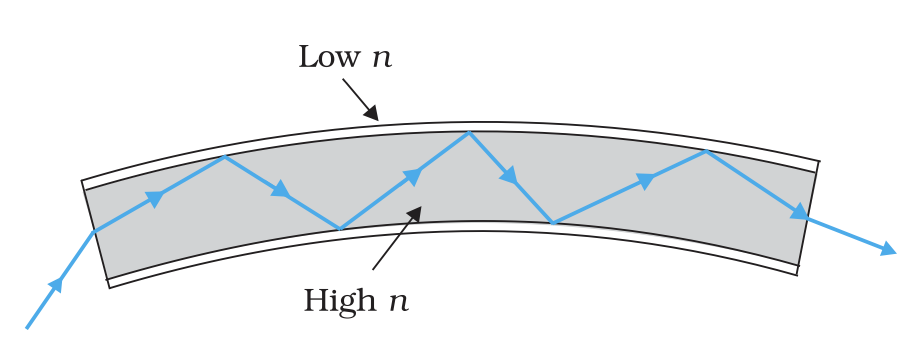
Optical Fiber: Extensively used for transmitting audio and video signals over long distances.
- Fabricated with high-quality composite glass/quartz fibers consisting of a core and cladding. The refractive index of the material of the core is higher than that of the cladding.
- Signal in the form of light directed at one end of the fiber undergoes repeated total internal reflections along its length.
- Light reflected at one side of the inner surface strikes the other side at an angle larger than the critical angle.
Advantage :
- High Bandwidth: Enables rapid data transmission over long distances.
- Low Attenuation: Minimal loss in intensity of the light signal due to total internal reflection.
- Immunity to EMI: Resistant to electromagnetic interference for stable transmission.
- Lightweight and Compact: Easy to install and manage, requiring less physical space.