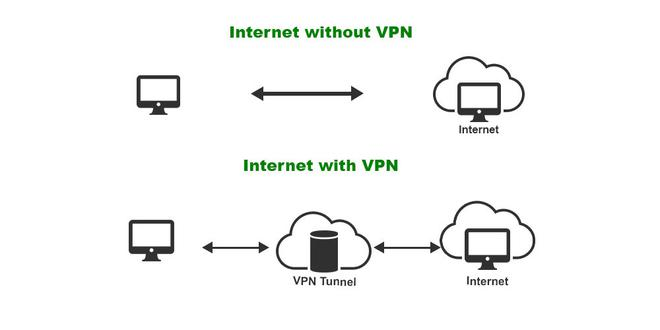
- A VPN creates a secure connection over a public network, such as the internet, to enable remote users to access a private network securely.
- It creates a point-to-point tunnel that encrypts personal data, masks your IP address, and lets you sidestep website blocks and firewalls on the internet.
- This ensures online experiences are private, protected, and more secure.
- It is
- Virtual because no physical cables are involved in the connection process.
- Private because through this connection, no one else can see your data or browsing activity.
- Networked because multiple devices—your computer and the VPN server—work together to maintain an established link.
- VPNs are commonly used to protect online privacy, bypass censorship and geo-restrictions, and enhance security while using public Wi-Fi networks.
| Aspect | Hub | Switch |
| Data Transmission | Connects multiple devices in a LAN and broadcasts data to all connected devices, regardless of destination. | Connects devices in a LAN and sends data only to the intended device based on MAC address. |
| Collision Handling | Creates more network collisions as all devices share the same bandwidth. | Reduces collisions by managing dedicated paths for data transmission. |
| Efficiency | Low efficiency due to unnecessary data sharing and collisions. | High efficiency as data is sent directly to the target device. |
| Simultaneous Transfer | Cannot handle multiple transmissions at once. | Can handle multiple transmissions simultaneously. |
| Example | Like an old-fashioned office where all computers and printers are connected via a hub — every message goes to everyone, even if it’s not meant for them. | Like a modern office network where devices are connected via a switch — messages go directly to the intended recipient. |
| Aspect | IPv4 | IPv6 |
| Address Length | 32 bits | 128 bits |
| Address Format | Decimal numbers separated by periods (.). | Hexadecimal numbers separated by colons (:). |
| Configuration | Manual or DHCP configuration. | Auto-configuration supported. |
| Speed and Efficiency | Slower routing due to address exhaustion. | Faster routing and simplified packet processing. |
| Address Capacity | ~4.3 billion addresses, insufficient for modern needs. | Virtually unlimited number of addresses to meet growing demand. |
| Security | Security optional (uses IPSec optionally). | IPSec mandatory for security. |
| Example | 192.168.0.178 | 2001:CDBA:0000:0000:0000:0000:3257:9652 |
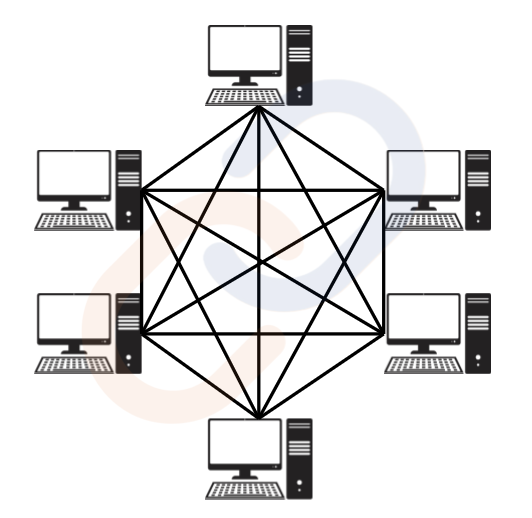
Sol- Mesh topology is a network setup where each device is directly connected to every other device in the network. This creates multiple paths for data to travel between devices, ensuring continuous communication.
Why is it Considered Reliable?
Mesh topology is considered highly reliable because:
- It provides multiple data paths, so if one connection fails, data can still be transmitted through other routes.
- There is no single point of failure, ensuring network stability and robustness.
- It offers consistent performance even under heavy network load or during hardware failure.
- Secure: Each link carries unique data between devices.