

Corporate governance is a set of internal systems, principles, and processes ensuring that businesses are run ethically and in the best interests of their shareholders and stakeholders. It relies on external market commitments, legal compliance, and a robust board culture safeguarding policies and procedures.
- The recent ICICI Bank case, PMC Bank failure, and the Byju’s case highlight weak corporate governance in India.
Challenges in corporate governance in india
- Weak Board culture : lack of diversity in Board (women directors) and Vacancies of independent director
- Director Performance Evaluation: Despite being a legal requirement in India, firms often withhold negative feedback to evade public scrutiny.
- True Independence of Directors: promoter appointed as independent directors is questionable
- Removal of Independent Directors:an independent director can be easily removed by promoters or majority shareholders.
- Weak Enforcement Mechanisms: : Indian company law, updated in 2013, mandates directors to fulfill duties not only to the company and shareholders but also to employees, communities, and environmental protection. Enforcement gaps lead to neglect of these obligations by directors.
- Instances of insider trading, fraud, and corporate misconduct. Eg SEBI imposed a Rs5 lakh penalty, a senior VP of ECL company,
- Limited shareholder activism: hinder effective oversight of management and decision-making processes.
- Absence of Ownership-Management Separation in Family-Run Businesses
- Change management is about deliberately making changes to how a company operates to deal with both internal and external changes and to take advantage of new opportunities.
- For instance, the Walt Disney Company, founded in 1923, has survived for over 100 years by adapting to change.
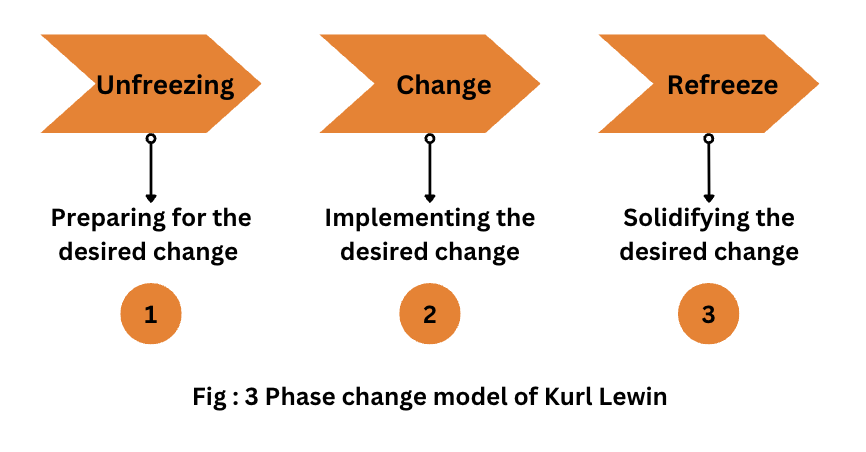
- According to Kurt Lewin, it has three stages.: 1) Organizations prepare for change by addressing resistance (unfreezing), 2) implement changes with stakeholder involvement (change), and 3) then stabilize the new state within the organization (refreezing).
- Smooth change management requires minimizing restraining forces and maximizing driving forces for change.
The Rajasthan Public Services Guarantee Act, 2011 came into effect on November 14, 2011, aiming to enhance transparency, responsiveness, and accountability in administration. It guarantees around 300+ services across 27 departments to the people of the state.
Significance | Limitations |
|
|
RGDPS Act, 2011: Ensures time-bound delivery of 308 services from 28 departments in Rajasthan.
Appeals Mechanism
| Appeal Type | Time Limit | Authority | Action/Outcome |
| First Appeal | Within 30 days | First Appeal Officer | May approve or reject the appeal |
| Second Appeal | Within 60 days | Second Appellate Authority | Can order service and impose penalties |
| Direct Appeal | First/Second Authority | Allowed if designated officer fails to respond |
Powers of Appeal Authorities:
Same as civil courts: summon, document inspection, etc.
Penalty & Compensation
| Against Whom | Reason | Amount |
| Designated Officer | Service denial | ₹500 to ₹5,000 |
| Delay in service | ₹250 per day (Max ₹5,000) | |
| First Appeal Officer | Delay in decision-making | ₹500 to ₹5,000 |
| Compensation to Applicant | From imposed penalty | Up to full penalty amount |
| Aspect | Significance | Limitations |
| Legal Right | Legal right to timely services. | Covers only 308 services of 28 departments. (Karnataka – 840 services ) |
| Citizen Empowerment | Empowers citizens to seek services. | Limited awareness among public/employees. |
| Accountability | Sets time limits & penalties for delays. | No independent appellate mechanism; departmental officers act as appellate authorities. |
| Complaint Process | Clear process for lodging complaints. | Poor monitoring; lacks a centralized online platform. |
| Appeal Mechanism | Provision for First and Second appeal. | Commission for Guaranteed Delivery not formed. |
| Legal Protection | Protects officials from legal action (good faith). | Key positions like Assistant Directors, Deputy Directors, and Information Assistants are often vacant. |
| Public Trust | Builds trust through assured service delivery. | Inconsistent enforcement of penalties by second appellate authority. |
The Rajasthan Public Services Guarantee Act, 2011 guarantees over 300 services across 27 departments. The Right to Hearing Act, 2012 ensures time-bound hearings and complaint resolutions. However, even after more than a decade of implementation, their performance in improving public service delivery has been suboptimal.
Measures for Effective Implementation:
- Appellate Officers: Appoint Sub Divisional Officer, Assistant Director, Public Services, District Collector, and Divisional Commissioner as second appeal officers instead of departmental officers.
- Broaden the Inspection System
- Establishing criteria for inspecting offices of appellate officers, Deputy Directors, and higher departmental headquarters officers.
- Defining criteria for inspections by district-level officers, ADMs, CEO ZP, SDMs, etc.
- Implementing periodic grievance redressal verification by evaluation department officials
- Regular review and monitoring system:
- Weekly review of cases registered online and offline by DMs and SDMs.
- Weekly review by departmental district officers
- Monthly review at the department head level and at the secretary level of the administrative department.
- Citizen Charter and Job chart: Under the RGDPS Act, the provision of notification of Citizen charter and Job Chart should be included and displayed on the portal.
- Portal Integration: Integrate Sampark Portal with the proposed RGDPS Portal.
- Social Audit: Conduct audits through SSAAT constituted under the Finance Department.
- Formation of Public Service Delivery Guarantee Commission at the state level
- Help Centers: Establish at village/ward level for grievance redressal.
- Automatic Forwarding: Non-delivered service applications to be forwarded to higher authorities automatically.
- Increase the penalty range from Rs. 2000 to Rs. 20000 from the current Rs. 500 to Rs. 5000.
- Early adoption of Rajasthan Transparency and Social Accountability Bill (RTSAB)
- In 2019, a committee chaired by former state election commission Ram Lubhaya was formed to advise on drafting the Social Accountability Bill
- Publicity: Use newspapers, TV, radio, hoardings, etc., for awareness.
- Training: Provide training for designated officers and appeal officers.
These measures will enhance transparency, accountability, and efficiency in public service delivery and grievance redressal, thereby fulfilling the objectives of the RGDPS Act, 2011, and the Rajasthan RTH Act, 2012.
Rajasthan is among the first Indian states to enact citizen-centric governance laws:
- Rajasthan Guaranteed Delivery of Public Services Act, 2011 – ensures timely delivery of 308 notified services from 28 departments.
- Rajasthan Right to Hearing Act, 2012 – ensures right to timely hearing for all complaints.
Together, they create a legal framework for efficient service delivery and accessible grievance redressal.
Complementarity between the Two Acts → One Act reinforces the other
| Aspect | Public Services Act, 2011 | Right to Hearing Act, 2012 | Complementarity |
| Purpose | Guarantees timely public services | Guarantees timely hearing of complaints | Delivery + Redressal = Complete service cycle |
| Legal Right | Legal right to receive services | Legal right to be heard | Converts entitlements into enforceable rights |
| Time Frame | Fixed timeline for each service | 15 days (hearing), 21–30 days (appeals) | Ensures prompt delivery and redressal |
| Penalties | Up to ₹5,000 on officers for delay/failure | ₹500–₹5,000 for delay in hearing | Induces discipline and accountability |
| Accessibility | Services available at citizen service centers | Hearings at gram panchayat, tehsil, district levels | Promotes last-mile service delivery |
| Appeal Mechanism | Two-level appeals with no fees | Two-level appeals with no fees | Multi-tier grievance redressal in bothStrengthens official accountability |
Impact on Citizen Empowerment:
- Rights-based governance – Converts services and grievance redressal into rights.
- Increased public participation – Citizens become rights-holders, not mere beneficiaries
- Ensures local-level access (Panchayat, Tehsil, CSCs).
- No fee ensures inclusiveness.
Impact on Administrative Accountability:
- Improved service quality – Officials are legally bound to deliver services timely
- Penalty provisions – Financial penalties ensure seriousness and responsibility
- Reduced red-tapism – Simplified and often digital processes enhance transparency
- Performance tracking – Enables monitoring of how responsive each official is.
- Promotes transparency, efficiency, and trust – Officers face disciplinary action for negligence.
Together, the 2011 and 2012 Acts build a rights-based, time-bound, and accountable public service system in Rajasthan. They serve as models for citizen-centric governance, aligning with the goals of Minimum Government, Maximum Governance.


