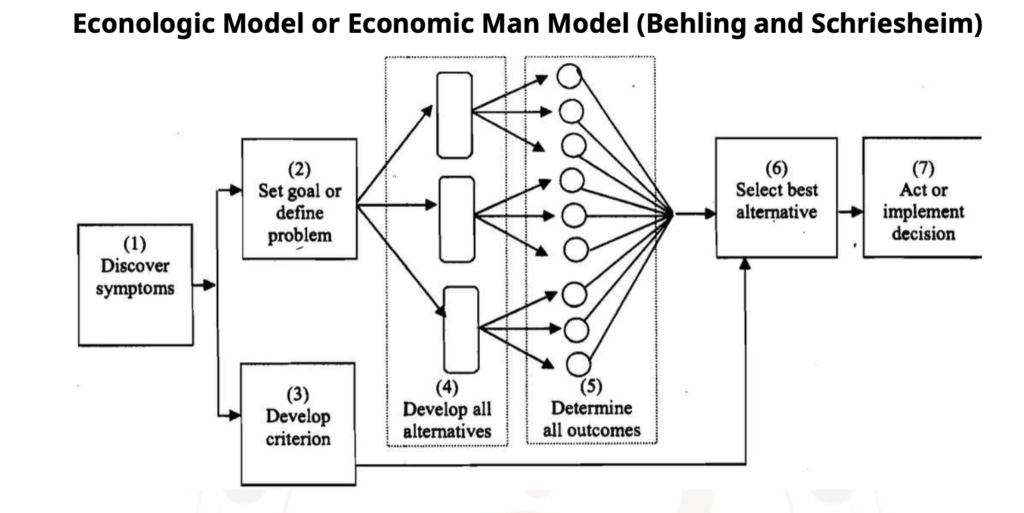

The statement highlights a key limitation in managerial decision-making. While classical theories assume that managers are fully rational (Economic Man Model) — i.e., they have complete information, unlimited time, and cognitive capacity to evaluate all alternatives and choose the optimal solution — in reality, this is rarely possible.
Bounded Rationality Model (or Administrative Man Model), proposed by Herbert Simon, explains this reality:
- Managers operate under bounded rationality — their rationality is limited by several constraints:
- Incomplete information: They do not have access to all relevant data.
- Limited cognitive capacity: The human mind cannot process and analyse unlimited alternatives.
- Time and resource constraints: Decisions often need to be made quickly under pressure.
- Environmental complexity: Uncertainty and changing conditions make perfect analysis difficult.
- As a result, instead of searching for the best (optimal) decision, managers satisfice — they choose a solution that is good enough or satisfactory under the given circumstances.
- Example: A manager may select a supplier based on past satisfactory performance rather than evaluating every possible supplier in the market, due to time and information limitations.
Thus, managers do not always take perfectly rational decisions because their rationality is bounded by practical limitations. This model is more realistic than the classical economic rationality model.
According to Beach and Mitchell’s Contingency Model, there is no single best way to make decisions. The model identifies three types of decision strategies:
- Aided Analytic Strategy: This is the most detailed and effortful method of decision-making. In this strategy, the decision-maker uses formal tools, models, checklists, or formulas to systematically analyse the problem. It involves careful and structured analysis with the help of external aids.
- Unaided Analytic Strategy: In this strategy, the decision-maker thinks carefully and systematically in their mind. They weigh the pros and cons of each option, imagine possible outcomes, and analyse the situation without using any external tools or aids. It is analytical but relies entirely on mental effort.
- No Analytic Strategy: This is the quickest and easiest method. Decisions are made using habits, rules of thumb (e.g., “better safe than sorry”), or past experience without deep analysis. It requires the least time and cognitive effort.
So, the decision-makers choose one of these three strategies depending on the situation, personal characteristics, and demands of the task, aiming to reach a satisfactory decision with the least time and effort.
The Economic Man Model is an ideal model of decision-making. It assumes that the decision-maker is completely rational and always chooses the best possible option.
Main Assumptions
- The decision-maker has complete and accurate information about the problem.
- He knows all possible alternatives.
- He can fully evaluate every alternative (advantages, disadvantages, risks, outcomes).
- His only goal is to maximize benefits or utility.
- He is not influenced by emotions, biases, or pressure.
Example
A company wants to set up a new factory. According to this model, the manager will collect complete information about all possible locations, compare costs, market access, labour, transport, etc., and choose the location that gives maximum profit.
Limitations
- In real life, complete information is never available.
- Time and mental capacity are limited.
- Therefore, this model is only theoretical.
This model shows the ideal way of decision-making, but it is not practical in real situations.