

British Imperialism and Resistance – Maratha, Mysore, Sikh is an important topic in the Modern History of India that explains the expansion of British power and the resistance offered by regional kingdoms. The Marathas, Mysore rulers, and Sikhs strongly opposed British imperialism through several Anglo wars and political struggles. These movements played a significant role in shaping the course of modern Indian history.
British Imperialism and Resistance – Maratha, Mysore, Sikh
European Companies In India
Reasons behind new trade routes
- Decline of Roman Empire → allowed Arabs to gain direct control over key trade routes with India.
- The fall of Constantinople in 1453.
- The Renaissance inspired curiosity, exploration, and geographical discovery.
- Europe’s economic growth; improved agriculture, and rising prosperity.
- Portugal emerged as the leader in exploration and Christian resistance to Islamic powers.
Portuguese in India
Advent of Portuguese in India –
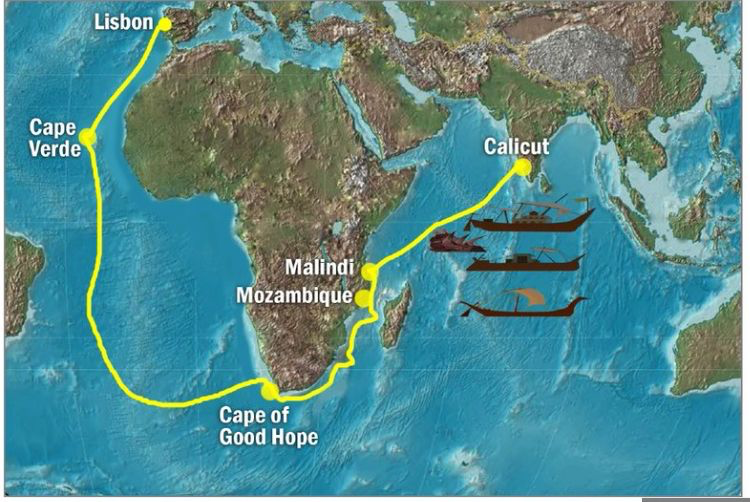
- Vasco da Gama arrived at Calicut in May 1498,
- Guided by a Gujarati pilot, Abdul Majid. The Zamorin of Calicut welcomed him.
- Vasco da Gama stayed for three months, his expedition had taken cargo valued at more than 60 times the expedition’s cost.
- He returned in 1501, established a factory at Cannanore.
- Pedro Alvarez Cabral –
- He arrived in September 1500, establishing the first Portuguese factory at Calicut.
- Francisco de Almeida –
- First official Governor of India (1505).
- Blue Water Policy (To achieve maritime dominance in the Indian Ocean by controlling sea lanes, rather than focusing on large land empires.)
- Alfonso de Albuquerque
- Successor of Almeida, real founder of Portuguese power in India.
- Cartaz (Permit) system for other ships.
- In 1510, Captured Goa from the Sultan of Bijapur.
- He Abolished sati in Goa.
- Encouraged marriages between Portuguese men and Indian women.
- Nino da Cunha (1529)
- Shifted Portuguese headquarters from Cochin to Goa.
- Bahadur Shah of Gujarat, during his conflict with Mughal emperor Humayun, sought Portuguese assistance.
- Bahadur Shah was lured onto a Portuguese ship and killed during his time.
Portuguese Lose after Arrival of the English
- In 1608, Captain William Hawkins arrived at Surat with a letter from James.
- Jahangir welcomed Hawkins warmly in 1609, impressed by his Turki language skills and made him a 400 mansabdar.
- Portuguese were angered by the Mughal grant of trading facilities to the English. Shah Jahan ordered Bengal governor Qasim Khan to act against the Portuguese. Mughal siege of Hooghly began in June 1632.
Reasons behind Portugal decline in India –
- Their decline was caused by the rise of powerful kingdoms in Egypt, Persia, and North India.
- Their aggressive religious policies.
- The discovery of Brazil shifted Portuguese focus westward.
- The 1580–81 union of Spain and Portugal dragged Portugal into European wars.
- Their exclusive knowledge of the sea route to India eroded as Dutch and English mastered ocean navigation.
- Portuguese possessions were taken by rivals: Southeast Asia – Dutch – 1596, Surat – English – 1612.
Religious Policy –
- Portuguese carried hostility toward Muslims and Hindus.
- Forcible conversions were practiced by Portuguese.
- Mixed marriages were also promoted by them.
- Akbar invited Jesuit scholars in 1579 – Fathers Rodolfo Aquaviva and Antonio Monserrate.
- The second mission (1590–1592) also failed to achieve conversion.
- A third mission (1595) Led by Jerome Xavier and Emanuel Pinheiro.
Portuguese impact in india –
- Potato, Tomato, Maize, Papaya, Peanuts, Guava, Tobacco, Chillies, Cashews nut, Corn, improved varieties of coconut.
- Brought first printing press to India (Goa, 1556).
- Gothic architecture.
- First Europeans to arrive in India and last to leave – Goa, Daman, and Diu were recaptured by India in 1961.
Dutch in India
- First factory in Masulipatnam (1605).
- Major exports included indigo, textiles, silk, saltpetre, opium, and rice.
- Actively engaged in the redistributive trade between India and the Far East.
- Dutch English conflict –
- Amboyna massacre (1623) (Dutch VOC agents tortured and executed English East India Company (EIC) men)
- Dutch withdrew from India to focus on the more profitable Indonesian trade (spices).
- English defeated the Dutch –
- Battle of Hooghly (Biderra) (1759), ending Dutch ambitions in India completely.
British in india
English company in india –
- In 1600, Queen Elizabeth I granted a charter to the East India Company (EIC)
- 1609: Captain Hawkins arrived at Jahangir’s court;
- 1611: English began trading at Masulipatnam.
- 1612: Captain Thomas Best defeated the Portuguese, established first English factory at Surat (1613).
- 1615–19: Sir Thomas Roe stayed at Jahangir’s court.
- 1639: Francis Day secured Madras, construction of Fort St. George 1662.
- Bombay received by Charles II as dowry from Portugal; handed to EIC in 1668.
- 1696–98: English purchased the zamindari of Sutanuti, Gobindapur, Kalikata; established Fort William (1700). Calcutta became the seat of the Eastern Presidency.
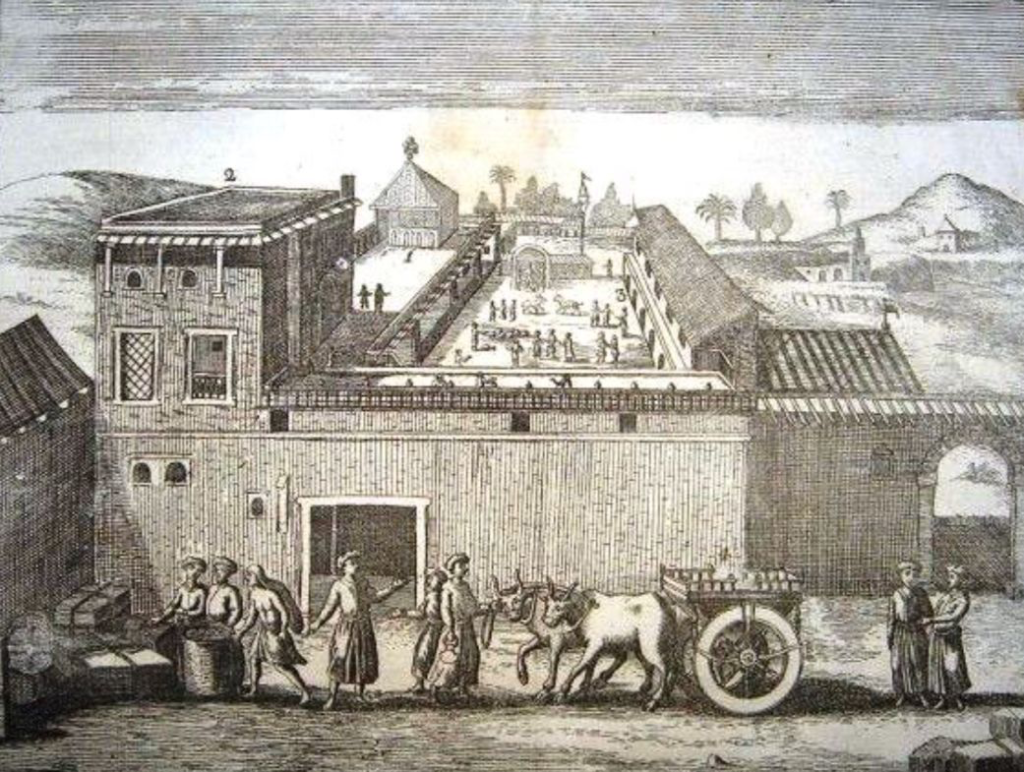
Farrukhsiyar’s Farman (1717) – “Magna Carta of the Company”
- Free trade in Bengal (annual payment of Rs 3,000).
- Permission to issue dastaks (trade passes).
- Allowed to rent more land around Calcutta.
- Duty-free trade in Hyderabad; pay rent only for Madras.
- Duty exemption in Surat for annual payment of Rs 10,000.
- Company’s coins minted at Bombay to circulate throughout the Mughal Empire.
Significance –
- Granted the British East India Company significant trade privileges, essentially making it the foundation of British commercial dominance
- Laid groundwork for political control in Bengal by allowing duty-free trade, issuing trade permits (dastaks), and securing land rights around Calcutta.
Danes in india
The Danes –
- Danish East India Company founded in 1616.
- They established a factory at Tranquebar (1620) and a settlement at Serampore near Calcutta.
- They Sold all their Indian settlements to the British in 1845.
- Focused on missionary activities rather than commercial or political ambitions.
French in india
French East India Company
- The French were the last major European power to arrive in India for trade.
- 1664: Minister Colbert under Louis XIV founded the Compagnie des Indes Orientales (French East India Company).
- 1667: Francois Caron established the first French factory at Surat.
- 1673–74: Sher Khan Lodi (Bijapur governor) granted land for a French settlement. Pondicherry was founded in 1674.
- Other French trading centres: Mahe, Karaikal, Balasore, Qasim Bazar.
- Carnatic Wars –
- Parties – British and French
- The reason behind the three carnatic wars was global rivalry between English and French –
First Carnatic War (1740–48) :
- This war was the extension of Austrian War of Succession. English navy seized French ships, became the immediate reason for the war.
- Battle of St. Thome (1746) a small disciplined French force defeated Nawab Anwaruddin’s large army.
- Ended with Treaty of Aix-la-Chapelle (1748) ; Madras returned to English; French regained North American territories.
Second Carnatic War (1749–54) :
- The succession dispute in Hyderabad and in Carnatic was the Immediate Cause of this war.
- Battle of Ambur (1749) and Robert Clive’s raid on Arcot (1751)
- Dupleix’s fall was also seen after this war, replaced by Godeheu.
Third Carnatic War (1758–63)
- This war was the Part of the global Seven Years’ War (1756–63).
- The English defeated the French under Count de Lally. Battle of Wandiwash (22 Jan 1760), British won the war Eyre Coote defeated Lally.
- Treaty of Paris (1763), French power was confined to trade only, gave up the right to interfere in political matters in India.
- English now had no European rival in India.
Why the English Succeeded Against Other European Powers –
- Structure and Nature of Trading Companies –
- English East India Company was controlled by a board of directors whereas French and Portuguese companies were state-controlled and feudal in nature.
- Naval Superiority –
- Britain had the largest and most advanced navy.
- Military Skill and Discipline
- British soldiers were well-trained, disciplined, and used new tactics with Technologically advanced weapons .
- Stable Government
- Britain had relatively stable governance, Other nations (France, Italy, Spain, the Netherlands) faced turmoil. E.g. – France: Revolution of 1789, Napoleonic Wars.
- Lesser Zeal for Religion
- Britain was less religiously motivated than Spain, Portugal, or the Dutch.
- Official name of companies –
- Dutch East India Company (Vereenigde Oostindische Compagnie or VOC )
- Portuguese Trading Company
- English East India Company
- Danish East India Company
- French East India Company (Compagnie française des Indes orientales.
India in early 18th century
| Important incidents | Ruler/Name of the Personality | Year |
| Afghan attack on India (Plunder of delhi) | Nadir Shah | 1739 |
| Afghan attack | Ahmad Shah Abdali | 1748-1767 |
| Third battle of Panipat | Ahmad Shah Abdali vs Maratha (Sadashivrao Bhau) | 1761 |
| Rise of Bengal regional state | Murshid Quli Khan; Ali vardi Khan | |
| Rise of Awadh regional state | Saadat khan Burhan Ul Mulk | 1722 |
| Rise of Mysore regional state | Hyder ali Tipu sultan | |
| Rise of jats bharatpur regional state | Badan singh Suraj mal | |
| Rise of Afghan regional state (Rohilla) | Ali Mohammed Khan | |
| Rise of travancore regional state | Martand Verma | |
| Rise of Sikh regional state | Ranjit Singh | |
| Maratha power | Maratha confederacy | |
| Rise of Hyderabad regional state | Nizam ul Mulk Asaf Jah | 1724 |
Bengal (Plassey and Buxar battle)
- Bengal was the richest Mughal province (including present-day Bengal, Bihar, Odisha).
- Nearly 60% of British imports from Asia came from Bengal.
- British wanted to establish indirect political control on state to secure economic rights.
- Ali vardi khan was succeeded by Siraj-ud-Daulah.
- The British conspired against Siraj, made an alliance with Mir Jafar (commander) Jagat Seth, Omnichand, Rai Durlabh and Rai Ballabh to fulfill their economic interests.
- They promised Mir Jafar to become Nawab in return for helping the British.
- Black Hole Tragedy: According to popular belief, Siraj-ud-daulah imprisoned 146 English individuals in a very small room, resulting in the death of 123 of them due to suffocation. This incident became the immediate cause for battle.
- Battle of Plassey (23 June 1757)
- led by Robert Clive against Siraj.
- British won this.
- Significance –
- Political Puppetry
- The victory of the British, whether by treachery or any means, undermined the position of the Nawab in Bengal.
- British got enormous wealth, zamindari of 24 parganas from Bengal.
- Exposed internal weakness of indian state.
- After some time, British replaced Mir Jafar with Mir Kasim to get more economic gains.
- Political Puppetry
Battle of Buxar (22 October 1764) –
Reasons –
- Misuse of Dastaks:
- The Company officials misused their trade permits (dastaks) which exempted specified goods from paying duties
- The misuse of dastaks resulted in reduced tax revenue for Mir Kasim.
- Company servants also sold dastaks to Indian merchants for a commission.
- The Company officials misused their trade permits (dastaks) which exempted specified goods from paying duties
- Abolition of duties:
- Mir Kasim decided to abolish the duties altogether, but the British protested and demanded preferential treatment.
- Thе disputе over transit duties escalated into armed conflict, leading to wars between the English and Mir Kasim in 1763.
Parties involved –
- British vs Mir qasim (formed alliance with Shuja-ud-Daulah (Awadh Nawab) Shah Alam II (Mughal Emperor).
Result –
- British (Major Hector Munro) defeated the combined armies.
Impacts –
- Treaty of Allahabad (1765) –
- In 1765, two Treaties were concluded by Robert Clive at Allahabad with Nawab Shuja-ud-Daulah and Emperor Shah Alam II.
- Under the first treaty with the Nawab of Awadh:
- Allahabad and Kara were surrendered by the Nawab to Mughal Emperor Shah Alam II.
- A sum of Rs 50 lakh was paid to the Company as war indemnity.
- Balwant Singh, the Zamindar of Banaras, was given full possession of his estate.
- Under the second treaty with Shah Alam II:
- The emperor was asked to reside at Allahabad under the Company’s protection.
- The Diwani of Bengal, Bihar and Orissa were granted to the East India Company in lieu of an annual payment of Rs 26 lakh
- An amount of Rs 53 lakh was to be given by the Mughal Emperor to the Company in return for nizamat functions (military defence, police, and administration of justice) of the said provinces.
- Clive introduced Dual Government in Bengal (1765–72).
- Nawab had nominal authority. Mohmmad Raza khan and Shitab ray were appointed as deputy diwans.
- The system was ended by Warren Hastings in 1772.
Significance of Battle of Buxar
- End of Native Power.
- Rise of British Political Power: Unlike Plassey, which gave indirect control, Buxar cemented direct political authority, transforming the EIC from traders to rulers.
- Economic Foundation: The grant of Diwani (right to collect revenue) from Bengal, Bihar, and Orissa provided the Company with immense financial resources.
- Symbolic & Strategic Victory: It was a decisive victory over a combined Indian force (Mughal Emperor Shah Alam II, Nawab of Awadh Shuja-ud-Daula, and Mir Qasim), proving British tactical and organizational strength.
Mysore
Emergence of Mysore
The Wodeyar / Mysore Dynasty
- After the Battle of Talikota (1565), the Vijayanagara Empire collapsed.
- Several small kingdoms emerged from its ruins.
- In 1612, a Hindu kingdom under the Wodeyars was established in the Mysore region.
- Chikka Krishnaraja Wodeyar II ruled from 1734 to 1766.
- By the second half of the 18th century, Mysore emerged as a powerful state under Haidar Ali and Tipu Sultan.
Why Mysore alarmed the English –
- Mysore’s close relations with the French worried the British.
- Haidar Ali and Tipu Sultan controlled the rich trade of the Malabar Coast.
- Mysore posed a threat to British political and commercial dominance in South India.
- Mysore’s strength challenged British control over Madras.
Rise of Haidar Ali –
- In the early 18th century:
- Nanjaraj (Sarvadhikari) and Devaraj (Dulwai) reduced the Wodeyar ruler to a puppet.
Haidar Ali:Born in 1721 in a humble family.Began his career as a horseman in the Mysore army.Served under Nanjaraj and Devaraj.Though uneducated, he had sharp intelligence, energy, and determination.
Political Situation of Mysore –
- Frequent invasions by:
- Marathas
- Nizam of Hyderabad
- Resulted in:
- Heavy tribute demands
- Financial and political weakness of Mysore
- Need arose for a leader with:
- Military ability
- Diplomatic skill
- Haidar Ali became de facto ruler of Mysore in 1761 by usurping royal authority.
Military and Administrative Reforms by Haidar Ali –
- Realised:
- Marathas could be checked only by a swift cavalry.
- French-trained Nizam’s army required strong artillery.
- Western arms could only be matched with Western technology.
- Took French assistance to:
- Establish an arms factory at Dindigul (Tamil Nadu).
- Train his army on European lines.
- Used diplomacy skillfully to outmanoeuvre rivals.
Territorial Expansion (1761–63) –
- Captured:
- Dod Ballapur
- Sera
- Bednur
- Hoskote
- Suppressed the Poligars of South India (Tamil Nadu region).
Conflict with the Marathas –
- After recovering from the Third Battle of Panipat (1761):
- Marathas under Madhavrao attacked Mysore.
- Haidar Ali was defeated in:
- 1764
- 1766
- 1771
- To buy peace:
- Paid heavy tributes to the Marathas.
- After Madhavrao’s death in 1772:
- Haidar Ali attacked Marathas during 1774–76.
- Recovered lost territories.
- Annexed additional areas.
First Anglo–Mysore War (1767–1769)
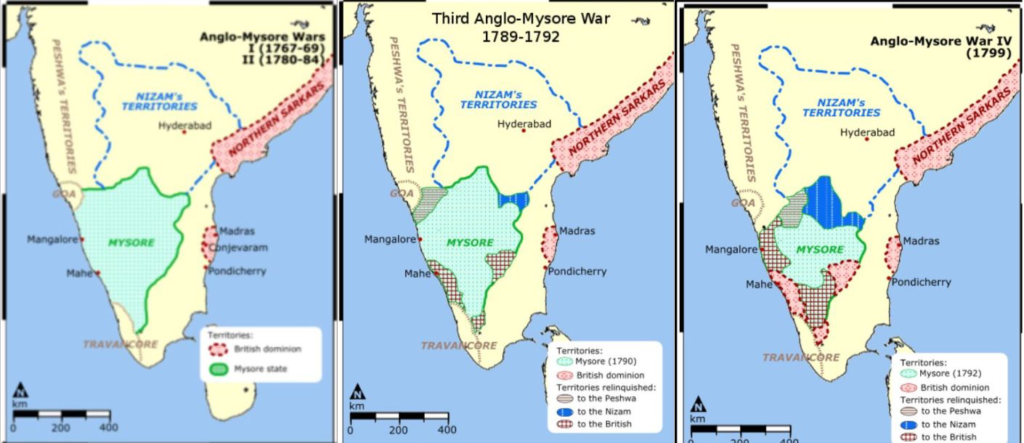
Background –
- British confidence rose after success in Bengal.
- British signed a treaty with the Nizam of Hyderabad (1766):
- Received Northern Circars.
- Promised to protect Nizam from Haidar Ali.
- Haidar Ali had disputes with:
- Nawab of Arcot
- Marathas
- Nizam, Marathas, and English initially formed an alliance against Haidar Ali.
- Haidar:
- Paid the Marathas to remain neutral.
- Promised territory to the Nizam and won him over.
- Haidar and Nizam jointly attacked the Nawab of Arcot.
Course of War –
- War dragged on for about 18 months.
- Haidar suddenly marched towards Madras.
- Panic gripped the English.
- Resulted in the Treaty of Madras (April 4, 1769).
Treaty of Madras (1769) –
- Exchange of prisoners.
- Mutual restoration of conquered territories.
- English promised to help Haidar Ali if attacked by any power.
Second Anglo–Mysore War (1780–1784)
Background
- English failed to help Haidar Ali when Marathas attacked him in 1771 → breach of Treaty of Madras.
- French supplied Haidar Ali with:
- Guns
- Saltpetre
- Lead
- Supplies came via Mahe, a French possession on the Malabar Coast.
- American War of Independence (1775–83):
- French supported American rebels.
- English feared Haidar–French alliance.
- English attempted to capture Mahe, which Haidar considered under his protection.
Course of War –
- Haidar formed an alliance with:
- Marathas
- Nizam
- Attacked the Carnatic.
- Captured Arcot.
- Defeated British army under Colonel Baillie (1781).
- English under Sir Eyre Coote:
- Detached Marathas and Nizam from Haidar.
- Haidar was defeated at Porto Novo (November 1781).
- Haidar regrouped and:
- Defeated British forces.
- Captured Commander Braithwaite.
Treaty of Mangalore (1784) –
- Haidar Ali died on December 7, 1782.
- Tipu Sultan continued the war.
- War ended without decisive result.
- Treaty signed in March 1784:
- Status quo ante bellum.
- Each side returned conquered territories.
- Regarded as a humiliating treaty for the English.
Third Anglo–Mysore War (1790–92)
Background –
- Dispute between Tipu Sultan and Travancore.
- Travancore purchased:
- Jalkottal
- Cannanore from the Dutch.
- These areas belonged to Cochin, a feudatory of Tipu.
- Tipu viewed Travancore’s action as a violation of his sovereignty.
- In April 1790, Tipu declared war on Travancore.
- This became the immediate cause of the Third Anglo–Mysore War.
Course of War –
- The English supported Travancore against Tipu Sultan.
- 1790: Tipu defeated the English army led by General Meadows.
- 1791:
- Lord Cornwallis took command of the English forces.
- He marched via Ambur and Vellore and captured Bangalore (March 1791).
- Advanced towards Seringapatam.
- Coimbatore was captured by the English but later lost.
- With support from the Marathas and the Nizam, the English attacked Seringapatam again.
- Tipu fought bravely but was overpowered by combined forces.
- Tipu was forced to accept the Treaty of Seringapatam (1792).
Treaty of Seringapatam (1792) –
- Nearly half of Mysore’s territory was taken away.
- Territorial distribution:
- English: Baramahal, Dindigul, Malabar
- Marathas: Areas around the Tungabhadra River
- Nizam: Territory from Krishna River to beyond Pennar
- War indemnity:
- ₹3 crore imposed on Tipu Sultan
- Half paid immediately; remaining in installments.
- Hostages:
- Tipu’s two sons were taken as hostages by the English until full payment
Cornwallis’ remark:
- “We have crippled our enemy effectively without making our friends too formidable.”
Fourth Anglo–Mysore War (1799)
Background
- Period between 1792–1799 used by both sides to regain strength.
- Tipu fulfilled treaty terms and secured the release of his sons.
- 1796: Tipu refused to install the minor Wodeyar prince and declared himself Sultan.
- Tipu sought revenge for humiliation under the Treaty of Seringapatam.
- 1798:
- Lord Wellesley became Governor-General.
- He feared Tipu’s relations with the French.
- Wellesley aimed to destroy Tipu’s independence or force him into Subsidiary Alliance.
- Charges against Tipu:
- Plotting with the French, Marathas, and Nizam
- Sending envoys to Arabia, Afghanistan, Kabul, Zaman Shah, Isle of France (Mauritius), and Versailles
- Tipu’s explanations were rejected.
Course of the Fourth Anglo–Mysore War –
- War started on 17 April 1799.
- Ended on 4 May 1799 with the fall of Seringapatam.
- Tipu was defeated by:
- General Stuart
- General Harris
- Arthur Wellesley (brother of Lord Wellesley) also took part.
- English were supported by the Marathas and the Nizam.
- Tipu died fighting bravely defending Seringapatam.
Consequences of Tipu Sultan’s Defeat –
- Tipu’s family interned at Vellore.
- Tipu’s treasures confiscated by the English.
- A boy from the Wodeyar dynasty was placed on the throne.
- Subsidiary Alliance imposed on Mysore.
Tipu Sultan
- Born: November 1750
- Parents: Haidar Ali and Fatima
- Languages known: Arabic, Persian, Kannada, Urdu
- Known as the “Tiger of Mysore”
- Army:
- Organised on European lines Persian commands used
- french officers used only as trainers
- Naval ambition:
- Board of Admiralty (1796)
- Planned 22 battleships and 20 frigates
- Dockyards at Mangalore, Wajedabad, Molidabad
- Science & technology:
- Pioneer of rocket technology in India
- Authored a rocket warfare manual.
- Introduced sericulture in Mysore
- Political ideas:
- Supported French Revolution ideals
- Set up Jacobin Club (1797) at Seringapatam
- Called himself Citizen TipuPlanted the Tree of Liberty
- Religious policy:
- Punished both Hindus and Muslims when they rebelled
- Protected Hindu temples in Mysore
- Funded Sringeri Temple repairs
- Economic vision:
- Early promoter of capitalist development
- Overall:Represented multiple traditions
- Colonial portrayal as bigoted is one-sided and incomplete.
Mysore After Tipu –
- Marathas:
- Offered Soonda and Harponelly districts (refused)
- Nizam:
- Given Gooty and Gurramkonda
- English annexed:
- Kanara, Wynad, Coimbatore, Dwaraporam, Seringapatam.
- New Mysore State:
- Restored to Wodeyars
- Minor ruler Krishnaraja III
- Subsidiary Alliance accepted
- 1831:
- William Bentinck took direct control due to misgovernance.
- 1881:
- Lord Ripon restored Mysore to its ruler.
Overall Significance
- Mysore under Haidar Ali and Tipu Sultan was:
- The strongest Indian power in South India.
- A major obstacle to British expansion.
- Their resistance delayed British political supremacy.
- Mysore symbolized military modernization, diplomacy, and anti-colonial resistance.
Maratha
Rise of the Marathas
- Decline of the Mughal Empire created political space for the Marathas.
- Marathas emerged as one of the strongest adversaries of the Mughals.
- They:
- Controlled large territories directly.
- Collected tributes (chauth and sardeshmukhi) from regions beyond their control.
- By the mid-18th century:
- Marathas reached Lahore.
- Played the role of kingmakers in the Mughal court.
- Third Battle of Panipat (1761):
- Marathas defeated by Ahmad Shah Abdali.
- Temporarily weakened Maratha power.
- After Panipat:
- Marathas regrouped and regained strength.
- Within a decade, re-emerged as a major power in India.
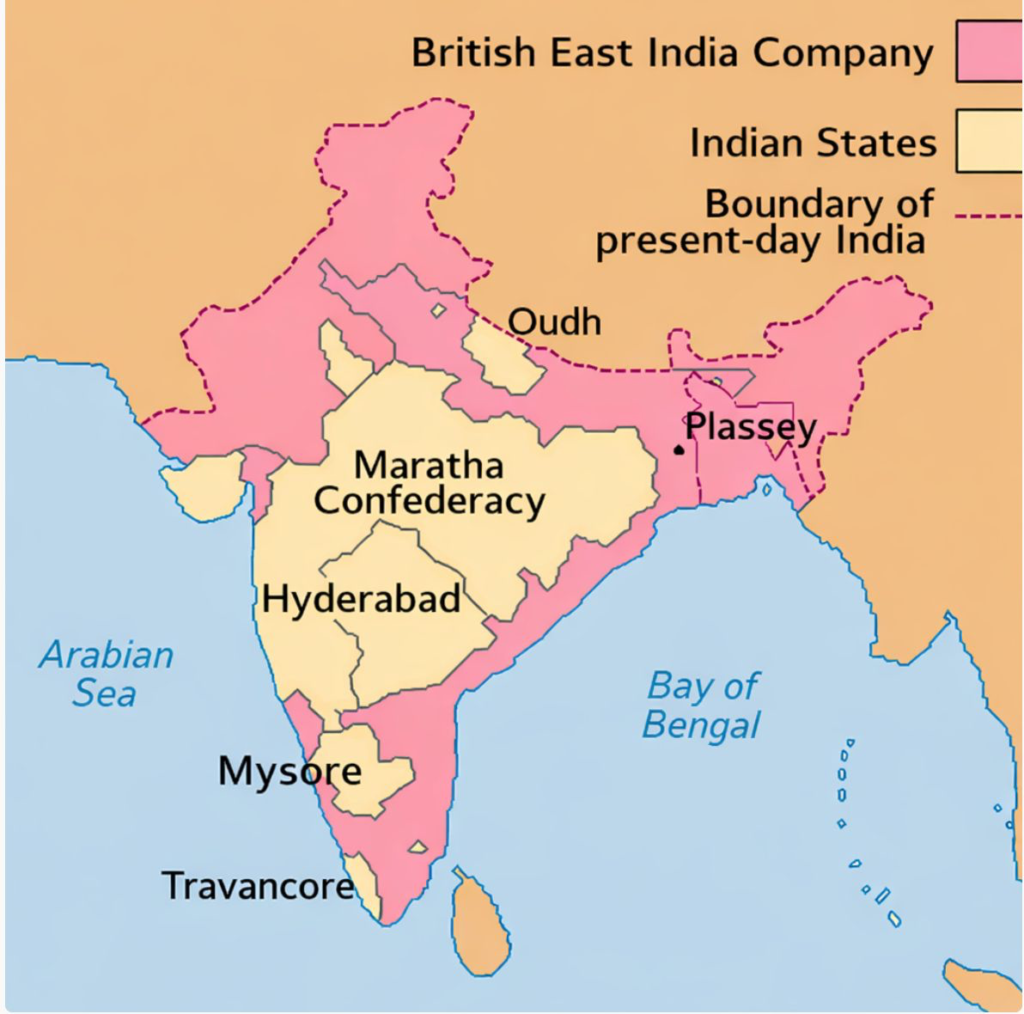
Maratha Confederacy –
- Bajirao I (1720–1740):
- Greatest of all the Peshwas.
- Created a Maratha confederacy.
- Objectives:
- Manage rapidly expanding empire.
- Appease the Kshatriya Maratha chiefs (Peshwas were Brahmins).
- Maratha king: Shahu (nominal head).
- Each chief:
- Assigned a sphere of influence.
- Ruled in the name of the Maratha king.
- Prominent Maratha families:
- Gaekwad – Baroda
- Bhonsle – Nagpur
- Holkar – Indore
- Sindhia (Scindia) – Gwalior
- Peshwa – Poona
- Confederacy functioned smoothly:
- From Bajirao I to Madhavrao I.
- Post-1761:
- Panipat defeat weakened unity.
- Death of Madhavrao I (1772) reduced Peshwa authority.
- Confederacy chiefs:
- United occasionally (e.g., against British, 1775–82).
- Frequently quarrelled among themselves.
Anglo–Maratha Struggle for Supremacy
Entry of the English into Maratha Politics –
- Period: Late 18th to early 19th century.
- Three Anglo–Maratha Wars fought.
- Main causes:
- British imperialist ambition.
- Internal dissensions among Marathas.
- English objective:
- Establish dominance like in Bengal, Bihar, and Orissa.
- Succession disputes among Marathas gave the English an opportunity.
- English mainly operated from Bombay Presidency.
First Anglo–Maratha War (1775–82)
Background
- 1772: Death of Peshwa Madhavrao I.
- Narayanrao became the fifth Peshwa.
- Narayanrao assassinated by his uncle Raghunathrao.
- Raghunathrao proclaimed himself Peshwa (illegal claim) and sought British help.
- Narayanrao’s widow Gangabai gave birth to a son:
- Named Sawai Madhavrao.
- Legally the next Peshwa.
- Barabhai (12 Maratha chiefs):
- Led by Nana Phadnavis.
- Declared infant Sawai Madhavrao as Peshwa.
- Governed as regents.
Treaty of Surat (1775) –
- Signed between:
- Raghunathrao and English (Bombay Government).
- Provisions:
- Raghunathrao ceded:
- Salsette
- Bassein
- Revenue share from Surat and Bharuch
- English promised:
- 2,500 soldiers to support Raghunathrao.
- Raghunathrao ceded:
Treaty of Purandar (1776) –
- British Calcutta Council:
- Opposed Treaty of Surat.
- Sent Colonel Upton to Pune.
- New treaty, Treaty of Purandhar was signed with Maratha regency:
- English renounced Raghunathrao.
- Promised him a pension.
- Bombay government:
- Rejected Treaty of Purandhar.
- Continued supporting Raghunathrao.
- 1777:
- Nana Phadnavis granted the French a west coast port.
- Violated treaty with Calcutta Council.
- English response:
- Sent troops towards Pune.
Course of the First Anglo–Maratha War –
- English and Maratha armies met near Pune.
- English advantages:
- Superior ammunition and artillery.
- Maratha advantages:
- Larger army.
- Brilliant leadership of Mahadji Scindia (Shinde).
- Strategy of Mahadji Scindia:
- Lured English into ghats near Talegaon.
- Cut off English supply lines at Khopali.
- Used scorched earth policy:
- Burned farmland.
- Poisoned wells.
- English retreat:
- Forced back to Wadgaon.
- English army:
- Surrounded on all sides.
- Cut off from food and water.
- Mid-January 1779:
- English surrendered.
- Signed the Treaty of Wadgaon.
Treaty of Wadgaon (1779) –
- Forced the Bombay Government to:
- Return all territories acquired since 1775.
- Considered a humiliating defeat for the English.
Treaty of Salbai (May 1782):
End of the First Phase of Anglo-Maratha Struggle
Background –
- Warren Hastings, Governor-General of Bengal:
- Rejected the Treaty of Wadgaon (1779).
- Decided to continue the war against the Marathas.
- British military actions:
- Colonel Goddard:
- Captured Ahmedabad (February 1779).
- Captured Bassein (December 1780).
- Captain Popham:
- Captured Gwalior (August 1780).
- General Camac:
- Defeated Mahadji Scindia at Sipri (February 1781).
- Colonel Goddard:
- After defeats:
- Mahadji Scindia proposed peace negotiations.
- A treaty was drafted between the Peshwa and the English.
Features of treaty of Salbai –
- Ratifications:
- By Warren Hastings: June 1782.
- By Nana Phadnavis: February 1783.
- Significance:
- Brought an end to the First Anglo-Maratha War.
- Guaranteed peace for 20 years between the English and the Marathas.
Main Provisions –
- Salsette to remain in English possession.
- All territories conquered since the Treaty of Purandhar (1776), including Bassein, to be restored to the Marathas.
- In Gujarat:
- Fateh Singh Gaekwad to retain pre-war territories.
- He would continue serving the Peshwa.
- English:
- To withdraw support from Raghunathrao.
- Peshwa to grant Raghunathrao a maintenance allowance.
- Haidar Ali:
- To return territories taken from the English and the Nawab of Arcot.
- English:
- To retain pre-war trade privileges.
- Peshwa:
- Not to support any other European power.
- Both sides:
- To ensure peace among their respective allies.
- Mahadji Scindia:
- Appointed mutual guarantor of the treaty.
Second Anglo-Maratha War (1803–05)
Background
- 1795:
- Peshwa Madhavrao Narayan committed suicide.
- Bajirao II:
- Son of Raghunathrao.
- Became Peshwa.
- Considered politically incompetent.
- Nana Phadnavis:
- Became chief minister.
- Death of Nana Phadnavis (1800):
- Further weakened Maratha unity.
- Strengthened British position.
- Internal conflicts among Marathas:
- Encouraged British intervention.
Course of the War –
- April 1, 1801:
- Bajirao II murdered Vithuji Holkar, brother of Yashwantrao Holkar.
- Yashwantrao Holkar:
- Attacked combined forces of Scindia and Bajirao II.
- Battle of Hadapsar (October 25, 1802):
- Holkar decisively defeated Scindia and Bajirao II.
- Placed Vinayakrao (son of Amritrao) on the Peshwa’s throne.
- Bajirao II:
- Fled to Bassein.
- Sought British protection.
Treaty of Bassein (December 31, 1802) –
- Peshwa agreed:
- To accept a permanent British subsidiary force:
- At least 6,000 native infantry.
- Supported by artillery and European personnel.
- To accept a permanent British subsidiary force:
- To cede territories yielding ₹26 lakh annual revenue to the Company.
- To surrender the city of Surat.
- To renounce all claims of chauth on the Nizam’s dominions.
- To accept British arbitration in disputes with:
- The Nizam
- The Gaekwad
- Not to employ Europeans from nations hostile to the English.
- To conduct foreign relations under British control.
Reduced to Vassalage –
- Acceptance of subsidiary alliance reduced the Peshwa to a British vassal.
- Scindia and Bhonsle:
- Attempted to preserve Maratha independence.
- British response:
- Arthur Wellesley led a disciplined British army.
- Outcomes:
- Defeat of Maratha chiefs:
- Bhonsle → Treaty of Deogaon (Dec 17, 1803)
- Scindia → Treaty of Surji-Anjangaon (Dec 30, 1803)
- Holkar → Treaty of Rajpurghat (1806)
- Defeat of Maratha chiefs:
- Yashwantrao Holkar (1804):
- Tried to unite Indian rulers against British.
- Failed due to lack of unity.
- Result:
- Marathas defeated, isolated, and reduced to British dependency.
Significance of the Treaty of Bassein –
- Signed by a weak and unpopular Peshwa, yet:
- Gave the English enormous strategic advantage.
- Permanent British troops now stationed at:
- Mysore
- Hyderabad
- Lucknow
- Poona
- Strategic importance:
- Troops could be rapidly deployed across India.
- Did not immediately hand over India to the British:
- But marked a decisive step towards British supremacy.
- Often described as:
- “The key to India” (though slightly exaggerated).
Third Anglo–Maratha War (1817–1819)
Background
- Lord Hastings:
- Aimed to establish British paramountcy over India.
- Followed an aggressive imperialist policy.
- Charter Act of 1813:
- Ended the East India Company’s monopoly of trade with China (except tea).
- Increased the Company’s need for new markets and territories.
- Pindaris:
- Irregular mercenaries attached to Maratha armies.
- Composed of various castes and social groups.
- Became unemployed as Maratha power declined.
- Turned to plundering neighbouring territories, including Company areas.
- British accusations:
- Charged the Marathas with harbouring and supporting the Pindaris.
- Pindari leaders:
- Amir Khan and Karim Khan surrendered.
- Chitu Khan fled into the jungles.
- Treaty of Bassein (1802):
- Described as “a treaty with a cipher (the Peshwa)”.
- Deeply hurt the sentiments of other Maratha chiefs.
- Viewed as a complete surrender of independence.
- Bajirao II:
- Repentant Peshwa.
- Made a final attempt in 1817 to unite Maratha chiefs against the English.
Course of the War
- Peshwa Bajirao II attacked the British Residency at Poona
- Appa Sahib of Nagpur attacked the British Residency at Nagpur
- Holkar prepared for war, After death of Jaswantrao Holkar:
- Tulsi Bai, his favourite mistress, controlled affairs Intelligent but failed
- Bhonsle of Nagpur and Scindia of Gwalior had also become weak.
- British counter-attack:
- Rapid and decisive
- Prevented Peshwa from reasserting authority over Maratha confederacy
Results of the War
- Maratha defeats:
- Peshwa defeated at Khirki
- Bhonsle defeated at Sitabuldi
- Holkar defeated at Mahidpur
Important Treaties
- Treaty of Poona – June 1817 (with Peshwa)
- Treaty of Gwalior – November 1817 (with Scindia)
- Treaty of Mandasor – January 1818 (with Holkar)
Final Outcome (1818–1819) –
- June 1818: Peshwa Bajirao II finally surrendered.
- Maratha Confederacy dissolved.
- Peshwaship abolished
- Bajirao II:
- Became a British pensioner
- Settled at Bithur (near Kanpur)
- Pratap Singh, descendant of Shivaji:
– Made ruler of Satara - Satara carved out of Peshwa’s former territories.
- Bajirao II:
Analysis: Why the Marathas Lost
Category | Detailed Points and Characteristics |
Inept Leadership |
|
Defective Nature of the Maratha State |
|
Loose Political Set-up |
|
Inferior Military System |
|
Unstable Economic Policy |
|
Superior English Diplomacy and Espionage |
|
Progressive English Outlook |
|
Conclusion |
|
Sikh
Consolidation of Punjab under the Sikhs
- After the murder of Guru Gobind Singh, Sikhs revolted against the Mughals.
- Banda Bahadur led the Sikh uprising during the reign of Bahadur Shah.
- Banda Bahadur was defeated by Farrukhsiyar in 1715 and executed in 1716.
- After his death, the Sikh polity again became leaderless.
- Sikhs were divided into two groups:
- Bandai (Liberal)
- Tat Khalsa (Orthodox)
- This division ended in 1721 due to the efforts of Bhai Mani Singh.
- In 1784, Kapur Singh Faizullapuria organised Sikhs under Dal Khalsa.
- Objectives of Dal Khalsa:
- Political unity
- Cultural unity
- Economic unity of Sikhs
- Khalsa was divided into:
- Budha Dal – army of veterans
- Taruna Dal – army of the young
- Decline of the Mughal Empire and repeated invasions of Ahmad Shah Abdali created:
- Political chaos
- Anarchy in Punjab
- These conditions helped the Dal Khalsa consolidate power.
- Sikhs organised themselves into misls:
- Military brotherhoods
- Democratic in nature
- Meaning of Misl:
- Arabic word meaning equal/alike
- Also used to mean state
- Between 1763–1773, misls ruled Punjab:
- From Saharanpur (east) to Attock (west)
- From mountains of north to Multan in south
Sukarchakiya Misl and Ranjit Singh
- Ranjit Singh was born on November 2, 1780.
- At that time, there were 12 major misls:
- Ahluwaliya
- Bhangi
- Dallewalia
- Singhpuria/Faizalpuria
- Kanhaiya
- Krorasinghia
- Nakai
- Nishaniya
- Phulkian
- Ramgarhia
- Sukerchakia
- Shaheed
- Central administration of a misl was based on Gurumatta Sangh:
- Political
- Social
- Economic institution
- Ranjit Singh was the son of Mahan Singh, chief of the Sukarchakiya misl.
- Mahan Singh died when Ranjit Singh was only 12 years old.
- Ranjit Singh displayed early political and military ability.
- By the end of the 18th century, most misls (except Sukarchakiya) were disintegrating.
- Afghanistan was also unstable due to prolonged civil war.
- Ranjit Singh exploited this situation using a policy of “blood and iron.”
- In 1799, Ranjit Singh was appointed Governor of Lahore by Zaman Shah (Afghan ruler).
- In 1805, Ranjit Singh captured:
- Jammu
- Amritsar
- Thus:
- Lahore became political capital
- Amritsar became religious capital
- Maintained good relations with:
- Dogras
- Nepalese
- Recruited them into his army.
Ranjit Singh and the English –
- Fear of Franco-Russian invasion of India alarmed the British.
- In 1807, Lord Minto sent Charles Metcalfe to Lahore.
- Ranjit Singh proposed an alliance with conditions:
- British neutrality in a Sikh-Afghan war
- Recognition of Ranjit Singh as sovereign of entire Punjab including Malwa (cis-Sutlej)
- Negotiations failed.
- After decline of Napoleonic threat, British became more assertive.
- Ranjit Singh signed the Treaty of Amritsar (April 25, 1809).
Treaty of Amritsar (1809)
Significance –
- Fixed River Sutlej as the boundary between:
- Ranjit Singh’s dominions
- British territories
- Checked Ranjit Singh’s ambition to unite the entire Sikh nation.
- Ranjit Singh turned westward and conquered:
- Multan (1818)
- Kashmir (1819)
- Peshawar (1834)
- In June 1838, Ranjit Singh signed the Tripartite Treaty with the British.
- However, he refused to allow British troops to pass through his territory to attack Dost Mohammad Khan.
- Ranjit Singh died in June 1839.
- After his death, the decline of the Sikh Empire began.
Punjab after Ranjit Singh
Beginning of Court Factions –
- Kharak Singh, Ranjit Singh’s legitimate son, succeeded him.
- He was inefficient.
- Court factions became very powerful.
- Kharak Singh died in 1839.
- His son Nau Nihal Singh died accidentally while returning from his father’s funeral.
- Punjab descended into political anarchy.
- Continuous conspiracies for the throne weakened the state.
- This gave the British an opportunity to intervene.
- Sikh army appeared strong but was actually weak.
- Able generals were already dead:
- Mokham Chand
- Dewan Chand
- Hari Singh Nalwa
- Ram Dayal
- Army discontent grew due to:
- Irregular payment
- Appointment of incompetent officers
- Indiscipline increased.
- Lahore government allowed British troops to:
- Pass through Punjab while retreating from Afghanistan
- March again to avenge defeat
- These movements caused:
- Economic disruption
- Public unrest in Punjab
Rani Jindan and Daleep Singh
- After Nau Nihal Singh’s death:
- Sher Singh became Maharaja
- Murdered in 1843
- Daleep Singh, a minor son of Ranjit Singh, was proclaimed Maharaja.
- Rani Jindan acted as regent.
- Hira Singh Dogra became wazir.
- Hira Singh was murdered in 1844 due to court intrigue.
- Jawahar Singh, brother of Rani Jindan, became wazir.
- He was:
- Deposed
- Executed by the army in 1845
- He was:
- Lal Singh, lover of Rani Jindan:
- Became wazir in 1845
- Teja Singh was appointed:
- Commander-in-chief of the Sikh army
First Anglo-Sikh War (1845–46)
Causes
- Immediate cause:
- Sikh army crossed the River Sutlej on December 11, 1845.
- The British treated this as an act of aggression and declared war.
- Underlying causes:
- Political anarchy in the Lahore kingdom after the death of Maharaja Ranjit Singh.
- Power struggle between:
- The Lahore court
- The increasingly powerful and autonomous Sikh army.
- Suspicion among Sikh soldiers due to:
- British annexation of Gwalior and Sindh (1841).
- British military campaign in Afghanistan (1842).
- Large concentration of British troops near the Sikh frontier.
Course of War
- War began in December 1845.
- Strength of forces:
- British army: 20,000–30,000 troops
- Sikh army: about 50,000 troops
- Sikh army was under the command of Lal Singh.
- Treachery of Lal Singh and Teja Singh led to Sikh defeats.
- Major battles and defeats of the Sikhs:
- Battle of Mudki – December 18, 1845
- Battle of Ferozeshah – December 21–22, 1845
- Battle of Buddelwal
- Battle of Aliwal – January 28, 1846
- Battle of Sobraon – February 10, 1846
- Lahore was occupied by British forces on February 20, 1846, without resistance.
Treaty of Lahore (March 8, 1846) –
- Signed after Sikh defeat in the First Anglo-Sikh War.
- Considered a humiliating treaty for the Sikhs.
- Main provisions:
- War indemnity of over 1 crore rupees to be paid to the British.
- Jalandhar Doab (between Rivers Beas and Sutlej) annexed by the Company.
- Appointment of a British Resident at Lahore, Henry Lawrence.
- Reduction in the strength of the Sikh army.
- Daleep Singh recognised as ruler:
- Rani Jindan as regent
- Lal Singh as wazir.
- Failure to pay full indemnity led to:
- Sale of Kashmir (including Jammu) to Gulab Singh.
- Gulab Singh paid 75 lakh rupees to the Company.
- Transfer of Kashmir formalised by a separate treaty on March 16, 1846.
Treaty of Bhairowal (December 1846) –
- Sikhs resented the Treaty of Lahore, especially over the Kashmir issue.
- Resulted in rebellion.
- Provisions of the treaty:
- Rani Jindan removed as regent.
- Establishment of a Council of Regency.
- Council consisted of:
- 8 Sikh sardars
- Presided over by Henry Lawrence, the British Resident.
Second Anglo-Sikh War (1848–49)
Causes
- Humiliation of the Sikhs due to:
- Defeat in the First Anglo-Sikh War.
- Harsh terms of the Treaties of Lahore and Bhairowal.
- Ill-treatment of Rani Jindan:
- Sent to Benares as a pensioner.
- Immediate cause:
- Mulraj, governor of Multan, was removed over increased revenue demand.
- Mulraj revolted and murdered two British officers.
- Sher Singh was sent to suppress the revolt.
- Sher Singh joined Mulraj instead.
- Led to a mass uprising in Multan.
- Lord Dalhousie, Governor-General:
- A strong expansionist.
- Used the revolt as a pretext to annex Punjab.
Course of War –
- Lord Dalhousie personally came to Punjab.
- Three major battles were fought:
- Battle of Ramnagar
- Led by Sir Hugh Gough, Commander-in-Chief.
- Battle of Chillianwala – January 1849
- Battle of Gujarat – February 21, 1849
- Fought near River Jhelum.
- Battle of Ramnagar
- Outcome:
- Sikh army surrendered at Rawalpindi.
- Afghan allies of Sikhs were expelled from India.
Effect of the Second Anglo-Sikh War –
- Surrender of the Sikh army and Sher Singh in 1849.
- Annexation of Punjab by the British.
- Lord Dalhousie:
- Received thanks of the British Parliament.
- Promoted in the peerage as Marquess.
- Administration of Punjab:
- A three-member Board of Administration was formed:
- Henry Lawrence
- John Lawrence
- Charles Mansel
- In 1853, the board was abolished.
- Punjab placed under a Chief Commissioner.
- John Lawrence became the first Chief Commissioner of Punjab.
- A three-member Board of Administration was formed:
Significance of the Anglo-Sikh Wars –
- Fostered mutual respect between:
- Sikhs
- British
- Sikhs gained reputation as:
- Brave
- Disciplined soldiers
- Sikhs:
- Fought loyally for the British in the Revolt of 1857.
- Continued to serve in British military campaigns until Indian independence (1947).
- Koh-i-Noor diamond was transferred to the British Crown.
British and Neighbouring States
Anglo – Nepal Relations
- Governor General – Lord Hastings
- War in 1814-16 .
Treaty of Sugauli (1816)
- Nepal provided the British with most of the regions of Garhwal and Kumaun district as well as the Himalayas.
- The English state and Nepal’s border were fixed.
- Nepal withdrew all its rights from Sikkim.
- Permission to hold a British resident in Kathmandu, the capital of Nepal.
- Consequences –
- British got Garhwal, Kumaon terai region (shimla, mussoorie, nainital etc).
- Gurkha recruited in british indian army .
Anglo-Afghan Relations
Reasons –
- Fear of Russian influence.
Forward Policy (1836) – Lord Auckland
- An aggressive strategy to counter Russian influence by establishing British control over Afghan foreign policy, often through installing friendly rulers or military presence.
The First Anglo-Afghan War (1839–42)
- British forces invaded Afghanistan and captured Kabul in 1839, installing Shah Shuja as a puppet ruler.
- In 1840-41, widespread revolts and an insurrection erupted, targeting British forces.
- Afghanistan regained independence under Dost Mohammed, and the British suffered a humiliating defeat.
- Dost Mohammed, old ruler, was restored.
Masterly Inactivity –
John Lawrence
- Non-intervention in Afghan internal affairs to avoid costly wars (like the disastrous First Anglo-Afghan War), preferring to watch from afar, consolidate India’s internal strength, and counter Russian expansion only if Afghan stability was threatened.
- It was a cautious, patient approach, learning from past failures, aiming to maintain a stable buffer state rather than directly controlling Afghanistan.
- Northbrook, Mayo, John Lawrence’s Masterly Inactivity
- Avoid interference in Afghan internal matters.
Lord Lytton followed Forward Policy (1876)
Second Anglo-Afghan War (1878–80)
- By the 1870s, British fears of Russian influence resurfaced.
- Amir Sher Ali Khan initially allowed Russian envoys but refused to receive a British mission in Kabul.
- The British interpreted this as a threat to Indian security and launched the Second Anglo-Afghan War.
- British forces invaded in 1878, forcing Sher Ali to flee.
Treaty of Gandamak (May 1879):
- Signed with Sher Ali’s son Yakub Khan
- Ceded control of Afghanistan’s foreign policy to Britain stationed a permanent British envoy in Kabul.
- Widespread resistance, including the killing of the British envoy in Kabul.
- Abdur Rahman was installed as the new Amir, Retaining internal sovereignty but with British control over foreign affairs.
- Afghanistan remained a buffer state, limiting Russian influence
- After the Anti-British revolt Ripon reversed Lytton’s policy → Afghanistan was kept as a buffer state
Anglo-Burmese Relations
Reasons-
- Burma’s westward expansion and lure of forest resources, teak etc.
First Anglo-Burmese War (1824–26)
- The First Anglo-Burmese War (1824-1826) began when the Burmese expanded into Assam, leading to direct conflict with British forces.
Treaty of Yandabo (1826):
- Burma, the province of Tenasirim and Arakan, gave it to the British.
- Manipur was considered independent.
- Burma Gave up claims on Assam, Cachar, Jaintia.
- Manipur was independent.
- Burma to pay 1 crore rupees.
Second Anglo-Burmese War (1852)
- Reasons :
- British commercial interests
- Dalhousie’s imperialism.
- Results –
- British annexed Pegu and secured Lower Burma → complete control of lower Burma.
Third Anglo-Burmese War (1885)
- Reasons –
- New king Thibaw was anti-British.
- Thibaw negotiated with France, Germany, Italy.
- Results –
- Lord Dufferin Annexed Upper Burma (1885).
- Burma was separated from India in 1935.
Anglo-Tibetan Relations
- Curzon feared Russian presence at India’s frontier.
- Younghusband Expedition (1904) .
Treaty of Lhasa (1904).
- The British got the rights to set up business centers in Gyantse, Matung and Gartok.
- Approval of the establishment of British Resident in Gyantse (Later limited control over Lhasa by Russian intervention).
- The burden of 75 lakh rupees over 75 years (later reduced to 25 lakhs) on Tibet for compensation for war.
- Until the amount of compensation was received, the Chumbi Valley was kept as hostage by the British (vacant after payment in three installments later).
- Tibet will not allow any foreign representative and will not provide any facility in rail, roads, wires, mines.
Conquest of Sindh
Conquest of Sindh
- In the early 19th century, the English showed growing interest in Sindh.
- Basis of British presence:
- A farman of the Mughal Emperor (1630) granted trade privileges to the English.
- Allowed the English to trade in ports of Sindh on terms similar to other regions.
Kallora Rule and Early British Trade
- Before Talpuras, Sindh was ruled by Kallora chiefs.
- 1758:
- An English factory was established at Thatta.
- Permission granted by Ghulam Shah Kallora through a parwana.
- 1761:
- Ghulam Shah ratified the earlier treaty.
- Excluded other European traders, giving the English monopoly.
- This privilege continued till 1775.
- Sarfraz Khan, a hostile ruler:
- Forced the English to close their factory.
Emergence of Talpuras
- 1770s:
- Talpuras, a Baluch tribe, migrated from the hills to Sindh plains.
- Characteristics:
- Excellent soldiers.
- Accustomed to hard life.
- 1783:
- Talpuras under Mir Fath (Fatah) Ali Khan seized power.
- Kallora ruler exiled.
- Durrani monarch:
- Confirmed Mir Fath Ali Khan’s claim.
- Ordered division of Sindh among his brothers (Char Yar).
- 1800:
- Death of Mir Fath Ali Khan.
- Char Yar divided Sindh and assumed the title Amirs of Sindh.
Gradual British Ascendancy over Sindh
- Late 18th century:
- British feared a Napoleon–Tipu Sultan–Shah Shuja alliance.
- 1799:
- Lord Wellesley attempted to revive trade relations with Sindh.
- Hidden objective:
- Counter the French–Afghan–Mysore threat.
- Negotiations initiated with Mir Fath Ali Khan.
British Expulsion (1800)
- October 1800:
- Amir ordered British agent Crow to leave Sindh within ten days.
- British quietly accepted the insult.
Treaty of ‘Eternal Friendship’ (1807)
- 1807:
- Treaty of Tilsit between Napoleon and Russia alarmed Britain.
- British objective:
- Create a buffer zone between Russia and India.
- Lord Minto sent missions:
- Metcalfe to Lahore
- Elphinstone to Kabul
- Malcolm to Tehran
- Nicholas Smith negotiated with Sindh Amirs.
Provisions –
- First treaty between Sindh and the English.
- Both sides agreed:
- To exclude the French from Sindh.
- To exchange agents.
- To maintain eternal friendship.
1820 renewal:
- Excluded Americans.
- Settled Kachch border disputes after Maratha defeat (1818).
Treaty of 1832 (Bentinck–Pottinger Treaty)
- William Bentinck sent Colonel Pottinger to Sindh.
- Main provisions:
- Free passage for British traders and travellers.
- Use of Indus for trade.
- No warships or war materials allowed.
- No British merchant to settle permanently.
- Passports required for travellers.
- Amirs could revise tariffs.
- No military tolls or dues.
- Joint action with Raja of Jodhpur to suppress Kachch robbers.
- Earlier treaties confirmed.
Lord Auckland and Sindh
- Lord Auckland (1836) viewed Sindh strategically:
- To counter Russian influence.
- As a gateway to Afghanistan.
- British sought control after:
- Ranjit Singh captured Rojhan (Sindh frontier town).
- Treaty of 1838
- Pottinger negotiated new treaty.
- Terms:
- British protection to Amirs.
- Stationing of British troops at Amirs’ expense OR territorial concessions.
- Terms:
- Amirs initially refused.
- Under pressure, they signed in 1838.
- Provisions:
- British intervention in Sikh–Sindh disputes.
- Appointment of a British Resident.
- Resident allowed free movement with British troops.
- Result:
- Sindh became a British protectorate.
Tripartite Treaty (1838)
- British persuaded Ranjit Singh:
- To accept British mediation with Sindh Amirs.
- Shah Shuja:
- Gave up sovereign rights over Sindh.
- In return for arrears of tribute (amount fixed by British).
- British objectives:
- Finance Afghan War.
- Secure route to Afghanistan via Sindh.
Sindh Accepts Subsidiary Alliance (1839)
- Under threat, Amirs signed treaty in February 1839.
- Provisions:
- British subsidiary force stationed at Shikarpur and Bukkar.
- Amirs to pay Rs 3 lakh annually.
- No foreign relations without Company approval.
- Storeroom at Karachi for British supplies.
- Abolition of tolls on Indus.
- Provide auxiliary force for Afghan War if required.
Capitulation and Annexation of Sindh (1843)
- First Anglo-Afghan War (1839–42) fought through Sindh.
- Amirs:
- Paid expenses.
- Resented British presence.
- British accused Amirs of:
- Hostility
- Treason
- Ellenborough sent James Outram to negotiate.
- New demands:
- Cession of important territories.
- Supply fuel to steamers.
- Stop minting coins.
- British intervened in succession dispute.
- Charles Napier launched military action.
- 1843:
- Sindh fully annexed.
- Amirs captured and exiled.
- Sindh merged into British Empire.
- Charles Napier appointed first Governor.
Contemporary Views on Sindh Conquest
- Charles Napier:
- Called it “a very advantageous, useful, humane piece of rascality.”
- James Outram:
- Criticised sword-based policy.
- P.E. Roberts:
- Described British policy as morally indefensible.
- Elphinstone:
- Compared annexation to a bully venting anger after Afghan defeat.
Criticism of the Conquest of Sindh
- Annexation based on:
- Manufactured causes.
- Bullying and deceit.
- Sindh annexation:
- Compensation for British humiliation in Afghanistan.
- Widely condemned by historians as:
- Unjust
- Immoral
- Imperialistic.



