

The Mughal Empire (Jahangir to Aurangzeb): In the subject of Ancient and Medieval History, the period from Jahangir to Aurangzeb (17th century) marks the height and later consolidation of Mughal power in India. This phase witnessed administrative refinement, territorial expansion, and significant developments in art and architecture, alongside emerging challenges that gradually affected the stability of the empire.
Jahangir (1605-1627 A.D.)
- Jahangir was born in Sikri village, and in his childhood he was called Salim.
- His first marriage was with Man Singh’s sister Manbai [Shah Begum], but in 1601 Manbai committed suicide. After this he married Jodha Bai or Jagat Gusai.
- In 1599 Salim revolted against Akbar and ruled independently in Allahabad.
- In 1605 he became Akbar’s successor in the name of Noor-ud-Din Muhammad Jahangir. His coronation took place in the Agra Fort.
- As soon as he ascended the throne, he issued 12 ordinances, the important ones of which were the abolition of many small taxes, prohibition of alcohol, provision of hospitals and hakims, a ban on animal sacrifice on Sundays and Thursdays, and release of old prisoners.
- Jahangir was a just ruler; to ensure justice to everyone, he installed a gold chain that was known as Zanjeer-e-Adli.
- A Jain saint, Mansingh, had predicted that his rule would not last more than two years.
Military achievements –
Khusro’s rebellion
- In 1606, Khusro revolted and reached Tantaran (Punjab) and received blessings from the fifth Sikh Guru Arjun.
- A battle took place between Jahangir and Khusro at a place called Bhairaval near Lahore in which Khusro was defeated and taken prisoner.
- Jahangir sentenced Guru Arjun Dev to death.
Mewar Campaign
- At this time the ruler here was Amar Singh.
- In 1614 the Mewar campaign took place under the leadership of Khurram.
- Agreement with Mewar:
- The Mewar king Amar Singh accepted Mughal sovereignty due to the poor economic condition of Mewar, ending the four-decade-long conflict.
- He was granted a mansabdari with a zat of 5000 and 5000 sawars.
- The Mughals agreed that the king of Mewar need not submit to the Mughal court nor be bound to a matrimonial alliance.
- In return, Amar Singh was given back the Chittor fort, with the condition that he would not be able to repair it, to ensure that Mewar did not become strong enough to exercise its independence.
South Campaign
- After Akbar’s death, Ahmednagar became independent under the leadership of its Wazir Malik Ambar.
- In 1616, Khurram led the South campaign, and Malik Ambar, terrified by its terror, accepted Jahangir’s suzerainty.
- On the occasion of the victory in the South, Jahangir gave Khurram the title of Shah Jahan.
Khurram’s rebellion
- In 1623, Khurram revolted against Jahangir but was unsuccessful.
- In 1622–26, his son Khurram (Shah Jahan) rebelled against Jahangir along with Malik Ambar of Ahmednagar in the Deccan. Mahabat Khan defeated him.
- Finally, he sought pardon from Jahangir in 1626 and ended the rebellion.
- Kandahar, which Akbar had captured from the Persians in 1595, was recaptured by the Persian emperor Shah Abbas in 1622. Jahangir wanted to recapture it but could not succeed due to the rebellion of Prince Khurram.
- During Jahangir’s reign, Mughal power was firmly established in East Bengal.
British influence on Jahangir:
- The first British envoy led by William Hawkins visited Jahangir in 1608. But the Mughals were not interested in dealing with Europeans.
- However, British conflict with the Portuguese changed the attitude of the Mughals towards the British. In the Battle of Swally of 1612, the East India Company led by Captain Thomas Best defeated the Portuguese in a naval battle near Surat.
- This impressed the Mughals, as they were worried about Portuguese settlements in Surat, Diu, Dadra and Nagar Haveli, Bassein, and Bombay.
- When Thomas Roe came to India in 1615, Jahangir permitted him to build a factory in Surat and appointed him a mansabdar with a zat of 400.
- Jahangir permitted the sons of Daniyal (brother) to embrace Christianity. This was praised by the then ruler of Spain, Philip III.
Mehr-un-Nisa (Nur Jahan)
- She was born in 1577.
- Her original name was Mehrunnisa. The literal meaning of Mehrunnisa is ‘very lovely.’
- Her father was Giyas Beg (Itmad-ud-Daulah), and her mother’s name was Asmat Begum, who invented perfume from rose flowers.
- In 1594, Mehrunnisa married Ali Quli Khan.
- In 1611, Jahangir married Mehr-un-Nisa. Mehr-un-Nisa (Nur Jahan) was the wife and chief consort of Mughal emperor Jahangir from 1620 until her death in 1627.
- Due to Jahangir’s addiction to alcohol and opium, it became easy for Noor Jahan to exert her influence on Jahangir, and she had immense power.
- Jahangir himself used to say, I have handed over the kingdom to Noor Jahan Begum; now I want a sher of wine and half a sher of kebabs.
- She was given the title of Badshah Begum, and coins were also issued in her name.
- She had the privilege of issuing decrees.
- Nur Jahan formed a powerful group of her family members, which included herself, her father Mirza Ghiyas Beg, her brother Asaf Khan, and Prince Khurram (Shah Jahan), to exercise her powers. Such a group is called a junta (a Latin term referring to a powerful political group).
Influence of Nur Jahan on Mughal art:
- Persian art and culture flourished in the court due to Nur Jahan’s influence.
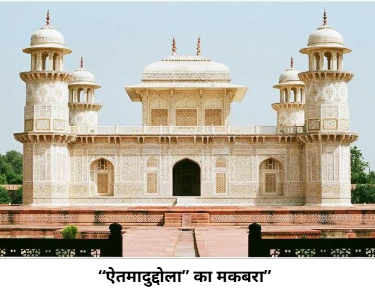
- Pietra Dyura (art using semi-precious stones) began to be used in her architecture. Example: Tomb of Itmadullah.
- She made insignificant contributions by introducing various new fabrics such as the Nurmahali dress, silver-thread brocade (badla), and silver-thread lace (kinari).
Death of Jahangir
- In 1627 Jahangir stayed in Kashmir, and while returning from Kashmir, he died at a place called Bhimber.
- His body was brought to Lahore and buried here in Shahdara.
- Jahangir was the first to include the Marathas in his noble class.
- William Finch described the story of Anarkali in his book “Lord General.”
Contribution to Art and Culture:
- He continued Akbar’s religious policy of ‘Suhel-i-kul.’
- Jahangir paid less attention to architecture but patronized painting, especially the portrait style. He introduced the use of halos in paintings.
- He wrote his autobiography, Tuzuk-i-Jahangiri, in Persian. It was completed by Motamid Khan and Mohammad Hadi.
Jahangir-period architecture
- During the reign of Jahangir, architecture declined as he paid more attention to painting and other forms of art.
- ‘Pacchikari’ on white marble was introduced during his reign.
- The first building built during his time was ‘Akbar’s Tomb.’
- He developed many gardens like Shalimar Bagh in Kashmir.
- He also built the Moti Masjid in Lahore.
- Noor Jahan built “Itmaduddaula’s Tomb” for her father, Mirza Ghiyas Beg, in Agra, which is the first tomb built in the “Pitradura style.” Being relatively smaller than other tombs of the Mughal period, it is also sometimes called Shringardan.
- The tomb of Itmad-ud-Daulah is the first monument in India is completely made of marble.
- The construction was done between
- This tomb is situated on the western bank of the Yamuna River.
- Its dome is built in Persian architectural style
Tomb of Jahangir (Shahdara)—
- The Jahangir Tomb, located near the Ravi River in Shahdara town in Lahore, is dedicated to the Mughal emperor Jahangir.
- It was built by Jahangir’s wife Noor Jahan after his death. The tomb was planned by Jahangir himself, but it was completed by Noor Jahan.
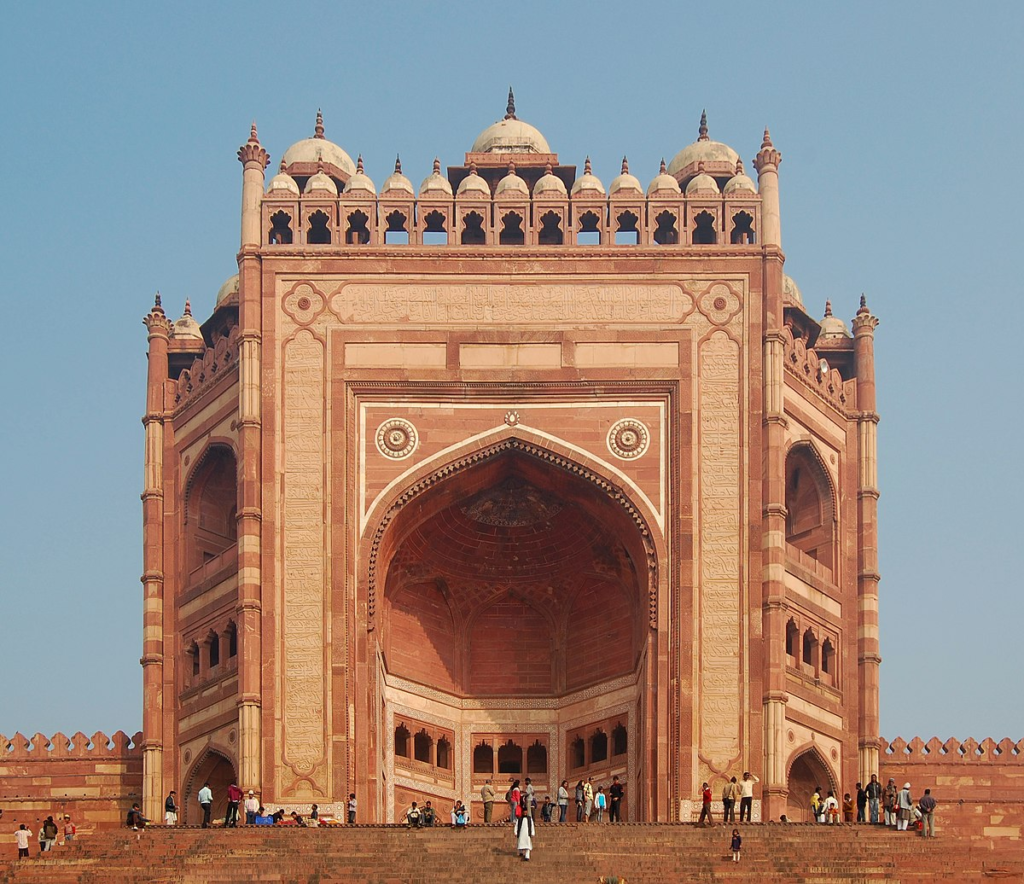
Akbar’s Tomb (Sinkdara, Agra)
- There is a garden spread around in a circle of 1 mile, in the center of which this tomb is built.
- Built in 1613
- It is a five (5) storey building.
- The top floor has a courtyard surrounded by a marble wall.
- There are 36 couplets written in the Persian language in the courtyard.
- This tomb can be considered a mixture of Islamic, Hindu, Christian, and Buddhist arts.
Painting during the Reign of Jahangir
- Jahangir was an expert in painting, and his reign is considered the golden age of Mughal painting.
- Notable painters:
- Farrukh Beg, Daulat, Manohar, Murad, Bishandas, Mansur, and Abul Hasan.
- Abu’l Hasan and Manohar painted Jahangirnama in 1620 (now scattered across various collections).
- Abul Hasan
- He was honored with the title “Nadir al-Zaman” (Wonder of the Age).
- Famous painting: Jahangir’s Dream (1618-22).
- The painting “Jahangir on the Hourglass Throne” was created by court painter Bichitr in 1625.
Ustad Mansur
- Honored with the title “Nadir-ul-Asr” (Rare of the Age).
- Famous for painting rare animals, exotic birds, and unique flowers.
- Notable works: Siberian Crane and A Flower from Bengal.
- Bishandas was sent to Persia to create realistic portraits of the Shah and Persian nobles.
- Aga Raza (Aqa Riza) of Herat and his son Abul Hasan were appointed as court painters. Under Aga Raza’s Leadership: An atelier was established in Agra.
- Changes in Mughal Painting Priorities
- Shift in Focus: Instead of illustrating manuscripts, more emphasis was placed on portraiture and natural scenes.
- New Themes: Instead of battles and stories, court scenes, royal portraits, flora, and fauna became dominant subjects.
- Mansur gained recognition for his expertise in human and animal portraiture.
- Under Jahangir’s patronage, Mughal painting reached the highest level of realism and scientific accuracy.
- Murakka paintings (single portraits compiled in albums) became popular, with gold-enriched decorative margins.
- European Influence: Increased realism and vibrancy in paintings; also, Christian religious festivals were depicted.
- Percy Brown’s Observation: During Jahangir’s reign, the soul of Mughal painting declined, but Indian artistic elements continued to develop alongside European influences.
Shah Jahan (1627-1658 A.D.)
- Shah Jahan was born in Lahore in 1592.
- His mother’s name was Jodha Bai (Jagat Gusai).
- In 1612, he married Asaf Khan’s daughter Arjumand Bano Begum, whom Shah Jahan gave the title of Mumtaz Mahal.
- Shah Jahan was in South India at the time of Jahangir’s death.
- Shah Jahan was more religiously fanatic than Akbar and Jahangir.
- Shah Jahan banned the construction of new temples.
- He re-imposed pilgrimage tax.
- He banned conversion to Christianity.
- Prince Khurram, also known as Shah Jahan, defeated Jahangir’s youngest brother Shahriyar Mirza after his death in 1627 and declared himself emperor in the Agra Fort.
Military achievements of Shah Jahan:
Political event
Bundela rebellion
- During his time, the ruler of Orchha, Jujhar Singh revolted in 1628.
- This rebellion finally ended in 1635 and Jujhar Singh was killed.
Suppression of the Portuguese
- In 1632, Shah Jahan ordered the governor of Bengal, Qasim Khan, to suppress the Portuguese of Hooghly.
- Qasim Khan attacked Hooghly and killed many Portuguese and thousands were taken captive.
Southern Campaign
- The Afghan Pir Lodi, who was given the title of Khan Jahan and was the governor of the southern provinces of the empire, became hostile. Shah Jahan ordered him to be removed from the Deccan, but he conspired with the Sultan of Ahmadnagar, Murtaza Nizam Shah II. When the situation became critical, Shah Jahan himself marched towards the Deccan.
- Shah Jahan campaigned for Ahmadnagar in 1630.
- The newly appointed governor of the Deccan, Iradat Khan, who was given the title of Azam Khan, led the imperial army and attacked Balaghat. Seeing the devastation caused by the imperial troops, Murtaza distanced himself from Khan Jahan. Khan Jahan fled to Malwa, but was pursued and eventually killed. Thereafter peace was restored in the Deccan.
- Shah Jahan divided the Deccan into four provinces—Ahmednagar (including Daulatabad), Khandesh, Berar and Telangana. He entrusted the charge of these four provinces to his eighteen-year-old son Aurangzeb.
- Thus, the Mughal Empire established effective control over the Deccan during Shah Jahan’s reign.
- Ahmednagar, which resisted the Mughals, was annexed by the Mughals despite the efforts of Malik Ambar.
- In 1636, Shah Jahan pacified the Nizamshahi rulers of Ahmednagar with the assistance of Mahabat Khan.
Conquest of Kandahar
- In 1638, Shah Jahan won over the administrator of this place, Ali Mardan Khan.
- He handed over Kandahar to Shah Jahan.
Note – During his reign, many European travellers visited India, including French physician and traveller Bernier, French gem merchant Tavernier, German adventurer Mandelslo, English merchant Peter Mundy and Italian writer and traveller Manucci. These travellers have left detailed accounts about India. Peter Mundy has described the famine that occurred during his reign.
War of succession between Shah Jahan’s sons
- In 1657, Shah Jahan fell ill and rumours of his death spread in South India. As a result, Murad and Shah Shuja declared themselves emperor.
- Aurangzeb waited patiently and after getting Murad on his side, he fought against Dara Shikoh.
- Shah Jahan was put under house arrest in Agra Fort by Aurangzeb, where he died in 1666. During his captivity, Shah Jahan was served by his daughter Jahanara Begum.
War of succession between the sons of Shah Jahan
| 1. Battle of Bahadurpurin 1658 | Royal army of Shah Shuja and Dara. |
| 2. Battle of Dharmatin 1658 | The joint army of Aurangzeb and Murad and the royal army of Dara. |
| 3. Battle of Samugarh1658 | Between the joint forces of Aurangzeb and Murad and Dara. |
| 4. Battle of Khajuwa1659 | Between Aurangzeb and Shah Shuja |
| 5. Battle of Devrai1659 | Between Aurangzeb and Dara |
Note—
- Shahjahan started the practice of “Chahar Tasleem.”
- Shahjahan started the “Hijri Samvat” again in place of Ilahi Samvat
- Shahjahan ended the pilgrimage to Allahabad and Banaras on the request of Kavindracharya.
- Dara Shikoh was a disciple of Sufi saint Mullah Shah Badakhshi of Qadiri Silsila.
- Dara Shikoh translated the Bhagavad Gita, Yoga Vashishtha, and 52 Upanishads from Sanskrit to Persian. The translation of the Upanishads was named Sirr-e-Akbar.
- Dara composed Persian texts named Safinat-ul-Auliya and Majm-ul-Bahrain.
- The Italian traveler Manucci served as Darius’s gunner.
Architecture of shahjahan’s era
- His reign is known as the golden age of Mughal architecture. In 1631, he began the construction of the Tajmahal in memory of his beloved wife Mumtaz Mahal.
- The construction of mosques and forts was at its peak during his reign.
- Shahjahanabad – Established in 1639 as a walled city named Shahjahanabad.
- Mughal Emperor Shah Jahan decided to shift the Mughal Empire’s capital from Agra to Delhi.
- Shah Jahan constructed the Takht-e-Taus (Peacock Throne).
- The designer of the throne was a European named Geronimo-Vironio.
- The architect of “Takht-e-Taus” was Bebadal Khan.
- The Takht-e-Taus (Peacock Throne) was adorned with the world’s most expensive diamond, Kohinoor.
- He demolished the buildings built by Akbar in the forts of Agra and Lahore and constructed new buildings.
- Many buildings were built in the Agra Fort by him.
- Diwan-e-Aam
- Diwan-e-Khas
- Machhi Bhawan
- Sheesh Mahal
- Angoori Bagh
- Moti Masjid – made of marble.
- Nageena Masjid
Other examples of architecture
- Jama Masjid (Agra)
- Jama Masjid (Delhi)
- Red Fort (Delhi)
- Diwan-e-Aam.
- Diwan-e-Khas
- Moti Mahal
- Heera Mahal
- Rang Mahal
- Nahar-e-Bahisht
Taj Mahal
- The Taj Mahal represents the pinnacle of medieval India’s architectural evolution.
- It stands as the finest example of Mughal architecture, showcasing grandeur and opulence.
- Both its structural and decorative elements reflect a fusion of influences—those introduced by the Mughals, those already existing in India, and those specifically envisioned by Shah Jahan and his architects for the Taj Mahal.
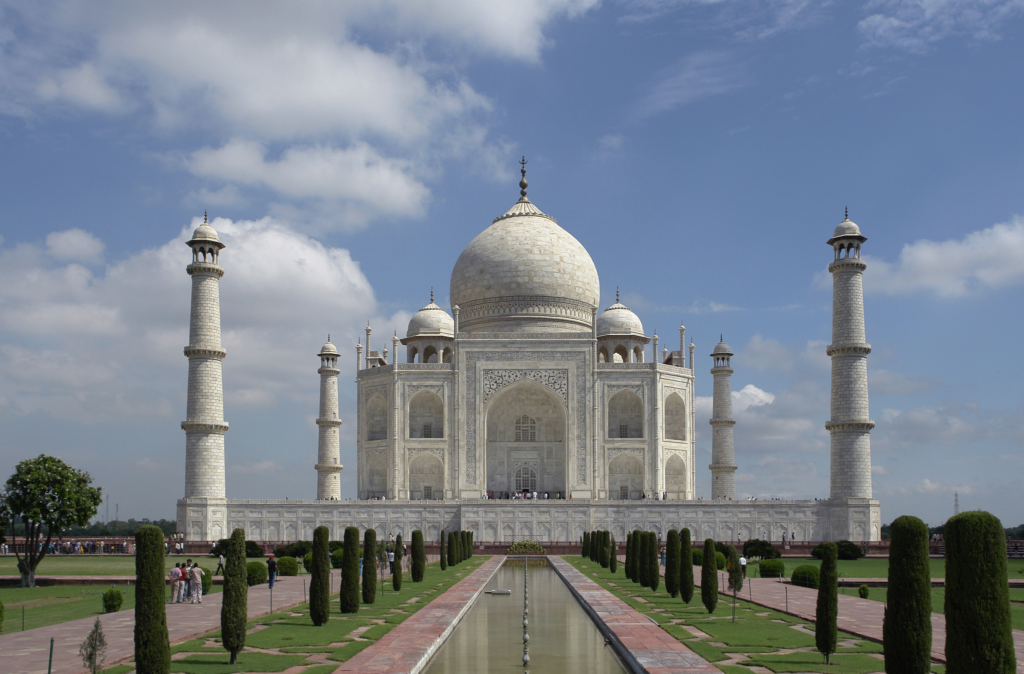
- Built in memory of Arjuman Bano Begum or Mumtaz Mahal.
- Architect: Insha Khan and Ustad Ahmad Lahauri
- Construction began around 1632. More than 20,000 artisans from India, Persia, the Ottoman Empire and Europe were employed to complete this magnificent mausoleum by 1638-39. The auxiliary buildings were built by 1643, and the decoration continued until 1647.
- Tomb of Mumtaj
- Architectural Features
- The Taj Mahal embodies all the distinctive features of Mughal architecture, including calligraphy, pietra dura inlay work, perspective techniques, the Charbagh garden layout, and the integration of water features within the complex.
- The jali (lattice) work in the Taj Mahal is of exceptional quality.
- Marble carvings are low-relief, enhancing the delicate aesthetic.
- The square tomb is built on a plinth and follows an octagonal design.
- A double dome crowns the mausoleum.
- The entrance gateway is narrow yet tall.
- The structure, built of brick, is clad in white marble sourced from Makrana.
- Four minarets stand at the edges of the plinth, tapering as they ascend, reaching a height of 132 feet each.
Painting during the Reign of Shah Jahan
- Emphasis shifted from realism to idealization and stylization.
- Royal portraits depicted imperial grandeur, jewelry, and prosperity.
- Prominent Painters: Govardhan, Chatur, Chintaramana, Anup, Balachandra.
- Significant Work: “Padshahnama” – A masterpiece of Indian miniature painting.
- Characteristics of Shah Jahan’s Paintings:
- Imperial, historical, and mystical themes depicted with captivating colors and intricate compositions.
- The famous European painter Rembrandt was influenced by the fineness and precision of Mughal painting, contributing to its global recognition.
Aurangzeb (1657-1707)
- Aurangzeb ascended the throne in 1658. He came to power after defeating his brothers Dara Shikoh, Shuja, and Murad in a war of succession.
- The 50-year period of his rule is divided into two parts. In the first 25 years he stayed in Delhi and mainly concentrated on the affairs of northern India. In 1681, he was forced to leave for the Deccan due to the rebellion of his son, Prince Akbar. He never returned to Delhi thereafter and died destitute in Ahmednagar in 1707.
- He ruled for about fifty years, during which the territories of the Mughal Empire reached their zenith.
- At its peak, it extended from Kashmir in the north to Jinji (Tamil Nadu) in the south and from the Hindukush in the west to Chittagong in the east.
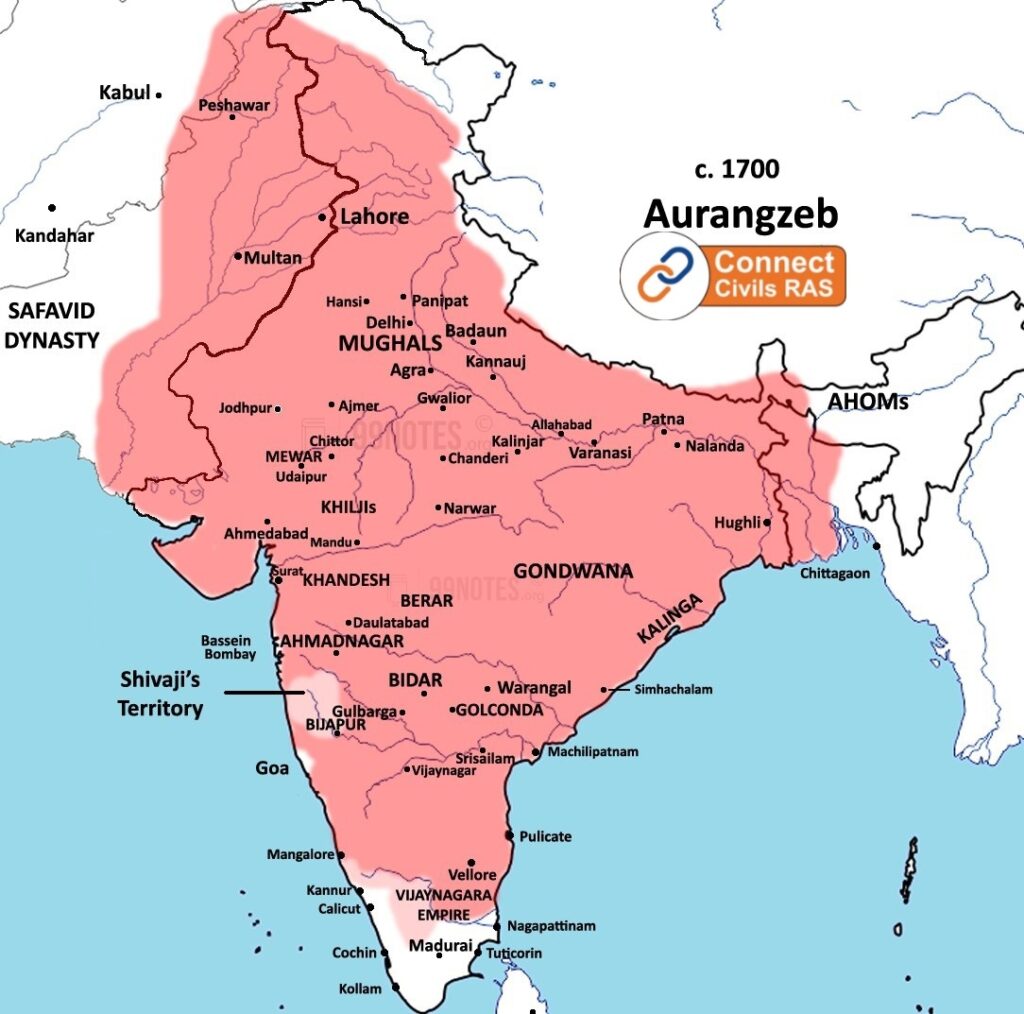
- His annexation of the Deccan is considered a political blunder and has been termed by historians as the Deccan Ulcer, as it led to a direct confrontation with the Marathas and also seriously affected the Mughal treasury.
- The Marathas under Shivaji and his successors challenged the Mughal Empire under Aurangzeb, and after his death, they emerged as a significant political force.
Major military campaigns
- Aurangzeb launched several military campaigns to expand the borders of the Mughal Empire, including wars in northwest and northeastern India. These campaigns put heavy pressure on the treasury.
- Crop revenues had been reduced from one-third to one-half during the reign of his father Shah Jahan, and Aurangzeb’s long-term military campaigns created a need to levy higher taxes on peasants.
Revolt of the Jats
- In 1669, the Jats revolted in the areas around Mathura under the leadership of Gokul.
Expedition against the Ahoms
- Expeditions were sent against the Ahoms (Battle of Saraighat (1671), but they had limited success.
Revolt of the Satnamis
- In 1672, the Satnamis revolted in the Mewat and Narnaul regions. The rebellion of the Satnamis was crushed with the help of local Hindu landlords.
- In Bundelkhand, there was a rebellion under the leadership of Champatrai and Chhatrasal Bundela.
Revolt of the Sikhs
- During Aurangzeb’s time, the new Guru of Sikhs was Teg Bahadur.
- He opposed Aurangzeb’s religious policies.
- Aurangzeb called him to Delhi and asked him to accept Islam.
- Guru Teg Bahadur opposed this, and due to this, he was given a death sentence in 1775.
- Guru Govind Singh was the 10th Guru of Sikhs. He prepared a Khalsa army of 80 thousand soldiers.
Akbar’s rebellion
- He was the son of Aurangzeb.
- In 1681 he rebelled and fled and took refuge with Maratha ruler Sambhaji in Raigad. Manha
- In 1682 he went to Persia.
Aurangzeb’s conquest of the South
- The main objective of Aurangzeb’s conquest of the South was to expand the empire.
- Apart from this, the Marathas in the South were becoming a future threat to the Mughals, so Aurangzeb’s objective was to end their power.
Bijapur campaign (1685–86)
- At this time the Sultan of Bijapur was Sikandar Adil Shah. Aurangzeb defeated him and took over his fort and annexed Bijapur to the Mughal Empire by giving him an annual pension of Rs 1 lakh.
Golconda Campaign (1686–87)
- At this time the ruler of Golkonda was Abul Hasan Qutub Shah.
- Aurangzeb imprisoned him and annexed his kingdom to the Mughal Empire by giving him an annual pension of Rs. 50,000.
Conflict with the Marathas
- The Marathas troubled Aurangzeb a lot.
- Among the Marathas, Shivaji fought continuously with the Mughals and established an independent Maratha state in Maharashtra.
- After Shivaji, his son Sambhaji fought continuously with the Mughals.
- In 1689, Aurangzeb imprisoned Sambhaji and killed him and took over the Maratha state.
- Aurangzeb died near Ahmednagar in 1707 and was buried in Aurangabad.
Religious and administrative policies
- Aurangzeb reintroduced the Jaziya (all-religion tax).
- He prohibited the construction of new temples but allowed the repair of old temples. These policies were motivated by his religious beliefs and political needs.
- Number of Hindu officials: The number of Hindu officials during Aurangzeb’s reign was higher than during his father Shah Jahan’s period.
- Rule according to Sharia: Aurangzeb abolished extrajudicial taxes like Abwab (additional tax) according to Sharia law.
- He banned the festival of Moharram as well as Nauroz because it was celebrated by the Shias.
- His campaign against the Deccan was also linked to his hatred towards the Shias.
- He prohibited music in the court, reintroduced the Jaziya tax, imposed customs duties only on Hindus, and appointed officials to enforce the moral code and Sharia.
- He was called Zinda Pir (living saint) due to his strict adherence to Islamic values. He was also called “Royal Darvesh” for his life full of simplicity
Aurangzeb’s reactionary actions
- Re-imposition of Jaziya tax on Hindus.
- Ban on Hindus, except Rajputs, from using good horses and riding palanquins.
- Ban on construction and repair of temples.
- Ban on music.
- Ban on writing history and astrology.
- Order to demolish temples.
Relationship between Mughals and Rajputs
- Akbar’s relationship with Rajputs:
- The unflinching loyalty rendered by the Rajputs was the most important factor in the consolidation and expansion of Akbar’s empire. The Rajputs who surrendered to Akbar were treated with respect and were appointed Mansabdars.
- He entered into matrimonial alliances with the Rajputs and married Harka Bai, daughter of Raja Bharmal.
- After a four-decade-long struggle Jahangir succeeded in bringing Amar Singh, the king of Mewar, under Mughal sovereignty and eventually gained control over the whole of Rajputana. However, Mewar and Marwar were given considerable independence and were therefore known as Watan Jagir.
- Aurangzeb alienated the Rajputs by interfering in the internal politics of succession. He also adopted a rigid religious policy, which was not liked by the Rajputs.
Important Facts
- Aurangzeb was also called “Hafiz” because he was well versed in the Quran.
- Aurangzeb sent two handwritten copies of the Quran to Mecca and Medina.
- He abolished the tax levied on Hindus at the time of birth of a son.
- During his time, there were most number of Hindu Mansabdars in the administration.He banned the practice of Sati and according to Manucci, he ordered the prostitutes to get married and settle down.
- In 1669 AD, the Vishwanath temple in Banaras and the Keshavrai temple in Mathura were demolished.
End of the reign
- The decline of the empire began in the last years of Aurangzeb’s reign. Due to his subsequent weak successors, the Mughal Empire remained only nominal. Administrative control weakened during their reign and many provinces became independent.
- After Aurangzeb’s death, the Mughal Empire ceased to be a dominant force in the political life of India.
Aurangzeb period architecture
- During the reign of Aurangzeb, Mughal architecture declined. Being a fanatic, he did not take any active interest in the development of art and architecture.
Yet many works were accomplished –
- Moti Masjid (in Delhi Red Fort) – Built in 1662. Marble building.
- Tomb of Rabia-ud-Durani [Aurangzeb’s wife] –
- Aurangabad
- Constructed in 1678 by Prince Azam Shah (son of Aurangzeb).
- It is also known as Bibi Ka Maqbara and Taj Mahal of the South.
- Badshahi Mosque (Lahore) – Built in 1672, 8 minarets constructed in the mosque.
- Aurangzeb’s tomb is located in Daulatabad (Khuldabad).
- Apart from this, he also built mosques in Mathura and Varanasi which are made of red stone.
Painting during the Reign of Aurangzeb
- Aurangzeb did not continue the royal patronage of Mughal painting.
- However, the imperial atelier was not immediately shut down, and beautiful paintings continued to be produced for some time.
Dara Shikoh
- He was deeply committed to Sufi mysticism and had a profound interest in Vedantic philosophy.
- Famous Painting: “Dara Shikoh with Sages in a Garden” (1635).
- A poet and connoisseur of art, he commissioned a special album of paintings as a gift for his wife.
Later Mughal Painting
- Due to declining patronage, highly skilled artists left the Mughal workshops.
- These artists were welcomed by provincial Mughal rulers, who sought to replicate imperial Mughal styles in their courts.
- They commissioned paintings depicting courtly grandeur, royal family members, and official proceedings.
- During the reigns of Muhammad Shah Rangila, Shah Alam II, and Bahadur Shah Zafar, a few exceptional paintings were still produced, but they were like the last flicker of a dying flame in Mughal miniature painting.
- In 1838, the painting titled “Bahadur Shah Zafar” was created—nearly two decades before he was exiled to Burma by the British.
- Bahadur Shah Zafar, the last Mughal emperor, was a poet, scholar, and art connoisseur.
- Eventually, Mughal miniature painting merged into other regional painting styles and the Company School of Painting.
Mughal Painting: Colors and Techniques
- Mughal painting was known for its exceptional colors and intricate techniques. These paintings were typically created on handmade paper using natural and opaque colors.
- Colors were derived from natural sources, such as vermillion (sindoori) from cinnabar (hingul), blue from lapis lazuli , bright yellow from orpiment (hartal), white from seashells, and deep black from charcoal. To enhance richness and value, gold and silver dust was often mixed into the pigments.
- The painting used fine brushes made from squirrel or kitten hair.
- The painting was a collective process, with one artist creating the outline, another preparing the colours, and others filling in the colors and adding details. When the painting was complete, it was polished with an agate stone so that the colors would look permanent and shiny.



