
Emerging Technologies is a key area within the subject of Science and Technology, focusing on innovative and rapidly evolving tools that transform human life and economic systems. It includes fields such as Artificial Intelligence, Blockchain, Internet of Things, and Quantum Computing, which are reshaping industries and governance. These technologies drive efficiency, innovation, and global competitiveness in the modern era.
Artificial Intelligence
- “The Science and Engineering of making intelligent machines, especially intelligent Computer programs is Artificial intelligence” – John McCarthy [Father of AI]
- NITI Aayog defines AI as: AI is a constellation of technologies that enable machines to act with higher levels of intelligence and emulate the human capabilities of sense, comprehend and act.
- Or simple ⇒ AI refers to the ability of machines to perform cognitive tasks like thinking, perceiving, learning, problem solving and decision making.
Types of Artificial Intelligence
Based on Capabilities (Stages of AI)
| Type | Description | Example |
| Narrow AI (Weak AI) | Performs a single task efficiently | Voice assistants like Siri, Alexa, Google Assistant |
| General AI (Strong AI) | Hypothetical future AI capable of performing any intellectual task that a human can do. | Robots capable of reasoning, problem -solving, and decision-making across multi -domain (not yet achieved) |
| Superintelligent AI | Surpasses human intelligence in all fields, including emotional intelligence. | Theoretical / Sci-fi (Ex Machina) |
Machine Learning
Machine Learning (ML) is a subset of artificial intelligence (AI) that enables systems to learn from data, identify patterns, and make decisions without being explicitly programmed.
Types of Machine Learning
- Supervised Learning
- Definition: Learns from labeled data (input + output).
- Models: Linear Regression, Logistic Regression, Support Vector Machines (SVM), Decision Trees, K-Nearest Neighbors (KNN).
- Applications:
- Spam detection, price prediction.
- India: ICAR & CropIn → crop yield prediction; HDFC/SBI → loan classification.
- Unsupervised Learning
- Definition: Learns from unlabeled data, finds patterns/clusters.
- Models: K-Means Clustering, Hierarchical Clustering, Principal Component Analysis (PCA), Autoencoders etc.
- Applications:
- Customer segmentation, anomaly detection.
- India: PMGSY → clustering underdeveloped regions for road planning.
- Reinforcement Learning
- Definition: Agent learns by trial & error with rewards/penalties.
- Models: Q-Learning, Deep Q-Network (DQN), Policy Gradient Methods, Proximal Policy Optimization (PPO).
- Applications:
- Game playing, self-driving cars.
- Robotics & drones (agriculture, defence).
- Semi-Supervised Learning
- Definition: Uses few labeled + many unlabeled data.
- Models: Semi-supervised SVM, Self-training, Graph-based models.
- Applications:
- Medical diagnostics, fraud detection.
- Agriculture → satellite image-based crop monitoring.
Deep Learning and Neural Networks
- Deep Learning is a branch of Machine Learning that relies on Artificial Neural Networks (ANN), mimicking the human brain.
- Unlike traditional programming, Deep Learning doesn’t require explicit programming for every task; learns patterns from data automatically.
- Nobel Prize in Physics 2024
- For foundational discoveries and inventions that enable machine learning with artificial neural networks.
Popular Neural Network Models
| Model | Strength | Uses |
| CNN (Convolutional NN) | Best for images, extracts spatial features | Face ID, medical scans, self-driving cars |
| RNN (Recurrent NN) | Handles sequential data → remembers past inputs. | Text generation, language models, forecasting. |
| LSTM (Long Short-Term Memory) | Captures long-term dependencies | Chatbots, speech, translation |
| Transformers | Modern NLP powerhouse → no loops, parallel training. | GPT, BERT, translation, summarization. |
| GANs (Generative Adversarial NN) | Generates realistic data (images & deepfakes) → Creative AI | Deepfakes, synthetic images |
Applications of Deep Learning
- Automated Driving: Detects signals, pedestrians, obstacles.
- Image & Speech Recognition: Facial ID, voice assistants.
- Natural Language Processing (NLP): Chatbots, translation, sentiment analysis.
- Predictive Analytics: Finance, healthcare, marketing.
- Aerospace & Defence: Satellite image recognition for troop safety.
- Medical Research: Early cancer detection.
- Industrial Automation: Worker safety, object detection near machinery.
Comparative Chart: AI vs ML vs DL
| Aspect | Artificial Intelligence (AI) | Machine Learning (ML) | Deep Learning (DL) |
| Definition | Machines mimicking human intelligence | Algorithms that learn from data | Neural networks that learn from large data |
| Goal | Decision-making, reasoning | Pattern recognition, prediction | Complex feature extraction, automation |
| Techniques | Rule-based systems, ML, DL | Supervised, unsupervised, RL | CNNs, RNNs, Transformers |
| Data Requirement | Moderate | High | Very high (big data) |
| Human Intervention | Often needed | Minimal after training | Least (end-to-end learning) |
| Examples | Chatbots, robotics, expert systems | Spam filters, stock price prediction, recommendations | Self-driving cars, image recognition, speech/NLP |
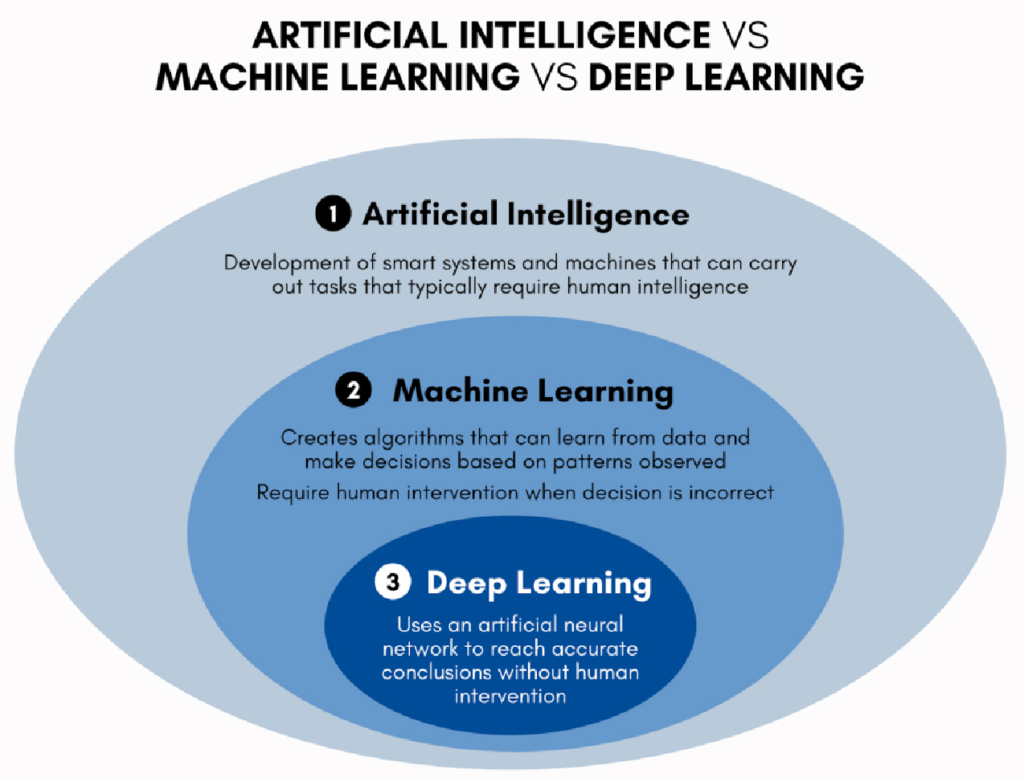
AI ⊃ ML ⊃ DL
Generative AI and Large Language Model (LLM)
Generative AI
- It is a cutting-edge technological advancement that utilizes machine learning and artificial intelligence to create new forms of media, such as text, audio, video, and animation.
- Generative AI models are trained using unsupervised learning techniques. They generate data by observing and capturing patterns and statistics from training data, creating new content that mimics human-generated data.
- Unlike traditional AI that classifies or predicts, Generative AI produces original outputs.
- The most used models are Variational Autoencoders (VAEs), Generative Adversarial Networks (GANs), and autoregressive models.
How It Works
| Component | Role |
| Foundation Models | Large-scale neural networks trained on diverse datasets. |
| Transformers | Architecture enabling context-aware generation (e.g., GPT, BERT). |
| Diffusion Models | Used for image/video generation (e.g., DALL·E, Midjourney). |
| Reinforcement Learning | Fine-tunes outputs based on feedback. |
Popular Generative AI Tools
| Tool | Developer | Focus / Type | Use Cases |
| ChatGPT | OpenAI | LLM / Text | Text generation, summarization, coding help |
| Bard → Gemini | Google DeepMind | Multimodal AI | Linked with Search & Workspace |
| Nano Banana | Image generation | ||
| Grok | xAI (Elon Musk) | Chatbot for X | Humor + real-time info from Twitter/X |
| LLaMA | Meta | Open-source LLM | Research & academic experimentation |
| DeepSeek | DeepSeek AI (China) | Open-source LLM | Coding + text generation |
| Sora | OpenAI | Text-to-Video | Converts prompts to video |
| DALL·E | OpenAI | Text-to-Image | AI-generated artworks, design |
| GitHub Copilot | GitHub + OpenAI | Code AI | Assists in coding tasks |
| Perplexity AI | Perplexity.ai | Search + LLM | Factual search with AI summaries |
| Copilot | Microsoft | Text, code, image generation | integrated with Office, Edge |
| Claude | Anthropic | Constitutional AI with safety-first design |
S.A.R.A.H.
- WHO unveiled a digital health promoter prototype S.A.R.A.H harnessing Generative AI for public health.
Large Language Model (LLM)
- A Large Language Model (LLM) is a type of Artificial Intelligence model that understands, generates, and manipulates human language.
- It is trained on massive amounts of text data (like books, websites, social media) and uses deep learning (especially transformer architecture) to learn language patterns.
- Examples
- Global: ChatGPT (OpenAI), BERT, Nano Banana & Gemini (Google), Claude (Anthropic), LLaMA (Meta).
- India’s AI & Large Language Models
| AI Platform | Model |
| BharatGPT (by CoRover.ai) | Supports 12+ languages (text), 14+ (voice) → Made for Indian enterprise & public use. |
| Krutrim (by Ola) | Trained on 2 trillion+ tokens, strong focus on Indic languages. |
| Project Vaani (Google-backed + IISc) | Collects massive data on Indian dialects → Improves speech & NLP systems. |
| Digital India Bhashini | AI-led language translation platform by MeitY.Part of National Language Translation Mission (NLTM).Enables digital access in Indian languages (text + voice); supports Indic content creation. |
| BharatGen | World’s 1st govt-funded multimodal LLM (launched 2024, Delhi). Developed under the National Mission on Interdisciplinary Cyber-Physical Systems (NM-ICPS).Covers language, speech, vision → improves citizen engagement & public services. IIT Bombay-led consortium of premier academic institutions. |
| Sarvam-1 | Large Language Model (2 billion parameters); supports 10 Indian languages; used for translation, summarisation, content generation. |
| Chitralekha (AI4Bharat) | Open-source video transcreation platform; enables audio transcript editing in Indic languages. |
| Hanooman’s Everest 1.0 (SML) | Multilingual AI system; supports 35 Indian languages (target: 90); broadest Indic language coverage. |
| BrahmAI (Zenteiq) | Multimodal model (8B–80B params) → science, industrial innovation. |
| Yukti (Base), Varta (Instruction), and Kavach (Guard) (GenLoop) | Creating small language models (2B parameters) – to support all 22 scheduled Indian languages with native reasoning and content moderation. |
| MuleHunter AI | Launched by RBI to help financial institutions identify mule accounts and curb digital frauds. |
Important Summits Related to AI
AI Action Summit 2025
- The AI Action Summit 2025 was held in Paris, France (10–11 February 2025). It is the third global summit on AI governance, following:
- Bletchley Park Summit (UK, 2023) → Bletchley Declaration to regulate AI.
- Seoul AI Summit (South Korea, 2024).
- Co-Chairs: President Emmanuel Macron (France) and Prime Minister Narendra Modi (India).
- Hosted 2nd India–France AI Policy Roundtable alongside this.
- Joint Declaration
- Signed by 58 countries (including India, China, EU)
- Title: “Inclusive and Sustainable Artificial Intelligence for People and the Planet”.
- US and UK abstained, citing concerns over excessive regulation.
- Major Initiatives Launched
| Initiative | Purpose & Partners |
| Public Interest AI Platform | Bridge public-private efforts; promote open, trustworthy AI. |
| Current AI Foundation | $400M fund for AI public goods (datasets, open-source tools). |
| Coalition for Environmentally Sustainable AI | Led by France, UNEP, ITU; backed by 11 countries & 37 companies. (India → founding member) |
India-AI Impact Summit 2026
- Venue: Bharat Mandapam, New Delhi (February 2026)
- Hosted by: Ministry of Electronics & IT, GoI
- First-ever AI Summit hosted by a Global South nation.
- Rajasthan Regional AI Impact Conference: 06th January 2026 at JECC, Sitapura (Jaipur).
- Theme & Guiding Principles
- Logo: Ashoka Chakra + neural flares→ symbolizing ethical governance & transformative AI.
- Three Sutras (Guiding Principles):
- People: Inclusive AI respecting cultural diversity & accessibility.
- Planet: Resource-efficient AI aligned with sustainability & climate goals.
- Progress: Democratizing access to compute, data, and models for development.
- Seven Chakras (Action Areas).
- Key Flagship Initiatives
- UDAAN – Global AI Pitch Fest: AI startups from Tier-2/3 India + women/differently-abled founders.
- YuvaAI Innovation Challenge & AI by HER: Empowering youth & women innovators.
- Global Innovation Challenge for All: AI solutions for real-world public challenges.
- Launch of Eight Foundational Model Projects
- Avatar AI, IIT Bombay Consortium – BharatGen.
- Fractal Analytics: India’s first large reasoning model (70B params) → STEM & healthcare.
- Tech Mahindra Maker’s Lab: Efficient 8B param Indic model (focus on Hindi dialects) + agentic AI Platform “Orion” for governance.
- Zenteiq – BrahmAI: Multimodal model (8B–80B params) → science, industrial innovation.
- GenLoop – Yukti/Varta/Kavach: Small LMs (2B params) → support all 22 scheduled Indian languages.
- Intellihealth
- Shodh AI: 7B param model for material discovery → accelerate material sciences.
Note: The 21st International Conference on Natural Language Processing (ICON-2024) will be held at AU-KBC Research Centre, Chennai, India during December 19-22, 2024.
Important Initiative related to AI
Global Level
- European Union AI Act
- World’s first comprehensive AI law.
- Introduces risk-based regulation: Prohibited, High-risk, Limited-risk, Minimal-risk systems.
- Global Partnership on Artificial Intelligence (GPAI)
- Launched: June 2020.
- Type: Multi-stakeholder initiative to bridge gap between AI theory & practice through applied research.
- Membership: 28 members + EU (open to all, incl. developing countries).
- Secretariat: OECD, Paris (France).
- India’s Role: Founding member; Lead Chair in 2024.
- New Delhi Declaration: Adopted to promote human-centric and responsible AI.
- Hiroshima AI Process (HAP)
- Launched: 2023 under G7 in cooperation with OECD & GPAI.
- Aim: Safe, trustworthy, interoperable AI governance frameworks.
India’s Initiatives
IndiaAI Mission (Launched: 7 March 2024)
- Budget Outlay: ₹10,371.92 crore.
- Nodal Agency: IndiaAI, an Independent Business Division (IBD) under Digital India Corporation, MeitY.
- Objectives:
- Democratize access to AI technologies.
- Promote technological self-reliance & innovation.
- Ensure ethical, safe & responsible AI.
- Drive inclusive growth & socio-economic transformation.
- 7 Key Pillars
- IndiaAI Compute Capacity → 10,000+ GPUs via PPP; AI Marketplace; AI-as-a-Service.
- IndiaAI Innovation Centre → Indigenous LMMs & sectoral foundational models.
- IndiaAI Datasets Platform (AIKosha) → High- quality non-personal datasets; unified access.
- IndiaAI Application Development Initiative→ AI in healthcare, agri, climate, governance, learning disabilities.
- IndiaAI FutureSkills → AI education UG–PhD; 570 Data & AI Labs in Tier 2/3 cities.
- IndiaAI Startup Financing → Funding support for deep-tech AI startups
- Safe & Trusted AI (AISI) → Frameworks, self-assessment, IndiaAI Safety Institute.
Other Indian Initiatives
- National AI Portal – INDIAai
- Launched by MeitY, NITI Aayog, and NIC.
- Serves as a one-stop digital platform for AI-related news, research, startups, funding, policy, and resources.
- YUVAi (Youth for Unnati & Vikas with AI)
- Launched by: NeGD (MeitY) + Intel India.
- Target group: School students (Class 8–12).
- Aim: Build AI mindset & skills; empower students as human-centric AI designers & users.
- RAISE Summit: Responsible AI for Social Empowerment, by MeitY, focusing on ethical AI use.
Key Components and Techniques in AI
AI Concept / Technology | Description and Key Features |
Machine Learning (ML) |
|
Deep Learning |
|
Neural Networks |
|
Natural Language Processing (NLP) |
|
Artificial General Intelligence (AGI) |
|
Foundational AI |
|
Computer Vision |
|
Robotics |
|
Expert Systems |
|
Robotics
- Robotics is the branch of technology that deals with the design, construction, operation, and application of robots.
What is a Robot?
- A robot is a programmable machine that can perform tasks autonomously or semi-autonomously.
- It may resemble humans (humanoids) or be functional and task-specific (industrial robots or drones).
- Examples: Self-driving cars, drones, robotic arms in factories, or surgical robots.
Asimov’s Laws of Robotics
- In 1942, science fiction writer Isaac Asimov introduced the famous “Three Laws of Robotics” in his short story collection I, Robot.
- These laws serve as a fictional ethical framework for robots:
- First Law: A robot must not harm a human being or allow harm through inaction.
- Second Law: A robot must obey the orders given to it by human beings, except where such orders would conflict with the First Law.
- Third Law: A robot must protect its own existence as long as such protection does not conflict with the First or Second Laws.
- Zeroth Law (Later Addition): A robot must not harm humanity or let humanity be harmed. (Added later by Asimov to prioritize collective human welfare over individuals.)
Important Robots (India & Rajasthan – 2025)
| Robot / Project | Sector | Why Important / In News |
| Vyommitra (ISRO) | Space | Humanoid robot for Gaganyaan mission; undergoing advanced simulation tests. |
| Mitra Robot (Invento Robotics) | Healthcare & Hospitality | Used in AIIMS Delhi & private hospitals for patient interaction, telepresence. |
| SS Innovations Surgical Robot | Healthcare | Indigenous, low-cost robotic surgery system; alternative to Da Vinci. |
| RoboDoc / Da Vinci Systems | Healthcare | Robotic surgery expanding to tier-2 cities. |
| Asimov Robotics (Kerala) | Service | Hospital & airport service robots. |
| TAL Brabo (Tata Motors) | Manu-facturing | India’s first industrial robot; part of Make in India 2.0. |
| Manav (A-SET Institute) | Education & Research | India’s first 3D-printed humanoid; showcased at Robotex India 2025. |
| Genrobotics Bandicoot | Sanitation | Sewer-cleaning robot; deployed under Swachh Bharat Mission.First robotic scavenger in the world. (Kerala – First state and Jaipur – First city in Rajasthan). |
| Homosep Atom | Sanitation | India’s first septic tank/manhole cleaning robot.Developed by IIT Madras based startup Solinas. |
| MULE (Multi-Utility Legged Equipment) | Defence | Indian Army + private partners. AI-powered robotic mules/dogs for surveillance, reconnaissance, and logistics; can carry ~12 kg, fitted with thermal cameras & radars. |
| Gridbots | Nuclear & Defence | Robots for hazardous environments. |
| Municipal Cleaning Robots (Jaipur) | Urban Governance | Pilots for robotic waste management under Smart City Mission. |
Big Data Analytics
- Big Data refers to datasets that are so large and complex that traditional data processing software and methods cannot handle them efficiently.
- Summary of the 6 Vs of Big Data:
- Volume – The amount of data.
- Velocity – The speed of data generation and processing.
- Variety – The different types and formats of data.
- Veracity – The quality and accuracy of data.
- Value – The usefulness and insights extracted from data.
- Variability – The changing nature and consistency of data.
- Big Data analysis involves identifying patterns and insights in data, which helps in decision-making and understanding trends.
- In January 2025, India joined the UN Committee of Experts on Big Data and Data Science for Official Statistics (UN-CEBD). This membership allows India to contribute to global standards in utilizing big data for official statistics.
- Project ADVAIT → Big data-driven analytics to detect fraud in tax systems.
Apache Hadoop – Foundation of Big Data
- Hadoop is an open-source framework used for distributed storage and processing of large datasets using clusters of computers.
- Big data analytics works on this framework.
- Main Components of Hadoop
- HDFS (Hadoop Distributed File System): Storage Layer of Hadoop. It divides the data into small pieces and distributes them across different nodes of the cluster.
- MapReduce: Processing Layer of Hadoop. It uses a Java-based programming model to process data in parallel.
- YARN (Yet Another Resource Negotiator): Resource management and job scheduling layer. It decides how much resources (CPU, RAM) should be allocated to which task.
- Hadoop Common: Provides shared libraries and Java APIs used by HDFS, YARN, and MapReduce.
Cloud Computing
- Cloud computing refers to the delivery of computing services (like servers, storage, databases, networking, software) over the internet (“the cloud”).
- It enables on-demand access to digital infrastructure without owning physical hardware.
- Examples: Google Drive, Amazon AWS, and Microsoft Azure, Microsoft Onedrive.
Types of Cloud Computing (Based on Deployment Models)
- Public Cloud
- Owned/managed: Third-party providers (AWS, Google Cloud, Azure).
- Advantages: Cost-effective, scalable, no maintenance burden.
- Use cases: SMEs, web hosting, testing.
- Indian Context: Zomato, Paytm use for scaling.
- Private Cloud
- Exclusive use: Single organization (on-premises).
- Advantages: Enhanced control, security, customization.
- Use cases: Finance, healthcare, govt agencies.
- Indian Context: SBI uses private cloud for customer data.
- Hybrid Cloud
- Mix: Combines public + private.
- Advantages: Cost efficiency + security, suited for dynamic workloads.
- Indian Context: Indian Railways manages vast datasets with hybrid model.
- Community Cloud
- Shared infra: Multiple orgs with common goals (security, compliance).
- Advantages: Collaboration, cost-sharing.
- Use cases: Research, healthcare, universities.
- Indian Context: Research institutions pooling resources.
- It is not openly accessible to the general public without regulatory checks.
Service Models of Cloud Computing
- Infrastructure as a Service (IaaS)
- Definition: Provides infrastructure (servers, storage, networking). User manages Operating system & apps.
- Examples: AWS EC2, Google Compute Engine, Azure VMs, MeghRaj (India).
- Advantages: Scalable, flexible, cost-efficient.
- Indian Context: Zomato uses Azure for platform management.
- Platform as a Service (PaaS)
- Definition: Provides platform for app development without infra management.
- Examples: Azure App Service, Google App Engine, AWS Elastic Beanstalk, Aadhaar auth services.
- Advantages: Simplifies development, faster deployment.
- Indian Context: Startups use PaaS for app building.
- Software as a Service (SaaS)
- Definition: Ready-to-use applications delivered via internet (subscription).
- Examples: Google Workspace, Office 365, Salesforce, GSTN, DigiLocker, BHIM, AEPS.
- Advantages: Accessible anywhere, no installation, subscription-based.
- Indian Context: DigiLocker = government SaaS service.
- Network-As-A-Service (NaaS)
- A cloud service model in which customers rent networking services from cloud providers.
- It provides the flexibility to pay for services based on usage and to scale as business needs change.
- Allows customers to operate the networks without maintaining their networking infrastructure.
Malware-As-A-Service (MaaS)
- It is not a legitimate cloud computing service model.
- Type of cybercrime model where malware is offered for sale or rent by cyber criminals as a service to other hackers or malicious actors on the internet.
- MaaS operates in a similar way to legitimate Software as a Service (SaaS) models, where software (malware) is provided on a subscription or pay-per-use basis.
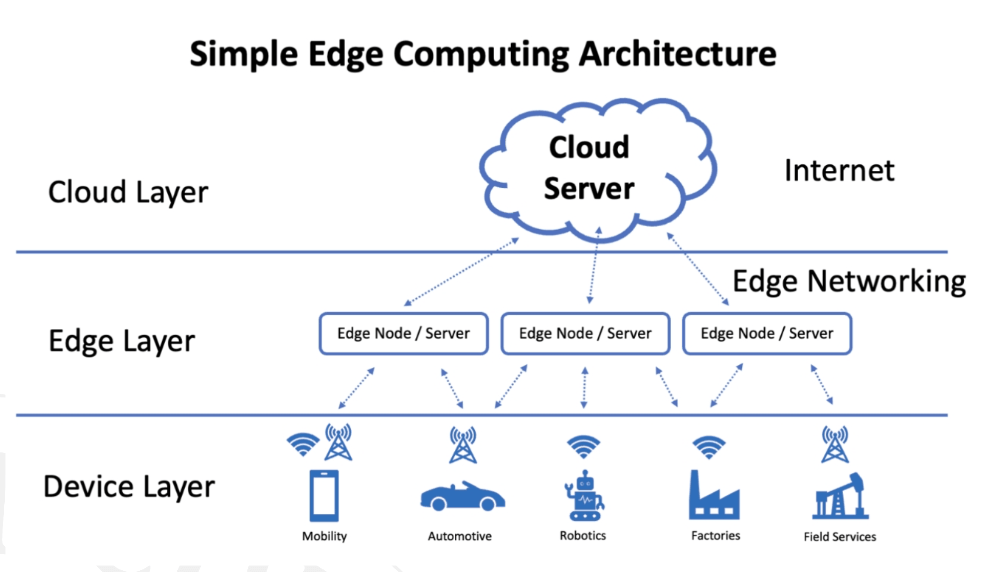
Edge Computing
- Edge Computing is a technology in which data processing and computation are carried out at the edge of the network (that is, where the data is generated – such as sensors, devices, or local servers).
- This eliminates the need to always send data to a distant cloud for processing.
- How It Works:
- Data → Processed locally → Only relevant info sent to the cloud.
- Key Features:
- Faster Processing – Since processing takes place close to the data source, latency (delay) is reduced.
- Bridge between IoT and Cloud – It handles both downstream (cloud → device) and upstream (device → cloud) data flows.
- Lower Bandwidth Requirement – There is no need to frequently send all data to the cloud.
- Real-Time Decision-Making – Enables immediate actions in systems like self-driving cars and healthcare devices.
- Examples:
- Self-driving Car – Data from sensors (speed, camera, brakes) is processed instantly by the car’s onboard computer (edge device) to make quick driving decisions.
- Smart Factory (Industry 4.0) – IoT sensors in machines process fault detection data locally and can immediately stop a machine to prevent damage.
Cloud Computing Initiatives of India
Cloud Initiative | PlatformFeatures and Services |
MeghRaj(2013) |
|
DigiBoxx |
|
DigiLocker |
|
RajMegh |
|
Bhamashah State Data Centre, Jaipur (March 2018) |
|
Rajasthan Data Center Policy – 2025
- Launched in the 2024–25 Budget, this policy aims to transform Rajasthan into a national hub for data centers, cloud infrastructure, and digital services.
- Vision: “Data is the New Oil & Data Centers the New Oil Wells.”
- It recognizes data centers as essential services, enabling fast-tracked development and strategic tech investment.
- Key Objectives
- Achieve 300 MW installed capacity in 5 years.
- Attract ₹20,000 crore investment over 5 years.
- Develop 5 dedicated Data Center Parks across Rajasthan.
- Promote data localization and position Rajasthan as a cost-effective destination for data centers.
- Incentives & Support
- Financial Incentives: Eligibility: Minimum 2 MW capacity; categories – Large (₹25 – ₹100 crore), Mega (₹100 – ₹250 crore) , Ultra-Mega (Above ₹250 crore).
- Options:
- Investment Subsidy: 75% reimbursement of state tax for 7 years.
- Capital Subsidy: 10–20% reimbursement of Eligible Fixed Capital Investment (EFCI).
- Turnover-linked Incentive: 1–1.4% of net sales turnover for 10 years.
- Sunrise Incentives (first 3 mega projects): extra 25% subsidy, 5% interest subvention, waiver on renewable energy charges.
- Other benefits: 100% electricity duty exemption (7 years), 75% stamp duty exemption, flexible land payment.
- IP Creation: ₹1 crore support for patents, GI tags, and innovation.
Internet of Things (IoT)
- The Internet of Things (IoT) refers to a network of interconnected devices, sensors, and systems that collect, exchange, and process data over the internet to perform tasks without direct human intervention.
- An IoT system has three components: Smart devices (e.g. television), IoT application and A graphical user interface.
- Key Features
- Connectivity – Devices connect via Wi-Fi, Bluetooth, 5G, LoRa, etc.
- Automation – Enables smart decision-making with minimal human input.
- Data-driven – Relies on real-time collection and analysis of data.
- Integration with AI & Cloud – Enhances predictive analysis, decision support, and remote control.
- Applications of IoT
- Smart Homes – Automated lighting, thermostats, appliances (e.g., Nest, Ring, Alexa).
- Healthcare – Wearables (Fitbit, smart bands) to monitor heart rate, BP, glucose.
- Industrial IoT (IIoT) – Predictive maintenance, robotics, supply chain optimization.
- Agriculture – IoT-enabled drip irrigation, soil moisture sensors, weather monitoring.
- Indian Example: PMFBY crop insurance using IoT data; Namo Drone Didi scheme.
- RajKisan IoT Pilot: App under testing for real-time soil moisture and irrigation control in Tonk and Sikar districts.
- Smart Cities – Intelligent traffic signals, waste collection, water & energy conservation.
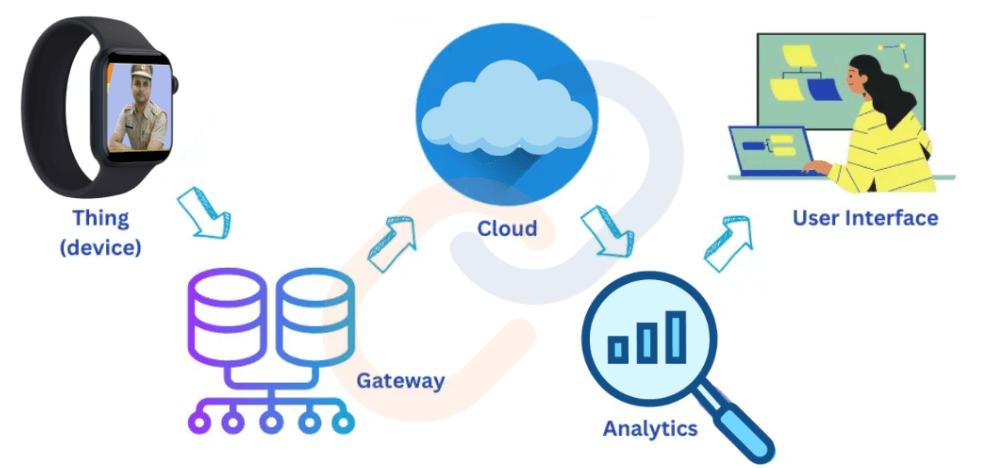
In the context of IoT architecture, wireless connectivity (like Wi-Fi, Bluetooth, Zigbee, LoRa, etc.) is primarily handled by the Network Layer. Here’s how each layer functions:
| Layer | Role in IoT Architecture |
| Application Layer | Interfaces with users and applications (e.g., smart home apps, health monitoring dashboards) |
| Perception Layer | Detects physical parameters via sensors (e.g., temperature, motion, humidity) |
| Network Layer | Transmits data via wired/wireless networks (e.g., Wi-Fi, Zigbee, cellular, LoRaWAN) |
| Transport Layer | Ensures reliable data transmission between devices and servers (e.g., TCP/UDP protocols). |
| Processing Layer (Middleware) | Data Storage, Processing, and Analysis (Cloud/Edge Computing) (e.g., Databases (SQL, NoSQL), Big Data Analytics, ML Algorithms.) |
IoT (Internet of Things) vs IoE (Internet of Everything)
- IoT (Internet of Things) → Connection of physical devices (smartphones, appliances, wearables, etc.) via the internet to exchange data and automate processes.
- Focus: Devices and their communication.
- Examples: Smart home devices, wearables, connected vehicles.
- IoE (Internet of Everything) → Broadens IoT by connecting not just devices but people, data, and processes.
- Focus: Holistic integration of devices, people, data, and processes.
- Examples: Smart cities, integrated industrial ecosystems, connected healthcare.
| Aspects | IoT | IoE |
| Scope | Devices only | Devices + people + data + processes |
| Interaction | Device-to-Device | All-encompassing connection |
| Purpose | Automation | Holistic Intelligence and optimization |
- IEMECON 2025 – Jaipur
- Dates: December 8–10, 2025
- Host: University of Engineering & Management (UEM), Jaipur
- Theme: “Advancements of AI in Embedded Systems, Microelectronics, Communication, and Optical Networks”.
- India International IoT Automation Expo
- Pragati Maidan, Delhi.
- Focus: Smart Cities, IoT, e-Governance, EVs, logistics, and automation.
- IDCIoT 2025 – Intelligent Data Communication & IoT Conference
- 2025- 3rd International Conference
- February 5-7, 2025, at REVA University in Bengaluru.
Blockchain Technology
- It is a decentralised, distributed ledger that records transactions across a network (multiple computers) in a way that makes them tamper-resistant and transparent.
- A blockchain is a chain of blocks, where each block stores data or digital information. (E.g., In the case of Bitcoin, a block stores a record of cryptocurrency transfer).
- Once a block is added to the chain, it is extremely difficult to alter, hence, ensuring the integrity of the data.
Concepts related to Blockchain Technology
Cryptocurrency
- A cryptocurrency is a digital or virtual form of currency that uses cryptographic techniques for security.
- Unlike traditional currencies issued by governments (fiat currency), cryptocurrencies operate on decentralized networks (distributed ledger) using blockchain technology.
- Examples: Bitcoin (First – 2008, Satoshi Nakamoto), Ethereum, Altcoin, Ripple, Litecoin, Central Bank Digital Currency (CBDC – India – Digital Rupee (e₹)).
- Consensus Mechanisms
- Proof of Work (PoW): Miners solve complex mathematical problems to validate transactions (used in Bitcoin).
- Proof of Stake (PoS): Validators are chosen based on the number of coins they hold (used in Ethereum 2.0).
- Other Mechanisms: Delegated Proof of Stake (DPoS), Proof of Authority (PoA), etc.
- Legal Status in India
- Classified as Virtual Digital Assets (VDAs) under the Income Tax Act, 1961.
- Not recognized as legal tender (cannot be used for payments), but holding, trading/investment allowed.
- Cryptocurrency Exchanges in India
- WazirX: One of the largest and most popular exchanges in India.
- Offers trading in major cryptocurrencies like Bitcoin, Ethereum, Ripple etc.
- CoinSwitch Kuber, ZebPay, Unocoin, Bitbns, Koine.
- WazirX: One of the largest and most popular exchanges in India.
- Markets in Crypto Assets (MiCA) Legislation
- Passed by European Parliament.
- A legal framework for crypto-asset services providers as well as consumer protection.
CBDC Pilot Projects
| Country / Organization CBDC | Initiative and Key Features | |
| Global | Bahamas | Sand Dollar: First fully deployed CBDC launched in October 2020 (first large-scale retail CBDC). |
| Nigeria | e-Naira | |
| China | – e-CNY (Digital Yuan) – Largest CBDC pilot in the world, not a full-scale launch. | |
| Brazil | Drex: Advanced pilot stage; retail + wholesale use cases. | |
| Sweden | e-Krona | |
| Kazakhstan | Digital Tenge: Pilot for retail + mining sector integration. | |
| mBridge Platform | Bank for International Settlements (BIS) launched mBridge platform for cross-border CBDC settlement. | |
| India | Retail CBDC (e₹-R) | – Launched on December 1, 2022. – Supports P2P (person-to-person) and P2M (person-to-merchant) transactions. – The e₹-R is a token-based CBDC, different from UPI, which is an account-based payment system. – Being tested in a “closed user group” (CUG) with a limited number of participants. |
| Wholesale CBDC (e₹-W) | – Launched on November 1, 2022. – Used for interbank settlements and government securities. |
Non-Fungible Tokens (NFTs)
- NFTs or non-fungible tokens are digital assets (often in the form of digital art, music, videos, or other digital content) based on blockchain technology.
- Each NFT is assigned a unique and unchangeable code stored on the blockchain, providing a clear record of ownership and verifying the authenticity of the associated digital asset.
- They are bought, sold, and owned as whole units (Indivisible).
- Each NFT is distinct and scarce and cannot be duplicated or forged.
- Unlike cryptocurrencies (like Bitcoin or Ethereum), which are fungible (interchangeable), each NFT is unique or one-of-a-kind, making it non-fungible.
Decentralised Finance (DeFi)
- An emerging concept that leverages blockchain technology to offer financial products and services without relying on traditional intermediaries like banks or brokerages.
- DeFi applications are built on blockchains and rely on smart contracts that automate financial transactions according to predetermined rules. This eliminates the need for a trusted third party.
Decentralized Applications (dApps)
- They are software applications that run on a blockchain (not on a single server).
- Unlike normal apps like Instagram or Paytm (which are controlled by companies), DApps have no single owner.
- They are open, secure, and run automatically with the help of smart contracts.
Virtual Digital Assets
- ‘Virtual digital asset’ refers to any information, code, number, or token (not being Indian currency or foreign currency) generated through cryptographic means or otherwise and can be called by whatever name.
- Eg. Crypto currencies like Bitcoin, NFTs etc Transactions come under the purview of the Prevention of Money Laundering Act (PMLA).
- Extra : VDAs was introduced in the Finance Bill 2022 to provide for taxation and withholding of tax pertaining to VDAs. Effective from 1 April 2022 onwards, any income from transfer of VDAs is taxable at the rate of 30% (plus surcharge and cess).
Initiative related to Blockchain Technology
Blockchain Projects in India
| State | Project / Initiative | Key Features and Applications |
| India | IndiaChain (NITI Aayog) | Project to create a national blockchain network by integrating with IndiaStack (the digital infrastructure behind Aadhaar) to improve transparency, efficiency, and trust in public services like land records, health, and subsidy distribution. |
| StaTwig | Vaccine supply chain tracking (COVID & beyond). | |
| AgriLedger | Blockchain for farmers–buyer direct linkages. | |
| Rajasthan | Apna Khata (Jamabandi) Pilot | – Integrated with blockchain for tamper-proof land records. – Rajasthan among the first states (with Telangana & Maharashtra) to test blockchain in land governance. |
| iStart Rajasthan | – Department of IT&C – Flagship startup program supports Web3 and blockchain startups. | |
| Center of Excellence for Blockchain Technology | – MoU between RajCOMP Info Services Limited and IIT Kanpur. – The center will work with the IIT to bring blockchain technology and AI from the lab to the real world. – Declared in Rajasthan Budget 2022-23. |
Vishvasya Blockchain Technology Stack
- Launched by MeitY in September 2024 as India’s National Blockchain Technology Stack.
- It is a part of National Blockchain Framework (NBF) under the National Strategy on Blockchain.
- It offers Blockchain-as-a-Service (BaaS) with a geographically distributed infrastructure (in NIC data centers at Bhubaneswar, Pune, and Hyderabad) designed to support various permissioned Blockchain based applications.
- Includes NBFLite sandbox for rapid prototyping, research, and innovation for startups & academia.
- Vishvasya is NOT for public crypto mining.
U-WIN (Universal Immunization Platform)
- Launched by: Ministry of Health & Family Welfare (MoHFW)
- Purpose: A digital platform to capture and manage all vaccination events of pregnant women and children under the Universal Immunization Programme (UIP).
- Model: Built on the success of Co-WIN (COVID vaccine platform).
- Key Features
- Digital Registry: Maintains electronic records of all routine immunizations.
- Diseases Covered: 12 vaccine-preventable diseases.
- Digital Certificates: QR-based, digitally verifiable e-vaccination certificates (like Co-WIN).
- Self-Registration: Parents and pregnant women can register via portal or mobile app.
- Offline Mode → enables vaccinators to record data without internet.
- Automated Alerts: SMS reminders for upcoming doses.
- ABHA & Child ABHA generation for digital health records.
- Languages: Available in 11 regional languages including Hindi.
Over-the-top (OTT) Platforms
- OTT platforms are digital services that deliver content (audio, video, text) directly to consumers via the internet, bypassing traditional broadcast or cable TV distribution methods.
- OTT services are also known as streaming platforms.
- Regulation → Covered under IT Rules 2021 → Code of Ethics, Content classification, Grievance redressal.
- Cable news networks are regulated under Cable Television Networks (Regulation) Act, 1995 (Ministry of Information and Broadcasting).
- Print media is regulated under the Press Council Act of 1978 by the Press Council of India.
- The Code of Ethics of the IT Rules 2021 describes OTT platforms as online curated content platforms (OCCPs).
- Online curated content is audio-visual content such as films, web-series, podcasts, etc., made available to viewers on demand.
- OTT platforms can operate on subscription, ad-based, or hybrid revenue models; they are not limited to subscriptions only.
- Examples of Popular OTT Platforms
- Video Streaming: Netflix, Amazon Prime Video, Disney+ Hotstar.
- Music Streaming: Spotify, Apple Music.
- Gaming and Live Streaming: Twitch, YouTube.
- Doordarshan is traditional broadcast TV, not OTT.
Social Media
- Social media refers to online platforms where users can create, share, and engage with content and connect with others in virtual communities.
- Unlike traditional media, social media allows two-way communication, enabling interaction between creators and audiences.
- Popular Social Media Platforms
- General Social Networking: Facebook, Instagram, Twitter.
- Professional Networking: LinkedIn.
- Short-Form Content: TikTok, Snapchat, YouTube Shorts.
- Community-Based Platforms (Discussion forums): Platforms where users answer each other’s questions and share new ideas and news. Example: Reddit, Quora.
| Platform Name | Key Features / Purpose |
| A popular social networking site where people share personal and career content, interests, and activities. | |
| A social network for sharing photos and videos, where most content is public and users can follow other users. | |
| Snapchat | A social networking app where people connect by exchanging photos and videos, and chatting. |
| A website where users create pinboards of related images to share with others. | |
| A professional networking site where companies and candidates can network. | |
| YouTube | Users can create and share videos, such as how-to videos, recipes, and humorous videos. |
| Discussion forums | Platforms where users answer each other’s questions and share new ideas and news. |
Immersive Technologies
Extended Reality (XR) – Umbrella Concept
- XR is a broad term that covers immersive technologies that extend or alter human perception of reality.
- It includes:
- Augmented Reality (AR)
- Virtual Reality (VR)
- Mixed Reality (MR).
- Importance: Blurs the line between physical and digital environments → used in gaming, defence training, healthcare, education, tourism, and governance.
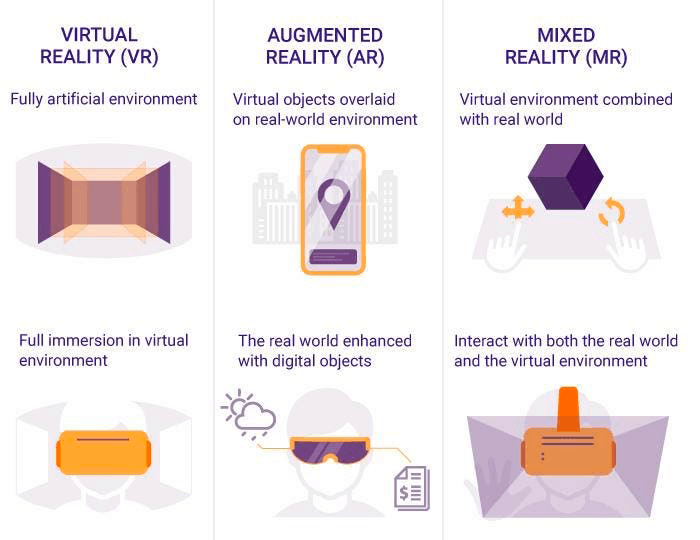
Technology (AR / VR/ MR) | Features, Devices, Examples and Applications |
Augmented Reality (AR) |
|
Virtual Reality (VR) |
|
Mixed Reality (MR) |
|
Key Differences (AR vs VR vs MR)
| Feature | AR (Augmented) | VR (Virtual) | MR (Mixed) |
| Reality | Real world + digital overlay | Fully virtual environment | Real + digital, interactive fusion |
| Immersion | Partial | Complete | Both real & virtual seamlessly |
| Devices | Smartphones, AR glasses | VR headsets | MR headsets with sensors/cameras |
| Example | Pokémon Go | Flight simulator | Microsoft HoloLens surgery training. |
Digital Twins
- A Digital Twin is a virtual, real-time replica of a physical object, process, or system.
- Powered by IoT sensors + AI + Cloud + Data Analytics, it continuously updates to mirror the real-world asset.
- Goes beyond simulation → enables prediction, optimization, and decision-making without disrupting real operations.
- It uses four key technologies to create a digital representation, collect real-time data, and provide valuable insights: the Internet of Things (IoT), Extended Reality (XR), Cloud computing, and Artificial Intelligence.
Metaverse
- A 3-D-enabled virtual reality space.
- Provides digital experiences as an alternative to or a replica of the real world.
- Allows people to have lifelike experiences online.
- It is essentially a convergence of augmented reality (AR), virtual reality (VR), the internet, and other technologies, creating a persistent and immersive digital universe.
- The term ‘metaverse’ was first mentioned in the 1992 science fiction novel ‘Snow Crash’ by Neal Stephenson.
Building Blocks of Metaverse (4 layers)
- Infrastructure layer: enables devices, connects them to the network, and delivers content.
- Virtualization engine layer: provides the computational and programming platform.
- Interface and Access layer: help users in accessing the Metaverse.
- User experience and use cases layer: creation, sale, trading, storage, etc.
Examples of Metaverse
- Facebook recently changed its name to ‘Meta’ to align the company with its ambitions to build the ‘metaverse’.
- Microsoft has come up with its ‘Mesh’ platform which has mixed reality capabilities.
- Nvidia is working on their versions of the virtual universe.
- Epic, the company behind the video game phenomenon Fortnite, has moved beyond games to social experiences like dance parties and virtual music concerts.
Rajasthan AVGC‑XR Policy (2024–25)
- AVGC‑XR = Animation, Visual Effects, Gaming, Comics & Extended Reality
- Date: Official Launch: December 4, 2024, Notification Issued: January 29, 2025. (Till 31 March, 2029)
- Announced: Rajasthan Budget 2024–25
- Aim: Make Rajasthan a national hub for creative technologies.
- Key Features
- Recognises AVGC‑XR as a sunrise sector within Media & Entertainment.
- Generate 50,000 jobs in 5 years in creative tech sector.
- Rajasthan AVGC-XR Fund: 50 Crore (to provide grants, equity investments, and financing to startups and enterprises).
- Beneficiaries:
- Startups, Studios, Enterprises
- Academic Institutions & Students
- Artists, Creative Professionals
- Infrastructure:
- Establishment of Atal Innovation Studios & Accelerators with ₹1,000 crore allocation.
- Expansion of iStart Rajasthan ecosystem (Techno Hub, Innovation Hub, incubators at divisional HQs).
- Use XR/AR/VR for heritage tourism (Amber Fort, Jantar Mantar, City Palace).
Note: India’s AVGC‑XR sector projected to grow from $3 billion (2023) to $26 billion by 2030 (CAGR 14–16%).
Quantum Computing
- Quantum computing is an area of computer science that uses the principles of quantum theory at the atomic and subatomic levels.
- German physicist Werner Heisenberg published a famous paper which led to the discovery of phenomena called quantum mechanics.
- Quantum computers use qubits as the basic unit of information, instead of bits.
- Applications: cryptography, drug discovery, climate modeling, logistics, AI optimization.
Quantum Computing vs Traditional Computing
Aspect | Traditional (Classical) Computing | Quantum Computing |
Basic Unit | Bit → 0 or 1 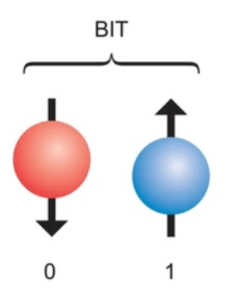 | Qubit → 0, 1, or both (superposition) 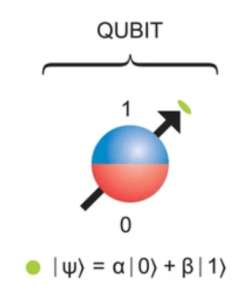 |
Processing | Sequential (one calculation at a time) | Parallel (many possibilities simultaneously) |
Principle | Based on classical physics (transistors, semiconductors) | Based on quantum mechanics (superposition, entanglement, tunneling) |
Speed | Limited by Moore’s Law; exponential scaling slowing down | Exponential speedup potential due to quantum parallelism. |
Noise tolerance | Minimal inherent noise | Extremely sensitive to noise (Decoherence) |
Error Handling | Stable, low error rates | Qubits fragile → need quantum error correction |
Security Impact | Relies on classical encryption (RSA, ECC) | Quantum Key Distribution (QKD) → Copying quantum information destroys quantum state. |
Processing Method | Classical logic gates (AND, OR, NOT) | Quantum gates (Hadamard, CNOT, SWAP) |
Hardware | Silicon chips, transistors | Superconducting circuits, trapped ions, photonics, topological qubits |
Applications | Everyday computing: word processing, browsing, databases | Specialized: cryptography, drug discovery, climate modeling, AI optimization, logistics |
Terms related to Quantum Computing
Quantum Computing | Key related concept |
Quantum Superposition 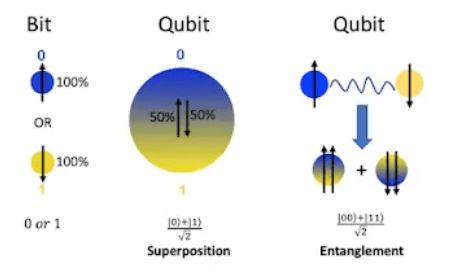 |
|
Quantum Entanglement 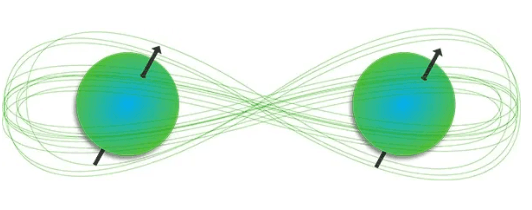 |
|
Quantum Interference |
|
Quantum Tunneling |
|
Quantum Coherence 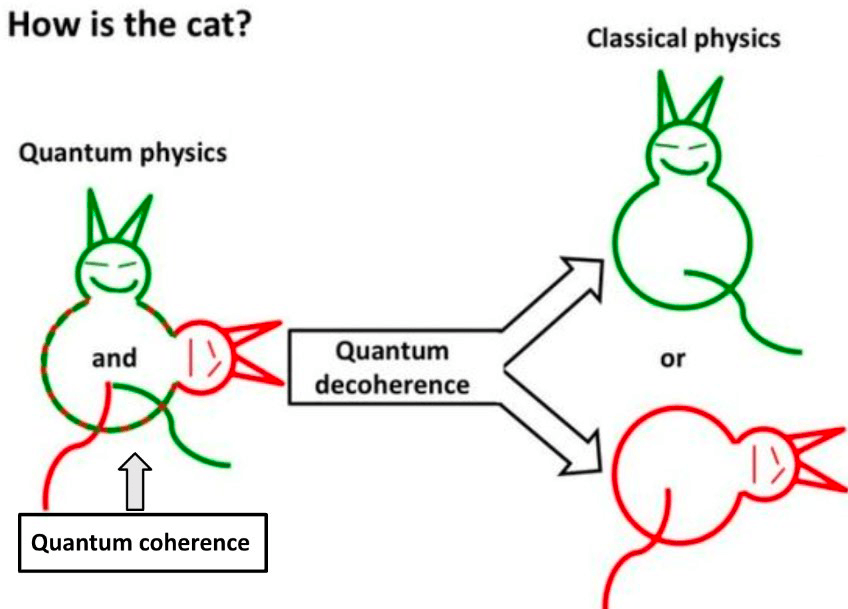 |
|
Quantum Supremacy |
|
Quantum Key Distribution |
|
Majorana Zero Modes |
|
Quantum Teleportation
- Quantum teleportation is a process for transferring the quantum state (information) of a quantum particle (qubit) from one location to another, without moving the physical particle itself.
- NASA’s quantum teleportation demonstration: 44 km teleportation of qubits of photons over a fibre-optic network and single-photon detectors.
‘qkdSim’: RRI’s QKD Simulation Toolkit
- A simulation toolkit for end-to-end Quantum Key Distribution (QKD)
- Developed by Raman Research Institute (RRI), DST autonomous institute.
- India’s first end-to-end free-space QKD experiment.
- Part of: India’s Quantum Experiments using Satellite Technology (QuEST), supported by ISRO → India’s first satellite-based secure quantum communication effort.
Note: In May 2025, the Centre for Development of Telematics (C‑DOT) signed a Memorandum of Understanding (MoU) with the CSIR-National Physical Laboratory (CSIR‑NPL) to advance collaborative research in Classical and Quantum Communications.
Recent Developments
| Institution | Achievement | Details |
| DRDO + IIT Delhi | Free-space QKD | 2025: Demonstrated 1 km free‑space QKD using entangled photons via a free-space optical link. |
| 2022: India’s first intercity quantum communication link between Vindhyachal and Prayagraj using commercial-grade underground dark optical fiber. | ||
| 2024: Using entanglement over a 100 km spool of telecom-grade optical fiber. | ||
| ISRO | Free-space QKD | 300 meters, at Space Applications Centre (SAC), Ahmedabad (2021). The aim of this project is to lead to Satellite Based Quantum Communication (SBQC). |
| Satellite-based QKD plan | Satellite SAQTI (Secured Applications using Quantum & Optical Tech) expected by 2025. | |
| DRDO + TIFR, Mumbai | 6-qubit quantum processor | Demonstrated via cloud interface (Aug 2024). Based on superconducting circuit technology. |
| C-DoT | India’s 1st quantum secure communication link (2023). Between Sanchar Bhawan – NIC, New Delhi. QKD based on optical fibre technology | |
| MeitY(C-DAC) | Centre of Excellence (CoE) in Quantum Technology Metro Area Quantum Access Network (MAQAN) – Secure quantum communication testbed – IIT Madras. | |
| C‑DOT + Sterlite Technologies (2025) | India’s first Quantum Diamond Microchip Imager. Uses the defects in a diamond’s structure, known as Nitrogen-Vacancy (NV) centers, for detecting anomalies in semiconductor chips. | |
| TCS + IIT-Bombay | India’s first Quantum Diamond Microchip Imager.Uses the defects in a diamond’s structure, known as Nitrogen-Vacancy (NV) centers, for detecting anomalies in semiconductor chips. | |
| QNu Labs (Startup) | Commercialization Developed Armos (QKD), Tropos (QRNG), QShield (integrated platform). | |
| Rajasthan | IIT Jodhpur → Research on quantum photonics & secure comms. Army’s South Western Command (Jaipur) → Exploring QKD for defence communications. | |
Recent Developments in Quantum Computing
National Quantum Mission (NQM)
- Approved in April 2023 with ₹6,003 crore for 8 years (2023–2031).
- Objective →
- Seed, nurture, and scale up scientific and industrial R&D in Quantum Technologies (QT).
- Build a vibrant ecosystem to position India as a global leader in Quantum Technology & Applications (QTA).
- Implemented by → Department of Science & Technology (DST).
- Focus → Quantum Communication, Computation, Sensing & Metrology, and Materials & Devices.
- Structure → 4 Thematic Hubs
- Quantum Computing – IISc Bengaluru
- Quantum Communication – IIT Madras + C-DOT, New Delhi
- Quantum Sensing & Metrology – IIT Bombay
- Quantum Materials & Devices – IIT Delhi
- Key Goals →
- Develop 20–1000 qubit quantum computers.
- Secure satellite-based quantum communication (2000 km).
- Quantum materials like superconductors and sensors.
QpiAI-Indus
- India’s first full-stack quantum computer, developed by Bengaluru-based startup QpiAI under National Quantum Mission.
- Technical specs: 25 superconducting qubits with advanced hardware, scalable quantum control, and AI-enhanced software → fast, stable calculations with low error.
- Enables hybrid quantum-classical computing with cloud access via QpiAISaaS platform.
- Applications: Targets sectors like drug discovery, materials science, logistics, mobility, climate change and sustainability.
- “Full-stack” means it covers hardware (qubits), control electronics, AI-enhanced software, and cloud platform.
India’s First Quantum Computing Village
- Location: Amaravati, Andhra Pradesh.
- Key Stakeholders
- Government of Andhra Pradesh (via Real‑Time Governance Society – RTGS)
- Industry Partners: IBM, Tata Consultancy Services (TCS), Larsen & Toubro (L&T).
International Year of Quantum Science and Technology
- UN designated 2025 to be the International Year of Quantum Science and Technology.
- Year 2025 was chosen as it recognizes 100 years since the initial development of quantum mechanics.
Quantum Chips
Majorana 1 Chip
- World’s first quantum processor built using topological qubits (based on Majorana Zero Modes – MZMs).
- Developed by Microsoft (2025) under DARPA’s US2QC program.
- Represents a new state of matter → “Topoconductors”.
- Aim → Achieve fault-tolerant, scalable quantum computing.
- Features
- Material: Indium arsenide + aluminum nanowires (H-shaped layout).
- Qubit Count: 8 qubits (prototype); scalable to 1 million qubits per chip.
Key Concepts
| Quantum Concept / Component | Key Features and Significance |
| Majorana Zero Modes (MZMs) | Exotic quasiparticles that are their own antiparticles; predicted in 1937, engineered in 2025. → ideal for stable qubits. |
| Topological Qubits | Encode data in global properties of quantum states → highly resistant to local errors. |
| Topoconductor | New material combining indium arsenide (InAs) and aluminum (Al) to host MZMs. |
| Cryogenic Operation | Chip operates near 10 millikelvin to preserve superconductivity. |
Willow (Google)
- Type: Quantum chip (105-qubit)
- Qubits: Superconducting transmon qubits → artificial atoms at low temperatures.
Ocelot
- Prototype quantum computing chip developed by Amazon.
Semiconductor Development in India
- India Semiconductor Mission (ISM)
- Launched: 2021, ₹76,000 crore outlay.
- Nodal Ministry: Ministry of Electronics & IT (MeitY).
- Aim: Develop a sustainable semiconductor & display ecosystem in India, strengthen chip design capability, and integrate into global electronics supply chains.
- Focus: Atmanirbhar Bharat, trusted global chip partner.
- 4 schemes: Fabs, Display Fabs, Compound/ Sensors/ATMP, DLI (Design Linked Incentive).
- Semicon India Programme → Annual flagship event → brings together industry, academia, policymakers, startups to drive innovation & collaboration.
- Vikram Processor (ISRO): 32-bit space-grade chip.
- SHAKTI-Based Semiconductor Chip (IRIS)
- Developed by: IIT-Madras & ISRO.
- Name: IRIS – Indigenous RISC-V Controller for Space Applications.
- Based on: SHAKTI microprocessor (open-source RISC-V architecture).
- Supported under: Digital India RISC-V (DIRV) initiative, Ministry of Electronics & IT.
- Predecessors:
- RIMO (2018) – first indigenously fabricated SHAKTI chip.
- MOUSHIK (2020) – SoC for IoT & consumer electronics.
- Applications: Aerospace (launch vehicles, ground stations), IoT & Industrial IoT.
- DIRV Initiative
- Aim: Promote indigenous development of microprocessor-based products using RISC-V.
Hyperloop Technology
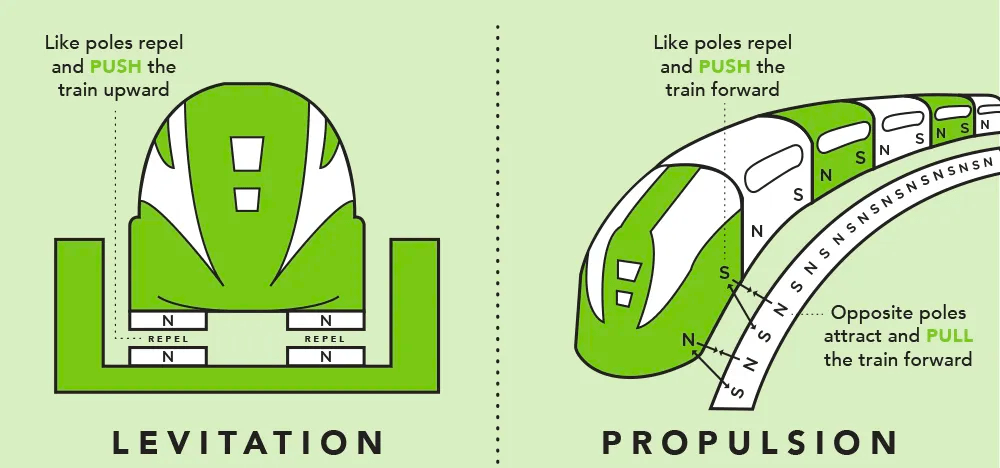
- Hyperloop (5th mode of transportation) is a high-speed train that travels in a near-vacuum tube (which eliminates friction and air drag) potentially allowing the pod to reach speeds of over 1000 kmph.
- Traditional 4 modes → Road, Rail, Water, Air.
- The basic principle behind Hyperloop technology is magnetic levitation which allows the vehicle to be suspended and propelled on a guidance track made with magnets.
- Asia’s first international Hyperloop summit was conducted at IIT-Madras. India’s first hyperloop test track of 450 metres has been completed at the campus.
- Potential routes under study: Mumbai–Pune, Bengaluru–Chennai.
Additive Manufacturing
3D Printing
- Definition: Layer‑by‑layer manufacturing of 3D objects from a digital model.
- It is the opposite of subtractive (traditional) manufacturing, in which an object is created by cutting away at a solid block of material.
- CAD (Computer-Aided Design) software is used for 3D printing.
- Technologies: FDM (Fused Deposition Modeling), SLA (Stereolithography), SLS (Selective Laser Sintering).
- Materials: Plastics, metals, ceramics, bio‑materials, concrete.
- Applications:
- Healthcare → Prosthetics, implants, organ scaffolds.
- Aerospace/Automotive → Lightweight parts, rapid prototyping.
- Construction → 3D‑printed houses (India: Tvasta, IIT Madras).
- Defence → Spare parts, drones.
- Education & R&D → Prototyping, innovation labs.
- Landmark projects:
- 3D‑printed post office (Bengaluru, 2023).
- 3D‑printed houses (IIT Madras, Tvasta).
- Kerala’s first 3D concrete printing lab (2024).
- 3D Printing in Space Tech (Agnikul Cosmos)
- IIT Madras–incubated startup Agnikul Cosmos successfully launched the world’s first rocket with a single-piece 3D-printed engine.
- About Agnibaan SOrTeD
- Full Form: SubOrbital Technological Demonstrator.
- Type: India’s first semi-cryogenic engine-powered rocket.
- Launchpad: Dhanush → India’s first privately developed launchpad at Sriharikota (Andhra Pradesh).
4D Printing
- Definition: Extension of 3D printing where printed objects change shape, properties, or function over time in response to external stimuli (heat, light, water, magnetic field).
- Evolved from 3D printing by adding the dimension of time.
- Core Idea: Uses smart materials (shape‑memory polymers, hydrogels, composites).
- Known as shape-morphing systems, programmable matter, or 4D bioprinting.
- Applications:
- Healthcare → Self‑adjusting stents, drug delivery systems.
- Defence/Aerospace → Self‑repairing structures, adaptive camouflage.
- Construction → Materials that adapt to environment (humidity, temperature).
- Textiles → Smart fabrics that change shape/insulation.
- Recent Breakthrough (India – 2025)
- Indian researchers developed 4D-printed artificial blood vessels → for advanced medical grafts.
- Potential use: Organ transplantation, vascular surgery, regenerative medicine.
3D vs 4D Printing
| Aspect | 3D Printing | 4D Printing |
| Nature | Static object creation | Dynamic, self‑transforming objects |
| Materials | Plastics, metals, ceramics | Smart materials (shape‑memory, hydrogels) |
| Trigger | No change after printing | Responds to stimuli (heat, light, water) |
| Applications | Prototyping, manufacturing | Adaptive healthcare, defence, smart infrastructure |
| Stage | Commercially mature | Emerging, experimental |
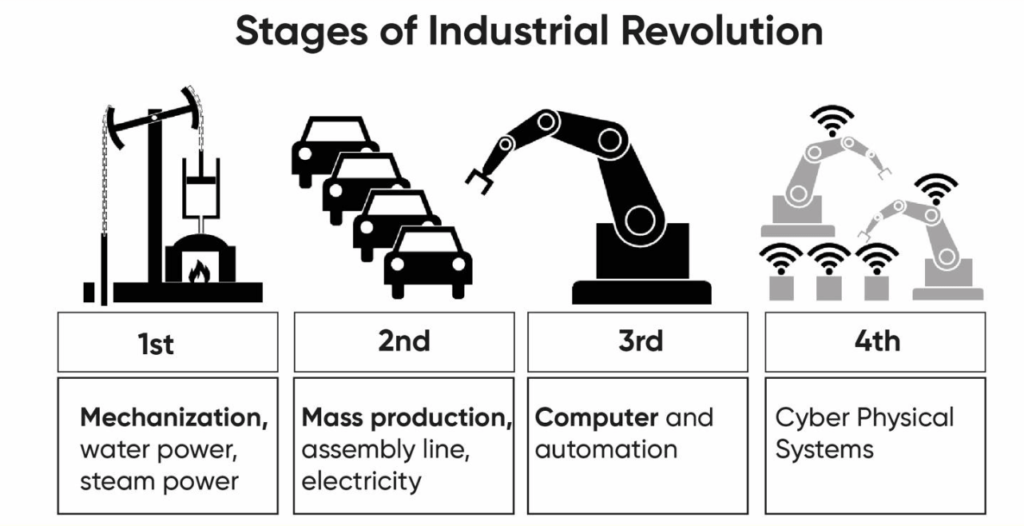
Fourth Industrial revolution (4IR)
- The term was coined by Klaus Schwab, founder of the World Economic Forum (WEF) in 2016.
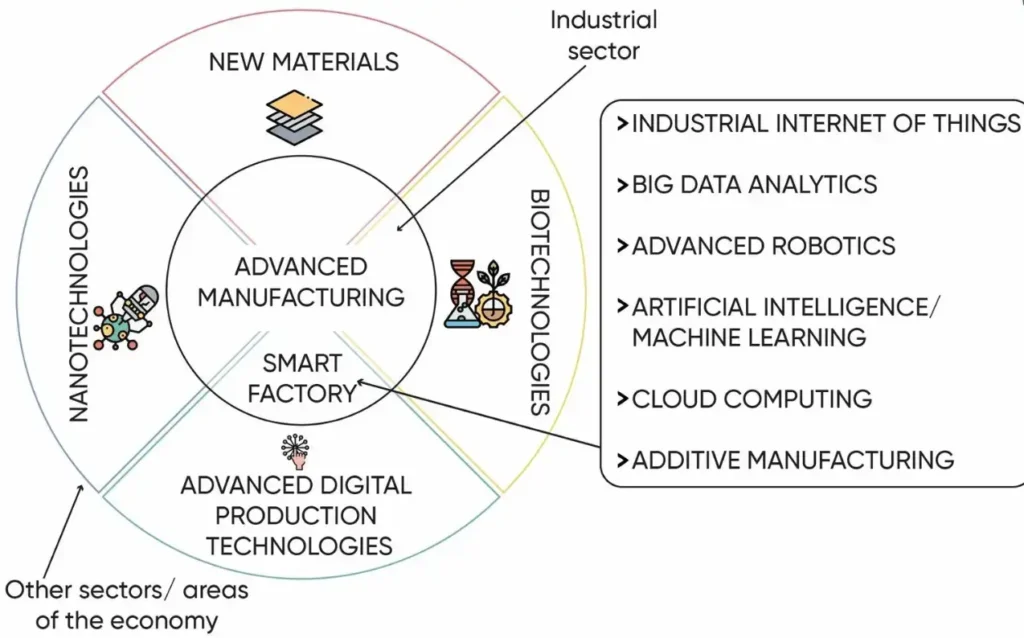
- 4th I.R means the digital transformation of the manufacturing industry by new technologies such as artificial intelligence, additive manufacturing, augmented/virtual reality, and the Internet of Things (IoT), machine learning, 5G technology, biotechnology, and quantum computing .
- It is also used to refer to the concept of “smart factories”– which are fully connected cyber-physical systems that merge the physical and digital aspects.
- Telangana signed an agreement with the World Economic Forum for setting up Centre for Industrial Revolution (C4IR) in Hyderabad.