Space Technology Ecosystem: Space Stations, Debris, Policies and ISRO Institution
Space Technology Ecosystem is an important topic in Science and Technology that encompasses the complete framework of space activities, including space stations, satellites, policies, institutions, and related infrastructure. It highlights how different components work together to support space exploration and utilization. Under this topic, we will study space stations, space debris management, important policies, and institutions related to ISRO, along with their role in advancing space research and applications.
International Space Stations
Modular space station (habitable artificial satellite) and the single largest man-made structure in low Earth orbit.
Serves as a microgravity and space environment research laboratory
Launched in 1998, it is a multinational collaborative project involving five space agencies:
NASA (United States)
Roscosmos (Russia)
JAXA (Japan)
ESA (Europe)
CSA (Canada).
Note: The first government-built space stations were Soviet Salyut (1971) and American Skylab (1973).
ISRO is working to set up Bhartiya Antariksh Station by 2035.
Tiangong
China’s first modular space station in low Earth orbit.
Meaning: Tiangong → “Heavenly Palace”.
Exclusion from ISS(Wolf Amendment, USA) → drove China to build independent station.
Structure & Modules: T-shaped → three main modules:
Tianhe Core Module (launched April 2021)
Wentian Experiment Module (Lab, 2022)
Mengtian Experiment Module (Lab, 2022)
Size: ~66–70 tonnes (≈ 1/5th ISS mass).
A Chinese spaceship “Shenzhou-12” carrying a three-person crew docked with Tianhe-1.
Shenzhou-21 Mission: Chinese crewed spacecraft sent to the Tiangong Space Station.
Launch Vehicle: Long March-2F.
Carried four small mammals (mice) – first biological reproduction study in Tiangong.
Upcoming: Launch of Xuntian Space Telescope (to dock with Tiangong for servicing).
Bharatiya Antariksha Station (BAS)
First Module by 2028 via LVM3 rocket
Full Station by 2035: BAS will become India’s first National Space Laboratory, enabling multidisciplinary microgravity experiments.
Design:
Five modules, ~52 tons, supports 3–4 astronauts
Orbit: 400–450 km altitude
Linked to Gaganyaan: Builds on technologies and expertise from India’s human spaceflight program.
Gaganyaan Programme: Human Spaceflight Mission
India’s first human spaceflight mission.
Objective: Demonstrate India’s capability for human spaceflight in Low Earth Orbit (400 Km).
Mission Plan: Manned spacecraft in LEO for 3-7 days → Followed by safe re-entry and recovery.
8 Missions by 2028 by launching first unit of Bharatiya Antariksh Station (BAS-1) (Updated):
6 unmanned missions: Vyommitra: ‘Female’ robot astronaut, the humanoid developed by ISRO to fly aboard unmanned test missions.
2 manned mission: Crew of 3 members.
Astronauts Announced (Feb 2024): → Awarded ‘Space Wings’ by PM.
Group Captain Prasanth Balakrishnan Nair
Group Captain Ajit Krishnan
Group Captain Angad Pratap
Group Captain Shubhanshu Shukla.
Training Update:
Group Captain Shubhanshu Shukla completed an 18-day mission aboard the International Space Station (ISS) during Axiom Mission 4, becoming the first Indian to stay on the ISS since Rakesh Sharma in 1984.
While Group Captain Prasanth Nair served as backup and continues training at NASA’s Johnson Space Center as part of Gaganyaan preparation.
Human-Rated LVM3: Identified as the launch vehicle for Gaganyaan mission.
Human Space Flight Centre (HSFC)
The hub of ISRO’s future manned missions.
Located at ISRO headquarters in Bengaluru.
SpaDeX Mission (Space Docking Experiment)
Developed by: Indian Space Research Organisation
Mission Type: Twin satellite technology demonstrator for autonomous rendezvous, docking, and undocking in space.
Launch Vehicle:PSLV-C60 | Orbit: ~470 km LEO
Satellites: Two (~220 kg each) → SDX-01 (Chaser) & SDX-02 (Target).
POEM-3 (C58, 2024): 10 payloads, safe de-orbit over Pacific → zero debris.
POEM-4.0 (PSLV-C60 / SpaDeX Mission): 24 payloads incl. robotic arm (precursor to Bharatiya Antariksh Station), debris capture manipulator, green propulsion, plant growth (CROPS). Completed 1,000 orbits before controlled re-entry.
CROPS (Compact Research Module for Orbital Plant Studies) Experiment
Aim: Study cowpea seed germination and growth in microgravity.
Digiantra Research and Technology
A space tech startup founded by Lovely Professional University alumni (Anirudh Sharma & Rahul Rawat) in 2018.
It has developed India’s first In-orbit Space Debris Monitoring and tracking system, which is based on LIDAR (Light Detection and Ranging) technology.
India’s first commercial Space Situational Awareness (SSA) Observatory will be set up in the Garhwal region of Uttarakhand.
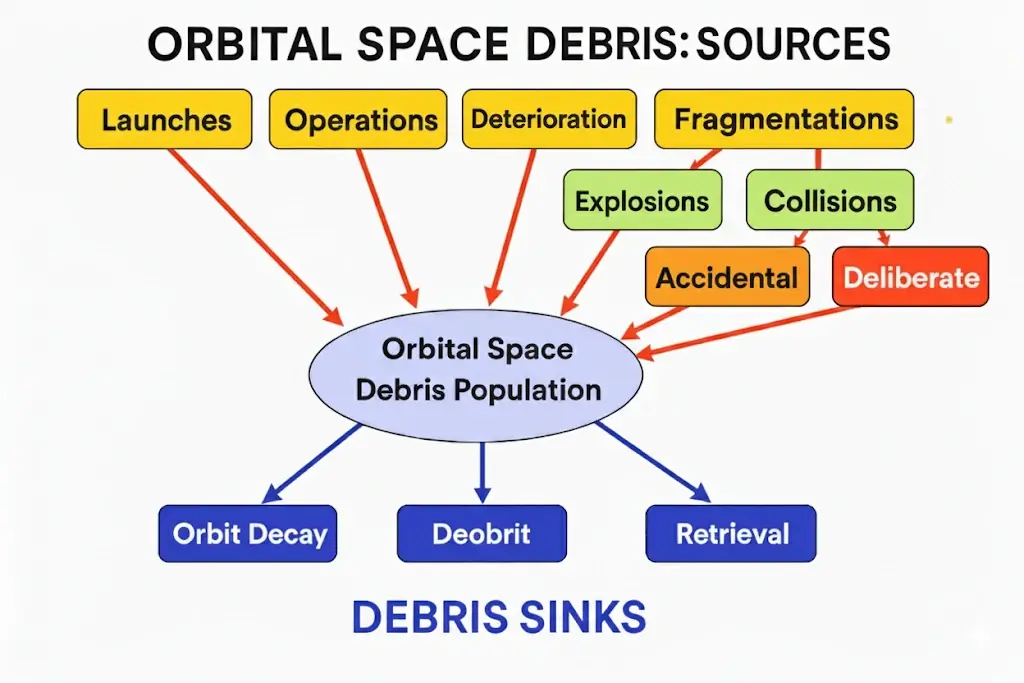
International Initiatives to Deal with Space Debris
Inter-Agency Space Debris Coordination Committee (IADC)
Global forum of 13 major space agencies.
Issues standard guidelines on:
Post-mission disposal
Minimising fragmentation
Reentry rules.
ISRO is a permanent member.
Its 2025/2026 updates emphasize reducing the “25-year deorbit rule” to a 5-year rule for LEO satellites.
UN COPUOS (Committee on Peaceful Uses of Outer Space)
Issued Space Debris Mitigation Guidelines (2007, updated 2019).
They provide a high-level framework for responsible behavior in space.
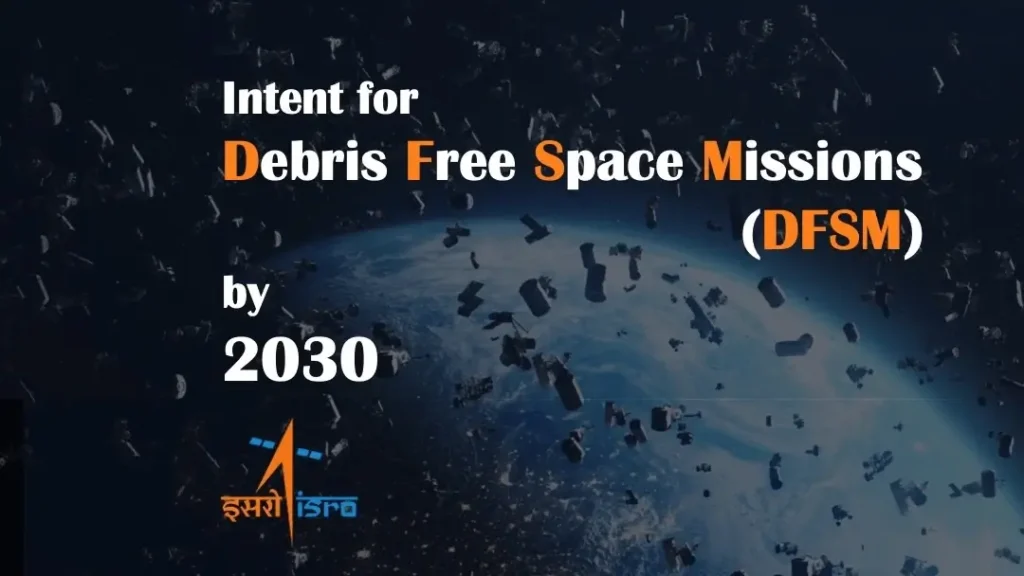
Zero Debris Charter
ESA (European Space Agency).
A bold initiative signed by over 40 organizations (as of 2026) aiming to make all space missions “Debris Neutral” by 2030.
European Space Agency (ESA) – ClearSpace-1 Mission (2026)
World’s first-ever active debris removal mission.
Will capture and deorbit a defunct Vega rocket (using a “pincer” movement with four robotic arms).
Terminator Tape
Developed by Tethers Unlimited (US-based company).
A 230-ft conductive tape deorbits dead satellites by increasing atmospheric drag → To tackle the problem of space debris.
Mission Shakti (DRDO)
Under Mission Shakti, India demonstrated the capability to destroy a satellite in low earth orbit (300 Km) using an anti-satellite (A-SAT) missile in 2019.
India became only the 4th country to conduct an Anti-Satellite missile test after the USA, Russia and China.
Target: Microsat R was a military imaging satellite placed in an orbit 274 km above the Earth surface with an orbital velocity of 7.8km/s.
The weapon used: Prithvi Delivery Vehicle Mark-II (PDV MK-II)
Technology: ‘Hit to kill’
The anti- satellite test involved the ‘hit to kill’ missile technology.
Under the ‘hit to kill’ technology, a missile is shot at the satellite in order to hit and kill the satellite.
The A-SAT missile was based on the exo-atmospheric kill vehicle technology.
Institutional Set Up
Parameter
DRDO
ISRO
Type of Institution
Defence R&D wing
Space agency
Dept./Ministry
Ministry of Defence
Dept. of Space (under PMO )
Establishment
1958 (merger of Technical Development Establishment (TDE – Indian Army) and Directorate of Technical Development & Production (DTDP – Defence Science Organisation)
15 August, 1969 in place of INCOSPAR (which was set up in 1962)
Motto
Balasya Mulam Vigyanam.
Space technology in the service of mankind.
HQ
New Delhi
Bangalore
Antrix Corporation Limited, Bengaluru
Incorporated as a private limited company in September 1992.
It is a wholly owned Government of India Company under the administrative control of the Department of Space.
Marketing arm of ISRO for promotion and commercial exploitation of space products, technical consultancy services and transfer of technologies developed by ISRO.
As the commercial and marketing arm of ISRO, Antrix is engaged in providing Space products and services to international customers worldwide.
NewSpace India Limited (NSIL), Bengaluru
Incorporated on 6 March 2019 (under the Companies Act, 2013).
It is a wholly owned Government of India company, under the administrative control of the Department of Space (DOS).
The commercial arm of ISRO.
NSIL is responsible for promoting and commercializing products and services from the Indian space program.
NSIL’s business areas include building satellites, producing launch vehicles, and marketing space-based services.
Indian National Space Promotion and Authorization Center (IN-SPACe)
Established in June 2020.
HQ – Bopal, Ahmedabad
Type: Autonomous single-window nodal agency under Department of Space (DoS).
Purpose: Facilitate and regulate private sector participation in India’s space activities (post space sector reforms).
Functions:
Authorize NGPEs for building launch vehicles, satellites, and offering space-based services.
Enable sharing of ISRO’s infrastructure with private entities.
Permit establishment of new space infrastructure by NGPEs.
Indian Space Association (ISpA)
Founded in October 2021.
ISpA is an apex non-profit industry body, setup exclusively for the successful collaborative development of the Private Space Industry in India.
ISpA was created to be the single Voice of the Private Space Industry and act as a bridge between the Government and the Private Industry.
ISpA connects industry-industry and industry-government, enabling partnerships and market access.
Authorisation/regulation of space activities is IN-SPACe’s mandate (under DoS), not ISpA’s.
ISpA does not build or launch satellites, but rather cooperates with private companies.
Important Policies Related to Space
Indian Space Policy 2023
The Indian Space Policy 2023 delineates roles in the space sector.
Vision:
Augment space capabilities.
Enable & encourage commercial space presence.
Use space as a tech driver & for allied benefits.
Create an ecosystem for effective space application implementation.
Focus: It emphasizes R&D to keep India at the forefront.
Scope: Applies to all space activities in/from Indian territory + EEZ.
Roles
ISRO → Applied research, tech dev, human spaceflight (e.g., Gaganyaan).
IN-SPACe → Autonomous body to promote, hand-hold, guide, authorise space activities (esp. private sector).
National Geospatial Policy (NGP) 2022
Released by: Department of Science & Technology (DST). (28 Dec 2022)
Objective: Liberalize access to geospatial data, promote innovation, boost citizen services, and strengthen Atmanirbhar Bharat in geospatial tech.
Vision & Goals
Make India a global geospatial leader by 2035.
Build a world-class innovation ecosystem & easy data access.
Support economic growth, governance, and citizen services.
Key Features
High-Resolution Mapping by 2030 (topographical & Digital Elevation Model).
Geospatial Knowledge Infrastructure (GKI) for integrated data.
Liberalized data access → self-certification, no prior approvals.
Promote PPPs, startups, open standards & interoperability.
Create National Geospatial Data Repository.
By 2035:Digital twins for urban centers, sub-surface mapping, Blue Economy data.
National Geographic Information Systems (GIS)/ Geospatial Mission
Ministry: Department of Science & Technology (DST).
Budget: ₹100 crore. (Budget 2025-26)
Anchored in National Geospatial Policy 2022.
Aim:
Develop foundational geospatial infrastructure across India.
Modernize land records, support urban planning, and improve infrastructure design.
India is celebrating its maiden National Space Day [NSpD-2024] on August 23, 2024.
Theme : “Touching Lives while Touching the Moon: India’s Space Saga.“
India became the fourth country to land on the moon and the first to reach its southern polar region on August 23, 2023. To honour this landmark achievement, Hon’ble Prime Minister Shri Narendra Modi announced August 23 as “National Space Day”.
The day is celebrated to honor India’s achievements in space exploration and to look forward to the future of space exploration.
National Space Day theme (2025): From Aryabhatta to Gaganyaan.
“Astronaut Pool” initiative launched.
ISRO National Space Meet 2.0 (22 Aug 2025)
Theme: Leveraging Space Technology & Applications for Viksit Bharat 2047.
Venue: Bharat Mandapam, New Delhi.
Recent Policy Decisions
₹1,000 crore Venture Fund for Space Startups.
100% FDI Allowed in the Space Sector.
VIKRAM3201 and KALPANA3201
First Make-In-India 32-bit Microprocessors for space applications.
Developed by ISRO‘s Vikram Sarabhai Space Centre + Semiconductor Laboratory (SCL), Chandigarh (MeitY).
S Ramakrishnan Centre of Excellence
Centre of Excellence (CoE) for Research in Fluid and Thermal Sciences at IIT-Madras.
Dr. S Ramakrishnan – Former Director, LPSC and VSSC, ISRO.
NE-SPARKS Program (North East Students’ Programme for Awareness, Reach, and Knowledge on Space)
A pioneering initiative to ignite curiosity and foster awareness about space science and technology among students from India’s North Eastern Region (NER).
Aims to bridge geographical and informational gaps.
Provides an immersive experience of India’s space advancements through visits to ISRO Centres in Bengaluru.
Memorandum of Understanding on Cooperation in Space Medicine
Indian Space Research Organisation (ISRO),
Department of Space (DoS) and
Sree Chitra Tirunal Institute for Medical Sciences & Technology (SCTIMST), Department of Science & Technology (DST).
Awards & Recognition to Space Agency ISRO
IAA Von Karman Award 2025 (IAA): Prestigious international award for lifetime achievement/contributions to astronautics.
AIAA Goddard Astronautics Award (AIAA): Honors outstanding contribution to space flight, specifically for the Chandrayaan-3 landing.
Broglio Award (AIAD): International award for excellence in the aerospace sector.
Vigyan Sri Puraskar 2025 & Rashtriya Vigyan Puraskar 2025 (Government of India): Significant national science awards.
Rajbhasha Kirti Award (Second Prize) 2024–25 (Ministry of Home Affairs): Awarded to the Department of Space for best implementation of Official Language Hindi.
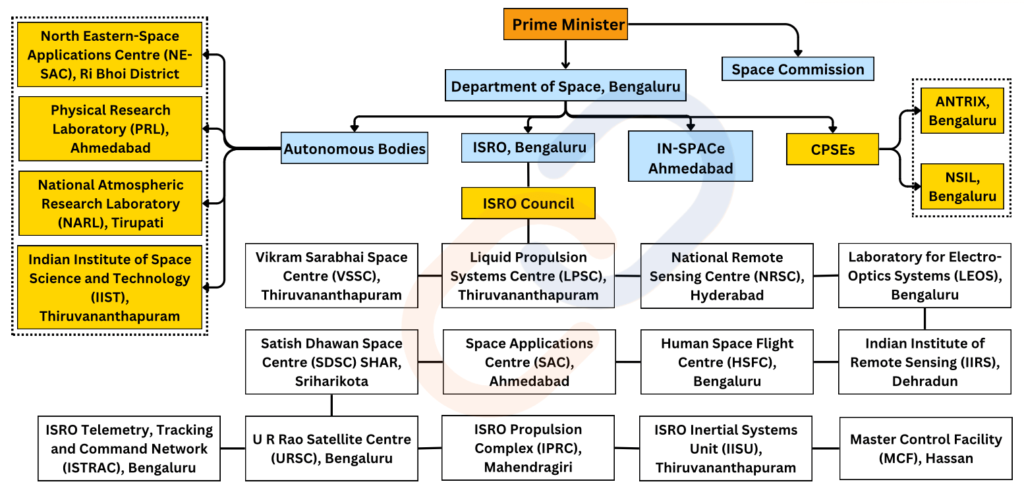
Institutes Related to ISRO
ISRO Centres
Location
Indian Institute of Space Science and Technology (IIST)
Thiruvananthapuram, Kerala
Physical Research Laboratory (PRL)
Ahmedabad, Gujarat
Indian Institute of Remote Sensing (IIRS)
Dehradun, Uttarakhand
National Remote Sensing Centre (NRSC)
Hyderabad (Telangana)
Space Applications Centre (SAC)
Ahmedabad, Gujarat
Liquid Propulsion Systems Centre (LPSC)
Valiamala, Thiruvananthapuram
Vikram Sarabhai Space Centre (VSSC)
Thiruvananthapuram
Satish Dhawan Space Centre (SDSC)
Sriharikota, Andhra Pradesh
Centre for Space Science and Technology Education in Asia-Pacific (CSSTEAP)
Dehradun, Uttarakhand
ISRO Propulsion Complex
Mahendra Giri, Tamil Nadu
North-Eastern Space Applications Centre (NE-SAC)
Umiam, Meghalaya
UR Rao satellite centre (URSC)
Bengaluru
ISRO Related Centers in Rajasthan
ISRO Centres
Location
Western RRSC – Regional Remote Sensing Center
Jodhpur
Solar Observatory
Udaipur
Infrared Observatory
Mount Abu
Regional Remote Sensing Centre-West (RRSC-W)
Location:Jodhpur.
Parent Body:ISRO/NRSC (National Remote Sensing Centre, Hyderabad).
Function: Caters to the needs of the Western region, including Rajasthan, for advanced satellite data processing and geospatial solutions. (SRSAC and RRSC-W often collaborate).
State Remote Sensing Application Centre (SRSAC)
Location:Jodhpur (Main Centre).
Parent Department: Department of Science and Technology (DST), Government of Rajasthan.
Function: Nodal agency for Remote Sensing (RS), Geographic Information Systems (GIS), and Global Positioning System (GPS) applications for natural resource management and infrastructure planning in the state.
A sub-centre of SRSAC was recently opened in Jaipur.