

Painting and Sculpture in India: In the subject of Ancient and Medieval History, painting and sculpture form an integral part of India’s artistic heritage, reflecting religious themes, social life, and cultural values. From the mural paintings of Ajanta to the refined sculptures of the Gupta and medieval temples, these art forms demonstrate remarkable creativity, technical skill, and spiritual expression.
Painting in India
1. Gupta Period Painting
- The best examples are found in the Ajanta Caves and the Bagh Caves of Gwalior.
- Themes: Natural beauty, Buddha and Bodhisattvas, and Jataka stories.
- Features: Rich colors, graceful lines, variety, emotional expression, and imaginative composition.
- Important Examples
- Ajanta Cave 16: Painting of the Dying Princess, Avalokiteshvara, and Yashodhara with Rahul.
- Ajanta Cave 17: Known as the “Chitrasala (Picture Gallery)”; famous for the Mother and Child painting.
- Bagh Caves (9 caves): Depictions of secular life, costumes, hairstyles, and scenes of music and dance.
- Samudragupta’s coins depicting him playing the veena indicate his love for music.
2. Pala School of Art (750–1150 AD)
- Location: Bengal and Bihar (under Pala rule).
- Medium: Buddhist manuscripts on palm leaf (Tadpatra) and parchment (Vajrayana deities).
- Characteristics: Sinuous/wavy lines, subdued backgrounds, solitary figures, simple compositions, and light colors.
- Prominent Artists: Dhimman and Vitapala.
- Style: Harmonious style between sculpture and painting (parallel to the Ajanta tradition).
- Ashtasahasrika Prajnaparamita: The finest specimen of Pala manuscript painting.
- Origin: Nalanda.
- Patron: King Ramapala.
- Period: 11th Century.
- Structure: Comprises 6 illustrated pages and decorated wooden covers.
3. Apabhramsha School of Painting (11th–15th Century)
- Region: Gujarat and Rajasthan (especially Mewar).
- Themes
- Initially Jain religious themes
- Later Vaishnava themes, such as Gita Govinda and romantic subjects.
- Medium
- Initially palm leaves, later paper.
- Colors
- Symbolic colors such as red, yellow, and ochre, and later white and gold.
- Features
- Fish-shaped protruding eyes
- Sharp nose
- Double chin
- Thin faces with rigid expressions
- Women with broad hips and prominent breasts
- Animals and birds depicted toy-like
- Important Texts Illustrated
- Kalpasutra
- Kalakacharya Katha
- Sangrahini Sutra
- Uttaradhyayana Sutra
- In Jain tradition, donating illustrated manuscripts to temple libraries (Bhandars) was considered a religious merit.
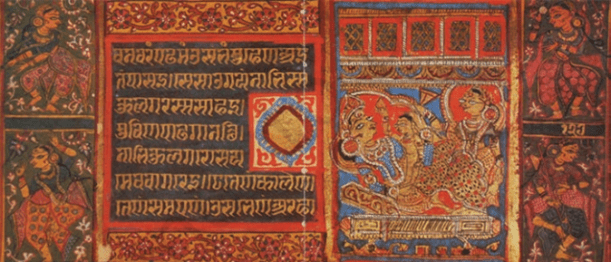
4. Chola Painting
- The evolved form of the Pallava-Pandya tradition.
- Primary Center: Thanjavur.
- Brihadisvara Temple: Religious frescoes influenced by the Ajanta style, depicting Shiva, Kailash, Nandi, etc.
5. Chalukya Painting
- Location: Badami (Vishnu Cave).
- Style: Adopted the Vakataka style.
- Themes: Incarnations (Avatars) of Vishnu and secular life.
- Famous Example: The “Game of Ball” scene from the palace of King Mangalesha (597–609 AD).
6. Vijayanagara Mural Painting
- Early Specimens: Tiruparankunram (near Trichy).
- Hampi – Virupaksha Temple: The ceiling of the Mandapa features the Ramayana, Mahabharata, and dynastic history.
- Famous Scenes: The palanquin procession of Sage Vidyaranya (the Guru of Bukka Raya); incarnations of Vishnu.
- Lepakshi (Andhra Pradesh): Magnificent murals depicting the lifestyles of various nations.
- Stylistic Characteristics:
- Faces shown in profile; figures are 2D (two-dimensional).
- Simple, static lines; compositions arranged in flat sub-sections.
7. Nayaka Mural Painting (17th–18th Century)
- Locations: Tiruparankunram, Srirangam, Tiruvarur, and Chengam (Sri Krishna Temple).
- Themes:
- Episodes from the Ramayana and Mahabharata.
- Krishna-Leela (Divine acts of Krishna).
- Muchukunda legend.
- Shiva (Bhikshatana—the Supreme Mendicant) and Vishnu (Mohini).
- Stylistic Characteristics:
- An expanded form of the Vijayanagara style with regional variations.
- Male figures depicted with slender waists (as opposed to the thick legs seen in Vijayanagara art).
- Profile views with flat backgrounds.
- Attempts to introduce dynamism/movement within the paintings.
- Example: The Nataraja painting of Thiruvalanjuli.
Sculptural art
1. Gupta Sculpture
- The era is characterized by images made of metal, stone, and terracotta.
- Characteristics: Fineness of drapery (clothing), ornate halos (Prabhamandala), distinct hairstyles, specific Mudras and Asanas, spirituality, grace, and complete Indianization.
- Sculptures were crafted according to classical canons.
- Exquisite Masterpieces:
- Sultanganj Buddha: (7.5 feet, copper, now in Birmingham Museum).
- Mathura Mahavira.
- Vishnu of Deogarh/Mathura.
- Varaha of Eran/Udayagiri.
- Ardhanarishvara: (Mathura Museum).
- Note: Complete absence of the nudity and sensuality found in the Kushan period.
- Styles/Centers:
- Mathura: Standing Buddha.
- Sarnath: Seated Buddha (drapery without folds).
- The Sultanganj Buddha was discovered at Sultanganj in Bihar and belongs to the post-Gupta period;
- Mankuwar Buddha (Prayagraj): The only Kushan-influenced Buddha of the Mathura style.
- Shaiva Sculptures:
- Karamdanda: Four-faced (Chaturmukhi) Shiva.
- Khoh: One-faced (Ekamukhi) Shivalinga.
- Bhumra: Shivalinga in the sanctum sanctorum (Garbhagriha).
- Vidisha: Harihara.
- Kartikeya on a Peacock: (Patna Museum).
2. Chola Sculpture
- Sculpture held special significance in temple decoration.
- Exquisite Stone/Bronze/Ashtadhatu Statues: Brahma, Vishnu, Nataraja, and Kings-Queens.
- Numerous bronze icons of Shaiva deities (Parvati, Skanda, Kartikeya, Ganesha).
- Sculpture served as an auxiliary to architecture—extensively used on walls and ceilings.
- Nataraja (Key Features):
- Upper Right Hand: Damru (Creation).
- Upper Left Hand: Fire (Destruction/Pralaya).
- Lower Right Hand: Abhaya Mudra (Protection).
- Lower Left Hand: Pointing toward the raised foot (Path to Salvation/Moksha).
- Dwarf under the foot: Apasmara (Ignorance/Avidya).
- Flying locks: Flow of the Ganges.
- Earrings: Male earring in one ear, female in the other (Ardhanarishvara sentiment).
- Snake: Kundalini Shakti.
- Halo of Light: The Wheel of Time (Kalachakra).

3. Development of Jain Bronze Statues in India
(a) Ancient – Kushan Period:
- Earliest Jain bronze icons;
- nude Tirthankara statues (Chausa, Bihar).
- The wavy hairstyle of Adinatha is famous.
(b) 5th–7th Century: Akota (Gujarat) —
- a massive horde. Created using the ‘lost-wax process’; eyes and crowns were later decorated with silver and copper.
- Also found in Hansi (Haryana), Chausa (Bihar), Tamil Nadu, and Karnataka.
(c) 6th–9th Century (Gujarat/Western India):
- Tirthankaras on thrones; group statues (3–24).
- Statues of Yakshinis/Shasana Devis show Gupta-Vakataka influence.
4. Development of Buddhist Bronze Sculptures in India
(a) Uttar Pradesh–Bihar (Gupta Period, 5th–7th Century)
- Most sculptures depict a standing Buddha in Abhaya Mudra.
- Styles
- Mathura Style: Drapery with visible folds.
- Sarnath Style: Drapery without folds.
- Examples
- Dhansar Khera image (with folds similar to Mathura style).
- Sultanganj Buddha (in Sarnath style).
(b) Maharashtra – Vakataka Period
- Example from Phopnar (Maharashtra).
- Influence of Amaravati style.
- Changes in the monastic robe style.
(c) Bihar–Bengal – Pala Period (9th–12th Century)
- A new style was developed at Nalanda and Kurkihar.
- Revival of Gupta artistic traditions.
- Important Example
- Four-armed Avalokiteshvara in tribhanga posture.
- With the rise of Vajrayana Buddhism, bronze images of Goddess Tara became very popular.
5. Pallava Period Shiva Sculpture
- Dated to the 8th century CE.
- Shiva depicted in the Ardhaparyanka posture.
- The right hand is in Achamana Mudra, symbolizing the drinking of poison.

6. Vijayanagar Sculpture
- Sculpture developed alongside painting during this period.
- Made in both stone and bronze.
- Important Features
- Large statues of rulers such as Krishnadevaraya and Venkat I.
- Life-size bronze statues at Tirupati depicting Krishnadevaraya with his queens, Tirumalamba and Chinnadevi.
- Vijayanagara artisans were highly skilled in bronze casting.



