

Air Defence Systems is an important topic in Science and Technology that focuses on protecting a nation from aerial threats such as aircraft, missiles, drones, and other airborne attacks. These systems use advanced radar, tracking, and interception technologies to detect and neutralize threats. Under this topic, we will study different types of air defence systems, their components, and their role in ensuring national security.
Air Defence System
What are Missile Defence Systems?
- Missile Defence Systems (MDS): Systems to detect, track, intercept, and destroy incoming missiles (ballistic, cruise, air-launched) before they reach their targets.
- India’s Air Defence: Developed a Multi-layered Air Defence Network to protect its airspace from hostile threats.
India’s Multi-layered Air Defence Network
India’s multi-layered air defence network is structured into several tiers based on range and altitude:
- The Outer Shield (Ballistic Missile Defence – BMD): Developed indigenously by DRDO, it features two interceptor systems:
- Prithvi Air Defence (PAD): Uses Pradyumna missiles for high-altitude (50-80 km) exo-atmospheric interception of longer-range missiles.
- Advanced Air Defence (AAD): Uses Ashwin interceptors for lower-altitude (15-30 km) endo-atmospheric interception.
- India is the 4th country with a working BMD system (following US, Russia and Israel).
- Long-Range Air Defence: Primarily uses the S-400 Triumph (SA-21 Growler), imported from Russia, with a range of up to 400 km to destroy various aerial targets.
- Medium-Range Air Defence:
- Handled by MRSAM (Medium Range Surface to Air Missile) / Barak-8, jointly developed by India (DRDO) and Israel (IAI). It provides 360-degree defence with a range of 70-100 km.
- Akash-NG.
- Short-Range Air Defence: Includes:
- Akash Missile System: 100% indigenous, with a range of 25-30 km (and a new variant, Akash-NG, up to 80 km), using the ‘Rajendra’ radar.
- SPYDER: Imported from Israel, a quick-reaction system (QRSAM) for low-flying threats within 15 km.
- SAMAR (Surface to Air Missile for Assured Retaliation): An indigenous innovation by the IAF that repurposes old Russian air-to-air missiles for ground launch.
- Very Short-Range Air Defence (VSHORAD): The final line of defence, often Man-Portable Air-Defence Systems (MANPADS).
- Currently uses the imported Igla-S (from Russia) with a range up to 6 km.
- DRDO is also developing an indigenous VSHORADS to replace the older systems.
Note: Aug 2025: DRDO conducted first successful flight-tests of the Integrated Air Defence Weapon System (IADWS) under Mission Sudarshan Chakra.
Akashteer – India’s Indigenous Automated Air Defence System
- An indigenous, automated Air Defence Control and Reporting System developed for the Indian Army.
- Developed by: BEL (Bharat Electronics Limited).
- Part of India’s C4ISR architecture (Command, Control, Communications, Computers, Intelligence, Surveillance and Reconnaissance).
- Key Features
- Function: Detects, tracks & neutralises aerial threats (aircraft, drones, missiles).
- Technology: Integrates multiple radar systems (e.g., REPORTER, 3D Tactical Radars and Akash Weapon System radars).
- Mobility: Vehicle-mounted for field deployment in active war zones.
- Integration: Seamlessly links with IAF’s IACCS and Navy’s TRIGUN systems.
- Successfully used during Operation SINDOOR (May 2025) to neutralize missile/drone attacks from Pakistan.
Project Kusha
- Goal: To deploy a Long-Range Air Defence System by 2028-29 (Comparable to Russia’s S-400).
- Aim: To develop India’s own Long-Range Surface-to-Air Missile (LR-SAM).
- Project by DRDO.
- It is being referred to as ‘Desi S- 400’.
- Range – About 400 Km
- The LR-SAM is a three-layered (150 km, 250 km, 350 km) long-range SAM defence system that is capable of striking down enemy aircraft and missiles from the surface.
VSHoRAD : Very Short-Range Air Defence System
- Man-Portable Air Defence System (MANPADS) developed by DRDO.
- Enhances India’s defence against low-flying aerial threats (e.g. helicopters, UAVs).
- Key Features
- Type: Short-range, lightweight, and portable surface-to-air missile.
- Range: Up to 8 km.
Global Air Defence Systems
1. S-400 Triumf ( SA-21 Growler)
- Mobile, Long Range Surface-to-Air (SAM) Missile System.
- Developed by Russia (Almaz Central Design Bureau).
- Nickname: “Sudarshan Chakra” in Indian military – symbolizing swift, precise, and powerful destruction, like Lord Vishnu’s divine weapon.
- Key Features
- Range: Up to 400 km.
- Altitude: Up to 30 km
- Multi-target Capability: Can engage up to 36 targets simultaneously.
- Missile Types: Supports 4 different missile types for layered defence.
- Targets: Aircraft, UAVs, cruise missiles, ballistic missiles.
- India signed a deal in 2018 to procure 5 units under a $5.43 billion contract.

2. National Advanced Surface-to Air Missile System (NASAMS)-II:
- An US-developed ground-based air defense system designed to counter threats like cruise missiles, aircraft, and drones.
- It will complement existing Russian (Pechora) and Israeli (Spyder) defence systems.
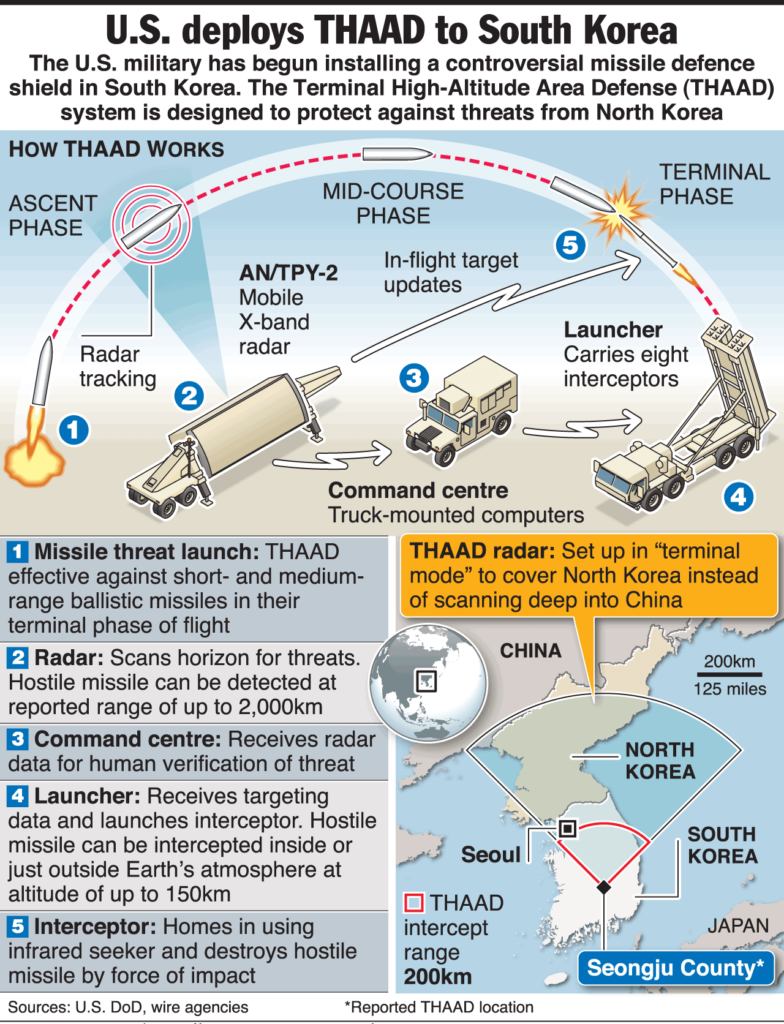
3. THAAD (The Terminal High Altitude Area Defence)
- It is a highly effective, combat proven American defence system against short, medium and intermediate-range ballistic missile threats.
- Designed and manufactured by US Company
Lockheed Martin.
- It is the only US system designed to intercept targets inside and outside the atmosphere.
- It is interoperable with other ballistic missile defence systems.
- Highly mobile and deployable worldwide.
4. HQ – 9 (Hong Qi 9)
- Long range surface-to-air defence missile.
- Developed by China.
- Range – 200 km.
5. Iron Dome
- It is Israel’s surface-to-air defence system that comprises radar and interceptor missiles that are capable of tracking and neutralising any rockets or missiles.
- Developed by Rafael Advanced Defense Systems and Israel Aerospace Industries.
- Range – Upto 70 km (Short range).
6. Patriot : USA
7. MEADS ( Medium Air Defence System ) : USA, Germany and Italy.
8. Barak 8 : Israel and India.
9. Golden Dome
- US President announced a $175 billion Golden Dome missile defence shield for the United States inspired by Israel’s Iron Dome.
- A ground & space-based multi-layered missile defence system.
- Designed to safeguard the US from long-range & space-launched missiles.
- Will integrate with existing systems (Patriot, THAAD, Aegis BMD, GMD).
Other Weapon Systems of Indian Army
Important Tanks of India
- Vijayanta
- First indigenous battle tank of the Indian Army.
- Operational range is 530 km.
- Production continued at the Heavy Vehicles Factory in Avadi (Tamil Nadu).
- Bhishma (T-90)
- Customized variant of the Russian T-90S tanks manufactured in India (By Heavy Vehicles Factory, Avadi, Chennai).
- Range – upto 5 km
- Ajeya (T-72)
- Customized variant of the Russian T-72MI tanks manufactured in India (By Armoured Vehicles Nigam Limited).
- Arjun MBT (Main Battle Tank)
- It is India’s indigenous MBT.
- It is a state-of-the-art tank with superior fire power, high mobility and excellent protection.
- It is developed by DRDO under ‘Arjun MBT Project’ which was started in 1972.
- It is equipped with an indigenously developed 120mm main rifle gun and Fin Stabilised Armour-Piercing Discarding Sabot (FSAPDS) ammunition.
Project Zorawar (Indian Light Tank)
- Aim : To Develop an indigenous light tank for rapid deployment in varied terrains, especially high-altitude operations.
- Developed by DRDO and Larsen & Toubro (L&T).
- Weight : 25 tons
- Capabilities: Air-transportable, high-angle firing, limited artillery role → boosts tactical & operational mobility.
- Name Origin: After Zorawar Singh Kahluria, 19th-century Dogra general under Raja Gulab Singh of Jammu, known as the “Conqueror of Ladakh”.
- Strategic Context: Developed to counter China’s deployment of Type-15 light tanks in high-altitude areas like Ladakh.
Assault Rifles
- India’s Indigenous Assault Rifles
- INSAS (Indian National Small Arms System)
- Multi Calibre Individual Weapon System (MCIWS)
- Ugram Assault Rifle
- Type: Indigenous assault rifle for armed forces, paramilitary, and state police.
- Developers: DRDO’s Armament Research & Development Establishment (ARDE) + Dvipa Armour India Pvt. Ltd. (Hyderabad).
- Purpose: Replace the ageing INSAS rifle in service with the Indian Armed Forces.
- Dhanush Artillery Gun
- It is an indigenously upgraded variant of the Swedish Bofors gun imported in the 1980s.
- Range : 36-38 km (Long range).
- Foreign Assault Rifles
- Heckler & Koch G36
- Heckler & Koch assault rifles are manufactured in Germany.
- T91
- The T91 is a gas-operated, magazine-fed, assault rifle produced by the National Defense in the Republic of China (Taiwan).
- Tikka T3x
- The Tikka T3x is a bolt-action rifle series manufactured by Sako in Finland.
- Heckler & Koch G36
Other Ammunitions
K9 Vajra
- It is a 155 mm, 52-calibre tracked self-propelled howitzer.
- Joint Venture of India (Larsen and Toubro) and South Korea (Hanwha Defense) based on S. Korean K9 Thunder.
- K9 gun has been developed under the ‘Buy Global’ programme of the Defence Procurement Procedure (DPP).
M 777 Howitzer
- Ultra light howitzers procured from the USA.
- Range : 30 km.
Long-Range Glide Bomb ‘Gaurav’
- Type: Long-range precision-guided bomb.
- Developer: DRDO (with Research Centre Imarat, Hyderabad, Armament Research and Development Establishment, Pune and Integrated Test Range, Chandipur).
- Industry Partners: Adani Defence, Bharat Forge, MSMEs.
- Purpose:
- Stand-off strike to neutralise high-value targets while minimising exposure of launch platform;
- Avoids enemy air defence zones.
- Tested from: Su-30MKI
- Range: 30–150 km (demonstrated about 100 km).
- Weight: Gaurav: Winged, 1000 kg.
- Guidance: Inertial Navigation + Satellite + Digital Control.
- Significance: Boosts indigenous smart munitions, complements Spice-2000, SAAW.
Long-Range Glide Bomb Gautham
- Type: Non-winged, 550 kg glide bomb.
- Range: Initial range of 30 km and is designed to be extended to 100 km in the future.
Airforce- Fighter Jet, Aircraft and Helicopter
Fighter Jets
Gen | Details |
Ist Gen. |
|
2nd Gen. |
|
3rd Gen. |
|
4th Gen. |
|
4.5th Gen. |
|
5th Gen. |
|
Advanced Medium Combat Aircraft (AMCA)
- India’s fifth-generation multirole fighter jet.
- A medium weight, twin engine fighter aircraft.
- Nodal agency for executing the programme and designing: Aeronautical Development Agency (ADA) (DRDO).
- Manufacturing agency: Hindustan Aeronautics Limited (HAL).
- Advanced stealth features such as radar absorbing material to avoid detection by enemy radar.
- Stealth mission enables Suppression of Enemy Air Defense (SEAD), Destruction of Enemy Air Defence (DEAD) and precision strike.
Light Combat Helicopter (LCH)
The LCH is specifically designed for high-altitude conditions and will be deployed in areas like Ladakh, making it suitable for mountain warfare.
LCH Prachand
- India’s first indigenous multi-role combat helicopter (including both air-to-ground and air-to-air combat).
- Developed by HAL (Hindustan Aeronautics Limited).
- Range – 700 Km
- The LCH is the only attack helicopter in the world which can land and take off at an altitude of 5,000 meters with a considerable load of weapons and fuel.
- This is enabled by the twin HAL-Turbomeca Shakti engines (French-origin), which are optimized for high-altitude performance, along with its lightweight, aerodynamic design.
- The LCH project was sanctioned in 2006 with the Indian Army joining in 2013.
MH-60R (Romeo) Seahawk Helicopter
- Type: Advanced maritime multi-mission helicopter.
- Role: Anti-Submarine Warfare (ASW), Anti-Surface Warfare (ASuW), Search & Rescue (SAR), surveillance, and logistics.
- Developed By: Lockheed Martin – Sikorsky
- Induction: Supplied to Indian Navy by US Navy under FMS (Foreign Military Sales).
- Deployment: Operates from frigates, destroyers, cruisers, and aircraft carriers.
- Capable of day/night & all-weather operations.
- Significance
- Enhances long-range maritime surveillance & strike capability.
- Boosts Indian Navy’s ASW capabilities against modern submarines in IOR.
- Current Update: The first squadron INAS 334 of MH-60R Seahawk helicopters was commissioned at INS Garuda naval air station in Kochi in March 2024, marking a significant boost to India’s maritime capabilities.
Apache Helicopters
- Equipped with laser-guided Hellfire missiles.
- Modernized version of the AH-64 platform.
- Precision attack capability, including standoff ranges, enables operations in hostile airspace with ground threats.
- Developed by Boeing Defense (USA).
Light Utility Helicopter (LUH)
- The LUH is a three-ton class new generation single engine indigenously designed helicopter and can operate at 20,000 feet above sea level.
- The LUH can transport six passengers at a time and can fulfil multiple roles including transportation, troop movement, and civil operations.
- Maximum speed – up to 240 km/h.
- Maximum take of weight – 3150 kg.
HAL Chetak, HAL Cheetah and HAL Dhruv, HAL Cheetal
- Provide logistical support for the Indian Army in remote and inaccessible areas.
HAL Rudra
- Two-engine helicopter designed for close air support of ground forces and transporting personnel.
Chinook Helicopter
- Acquired from USA under Foreign Military Sales (FMS) program.
- Will replace the Mi-26 heavy-lift helicopters of IAF.
- Importance: Airlift artillery, light armoured vehicles, troops and supplies to difficult Himalayan mountainous terrains.
What is Air-to-Air Refuelling?
- A process where fuel is transferred from one aircraft (tanker) to another in mid-air
- Enhances operational range, mission flexibility, and combat endurance.
- The Ilyushin Il-78 (Russian origin) is the dedicated air-to-air refuelling aircraft of the Indian Air Force (IAF).
- NATO reporting name: Midas.
- India is exploring Airbus A330 MRTT and Boeing KC-46 Pegasus with modern multi-role tankers.
Aircraft Hansa-3 NG
- Hansa-3 NG is India’s first indigenous, production-ready pilot trainer aircraft.
- Type: Two-seater, next-generation trainer aircraft.
- Purpose: Designed for training pilots for Private Pilot License (PPL) and Commercial Pilot License (CPL).
- Developer: CSIR–National Aerospace Laboratories (NAL), located in Bengaluru.
Unmanned Aerial Vehicle (UAVs)/Drones
- An unmanned aerial vehicle (UAV) or unmanned aircraft system (UAS), commonly known as a drone, is an aircraft with no human pilot, crew, or passengers on board, but rather is controlled remotely or is autonomous.
ABHYAS – HEAT
- Abhyas is a High-speed Expendable Aerial Target (HEAT).
- Developed at Aeronautical Development Establishment (ADE) of DRDO.
- Production – Hindustan Aeronautics Limited (HAL) & Larsen & Toubro (L&T).
- It offers a realistic threat scenario for practice of weapon systems.
- Abhyas is designed for autonomous flying with the help of an autopilot.
- Abhyas has RCS, Visual, and IR augmentation systems required for weapon practice.
An expendable aerial target is a low-cost, replaceable drone or Unmanned Aerial Vehicles (UAVs) that is used to simulate aerial threats and enable military training, testing, and evaluation activities.
Major Indian UAVs / Drones
| UAV Name | Type | Developer(s) | Role / Use | Key Features |
| Abhyas (HEAT) | High-speed Expendable Aerial Target (HEAT) | DRDO–ADE | Simulated aerial target for weapon testing & training | RCS, Visual & IR signature, autonomous flight |
| Tapas-BH (Rustom-II) | MALE UAV (Medium-Altitude, Long Endurance) | DRDO–ADE | Intelligence, Surveillance, Reconnaissance (ISR) | Endurance: about 24 hrs, EO/IR (elctro-optical/infrared) sensors, SATCOM |
| Rustom-1 | Tactical UAV | DRDO–ADE | Short-range ISR | Range: 250 km, Flight endurance: 12–15 hrs |
| Archer-NG | UCAV (Combat + Surveillance) | DRDO–ADE + Private partners | Armed surveillance, precision strikes | Weaponized, Satellite control, AESA radar |
| Nishant | Tactical UAV (Catapult-launched) | DRDO–ADE | Real-time battlefield surveillance | Rail-launch, Parachute recovery, EO payload |
| Panchi | Wheeled version of Nishant | DRDO–ADE | ISR with runway-based takeoff/landing | Conventional landing gear (vs rail launch) |
| SWiFT (Stealth Wing Flying Testbed) | Stealth UAV (Prototype for Ghatak UCAV) | DRDO | Technology demonstrator for autonomous stealth strike | Flying-wing design, Jet-powered |
| Ghatak (AURA) | Stealth UCAV | DRDO + ADA | Autonomous precision strike capability | Stealth, Jet engine, Internal weapons bay |
| Raven (by Adani-Elbit) | Mini UAV | Private sector | Tactical surveillance, man-portable system | Lightweight, Quick deploy |
Foreign Drones/UAVs
Heron |
|
MQ-9B Predator |
|
Integrated Drone Detection & Interdiction System (Mark-2):
- Advanced indigenous counter-drone platform developed by DRDO–CHESS.
- Purpose: Detect, track, and neutralise hostile drones (surveillance, weaponised, swarm attacks) at borders and critical sites.
- Key Features:
- 10 kW High-Energy Laser: Destroys drones up to 2 km (double Mark-1 range).
- Multi-Sensor Suite: Radar, EO/IR, RF detectors, and AI-based classification.
- Dual Kill Mechanism: Hard-Kill (Laser destruction) + Soft-Kill (RF jamming, GNSS spoofing).
- Mobility: Vehicle-mounted for quick deployment.
- Future Readiness: Compatible with upcoming 30 kW laser systems (range up to 5 km).
Aircraft Classification by Role
Category | Aircraft Examples | Role |
Fighter |
| Air superiority, strike |
Transport |
| Troop & cargo movement |
Refueller |
| Mid-air refuelling |
AWACS/Surveillance |
| Radar coverage, command |
Trainer |
| Pilot training |
Helicopters |
| Utility, attack, rescue, logistics |
UAVs & Drones |
| Reconnaissance, surveillance, strike |
Indian Navy
Submarines
Submarine Classification
| Abbreviation | Propulsion Type | Purpose/Role | Indian Examples |
| SSK – Submersible Ship (Killer) | Diesel-Electric (Conventional) | Attack/Hunter-Killer (Limited underwater endurance, reliant on Air-Independent Propulsion (AIP) for extended dives). | Shishumar-class (INS Shishumar & INS Shalki), Sindhughosh-class (INS Sindhuvir), Kalvari-class (Scorpene). |
| SSN – Submersible Ship (Nuclear) | Nuclear Reactor | Attack/Hunter-Killer (Fast, virtually unlimited underwater endurance and range). | INS Chakra (Leased, now returned). |
| SSBN – Submersible Ship (Ballistic, Nuclear) | Nuclear Reactor | Strategic Deterrence (Carries Submarine- Launched Ballistic Missiles – SLBMs; Forms the Sea-Based Leg of the Nuclear Triad). | INS Arihant-class (INS Arihant, INS Arighaat). |
Project 75
- It was initiated in 1997, which is part of the Indian Navy’s 30 year plan for indigenous submarine construction.
- Six Kalvari-class (Scorpene-class) diesel-electric submarines are being constructed under this project.
- INS Kalvari
- INS Khanderi
- INS Karanj
- INS Vela
- INS Vagir
- INS Vagsheer (6th submarine; named after a sand fish, a deep sea predator of the Indian Ocean).
- Developed by Mazagon Dock Shipbuilders Ltd. (MDL), Mumbai.
- Features advanced stealth features and Air-Independent Propulsion (AIP) which allows them to stay submerged longer than normal diesel submarines.
- Transfer of technology from the Naval Group, France.
Project 75 (I)
- It is a follow-up and improvement over Project 75.
- The initiative envisages new SSK submarines with fuel cells and Air-Independent Propulsion System (AIP) for the Indian Navy.
Submersible Ship Nuclear (SSN) of India
- SSNs are attack submarines of India.
- They are propelled by nuclear power.
- They are capable of launching conventional weapons (not nuclear weapons) like torpedoes and cruise missiles.
- Example : INS Chakra
- Leased from Russia.
- 3 variants : INS Chakra I, INS Chakra II, INS Chakra III.
- In 2019, India and Russia signed an agreement for leasing of the Akula class nuclear powered submarine Chakra III for $3 billion for at least 10 years.
- Powered by 190 MW nuclear power.
- Expected to be delivered in 2026 or later.
Nuclear-powered ballistic missile submarines (SSBNs)
- Arihant class SSBNs to be built under the Advanced Technology Vessel (ATV) project.
- Built by the Indian Navy’s Ship Building Centre, Visakhapatnam.
- INS Arihant
- India’s first indigenous nuclear-powered ballistic missile submarine (SSBN).
- Inducted into the Indian Navy in 2016 (became fully operational in 2018).
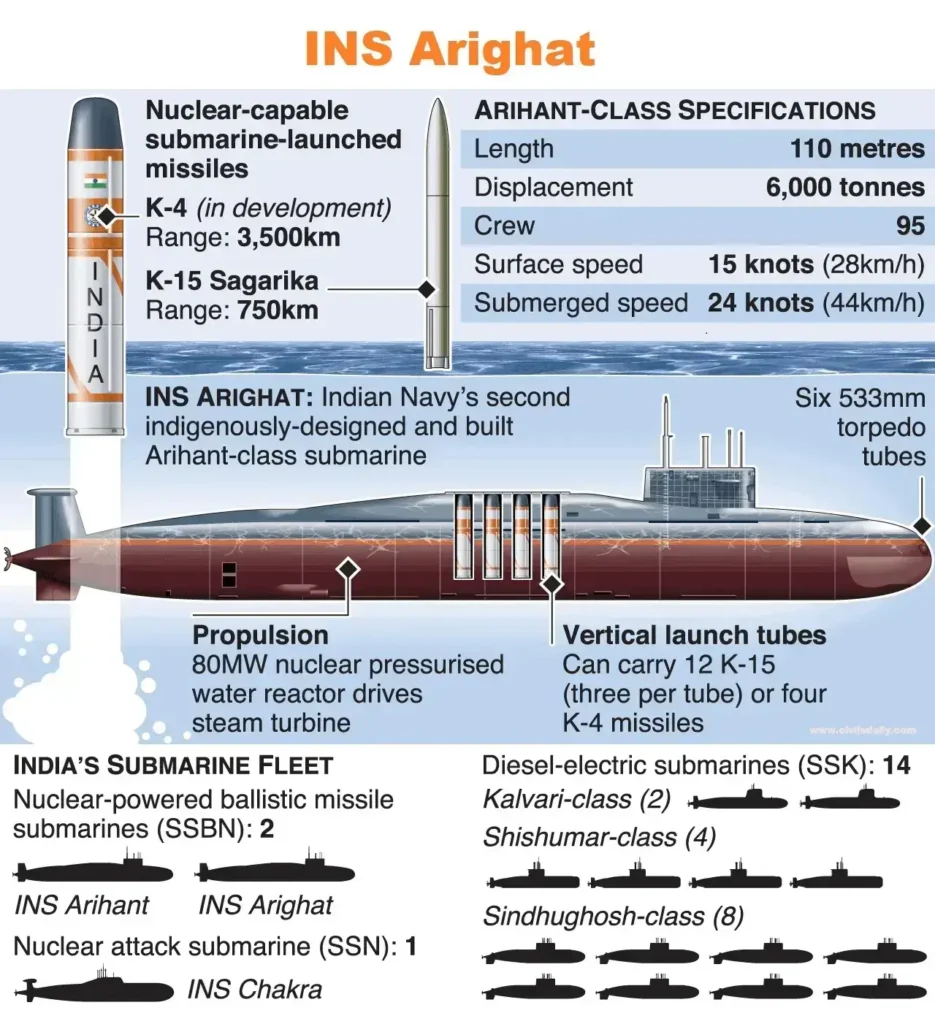
- INS Arighaat (S-3)
- India’s second indigenously built nuclear-powered ballistic missile submarine (SSBN). (Arihant class)
- It will strengthen the country’s ‘nuclear triad’ – the capability to fire nuclear weapons from the land, air and sea (by enabling second-strike capability).
- Powered by 83 MW Pressurised light-water nuclear reactor.
- Equipped with 12 Sagarika SLBMs ( K-15) (Range 750 km) or 4 of the under-development K-4 missiles.
- Displacement capacity 6000 tonnes.
- INS Aridhaman (S-4)
- India’s third indigenous SSBN (to be commissioned).
Aircraft Carrier
- In initial days India didn’t have its own aircraft carrier. It bought aircraft carriers from friendly countries. These are:
- INS Vikrant
- 1st aircraft carrier of India purchased from UK.
- Decommissioned in 1997 after serving for 37 years.
- Played important role in the 1971 India-Pakistan war.
- INS Viraat (HMS Hermes)
- 2nd and the longest serving aircraft carrier of India.
- Purchased from UK.
- Decommissioned in 2017 after serving for 56 years.
- INS Vikramaditya (Admiral Gorshkov/Baku Series)
- 3rd aircraft carrier of India purchased from Russia (Inducted to the Indian Navy in 2013).
- Currently in service.
- INS Vikrant
Indigenous Aircraft Carriers of India
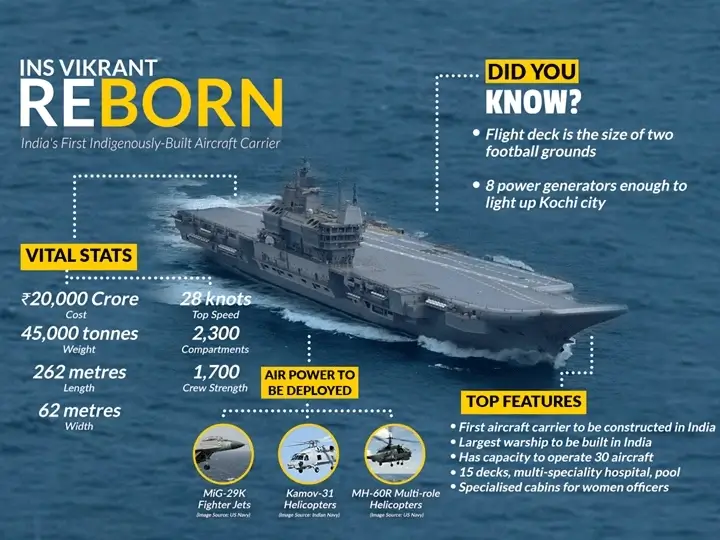
- INS Vikrant : India’s First Indigenous Aircraft Carrier
- Designed by the Indian Navy’s Directorate of Naval Design.
- Developed by Cochin Shipyard Ltd.
- A Public Sector Shipyard under the Ministry of Ports, Shipping and Waterways.
- 76% indigenous content.
- Commissioned in the Indian Navy in 2022.
- Capacity : 43000 tonnes (7th largest in the world)
- It uses the STOBAR (Short Take-Off but Arrested Recovery) method to launch and recover aircraft.
- Motto: “Jayema Sam Yudhi Sprdhah” which is taken from Rig Veda and is translated as “I defeat those who fight against me”.
- 262 meters long. Its design prioritizes maneuverability with a top speed of 28 knots.
- It can operate an air wing of 30 aircraft comprising MiG-29K fighter jets, Kamov-31, MH-60R multi-role helicopters, in addition to indigenous Advanced Light Helicopters and Light Combat Aircraft (Navy).
- INS Vishal : India’s second Indigenous Aircraft Carrier
- Capacity : 65000 tonnes (India’s largest)
- In developing stage
- The USA is providing technical collaboration for its development.
Other Important Vessels of Indian Navy
Destroyers
- Destroyers are fast, highly maneuverable, and heavily armed warships designed to escort larger vessels and defend them against short-range attackers.
- Project 15A (Kolkata Class)
- Indigenous stealth guided-missile destroyers.
- 3 Ships: INS Kolkata, INS Kochi, INS Chennai.
- Project 15B (Visakhapatnam Class)
- Aim: To build the advanced variants of Kolkata class destroyers as Visakhapatnam class destroyers (total 4 – often named after major Indian port cities).
- INS Visakhapatnam
- INS Mormugao
- INS Imphal
- Raksha Mantri Rajnath Singh commissions stealth guided missile destroyer INS Imphal in Mumbai on 26 Dec. 2023.
- First warship named after a Northeast city (Imphal, Manipur).
- First Indian naval ship with dedicated accommodation for women officers & sailors.
- PASSEX with US Navy (2025).
- INS Surat (Expected in 2026).
- Constructed by Mazagon Dock Shipbuilders Limited (MDSL) in Mumbai.
- Aim: To build the advanced variants of Kolkata class destroyers as Visakhapatnam class destroyers (total 4 – often named after major Indian port cities).
Frigates
- Frigates are medium-sized warships, generally slower and less heavily armed than destroyers, used primarily to protect other ships and for anti-submarine warfare.
- Project 17 (Shivalik Class): India’s first multi-role stealth frigates.
- Project 17A or 17 Alpha (Nilgiri Class)
- Launched by the Indian Navy in 2019.
- Aim: To construct a series of stealth guided-missile frigates (total 7) (Nilgiri class)
- INS Nilgiri
- INS Udaygiri
- INS Himgiri
- INS Taragiri (Recently, Indian Navy has received INS Taragiri)
- INS Dunagiri
- INS Vindhyagiri
- INS Mahendragiri (Launched by Sudesh Dhankhar on 1 Sep., 2023).
- Constructed by: 4 ships by Mazagon Dock Shipbuilders (MDL) and 3 ships by Garden Reach Shipbuilders & Engineers (GRSE).
- The ship features a stealth design incorporating radar-absorbent coatings and low-observable characteristics, making its approach difficult for enemies to detect. Additionally, it minimizes the ship’s infrared signature.
INS Tamal (F 71)
- Stealth Multi-Role Frigate (Project 1135.6 – Tushil Class).
- Commissioned: 01 July 2025 at Yantar Shipyard, Russia.
- 8th ship in Project 1135.6; 2nd ship in Tushil Class.
- Joint Indo-Russian collaboration
- 51st warship built under Indo-Russian cooperation (in 65 years)
- Built in Russia but with 26% indigenous components (e.g., BrahMos, Humsa-NG sonar).
- Equipped for all dimensions: air, surface, underwater & electromagnetic.
INS Teg
- A stealth frigate of the Indian Navy.
Corvettes
- Corvettes are small, fast warships, typically used for coastal defense and quick strikes.
- Project 28 (Kamorta Class)
- Project 28 was approved in 2003.
- Aim: To build four indigenous ASW corvettes (Kamorta class)
- INS Kamorta
- INS Kadmatt
- INS Kiltan
- INS Kavaratti
- Designed by the Indian Navy’s Directorate of Naval Design and built by Garden Reach Shipbuilders & Engineers (GRSE) in Kolkata.
Anti-Submarine Warfare Shallow Water Craft (ASW-SWC)
- Context: Indian Navy inducted ‘Androth’, the second Anti-Submarine Warfare Shallow Water Craft (ASW-SWC), under the Aatmanirbhar Bharat initiative.
- Type: Indigenously built ASW-SWC, second in the 8-ship Arnala-class series.
- Arnala class Ships: INS Arnala, INS Anjadip, INS Amini, INS Agray, INS Androth, INS Akshay, INS Azhikkal, and INS Ajay.
- Purpose: Coastal security, anti-submarine patrols, and shallow-water operations (especially around Lakshadweep).
- Built By: Garden Reach Shipbuilders & Engineers (GRSE), Kolkata.
- Key Features:
- Propulsion: Diesel engine + waterjet combination (first in Indian Navy).
- Weapon Systems: Indigenous lightweight torpedoes and ASW rockets.
- Surveillance: Advanced sonar and sensors.
- Indigenous Content: >80% made in India.
Amphibious Warfare Ships
- Transport troops, tanks, and helicopters onto hostile shores.
- INS Jalashwa:
- Procured from the United States (formerly USS Trenton).
- The Indian Navy’s only Landing Platform Dock (LPD).
- Heavily used for disaster relief and evacuation (e.g., Operation Samudra Setu).
Sandhayak-class Hydrographic Survey Vessels
- Indigenously built Survey Vessel (Large) for hydrographic mapping.
- Builder: Garden Reach Shipbuilders & Engineers (GRSE), Kolkata (80% indigenous content).
- The Four Ships of the SVL Project
- INS Sandhayak (The lead ship, recently commissioned)
- INS Nirdeshak
- INS Ikshak (Means ‘Guide’ or ‘One who sees’)
- 3rd ship – commissioned in November 2025.
- Other Roles: Supports blue economy, can serve as a hospital ship (40-bed), and for HADR.
- Accommodation: First SVL with dedicated women’s accommodation.
- Output: Produces nautical charts for the National Hydrographic Office.
- Global Reach: Conducts surveys for countries like Mauritius, Sri Lanka, Bangladesh, and Myanmar.
- INS Sanshodhak (Means ‘Researcher’)
- Primary Role: Precise hydrographic and oceanographic surveys for navigation, port development, and naval operations.
INS Sutlej (J17)
- INS Sutlej is a Sandhayak-class (old) Hydrographic survey vessel of the Indian Navy, commissioned in 1993 and based in Kochi.
- It was built by Goa Shipyard Limited (GSL).
- It recently undertook the 18th Joint Hydrographic Survey in Port Louis, Mauritius.
- Purpose: To produce accurate electronic navigation charts meeting ISO 9002 standards.
- It is equipped with a Chetak helicopter and four survey motorboats.
ICGS Akshar : Fast Patrol Vessel
- ICGS Akshar is a Fast Patrol Vessel (FPV) recently commissioned at Karaikal, Puducherry.
- Second vessel in a series of eight Adamya-class FPVs.
- Adamya-class Fast Patrol Vessels
- Designed for quick-reaction coastal operations, EEZ patrol, and multi-mission roles.
- Built by Goa Shipyard Limited (GSL).
- Adamya-class FPVs: ICGS Adamya, ICGS Akshar, ICGS Amulya, ICGS Akshay, ICGS Achal, ICGS Atal, ICGS Ajit, ICGS Aparajit.
- ICG ‘Adamya’
- First Fast Patrol Vessel (FPV) under the eight FPV Project inducted in the Indian Coast Guard (ICG).
INS ‘NISTAR’
- India’s first indigenously designed and constructed Diving Support Vessel.
- Built By: Hindustan Shipyard Limited, Visakhapatnam. (July 2025)
- Name Significance: ‘Nistar’ in Sanskrit means liberation, rescue, or salvation.
- Specialised Capabilities
- Deep Sea Saturation Diving: Up to 300 m depth.
- Side Diving Stage: For operations up to 75 m depth.
- Remotely Operated Vehicles (ROVs): Support operations up to 1000 m depth.
- Mother Ship for DSRV (Deep Submergence Rescue Vessel): For submarine crew rescue & evacuation in emergencies.
- INS Nipun (2026)
- Diving support vessel for the west coast.
- Sister vessel, launched in November 2023, commissioned in 2026.
INSV Kaundinya
- A stitched sail ship (Indian Naval Sailing Vessel – INSV), based on a 5th century CE ship depicted in the paintings of Ajanta Caves.
- Location: Naval Base, Karwar.
- Project: Tripartite agreement between → Ministry of Culture (Funding), Indian Navy, and M/S Hodi Innovations.
- Built using a traditional method of stitching (coir rope, coconut fiber, resin).
- Constructed by Kerala artisans led by Shri Babu Sankaran.
- Symbols: Simha Yali, Gandabherunda, Sun, Harappan anchor.
- Named after Kaundinya, ancient Indian mariner to SE Asia
- Future Mission: Planned transoceanic voyage: Gujarat to Oman (ancient trade route).
Products developed by DRDO
Notable Polyherbal Products by DRDO
| Product Name | Use Case |
| Lukoskin | Treatment of vitiligo (leucoderma) |
| Amtooth | Herbal toothpaste for dental hygiene |
| Eczit | Herbal ointment for eczema and skin issues |
| Herbozyme | Digestive aid for soldiers in high-altitude |
| Cordyceps/DIP-G-FIT | Enhance physical endurance, mitigate fatigue, and act as a herbal prophylactic against High Altitude problems. |
Pharmacology products by DRDO
| Product | Use Case |
| 2-Deoxy-D-Glucose (2-DG) | COVID-19 supportive therapy (INMAS + Dr. Reddy’s) – oral drug. |
| Antidotes | For Chemical Warfare (CW) agents and toxins like Cyanide Poisoning. |
| miDMSA | Treatment for Chronic Arsenic Poisoning. |
Initiative Related to Defence Sector
Defence Industrial Corridors
- Uttar Pradesh: Six nodes → Agra, Aligarh, Chitrakoot, Jhansi, Kanpur & Lucknow.
- Tamil Nadu: Five nodes → Chennai, Coimbatore, Hosur, Salem and Tiruchirapalli.
iDEX (Innovations for Defence Excellence)
- Launched: May 2021.
- Budget: ₹498.78 crore (2021–22 to 2025–26)
- Implementing Body: Defence Innovation Organisation (DIO) under Ministry of Defence.
- Founders: HAL and BEL (as not-for-profit Section 8 Company).
- Objectives
- Promote rapid development of indigenised & innovative technologies in Defence & Aerospace.
- Create a culture of co-creation and co-innovation with start-ups/MSMEs.
- Foster engagement with individual innovators, academia & R&D institutes.
- Enable faster procurement of innovative technologies under Defence Acquisition Procedure 2020.
- Key Features
- SPARK (Support for Prototype and Research Kickstart) Grant:
- Up to ₹1.5 crore for Startups/MSMEs.
- Up to ₹10 crore under iDEX Prime.
- For projects under Defence India Startup Challenge (DISC) and Open Challenges (OC).
- DefConnect 2024 (March 2024) → Organised by iDEX.
- ADITI (Acing Development of Innovative Technologies with iDEX) scheme: Support up to ₹25 crore for startups/MSMEs → Development of cutting edge, critical and strategic technologies.
- Defence India Start-up Challenge (DISC).
- SPARK (Support for Prototype and Research Kickstart) Grant:
INDUS-X Summit (India-US Defence Acceleration Ecosystem)
- 3rd edition held in California (Sep 2024), highlighted in India-US Joint Statement.
Technology Development Fund (TDF) Scheme
- Launched by DRDO in 2016. (flagship programme of Ministry of defence under ‘Make in India’ initiative)
- It provides financial support to the Indian industries, including MSMEs and start-ups for the design development of innovative defence products and dual use technologies that are currently not available with the indian defence industry.
SRIJAN Portal
- An indigenization portal launched by the Ministry of Defence in August 2020.
- It is for DPSUs/OFB/ Service with an industry interface to provide development support to MSMEs/ Startups/ Industry for import substitution.
- The main objective of the portal is to partner the private sector in indigenization efforts of the defence public sector.
National Maritime Domain Awareness (NMDA) Project
- Stakeholders: Indian Navy & M/s Bharat Electronics Limited (BEL), Bengaluru.
- Objective:
- Strengthen maritime and coastal security.
- Enable real-time surveillance, analysis & information sharing.
- Execution Mode: Turnkey Basis.
- Key Infrastructure Upgrade
- Existing National Command, Control, Communication and Intelligence (NC3I) Network
- Upgradation to an advanced NMDA Network.
- Integration of AI-enabled software for better: Data collation, analysis and Information sharing.
- IMAC (Information Management and Analysis Centre), Gurugram
- Will be upgraded into a Multi-Agency NMDA Centre.
- Will host representatives from various national agencies.
- Existing National Command, Control, Communication and Intelligence (NC3I) Network
Digital Initiatives of Ministry of Defence [Defence Accounts Department (DAD)]
- SAMPURNA: An AI-driven, end-to-end automation system for defence procurement and payments, enhancing transparency and agility.
- SPARSH: Now serving over 32 lakh pensioners, this digital platform has redefined pension delivery with transparency and accessibility.
- SPARSH VAN: A mobile outreach innovation launched in Tamil Nadu, delivering pension services directly to veterans’ doorsteps.
- e-Raksha Awaas: Automated recovery of over Rs 500 crore in rent, generating Rs 2,700+ crore in rent bills.
- Defence Travel System (DTS) and AI-based procurement tools: Building a smarter, data-centric financial network for defence.
Operation Olivia
- Conducted by: Indian Coast Guard (ICG)
- Duration: Annually (Nov–May)
- Aim: To ensure safe nesting grounds for Olive Ridley turtles through community engagement & NGO partnerships (via MoUs).
- Focus Areas: Gahirmatha Beach, Rushikulya river mouth (Odisha)
- 2025 Highlight → 6.98 lakh turtles nested at Rushikulya (record number).
Initiatives Taken to Promote Technology Infusion in Indian Army
- Army Design Bureau (ADB): Acts as facilitator for indigenous R&D and procurement. → Make Projects & Army Technology Board.
- Positive Indigenisation List → Expected impact: ₹5 lakh crore in next 5–10 years.
- Intellectual Property Rights (IPRs): 10 IPRs filed in 2024; 3 granted. Key innovations:
- Portable Multi Target Detonation Device – by Maj Rajprasad RS
- Hexacopter RPAS – by Maj Rengarajan
- Full Body Armour Suit – by Lt Col Anoop Mishra.
- Inducted Innovations (Service Personnel)
- ‘Xploder’ UGV – IED disposal and room intervention UGV (ToT done).
- ‘Agniastra’ – Multi Target Portable Detonation Device (ToT done).
- ‘Vidyut Rakshak’ – IoT Enabled Integrated Generator Monitoring Protection and Control System (Inducted in Northern Command).
Women Empowerment
- Leadership & Command:
- 124 WOs in command roles; 507 granted Permanent Commission. (SC – Babita Puniya & Ors. case (2020))
- Lt Gen Sadhna Saxena Nair: 1st woman DGMS (Army), Aug 2024.
- Wider Roles:
- Induction into Artillery & Territorial Army (9 WOs).
- Equal access to career courses, tough postings & foreign training.
- UN Peacekeeping:
- WOs occupy 23% of staff/military observer posts.
- FETs operational in MONUSCO, UNISFA, UNDOF, UNMISS; UNIFIL by mid-2025.
- International Recognition:
- Major Radhika Sen was awarded UN Military Gender Advocate of the Year (2023).
- Military Schools: Entry of girls in Class XI of Military Schools (2024-25); 90 enrolled.
Operation Sadbhavana
- Objective: Military Civic Action programme by Indian Army to foster goodwill & development in border areas.
- Focus Areas: → Education, Healthcare, Women Empowerment, Environment, Sports, National Integration.
- Budget: ₹150 crore annually. → 75% of projects in 100 Vibrant Villages under Vibrant Villages Programme.
Current News related to Defence Technology
- Miniratna status (Category-I) to three DPSUs (June 2025)
- Munitions India Limited (MIL)
- Armoured Vehicles Nigam Limited (AVNL)
- India Optel Limited (IOL).
- Maharatna status → Hindustan Aeronautics Limited (HAL) (October 2024) → 14th CPSE.
- Navratna status → Mazagon Dock Shipbuilders Limited (MDL) (June 2024) → 21st PSU, first amongst the government owned shipyards.
- Vajra – Riot Control Vehicle by DRDO.
- Sabal, Ojas → 25T Bollard Pull (BP) Tug
- Arowana → Midget Submarine Prototype by Mazagon Dock Shipbuilders Limited (MDL).
- Quantum Technology Research Centre (QTRC) → At Delhi by DRDO.
- Femto-LASIK Suite
- Inaugurated: By DG AFMS & DGMS (Army) at Army Hospital (Research & Referral), Delhi Cantt.
- Advanced laser tech for spectacle removal.
- Customised treatment for refractive errors & corneal diseases.
- Targets young & middle-aged adults.
- Advanced 3D Microscope
- For Minimally Invasive Glaucoma Surgery.
- DRDO develops nanoporous multilayered high-pressure polymeric membrane for sea water desalination.
- Pollution Control Vessels (PCVs) – Indian Coast Guard
- 2 vessels being indigenously designed and built by Goa Shipyard Ltd (GSL) for the first time.
- 1st PCV ‘Samudra Pratap’ launched in Aug 2024 in presence of Raksha Rajya Mantri.
- ABHED Bulletproof Jacket: Developed by DRDO-IIT Delhi; lightweight, Level-6 BIS protection; made from boron carbide and polymer



