

Satavahana Dynasty is an important topic in Ancient and Medieval history, ruling large parts of the Deccan from around the 1st century BCE to the 3rd century CE. They acted as a bridge between northern and southern India and played a key role in trade and cultural exchange. The dynasty is known for its patronage of Prakrit language, Buddhism, and the development of inland and maritime trade networks.
Satavahana Dynasty
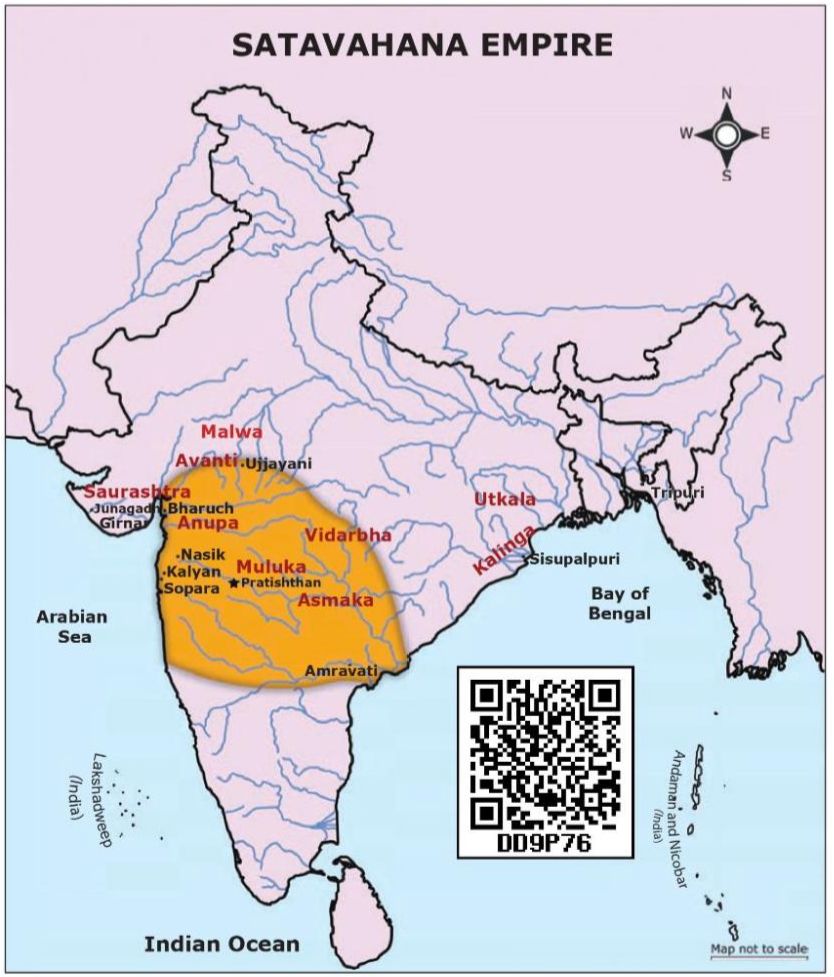
In the northern region, the most important successors of the Mauryan empire were the Shungas and then the Kanvas. In the Deccan and central India, the Mauryans were succeeded by the Satavahanas after a gap of about 100 years. The earliest records of the Satavahanas date back to the first century B.C., when they defeated the Kanvas and established power in parts of central India.
- The founder of the dynasty was Simuk.
- The ruling area of the Satavahana dynasty was mainly Maharashtra, Andhra Pradesh, and Karnataka.
- The capital of the Satavahana dynasty was Pratishthan/Paithan.
- The official language was ‘Prakrit,’ and the script was ‘Brahmi.’
- On the basis of the Satavahana inscription, Simuka is considered the founder of the Satavahana dynasty. He made Paithan, or Pratishthan, on the banks of the Godavari River, his capital.
Sources
- Important sources for knowing the history of the Satvahanas are the Matsya and Vayu Puranas. In the Puranas, the Satvahanas have been called “Andhrabhruvya” and “Andhrajatiya.”
Note—In the Puranas, they have been called ‘Andhrabhruty,’ and in the inscriptions, they have been called ‘Satvahana.’
- Nanaghat inscription of Queen Naganika (Pune, Maharashtra)
- Two cave inscriptions of Gautamiputra Satkarni found from Nasik
- Nashik cave inscription of Gautami Balashri
- Nashik cave inscription of Vasishthiputra Pulumavi
- Karle cave inscription of Vasishthiputra Pulumavi
- Nashik cave inscription of Yagyashree Satkarni
Note: According to the Puranas, the Andhras ruled for 300 years, although this period is also considered to be the rule of the Satavahana dynasty.
Major Satavahana Rulers
- Emperor Simuk
- Kanha
- Shatakarni I
- Haal
- Emperor Gautamiputra Satakarni
- Vasishthiputra Pulumavi
- Shivshree Shatkarni
- Shivaskanda Shatakarni
- Yagyashree Shatkarni
Simuka (Founder of the Satavahana Dynasty)
- Founder of the Satavahana dynasty in the 1st century BCE.
- According to Jain traditions, he constructed Buddhist and Jain temples.
- In his later years, he became tyrannical and was eventually killed.
- The name of the first Satavahana ruler is also found as “Siri Satavahana.”
- His successors were Krishna and then Satakarni I.
Satakarni I
- Information about this is available from the Nanaghat and Naganika inscriptions.
- The practice of Bhumidan (land donation) was first started by the Satavahana rulers. Its first mention is found in the Nanaghat inscription of Naganika. (First epigraphic evidence—Bhumidan)
- He was the first successful ruler of the Satavahana dynasty.
- Shatakarni I performed two Ashvamedha Yajnas and one Rajasuya Yajna.
- Shatakarni I assumed the titles of ‘Dakshinapathapati’ and ‘Apratihatchakra.’
- Shatakarni I got round coins of the Malava style and silver coins engraved with the name of his wife.
- ‘Srisat’ (indicator of Shatakarni) is mentioned on his coins.
Hal
- Hal was a great poet and patron of poets and scholars.
- Hal composed a free verse poem named ‘Gathasaptashati’ [language ‘Prakrit’].
- Gunadhya, author of ‘Brihatkatha’ (written in the Paishachi Prakrit language), and Sarvavarman, author of the Sanskrit grammar named ‘Katantra,’ lived in his court.
- The Amaravati stupa was expanded during his reign.
Gautami’s son Shatakarni (106-130 AD)
- He was the greatest ruler of the Satavahana dynasty. He revived the Satavahana dynasty.
- Gautamiputra Satakarni is also called ‘Tri-Samudra Toya-Pita Vahana,’ which means his horses had drunk the water of all three seas.
- Information about his victory is obtained from the Nasik inscription of his mother, Gautami Balashri. In this inscription, he has been called a unique Brahmin (Ekbrahman).
- Gautamiputra Satakarni assumed the title of Venkataka Swami and founded a city named Venkataka. Apart from this, he also assumed the titles of ‘Rajaraja’ and ‘Vindhyanaresh.’
- He donated a village named ‘Ajakalkiya’ to the Buddhist Sangha and ‘Karajak’ to the monks of Karle.
- His empire probably extended from Malwa in the north to Karnataka in the south.
- Gautamiputra Satakarni defeated the Shaka ruler Nahapana.
- About 8 thousand silver coins have been found from Nasik (Jogalthambi), on one side of which is the name of Nahapana and on the other side is the name of Gautamiputra Satakarni.
Vashishthiputra Pulmavi (130-154 AD)
- Gautamiputra became the ruler after the death of Satakarni.
- Information about this is available from the inscription obtained from Amaravati.
- After the victory over Andhra Pradesh, he was called the first Andhra emperor.
- Pulumavi made his capital Paithan, or Pratishthan, on the banks of the Godavari River in the Aurangabad district of Andhra Pradesh.
- He defeated the Shaka ruler Rudradaman twice. He has also been called ‘Dakshinapatheshwar.’ ‘ His name is found as ‘Puloma’ in the Puranas.
After Pulumavi, Shivashri Satakarni (154-165 AD) and Shivaskandashatakarni (165-174 AD) became kings.
Yagyashree Shatkarni (174-203 AD)
- Yagyashree Satkarni was the last important king of the Satavahana dynasty. He regained control over the conquered territory of the Shakas.
- Yagnashri Satkarni was a lover of trade and sea travel. The figures of a ship, a fish, and a conch were engraved on his coins.
- His coins have been found in Andhra Pradesh, Maharashtra, Madhya Pradesh, and Gujarat.
- After the death of Yagyashree, the empire of the Satavahanas was divided, the main reason for which was rebellion and the weakness of the central government.
Pulumavi IV – The last ruler of the Satavahana dynasty.
Satavahana Period: Society, Culture and Administration
Society
- Society was divided into four varnas—Brahmana, Kshatriya, Vaishya, and Shudra, based on occupation.
- Matrilineal elements existed in society, though inheritance passed from father to son.
- Naganika (queen of Satakarni I) and Gautami Balashri (mother of Gautamiputra Satakarni) played active roles in administration.
- Gautamiputra Satakarni was called “Agaman Nilaya.” (abode of the Vedas) and “an unparalleled Brahmana.”
- He restored the varna system.
- Vaishnavism, Shaivism, and Buddhism were all practiced in society.
Administration
- The concept of the divine origin of kingship was prevalent. Queens also used titles such as “Devi” or “Mahadevi.”
- The Satavahana administration was influenced by the Mauryan system.
- The kingdom was divided into districts called “Ahara.”
- Each Ahara was administered by an Amatya.
- Senior officials working in the capital were called Rajamatyas.
- The administrative unit below Ahara was the village, headed by a Gaulmika (Gaulika).
- Halik were also village administrative officers.
- Katak and Skandhavara were military camps that functioned as administrative centers.
- Frontier defense officers: Durgadhipa.
- Mahasenapati: High military officer.
- Royal symbol: Chaitya.
- Official language: Prakrit.
- Script: Brahmi.
Social and Administrative Hierarchy
- First category: King
- Second category: Mahabhoja
- Third category: Senapati
Other important officials
- Bhandagarika – Treasurer
- Rajjuk—Head of the revenue department
- Paniyagharika – Officer responsible for water supply in cities
- Karmantika—Inspector of construction works
Land Grant System
- The practice of land grants began under the Satavahanas.
- Land grants were mainly given to Brahmanas and Buddhist monks.
- The Nasik inscription of Gautamiputra Satakarni provides major epigraphic evidence of land grants (including tax exemptions and privileges).
- The Nanaghat inscription provides the earliest epigraphic evidence of land grants.
- The land grant system led to administrative decentralization and laid the foundation of feudalism.
- Land tax: 1/6 of the total agricultural produce.
Coinage System
- The Satavahanas did not issue gold coins; gold was used only as a valuable metal.
- Coins were made of lead, copper, bronze, and potin (an alloy of copper, zinc, lead, and tin).
Symbols on coins
- Portrait coins start mainly with Gautamiputra Satakarni
- Chaitya tree with five leaves
- Swastika
- Ship (symbol of maritime trade)
- Satakarni I was the first ruler to issue coins in his own name.
- Avaksha coins were found at Balgarh (Chhattisgarh).
- The first evidence of Karshapana (Kahapana) comes from the Nanaghat inscription.
- The large number of Roman coins found in India confirms Indo-Roman trade.
- Maharathis and Mahabhojas had the authority to issue coins within their territories.
Trade and Economy
Major products
- Cotton
- Metals
- Pearls
- Spices
Major ports and cities
- Bharuch, Sopara, Paithan, Tagara (Ter), Dhanyakataka, Amaravati, Nagarjunakonda, Arikamedu, and Kaveripattinam.
- The Karle inscription mentions the term “Karukara,” referring to a tax imposed on artisans.
- Mahayana Buddhism became popular among merchants and artisans.
Religion, Culture and Architecture
- The chaitya served as the main royal symbol.
Major Buddhist monuments
- Chaitya of Karle
- Amaravati Stupa—constructed around 200 CE; discovered by Mackenzie in 1797.
- Nagarjunakonda—an important Buddhist center during the Satavahana and later Ikshvaku periods.
- Amaravati and Nagarjunakonda emerged as major centers of Buddhist culture during the Satavahana period



