

Fundamental Duties are the moral and civic obligations enshrined in Part IVA of the Indian Constitution, intended to promote patriotism, discipline, and responsible citizenship. In Indian Polity, they complement Fundamental Rights by reminding citizens of their duties toward the nation, society, and fellow citizens. These duties strengthen constitutional values and encourage active participation in nation-building.
- At the time of framing the Constitution, the Constituent Assembly included Fundamental Rights but did not consider Fundamental Duties necessary.
- It was expected that citizens would fulfill their duties voluntarily.
- The constitutions of democratic countries like the USA, Canada, France, Germany, and Australia do not contain an explicit list of citizens’ duties. In these countries, duties are considered moral responsibilities rather than constitutional obligations.
- Japan is the only major democratic country which has a constitution that contains an explicit list of the duties of citizens.
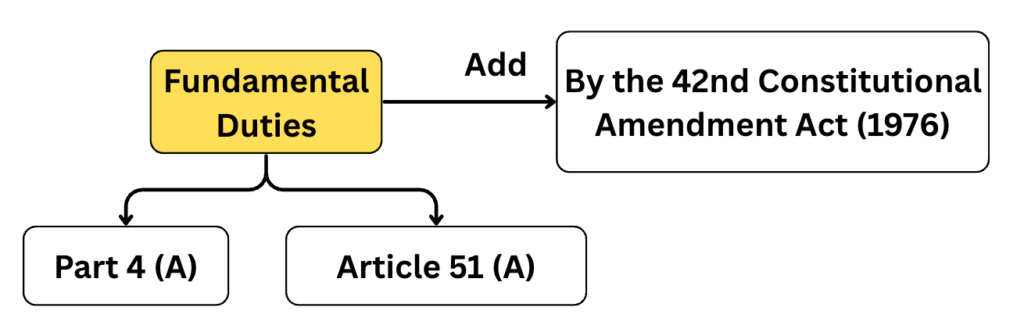
Fundamental Duties: Introduction
- The Fundamental Duties in the Indian Constitution are inspired by the Constitution of the USSR (Soviet Union).
- On the recommendation of the Sardar Swaran Singh Committee, Part IV-A and Article 51A were added to the Constitution by the 42nd Constitutional Amendment Act, 1976. Through this, 10 Fundamental Duties were added to the Constitution for the first time.
- The 86th Constitutional Amendment Act, 2002 amended Article 51A to add the 11th Fundamental Duty.
- “Who is a parent or guardian to provide opportunities for education to his child or, as the case may be, ward between the age of six and fourteen years.”
- Presently, there are 11 Fundamental Duties.
- Parliament can enact laws for the implementation of Fundamental Duties. The Constitution does not explicitly state that “punishment will be given for non-compliance,” but under Articles 245 and 246, Parliament has the power to make such laws that compel citizens to follow their Fundamental Duties.
- Constituent Assembly member K.T. Shah was a strong advocate for including Fundamental Duties in the Constitution.
- Fundamental Duties were added to maintain moral discipline and national unity in the Constitution. They are a cultural and legal bridge to unite Indian society.
Sardar Swaran Singh Committee and Fundamental Duties
- The Swaran Singh Committee suggested the incorporation of eight Fundamental Duties in the Constitution, but the 42nd Constitutional Amendment Act (1976) included 10 Fundamental Duties.
- This committee was appointed by the then Congress Party President Dev Kant Borooah on February 26, 1976. It consisted of 12 members:
- Sardar Swaran Singh (Chairman)
- A.R. Antulay (Member Secretary)
- S.S. Ray
- Rajni Patel
- H.R. Gokhale
- V.A. Seyid Muhammad
- V.N. Gadgil
- C.M. Stephen
- D.P. Singh
- D.C. Goswami
- V.V. Sathe
- B.N. Mukherjee
- Report: August 1976
↓
Title: “Report of the Committee appointed by the Congress President on Proposed Amendments to the Constitution of India”
8 Fundamental Duties Proposed by the Sardar Swaran Singh Committee:
- To uphold and respect the Constitution and the laws.
- To uphold the sovereignty, unity, and integrity of the country.
- To respect democratic institutions.
- To defend the country.
- To take a pledge against communalism.
- To assist in the implementation of Directive Principles and to promote the common good of the people, which may help in the interests of socio-economic justice.
- To abjure violence and to protect and safeguard public property.
- To pay essential taxes according to the law of the land.
- Certain recommendations of the Committee were not accepted by the Congress Party and were not included in the Constitution. These include:
- Parliament should have the power to provide for the imposition of such penalty or punishment as may be considered appropriate for non-compliance with or refusal to observe any of the duties.
- No law imposing such penalty or punishment shall be called in question in any court on the ground of infringement of any of the Fundamental Rights.
- The duty to pay taxes should also be a Fundamental Duty of the citizens.
Features of Fundamental Duties
- Some of them are moral duties while others are civic duties.
- Moral Duty: (e.g., Cherishing the noble ideals of the freedom struggle).
- Civic Duty: (e.g., Respecting the National Flag and National Anthem).
- Fundamental Duties are confined to citizens only and do not extend to foreigners.
- Like the Directive Principles, Fundamental Duties are non-justiciable. The Constitution does not provide for their direct enforcement by the courts.
- Fundamental Duties are not enforceable by courts; for this reason, former Chief Justice Lahoti called them a ‘Show Piece’ and ‘Dead Letters’.
At present, Fundamental duties:At present there are 11 fundamental duties.(Articles 51 (A)(a) to 51 (A)(k))
| S. No. | Description |
| 1 | To abide by the Constitution and respect its ideals, institutions, national flag and national anthem. |
| 2 | Let us cherish and follow the noble ideals that inspired our national movement for freedom. |
| 3 | To protect and preserve the sovereignty, unity and integrity of India. |
| 4 | Defend the country and serve the nation when called upon to do so. |
| 5 | To foster among all the people of India a spirit of harmony and equal brotherhood, transcending all distinctions based on religion, language, region, or class. Abandon practices that are derogatory to the dignity of women. |
| 6 | Understand and examine the importance of the glorious tradition of our social culture. |
| 7 | Protect and conserve the natural environment, forests, lakes, rivers and wildlife and be kind to all living beings. |
| 8 | Develop scientific outlook, humanism and spirit of acquiring knowledge and improvement. |
| 9 | Protect public property and stay away from violence. |
| 10 | To strive continuously towards excellence in all spheres of individual and collective activities so that the nation can continuously touch new heights of progress and achievement. |
| 11 | Every parent or guardian shall provide opportunities for education to his child or ward, as the case may be, below the age of six to fourteen years. (This duty was added by the 86th Constitutional Amendment Act, 2002.) |
| Note : Directive Principles of State Policy (Article 51):- To promote international peace and security and to maintain just and honourable relations between nations | |
Criticism of Fundamental Duties
- Durgadas Basu – This duty is not enforceable but this fact cannot be ignored.
- The Fundamental Duties mentioned in Part IV-A of the Constitution have been criticized on the following grounds:
The list of duties is incomplete.
- The current list does not include important civic duties such as voting, paying taxes, and family planning, even though the Swaran Singh Committee had recommended making tax payment a fundamental duty.
Many duties are vague and ambiguous.
- Some duties are worded like:
- “High ideals”,
- “Composite Culture”
- “Scientific approach”
- These are ambiguous and difficult to understand for the average citizen and can be interpreted in various ways.
Criticism of being non-justiciable
- These duties are not enforceable in a court of law.
- For this reason they are considered merely moral commands or merely didactic.
- The Swaran Singh Committee had recommended fines and punishment for not following these, which was not implemented.
Redundancy in the Constitution
- Their inclusion in the Constitution is superfluous.
- This is because these duties apply even to citizens who are not familiar with the intricacies of the Constitution.
Insert in the wrong place
- The Fundamental Duties were added to Part IV-A of the Constitution,
- Critics were of the view that these should have been placed after Part III (Fundamental Rights), which would have placed them on an equal footing with rights.
Importance of Fundamental Duties
- Although the Fundamental Duties have been criticized, they still have many positive aspects that make them an important part of the Indian Constitution. Their importance can be understood in the following points:
Function of warning in the exercise of rights
- This balance strengthens democracy.
Control of anti-national activities
- These duties prevent citizens from committing acts like insulting the national flag, damaging public property, anti-social activities etc.
Source of inspiration and discipline
- Fundamental Duties develop discipline, sense of duty, and a sense of participation in nation building among the citizens.
Aids in constitutional interpretation
- In 1992, the Supreme Court held that if a law is inspired by fundamental duties, it can be saved from unconstitutionality by holding it reasonable under Articles 14 or 19.
Possibility of legal enforcement
- Although fundamental duties are non-justiciable, Parliament can make laws for the violation of any of these duties.
- E.g.: National Honour Act, 1971 – provides for punishment for insulting the national flag or the national anthem.
Views from a historical perspective
- H.R. Gokhale (then Law Minister): “On the eve of the Emergency, people did not respect the legal system. Fundamental duties will help in controlling rebellious tendencies.”
- Indira Gandhi (Prime Minister): “The Fundamental Duties will create a democratic balance. They will not only be moral imperatives but will also make citizens conscious of their duties.”
Conclusion:
- Fundamental Duties serve to strengthen the sense of duty, national unity, respect for constitutional ideals and democratic values among Indian citizens.
- They strengthen democracy by balancing rights.
Judicial decisions related to Fundamental Duties
- Naveen Jindal vs. Union of India –Right to hoist the national flag with respect and dignity.
- S.C. Mehta vs. Union of India – 1988– The Court held that under Article 51A(G), it is the duty of the Central Government to direct educational institutions in the country to impart education on environmental protection for one hour a week.
- Interrelationship between Fundamental Rights, Directive Principles of State Policy and Fundamental Duties – These three are interrelated and complement each other.
Expressed views regarding fundamental duties
Narayan Agarwal— in Gandhian Constitution for a Free India (1946)
National Review Commission (2002)– Recommended addition of two fundamental duties.
- Promoting the spirit of motherhood and fatherhood and family values
- Duty of industrial organizations to provide education to the children of their employees.
- Verma Committee (1999) and Fundamental Duties
- This committee was formed to suggest ways to make the fundamental duties effective.
- It observed that fundamental duties would be followed only when people understood their importance and adopted them in their everyday lives.
- To create awareness about social responsibility, constitutional values must be included in the co-curricular activities in the education curriculum.
- There should be a preface and fundamental duties in the books
- Services can be imposed on the rights for implementing the fundamental duties relating to environmental protection.
- In this context, the Committee identified some of the existing laws which are helpful in giving effect to the fundamental duties.
- Verma Committee (1999) and Fundamental Duties
Conclusion:
- These observations of the Verma Committee make it clear that many existing laws already facilitate the implementation of fundamental duties. What is needed is:
- These laws should be implemented effectively.
- Citizens should be informed about their duties.
Legal provisions relating to Fundamental Duties
- Prevention of Insults to National Honour Act, 1971 – The law makes disrespecting national symbols—the Constitution, the national flag, the national anthem—a punishable offense.
- Protection of Civil Rights Act, 1955 –This Act prohibits discrimination and crimes based on caste and religion.
- Indian Penal Code (IPC) –It provides that words that promote prejudice or hatred against national integration are punishable offences.
- Unlawful Activities (Prevention) Act, 1976 –This law provides for declaring communal, disruptive organisations illegal.
- Representation of the People Act, 1951 –The Act disqualifies representatives who:
- They ask for votes on the basis of religion.
- They spread discrimination in the name of caste, language, religion etc.
- They remain involved in corruption.
- Wildlife (Protection) Act, 1972– This law protects rare and endangered species and prohibits their trade.
- Forest (Conservation) Act, 1980 –This Act prevents indiscriminate cutting of forests and non-forest use of forest land.
- Emblems and Names Act-1950-It prohibits the improper use of the Indian emblem, national flag and currency.
- Flag Code of India 2002



