

Preamble of the Constitution is a foundational topic in Indian Polity, as it expresses the philosophy, objectives, and guiding principles of the Indian Constitution. It declares India to be a sovereign, socialist, secular, democratic republic and outlines the ideals of justice, liberty, equality, and fraternity. Often described as the soul of the Constitution, the Preamble serves as a key to understanding the intent of the constitutional framework.
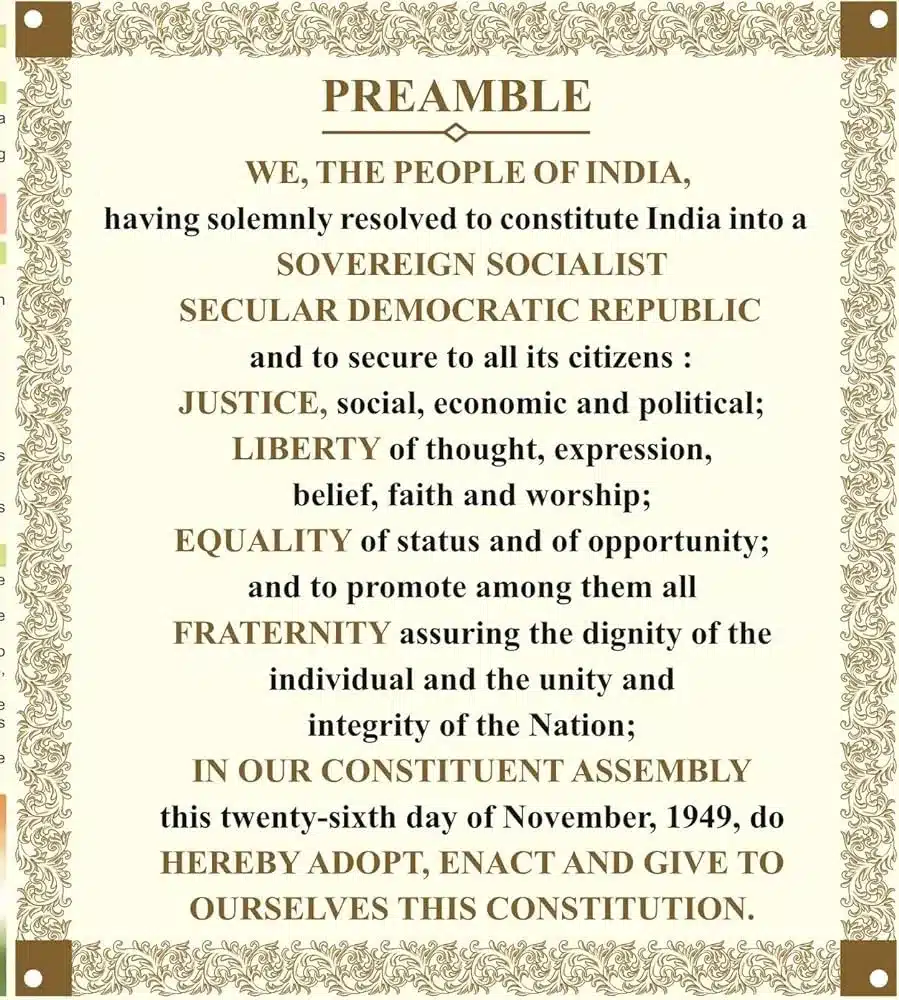
Main subject of preamble of constitution
Meaning and introduction of preamble of constitution
- “We, the People of India”
- These words are analogous to the Preamble of the Constitution of the U.S.A. – “We, the people of the United States.”
- The Preamble was first included in the Constitution of the U.S.A. Therefore, the idea of the Preamble was borrowed from the U.S.A.
- Language of the Preamble – Constitution of Australia
- Opening and closing words of the Preamble – Constitution of Ireland
- Ultimate sovereignty under the Constitution is vested in the ‘People of India.’ They are the focal point of all powers.
- The basis of the Preamble to the Indian Constitution is the ‘Objectives Resolution’ moved by Pandit Nehru in the Constituent Assembly (introduced on December 13, 1946, and adopted on January 22, 1947).
- The Constituent Assembly accepted the Preamble on October 17, 1949, the final day of the second reading of the Draft Constitution.
- The Preamble came into force (commencement) on January 26, 1950.
- The Government of India Act, 1919, contained a Preamble, but the Government of India Act, 1935, did not mention a Preamble.
- The Preamble to the Indian Constitution has been amended only once so far. (42nd Constitutional Amendment Act, 1976)
- The words ‘Socialist’, ‘Secular’, and ‘Integrity’ were not present in the original Preamble. These were added later by the 42nd Constitutional Amendment Act, 1976.
- In the original Preamble of the Constitution, only the word ‘Unity’ existed. However, by the 42nd Constitutional Amendment, the word ‘Integrity’ was added to clarify the objective of further strengthening the spirit of ‘Unity of the Nation.’ These words were added on the recommendation of the Sardar Swaran Singh Committee. Sardar Swaran Singh was the Minister of Defence in Prime Minister Indira Gandhi’s Cabinet at that time.
What the Preamble is Not
- The Preamble is non-justiciable.
- The Preamble cannot be independently enforced in a court of law.
- The Preamble is not a source of power.
- It merely reflects the objectives and values of the Constitution, but no executive power is derived from it.
- The Preamble is not a source of prohibition or limitation upon the powers of the Legislature.
- It does not directly control or limit the boundaries of the powers of the Legislature.
Four Ingredients of the Preamble
Source of authority of the Constitution:
- The Preamble states that the Constitution derives its authority from the ‘People of India’.
- This implies that sovereignty lies with the people, and the roots of democracy in India are in the will of the people.
Nature of Indian State:
- According to the Preamble, India is a Sovereign, Socialist, Secular, Democratic, Republican Polity.
Objectives of the Constitution:
- The fundamental objectives mentioned in the Preamble to be achieved are:
- Justice – Social, Economic and Political
- Liberty – of thought, expression, belief, faith and worship
- Equality – of status and of opportunity
- Fraternity – assuring the dignity of the individual and the unity and integrity of the Nation
Date of adoption of the Constitution:
- It stipulates November 26, 1949, as the date on which the Constitution was “adopted, enacted and given to ourselves.”
- Although it came into force on January 26, 1950.
Meaning of key words in the Preamble of the Constitution
1. Sovereignty
- India is completely independent in its internal and external affairs.
- The source of power is the people of India – they are the source of the power of the Constitution.
- Maganbhai Ishwarbhai Patel Case (1970):India is a sovereign country; it can modify its borders.
2. Socialist
- The word “socialist” was inserted in the Preamble by the 42nd Constitutional Amendment (1976) but it is not defined in the Constitution.
- Indian socialism is ‘democratic socialism’ and not ‘communist socialism’, which is also called ‘state-dependent socialism’
- D.S. Nakara Case (1982) -It is a mixture of Gandhism + Marxism, but with a greater influence of the Gandhian approach.
- The first constitutional amendment in 1951 under Nehru’s leadership made two important provisions to establish the socialist goal.
- Avadi session of 1955- ‘of societySocialist modelaccept the position
- Andrebeitei- The Constitution shows the direction.
- State of Punjab vs. Modern Vad (2004)- Socialism must have been an attractive word in our history.
- Durgadas Basu – The country “has swung the pendulum away from socialism towards a free economy” (after 1991)
- Amendment of the Fundamental Right to Property to provide for economic equality and inclusion of the Ninth Schedule to provide constitutional protection to State-determined laws for land acquisition and empowering the State to make special provisions for the benefit of socio-educationally backward citizens to widen the scope of social equality.
- To perform both these functions, new articles 31A and 318 were added to the Constitution and a new clause 15(4) was added to Article 15.
3. Secular
- Added by the 42nd Amendment (1976).
- There is no official state religion.
- Equal attitude towards all religions.
- First – U.S.A.
- Secularism is not defined anywhere in the Constitution.
- India’s secular philosophy is not as negative as in the West, which advocates a complete separation of religion and state power. Rather, Indian secularism is based on the idea of positive intervention.
- Kameshwar Prasad- Demand for the word secular in the Preamble was made but was not accepted.
- D.D. BasuMore misconceptions, less benefits
- S.R. Bombay Case (1994)secularism in the ConstitutionBasic frameworkwas declared.
- Religious freedom guaranteed in Articles 25–28.
- Justice M.C. Setalvad– “All citizens should be treated equally under a secular state.”
- 45th Constitutional Amendment Bill– An attempt was made to clarify that secularism is a fundamental feature, but the bill could not be passed.
- Rajiv Bhargavahas described 6 such characteristics of Indian secularism which are different from mainstream secularism –
- Principled distance or theoretical separation – allows for differentiated treatment.
- System of specific community rights
- No complete exclusion of religion
- It does not divide the social world into rigid boundaries such as ‘modern Western’ and traditional, non-Western (indigenous)
- It embraces a “contextual” conception of moral reasoning. It embraces change and accommodation rather than atheistic morality.
- Valuable character
- Rajiv Bhargava famously said, “Indian secularism is a unique compromise between different groups and values, which is morally very sensitive. If not seen as such, it either becomes a dead formula or a tool for political maneuvering.”
- State of Bombay v. Narasu Appa Case (1952) (Related to Principled Distance):
- The Legislature is not bound to legislate against all evils at the same time.
4. Democratic
- The Indian Constitution provides for representative democracy instead of direct democracy.
- Efforts have been made to establish social and economic democracy alongside political democracy.
- Universal adult franchise, independent elections, and responsible government.
- Dr. Ambedkar: “Political democracy cannot last unless there lies at the base of it social democracy.”
5. Republic
- The Head of the State (President) is elected.
- No hereditary ruler.
- Equal opportunities for all citizens – without any privileged class.
6. Justice
- The Preamble describes three types of justice: Social, Economic, and Political Justice.
- Social: A society without discrimination.
- Economic: Equality in resources.
- Political: Equal political rights.
- The idea of social and economic justice is influenced by the Russian Revolution of 1917 and is reflected in the Directive Principles of State Policy.
- Political Justice: The Right to Equality (Articles 14 to 18), Universal Adult Franchise, and political participation are forms of political justice.
7. Liberty
- In the Preamble, the words follow the sequence: ‘Liberty-Equality-Fraternity’, which are inspired by the French Revolution of 1789.
- The Preamble mentions 5 types of liberty: TEBFAW
- Liberty of Thought
- Liberty of Expression\
- Liberty of Belief
- Liberty of Faith
- Liberty of Worship
- This liberty is not absolute. It is provided for in Article 19 and Articles 25–28.
- Karl Marx: A free person is one who controls their environment and is not controlled by the environment.
8. Equality
- The Preamble provides for equality of status and of opportunity – moving towards social and economic equality.
- All citizens are equal before the law.
- Articles 14 to 18 grant the Right to Equality.
- The equality provision of the Preamble embraces three dimensions of equality:
- Civic Equality (Articles 14 to 18)
- Political Equality (Article 325 – no discrimination in inclusion in electoral rolls on grounds of religion, race, caste, or sex; Article 326 – adult suffrage).
- Economic Equality – Article 39 and protective discrimination for equality of opportunity.
9. Fraternity
- The Preamble aims for fraternity that promotes the dignity of the individual and the unity and integrity of the Nation.
- Individualism + Collectivism.
- A sense of common brotherhood among all Indians.
- Objective: To establish unity and integrity in Indian society.
- Ernest Barker called fraternity the ‘Principle of Cooperation’.
- Liberty, Equality, and Fraternity (Union of Trinity): Bhimrao Ambedkar gave a significant speech in the Assembly regarding this.
- Liberty, Equality, and Fraternity are heavily influenced by the French Revolution (1789).
10. Dignity of the Individual
- This was a paramount value for the makers of the Constitution.
- Objective: Improvement in the quality of life of the individual.
- Article 17: Abolition of Untouchability — protecting the dignity of the individual.
- Article 32: Direct petition to the Supreme Court on violation of Fundamental Rights — protection of dignity.
11. Unity and Integrity of the Nation
- Fraternity is essential for unity and integrity in a pluralistic society.
- Article 51(A): To uphold and protect the sovereignty, unity, and integrity of India.
- For Integrity: 16th Amendment (1963).
- Reasonable restrictions added to Articles 19(2), 19(3), and 19(4).
Is the Preamble part of the Constitution?
Berubari Union Case (1960):
- The Supreme Court held that:
- The Preamble is not a part of the Constitution.
- t is a key to open the minds of the makers, showing the general purposes for which they made the several provisions in the Constitution, especially where the language of any article is found to be ambiguous or capable of more than one meaning.
- Berubari Territory: It was in the Jalpaiguri district (West Bengal). It was ceded to Pakistan (now Bangladesh) by the 9th Constitutional Amendment Act, 1960
Sajjan Singh v. State of Rajasthan (1965):
- The Preamble is the key to the minds of the lawmakers. It cannot be called a formal part of the Constitution in any manner.
Kesavananda Bharati Case (1973):
- The Supreme Court held that:
- The Preamble is an integral part of the Constitution; it overruled the decision in the Berubari Case.
- The Preamble can be amended, except for the ‘Basic Structure’.
- The Preamble is non-justiciable.
- Significance in Interpretation: Thus, after the Kesavananda case, the Preamble is a part of the Constitution and can be amended under Article 368, but without altering the Basic Structure.
Indira Gandhi v. Raj Narain (1975):
- The Preamble cannot override the specific provisions of the Constitution.
- The Preamble is neither a source of any power nor does it limit it in any way.
S.R. Bommai Case (1994) – Justice Ramaswamy:
- The Preamble is an integral part of the Constitution.
- Secularism is a part of the Basic Structure of the Constitution.
LIC of India Case (1995):
- The Supreme Court again held that the Preamble is an integral part of the Constitution.
A.K. Gopalan v. State of Madras (1950):
- The Preamble is not enforceable by the courts.It is not a source of power.
Golaknath v. State of Punjab (1967):
- Justice Hidayatullah:
- The Preamble is the very soul of the Constitution.
Minerva Mills Case (1980):
- The Supreme Court held that, “The Indian Constitution is founded on the bedrock of the balance between the Fundamental Rights and the Directive Principles.”
Current Status
Amendment to the Preamble:
- It can be amended under Article 368, but the Basic Structure must not be altered.
Other Important Points:
- Under Articles 14, 16, and 39(d), the right to equal pay for equal work for both men and women is a constitutional goal; therefore, it is a fundamental right. — Randhir Singh v. Union of India
Significant Statements Regarding the Preamble
- K.M. Munshi: * “It is the ‘Political Horoscope’ of the Constitution.”
- “It is the prophecy of our sovereign democratic republic.”
- V.N. Gadgil: * “The Preamble can be compared to the ‘Nandi Path’ (prologue) of ancient dramas.”
- Sir Ernest Barker:
- He calls the Preamble the ‘Key Note’ of the Constitution.
- He referred to those who wrote the Preamble as ‘Political Intellectuals’.
- He began his book, ‘Principles of Social and Political Theory’, with the Preamble.
- Pandit Thakur Das Bhargava:
- “The Preamble is the most precious part of the Constitution.”
- “The Preamble is the Soul of the Constitution.”
- “The Preamble is the Key to the Constitution.”
- It is a ‘Jewel set’ in the Constitution.
- “The Preamble is not just excellent prose-poetry, it is a picture of perfection.”
- N.A. Palkhivala:
- The eminent jurist and constitutional expert called the Preamble the ‘Identity Card of the Constitution’.
- J.B. Kripalani:
- “These (principles enshrined in the Preamble) are profound principles.”
- Pandit Govind Das:
- The Preamble is the ‘Adi Vakya’ (Primal Word) and the foundation stone of the Constitution.
- Alladi Krishnaswami Iyer:
- “The Preamble to our Constitution expresses what we had thought or dreamt so long.”
- Subhash Kashyap:
- “If the Constitution is the body, the Preamble is its soul; if the Preamble is the foundation stone, the Constitution is the edifice standing upon it.”
- “If the Preamble is the direction, the various Articles of the Constitution are the means to achieve that fact.”
- Hansa Mehta:
- “Only upon the fulfillment of the promise given by the Preamble will this country regain its ancient prestige.”



