

Religious Movements and Philosophy in Medieval India is an important topic in Ancient & Medieval India that reflects the spiritual and intellectual transformation of society during this period. Movements like Bhakti and Sufism emphasized devotion, equality, and social harmony, challenging rigid social structures. These traditions played a crucial role in shaping India’s composite culture and religious outlook.
Religious Movements and the Contribution of the Bhakti and Sufi Movements
Sufi Movement
Sufism represents the inner or esoteric side and mystical dimension of Islam. Sufi saints worked for the welfare of humanity transcending religious and sectarian distinctions. Sufis were a philosophical class renowned for their religious broadness and tolerance.
- Sufis believed that God is the supreme beauty and one should look at Him with reverence, take pleasure in thinking about Him and concentrate on Him alone.
- They believed that God is the ‘Mashooq’ (beloved) and the Sufi is the ‘Aashiq’ (lover).
Sufi words: –
- The word “Sufi” primarily derives from “Suf” (wool), symbolizing asceticism.
- The ideology promoted by Sufis is known as Sufism.
- Other arguments
- In Arab countries, people who wore clothes made of wool of Safa sheep were called ‘Sufis.’
- According to historian Yusuf Mohammed, Prophet Muhammad built a mosque on a hill called ‘Safa.’ in which people who took shelter and preached Allah were called Sufis.
All of Sufism was divided into 12 Silsilas (Orders or Brotherhoods).
Reasons for Sufi movement –
- To end the ritualistic system.
- To uplift the morale of the people and improve the caste system.
Note—Sufis used to preach in common language. They stayed away from politics.
Main teachings of the Sufi movement:
- Monotheistic
- Great emphasis on worship
- Centered on the spirit of monotheism.
- The aim of the seeker is to move from human love to divine love.
- Main emphasis on charity and the welfare of the poor.
- Primacy of the Guru.
- Emphasis on mysticism instead of the fanaticism of Islam.
- Offering Namaz five times a day.
- Giving charity.
- Performing the Hajj pilgrimage.
Main features of Sufism:
- Fundamental Principles: The loving relationship between God and man is the basis of Sufism.
- Central Ideas: The idea of the soul, divine closeness, Divine love and self-destruction are central to the doctrine of Sufism.
- Love of Humanity: According to Sufism, love of God means love of humanity, and thus they stressed that service of God is nothing but service of humanity.
- Belief in Equality: Sufism is beyond all religious and sectarian differences and considers all human beings equal.
- Self-discipline: Sufism also emphasizes self-discipline and considers it essential to attain knowledge of God.
- Inner Purity: Unlike orthodox Muslim sects (which emphasize external conduct), Sufism emphasizes inner purity.
Beginning of the Sufi movement—
- The Sufi movement is believed to have started from Iraq (Basra and Kufa) and Arabia.
- It was divided into 12 Silsilas, and each Silsila had a religious guru who was called “Peer.”
- In this ideology, great emphasis was laid on the relationship between the Guru (peer) and the disciple (murid).
Beginning of Sufi movement in India—
- Sufi saints came to India for the first time during the time of the first Turk invader Mahmud Ghaznavi.
- Sheikh Ismail was the first Sufi saint to come to India during Mahmud’s conquest of Punjab in 1005 AD.
- The second Sufi saint to come to India was “Sheikh Ali bin Usman al Hujberi.”
- In the 12th century another saint, ‘Syed Ahmed Sakhi Sakhar,’ came to India, who became famous by the name of ‘Lakhdata.’
- Khwaja Moinuddin Chishti came to India during the second battle of Tarain of Mohammad Ghori (1192 AD).
Sufi Glossary –
- Peer – Guru was called Peer.
- Mureed – A disciple was called so.
- Wali – The guru’s successor was called Wali.
- A Khanqah-Dargah (monastery) is the residence of Sufis.
- Fana & Sama – People of Sufi ideology consider God as their beloved and themselves as the beloved. To please God, they sing music (Qawwali), which is called “Sama.” Merging with God through this (i.e., attainment of salvation) is called “fana.”
- Mazar – A place of burial.
- Tasawwuf – Various mystical tendencies or movements.
- Malfoozat – A collection of the teachings of Sufi saints or their ideology.
- Maktubat – A collection of the letters of Sufi saints.
- Wilayat – An area free from state control.
- Khalifa – The highest religious leader of Islam.
- Ulema – A religious leader.
- Qazi – A religious judge.
The first book on Islamic mysticism written in India was “Kashf-ul-Mahjub.” Its author was Hujvery.
The first two mystic saints in India were
- Rabia (8th century) She is compared with the great female saint Mirabai.
- Mas’ur Bil al-Hajjaj (10th century) He declared himself as Anlak (i.e., God), but people hanged him.
There are two schools of thought in Sufi ideology—
- Wahdat-ul-Wujud—These believe in one God (monotheism); its founder is considered to be Ibn-ul-Arabi.
- Wahdat-ul-Sudub—These believe in the relationship of master and slave between soul and God; its founder is Sheikh Ahmad Sirhindi.
Note—The ultimate goal of both these ideologies is to attain God.
Two ideologies of the Sufi movement—
Ba-Shara –
This ideology had people who believed in Islamic law, Shariat, and later this ideology got divided into many branches. Such as Chishti, Suhrawardi, Qadri, Naqshbandi, Firdausi, and Satari.
Be-Shara –
- In this ideology, people did not believe in Shariat and were just like travellers.- This ideology later came to an end (collapse).
- Abul Fazal has mentioned 14 Sufi Silsilas in his book Ain-i-Akbari, but the main Sufi Silsilas that came to India were six
The order of their arrival in India was – Chishti ➟ Suhrawardi ➟ Firdausi ➟ Shattari ➟ Qadiri ➟ Naqshbandi.
Major Sufi orders and their founders in India
| Silsila | Founder | Place | |
| 1. | Chisthi | Khwaja Muinuddin Chishti (12th century) | Ajmer |
| 2. | Suharwardi | Shihabuddin Suhrawardi (12th century) | Multan |
| 3. | Firdausi (influenced by Suhrawardy) | Sheikh Badruddin Samarqandi (13th century) | Bihar |
| 4. | Shattari (influenced by Suhrawardi) | Shah Abdullah Shattari | Jaunpur |
| 5. | Kadiri | Shah Niamatullah and Nasiruddin Muhammad Jilani (15th century) | Uccha |
| 6. | Naqshbandi | Khawaja Baqi Billah (16th century) | Ucccha |
Chishti Silsila
- In India, the founder of the Chishti order is considered to be Khwaja Muinuddin Chishti, and outside India, in Herat, the founder of this order is considered to be Abu Abdal Chishti (resident of Khurasan).
- Sufis do not have any attachment towards worldly things, they have a feeling of renunciation of the world and lead an ascetic life (which is called tark-e-duniya).
- Teachings/Principles
- A life of poverty and misery
- Wealth is an obstacle to the spiritual path
- A simple and plain life should be lived away from politics.
- A feeling of love and generosity towards all living beings
Khwaja Moinuddin Chishti – (1143 – 1236)
- He was born in 1143 AD at a place called Sinjari in Sistan, Iran.
- His father’s name was Hazrat Mohammad Gayasuddin, and his mother’s name was Bibi Mahenur.
- His title Sultan-ul-Hind (spiritual guru of Hind) was given by Mohammad Bin Tuglak.
- His gurus’ names were Hazrat Sheikh Usman Harooni.
- Khwaja Saheb was the 8th saint (guru) of the Chishti order.
- Moinuddin Chishti came to India during the reign of Prithviraj Chauhan III with Mohammad Gauri during the Second Battle of Tarain in 1192 AD.
- After his death (1230 AD), his dargah was built in Ajmer itself.
- According to some historians, the Kachchi Mazar of “Khwaja Saheb” was built by Iltutmish, and the Pakki Mazar was built by Sultan Mohammad Khilji of Malwa in 1464 AD.
- The Urs of Khwaja Saheb is held in Ajmer from the first of Rajab to the sixth of Rajab. It is also called the fair of communal harmony.
- The devotees of Khwaja Saheb used to call him Garib Nawaz (well-wisher of the poor).
- Khwaja Sahab’s biography was written by Jahanara. “Mirza Wahauddin Beg.” in the name of Munis-ul-Arwah
- Muhammad bin Tughlaq was the first sultan who visited Khwaja Sahab at the dargah.
- Mughal emperor Akbar donated 18 villages to the Ajmer dargah and travelled twice on foot from Delhi to Ajmer for prayers.
- Malwa Sultan Mahmud Khilji built the modern dargah in the 15th century. In 1911, Hyderabad’s Nizam Osman Ali built the main part and door of the dargah, which is why the main gate of the khanqah is called Nizamgate.
- Khwaja Sahab had two disciples, Sheikh Hamimuddin Nagauri and Qutubuddin Bakhtiyar Kaki.
Sheikh Hamimuddin Nagauri-
- Contemporary of Qutubuddin Aibak and Iltutmish.
- The first Sufi saint born in India.
- He made Nagaur his workplace on the orders of Moinuddin Chishti.
- The only Sufi saint who adopted vegetarianism.
- Titles:- Sultan-ul-Tarqeen This title was given by Moinuddin Chishti. Which means Sultan of ascetics
- He lived his entire life through agriculture (as a farmer).
- Death—in 1174 AD.
- His dargah was built near Nigani pond in Nagaur, where his Urs is organized on the day of Krishna Janmashtami, which is considered to be the second largest Urs of Rajasthan.
- The famous Tarkin ka Darwaza was built by Iltutmish in Nagaur.
Qutubuddin Bakhtiar Kaki:
- He was born in 1186 AD in Fargana (Uzbekistan).
- He was a contemporary of Qutubuddin Aibak, the ruler of the Delhi Sultanate, and was also Aibak’s spiritual guru.
- He made Delhi his workplace.
- Aibak built the first mosque of North India, Quwwat-ul-Islam, in his name It was the Qutub Minar that was dedicated to the saint Qutbuddin Bakhtiyar Kaki.
- After defeating Nasiruddin Qubacha, Iltutmish decided to give the title of Sheikh ul Islam to the Guru, but Kaki refused to accept it.
- Bakhtiyar Kaki’s disciple was Sheikh Fariduddin (Gaz-e-Shakar) Baba Farid.
Sheikh Fariduddin (“Baba Farid – Gaz-e-Shakkar”) (1175-1265 A.D.).
- Born in Multan.
- Due to encouragement by Baba Farid’s family, he moved from Multan to Ajodhan and made it his workplace.
- In the Sikh tradition, he is known as Baba Farid.
- Guru Nanak was very impressed by him.
- Some of his works are included in the “Adi Granth.”
- Baba Farid is considered to be the first poet of the Punjabi language.
- He was the third famous saint of the Chishti order in India.
- In his old age he married three times.
- He was Balban’s son-in-law.
- His tomb is in Ajodhan (Pak).
Nizamuddin Auliya (1238-1325 A.D.)
- The original name of Nizamuddin Auliya was Mohammad bin Ahmad bin Daniel al-Bukhari.
- He was born in Badaun (Uttar Pradesh).
- His father’s name was Ahmad Badayani, and his mother’s name was Bibi Zulaikha.
- He is also called Mehboob e Ilahi (lover of God) and Sultan ful Auliya (King of Sufis).
- His guru was Baba Farid (Gaj-e-Shakar), whom he met in Ajodhan (Pak).
- Auliya remained unmarried throughout his life.
- Auliya is considered to be the most famous saint of the Sufi order. He made the Sufi movement popular through yoga and pranayama.
- The method of yoga and pranayama was called “Habs-e-Dam,” due to which he is also called “Yogi Fakir, Yogi,” and “Pratham Yogi”.
- He was a promoter of Hindu-Muslim unity.
- Due to his liberal attitude towards both the communities, he was called “Mehboob-e-Ilahi” (true lover of God) and “Qutub-e-Delhi.”
- He had seen the reign of seven sultans of Delhi but did not visit the court of anyone.
- Impressed by his popularity, Ghiyasuddin Tughlaq, while on a Bengal expedition, wrote a letter to Aulia ordering him to “leave Delhi.” Aulia replied that “Delhi is still far away.” Ghiyasuddin Tughlaq died before reaching Delhi due to the collapse of a wooden palace in Afghanpur (near Delhi).
- Alauddin Khilji wrote a letter asking for permission to meet Aulia, but Aulia replied that my house has two doors. If the Sultan enters from one, I will go out from the other.
- Auliya says that some Hindus know that Islam is a true religion, but still they do not adopt it.
- The tomb of Nizamuddin Auliya is located in Delhi.
- His last wish was that no tomb should be built on his grave but ‘Mohammad bin Tughlaq built his tomb.
- Near his tomb are the tombs of his great disciple Amir Khusro and Shahjahan’s daughter ‘Jahanara’.
- The teachings and sayings of Auliya were compiled by “Hasan Sijji” in the Persian language under the name “Fawaid-ul-Fawad.”
- Two main disciples of Nizamuddin Auliya—
Nasiruddin (Chirag-e-Delhi)
- The name of his book is Tauhid-e-Wajudi
- A collection of 100 talks is called “Khair-e-Majlis,” which was compiled by Hamid Qalandar.
- The name of Nasiruddin’s disciple was Syed Mahmud Gesudaraz (Banda Nawaz), who laid the foundation of the Chishti order in Gulbarga (Karnataka) in South India.
Ameer Khusro
- Amir Khusro is called Tota-e-Hind.
- He invented sitar and tabla.
- He translated Hindi texts into Arabic.
- The name of his book is “Noor-e-Sipehar” which literally means “OpenSky”.
- He is considered the first poet of Urdu.
Other important Sufi saints –
Sheikh Salim Chishti-
- He was considered the most popular Chishti saint during the Mughal period and was the spiritual guru of Akbar.
- Jahangir was born with his blessings and Jahangir’s childhood name was Salim after him.
- The tomb of Sheikh Salim Chishti is located in Fatehpur Sikri.
Sheikh Abdul Quddus
- His nickname was Gangohi. He was considered a contemporary of Sikandar Lodi and Babar.
- His tomb is located in Gangoh Saharanpur (Uttar Pradesh).
- His collection of poems is famous by the name of Alakh. (Alakhdasi sect)
Syed Mohammed Gesudaraj
- Made Gulbarga his Khanqah
- Differences with Bahmani Sultan Tajuddin Firoz Shah
- He is known in history as Banda Nawaz, the well-wisher of God’s creatures
- Disciple of Chirag
Sheikh Burhanuddin Gareeb
- A disciple of Amir Khusro.
- Gareeb took the Sufi tradition from North India to South India and hence he is considered the founder of the Chishti sect in the South.
- The Chishti sect is believed to have three branches – Nagauri, Sabri and Nizami.
Suhrawardi Sect
- It was founded in Baghdad by Shihabuddin Suhrawardi.
- It was founded in India (Punjab and Sindh) by Sheikh Bahauddin Zakaria.
- He established the Suhrawardi order at a place called Multan in India.
- Zakaria helped Iltutmish against Nasiruddin Qubacha and Tajuddin Yaldouz, so Iltutmish gave Zakaria the title of Sheikh ul Islam.
- After Bahauddin Zakaria, his son Sheikh Sadaruddin became the leading saint of this order. He donated all the property he inherited. He married the wife of Balban’s son Muhammad.
- After Sheikh Sadaruddin, his son Sheikh Ruknuddin Abbulfat became the biggest Sufi saint. During his time, the Suhrawardi order was most popular. He had close relations with the Sultans and Amirs. He said that greed, anger and ego should be abandoned because these turn people into animals.
- Jalaluddin Tabriji is credited with making it popular. He expanded this Silsila in eastern India and made Bengal his Khanqah.
- The most famous saint of this Silsila is Sheikh Jalaluddin Surkh Bukhari who visited Mecca 36 times due to which he is called “Jahaniyan-e- Jahajsht” (world traveler). Khanqah in Sindh
- Characteristics of Suhrawardi sect-
- They lived a life contrary to the Chishti order.
- They lived a life of luxury.
- They took part in active politics.
- They held high government positions such as “Sadr-e-Wilayat”
Firdausi Silsila
- This was a sub-silisa of the Suhrawardi Silsila. The main Sufis of this Silsila were as follows:
- Badruddin Samarqandi –
- Founder of Firdausi Silsila.
- Khanqah in Bihar,
- This Silsila was contemporary to the Tughlaq dynasty. Samarqandi was a friend of Muhammad bin Tughlaq.
- Sheikh Sarfuddin Yahiya Bin Muniri
- He was a contemporary of Firoz Shah Tughlaq. It was on his advice that the Sultan established the department of Diwan-e-Bandagan.
- Muniri was considered to be the compiler of Maktubat.
Shattari silsila
- Suhrawardi was a sub-silisa of the Silsila, meaning a life that preferred comfort.
- The main saints of the Silsila are as follows
- King Abdullah Shattari –
- Founder,
- Khanqah- Jaunpur 1485
- Contemporary of the Lodhi dynasty, he was actively involved in politics during the reign of Abdullah Shattari Bahlol Lodhi and Sikandar Lodhi.
- Mohammed Gauss –
- The most influential Sufi saint in India after the Chishti saints.
- He was the guru of the Mughal emperor Humayun and the famous musician Tansen.
- Khanqah, Gwalior
- He was an expert in Hatha Yoga Vidya; he translated the famous Sanskrit Hatha Yoga-based book Amrit Kund into Persian language Bahar e Hayat
- Ghaus wrote books on Hatha Yoga named Jawahar e Khamshah and Khalid e Mukhajin.
Kadiri Silsila
- This Silsila is considered to be the first mystical sect of Islam.
- Its founder is Sheikh Abdul Qadir Jilani.
- The Silsila was established in Tehran, Iran.
- In India, its founder is considered to be Nasiruddin Mohammed Syed Jilani.
- Khanqah – Sindh
- Jahangir also respected it.
- The biggest center of this Silsila was in Multan, Punjab.
- Specialty of Qadri Silsila-
- The followers of Qadiri Silsila did not like singing and playing music and were staunchly opposed to it.
- The followers of this Silsila used to wear green-colored turbans on their heads. They used to wear rose flowers, which were a symbol of peace.
- The saints of this Silsila rejected the conservative elements.
- The saints of this order considered government service to be good.
- Dara Shikoh was influenced by this tradition.
- The most famous saint of this sect in Lahore was “Sheikh Mir Mohammad” (Mian Mir), who was a saint of liberal ideology and promoted Hindu-Muslim unity.
- The fifth Sikh Guru, “Arjun Dev,” got the foundation of the Golden Temple laid by “Mian Mir.”
- Sheikh Mullah Shah – Khanqah Kashmir, Mughal Emperor Shah Jahan, and Prince Dara Shikoh were the gurus of Jahanara.
Naqshbandi silsila
- It was founded in Baghdad by Khwaja Bahauddin.
- In India, the founder of this order is considered to be Khwaja Baqi Billah.
- Characteristics of the Naqshbandi order:
- This Silsila is considered to be the most orthodox Silsila in Islam.
- In this Silsila, full emphasis was laid on following the Shariat.
- They were equally opposed to Shias and Hindus.
- They considered the use of force in religious conversion to be good and were also against music.
- They considered government service to be good.
- Khwaja Baqi Billah came to Delhi from Kabul in 1597 AD during the time of Akbar and established his khanqah here. He was a very fanatic Sufi who came to Delhi to oppose the liberal policies of Akbar.
- Baqi Billah’s disciple “Sheikh Ahmed Sirhindi” declared himself a Mujahid (God) and issued a fatwa against Emperor Akbar. In 1619 AD, Jahangir put him in jail.
- Sirhindi propagated Islam in India, and hence he was given the title of Mujadiya/Mujaddid (renaissance). He declared himself Qayum.
- The second Qayum-Sheikh was Muhammad Masoom. Aurangzeb was his disciple. Aurangzeb was influenced by Naqshbandi, and hence, he demolished Hindu temples.
Bhakti movement
- The Bhakti movement attempted to bring about religious reform by adopting the method of devotion to attain salvation.
- Begun as a major reform in South India in the eighth century, it later spread to North India.
- The main aim of Bhakti was devotion and surrender to the supreme deity to attain salvation, which was also mentioned in the Bhagavad Gita.
- The great Saivite Nayanars and Vaishnava Alvars gave form to the Bhakti doctrine through their inspiring poetry and gained popular support. Historians refer to this as the Bhakti movement.
- The Bhakti movement, with the support of rulers, had a profound influence on society, politics, religion, culture, and language.
- South India became a center of religious renaissance from the 7th to the 10th centuries, and with theologians like Ramanuja, it culminated in a philosophical and ideological movement. After the 11th century, the Bhakti movement spread throughout India, inspired by saint poets.
Bhakti Movement in South India
- The transformation of a primitive tribal society into a well-organized social structure and the emergence of a powerful monarchical system of government led to the need for the patronage of some religion to legitimize authority. Buddhism and Jainism were often patronized by the merchant class and were also supported by the states.
- The Bhakti movement arose among the land-owning castes and was vocal in its criticism of the Buddhists and Jains. It also resulted in a struggle for state patronage.
| Alvar | Nayanar |
| Vishnu devotee | Shiva Devotee |
| Andal was the most famous female Alvar saint. | Karaikal Ammaiyar was the most famous female Nayanar saint. |
| 12 Alvars’ compositions Nalayira Divyaprabandham (“Four Thousand Sacred Compositions”)—Its importance is said to be equal to the four Vedas. | 63 Nayanars’ songs are part of the Tirumurai, a twelve-volume compendium. The poems of Appar, Sambandar, and Sundarar form the Tevaram |
| revered in the Sri Vaishnavism tradition. | important in the Tamil Shaiva Siddhanta tradition. |
Alvar and Nayanar tradition
- Alvar and Nayanar saints travelled from place to place singing hymns in Tamil in praise of their deity.
- Female devotees: Perhaps the biggest feature of this tradition was the presence of women in it. These women renounced their social duties. They did not become members of any alternative order or Bhikshuni community. The lifestyle and writings of these women challenged patriarchal ideals. For example: Andal (Alvar saint) and Karaikkal Ammaiyar (Shiv devotee or follower of Nayanar tradition).
- Pancharatra is an ancient religious tradition within Vaishnavism that focuses on the worship of Lord Vishnu and his manifestations.
- It is based on the Pancharatra Agamas, a set of Sanskrit scriptures that describe rituals, temple worship, iconography, and the philosophy related to Vishnu and his avatars.
- The core teaching of Pancharatra is its explanation of cosmic creation through the fourfold manifestations of Vishnu:
- Vasudeva – The supreme, absolute form of Vishnu, source of all creation.
- Sankarshana – Associated with individual ego, cosmic intelligence, and dissolution.
- Pradyumna – Represents the mind, creative energy, and generation of the universe.
- Aniruddha – Linked to the individual soul, intellect, and maintenance of cosmic order.
- Narayana – The all‑pervading cosmic form resting in the cosmic ocean.
- The Pancharatra tradition has greatly influenced temple rituals, icon worship, and devotional practices across India, making it an integral part of Vaishnavism.
Veerashaiva and Lingayat movements
- In the twelfth century a new movement emerged in Karnataka, led by a Brahmin named ‘Basavanna’ (1106-68).
- Basavanna was originally a Jain and a minister in the court of the Chalukya king.
- His followers were called ‘Veerashaivas’ (heroes of Shiva) or ‘Lingayats’ (worshippers of Linga).
- Lingayatas believe that after death the devotee will merge with Shiva and will not return to this world. Therefore, they do not follow the Shraddha rites prescribed in the scriptures and bury their dead in a proper manner.
- Lingayatas opposed the concept of caste and the Brahmanic concept of certain communities being ‘tainted.’ They also questioned the theory of rebirth.
- For all these reasons, all the communities that had a secondary place in the Brahmanic social system became followers of Lingayats.
- The Lingayatas recognized practices (such as adult marriage and widow remarriage) that were rejected in the Dharmashastras.
- The Veerashaiva tradition Derived from Sanskrit words meaning “Heroic Shaivism,” composed in the Kannada language by men and women who joined the movement.
Spread of the Bhakti movement in North India
- When the popularity of the bhakti movement reached its peak in South India, the bhakti doctrine was elaborated at the philosophical level by a series of Vaishnava scholars and saints. Ramanujacharya propounded a philosophy called Vishishtadvaita (exclusive monotheism). He presented a modified form of Advaita Vedanta (that is, the absolute unity of the Supreme and the individual) propounded by Adi Shankaracharya.
- If the Bhakti movement flourished in the Tamil region from the seventh century onwards, in North India there was an extraordinary flowering of Bhakti poetry from the fifteenth century onwards. At that time, North Indian society was plagued by caste-based discrimination, segregation, polytheism, and idolatry.
- The saints and poets of this time gave a new direction to society, which included opposition to caste discrimination and religious dogmas.
Nature of Bhakti Movement:
- The most popular saints with Nirguna (formless) form were Kabir and Nanakdev.
- The most popular saints with Saguna (embodied) form were Tulsidas, Surdas, Vallabhacharya, Meera, and Chaitanya.
Why should one do devotion? According to ancient philosophy,
- There are three ways to attain salvation—
- Knowledge: Upanishad, Veda
- Ritual-ritual
- Devotion – (i) Nirguna (ii) Saguna
Bhakti: – first mention
- Mentioned in “Shvetashvettar Upanishad”
- Detailed mention—In “Shrimad Bhagwat Gita,” it has been described as the means of salvation.
Salient features of the Bhakti movement:
- Preaching monotheism: The Bhakti reformers preached the doctrine of the oneness of God (monotheism).
- Liberation from the cycle of birth and death: They expressed the belief that liberation can only be achieved through deep devotion and faith in God.
- Importance of surrender: The Bhakti reformers believed that surrender is necessary to attain God’s grace and bliss.
- Guidance of the Guru: The guidance of the Guru, who would guide the devotees to follow the right path, was important.
- He supported the principle of universal brotherhood.
- He criticized idol worship.
- He emphasized the singing of hymns with deep devotion.
- Arguing that all beings, including humans, are children of God, he strongly criticized the caste system that divided people on the basis of birth.
- He denounced ritualism, pilgrimages, and fasting.
- He did not consider any language sacred and composed poems in the language of the common people.
Adiguru Shankaracharya:
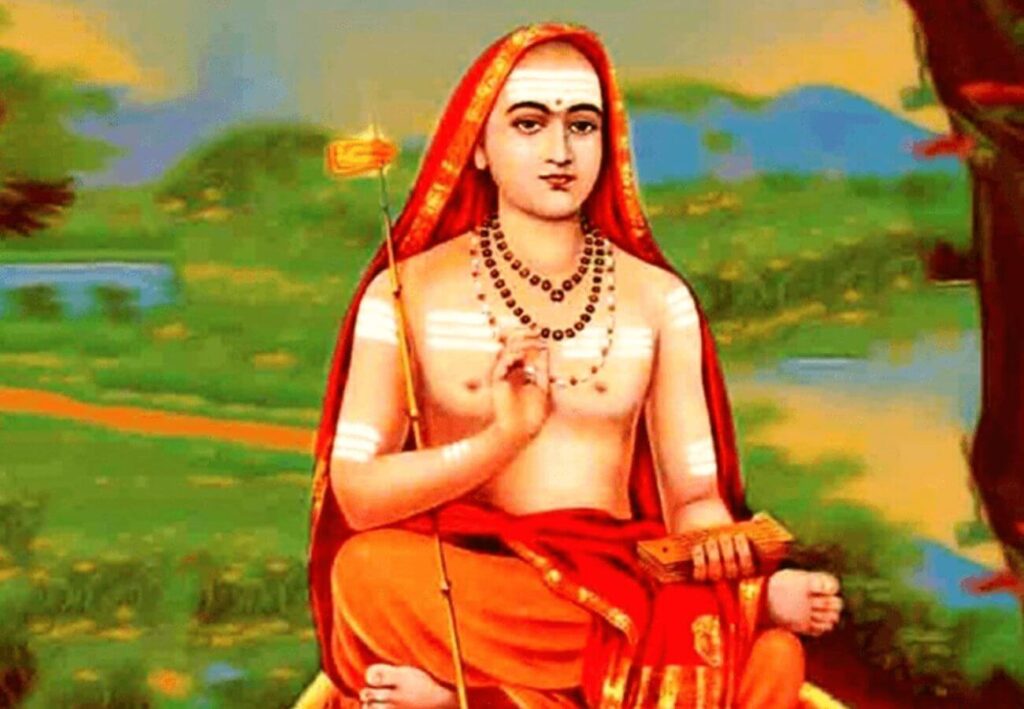
- Birth – 788 AD
- Where: In “Kaldi” village on the banks of the Purna River in Kerala.
- Father – Shiv Guru; Mother – Subhadra/Ayyappa
- Guru – Govinddevpada gave the title to Shankar Paramhansa.
- Title – Disguised Buddhist He was influenced by the Mahayana sect.
- His mother sent Shankar to Kaladi Guru for studies at the age of 5. He took sannyas at the age of 8 after taking permission from his mother.
- Opinion: “Non-dualism” (Advaita) – Brahma Satya Jagat Mithya
- Literal meaning – Not having two means unity
- First of all, Gaud Padacharya explained Advaita and said that both the living being and Brahma are one. His disciple Govindacharya said that the difference between soul and God is of Maya.
- Govindacharya’s disciple Shankaracharya explained the meaning of Maya as Avidya/Ignorance.
- He met the great Acharya Kumaril of North India. After meeting Kumaril said, “I have a husband and wife who are experts in Vedic rituals” (1. Mandana Mishra). 2. Bharati)
- He called both of them to the banks of Narmada and debated.
- In this Shankar defeated both of them; both husband and wife became disciples of Shankar. He took both of them to South India. There he established Shringeri Peetha on the banks of Tungabhadra River.
- Kumarilla, the greatest scholar of northern India, reestablished Vedic religion.
- In Sringeri, Shankaracharya got the news of the death of his mother Subhadra. Hearing this, tears came out of the eyes, renouncing retirement from sanyas.
- After this it came to Eastern Ghat, Puri, Odisha
- Arrived at Kedarnath for the last time and died at the age of 32 (820 AD).
- Sect – Smriti/Smarta Sect
- Established four Peethas—
- (1) Shringeri Peetha – 804 AD in Mysore, Karnataka. The Peetha is dedicated to Lord Shiva. The Acharya was Mandal Mishra.
- (2) Govardhan Peetha – 808 AD in Jagannath Puri(Orissa). This Peetha is dedicated to Vishnu, Bhairavi, Subhadra, and Balarama.
- (3) Jyoti Peetha – 910 AD in Badrinath (Uttarakhand). This Peetha is dedicated to Vishnu. His Acharya was Trotakacharya
- (4) Sharada Peetha – Dwarka in Gujarat. This Peetha is dedicated to Lord Krishna.
- Major texts :- (in Sanskrit language)
- commentary on Brahmasutra
- Vedas, Upanishads (12), Commentaries on Geeta
- Saundaryalahari
- Vivek Chudamani
- Manisha Pancham
- Aparokshanubhuti
- Physical commentary “Bhamti.”
Note –
- Shankaracharya could not become as famous as Ramanuja or Madhvacharya because he spoke Sanskrit, which was not the language of the common people.
- Ramanand became famous and made Hindi his base.
- Bridge of Bhakti movement
- Ramanand brought the Dravidian origin
- Brought Bhakti from South to North India
Ramanujacharya: –
- Theory – Vishishtadvaita
- ‘Vishishtadvaita’ means that ‘Brahma,’ i.e. God, despite being non-dual, is distinct from the powers of the living beings and the world. Both the living beings and the soul are different but are born from Brahma and are connected to Brahma in a specific way, just like the rays are connected to the sun. The rays have their independent existence on the earth from the sun, but they are specifically related to the sun; such is the relationship between the living being and Brahma.
- Sect “Sri Sampradaya”
- Born – 1017 AD in Perumbudur, Tamil Nadu
- Made devotion the basis of philosophy.
- Main centers: Kanchi and Srirangam (Tamil Nadu).
- Taught in temples for a long time.
- Guru – Yamunacharya (Alwar was a southern saint who had complete devotion towards Vishnu)
- In Kanchi, he made Yadav Prakash his guru. He learned the Vedas and Upanishads from him.
- “Ramanuja—”Knowledge is not the means of salvation; nothing is better than devotion for attaining salvation.”
- The Tamil ruler Kulothunga-I of the Chola dynasty, who was from the Nayanar side, opposed Ramanuja. Ramanuja had to leave Srirangam.
- After leaving, he made Tirupati (Andhra Pradesh) his center.
- He was of Saguna ideology.
- Major texts:
- Vedanta Sangraha
- Sribhashyam
- Geeta Bhashyam
- Vendant Deepam
- Vedanta Saram
- Sharanagati Gadyam
Madhvacharya :- (Saint of the 12th-13th century)
- Theory – Dualism (soul, god) 2 elements
- Sagun stream – Vishnu is considered a god.
- Birth – 2 views. [1199-1276 AD, 1238-1317 AD]
- Where—Originally from South India Udupi, Karnataka.
- “Titles—”Poornapragya,” “Anandtirtha,” and “Third incarnation of Vayu” (first Hanumanji, second Bhima)
- Social work—Banned animal sacrifice during yagya.
- Sect—”Brahma Sampradaya
- Dwaitvaad—They said that the soul and the Brahma are not the same but different; this is duality
- Madhvacharya gave the Pancha Bheda theory to explain this difference, which is as follows:
- God is eternally different from the world.
- God is eternally different from the soul.
- The world is also eternally different from the soul.
- There is an eternal difference between one living being and another living being.
- There is an eternal difference between one inanimate object and another inanimate object.
Major texts
- Anu Bhashyam
- Nyaya Vivarana
- Geeta Bhashyam
- Rig Bhashyam (commentary on the first 30 hymns of the Rigveda)
- Ramanuja and Shankaracharya opposed the philosophies of both (refutation of the argument)
- According to Madhvacharya, two types of people cannot attain salvation.
- (1) Nitya Samsari – those who are bound in the worldly cycle.
- (2) Tamo yogya – those who have to go to hell.
Nimbarkacharya: (12th/14th century)
- Born in Chennai, Vellari (Telugu Brahmin)
- Idea—Dvaitadvaita/Bhedabheda—According to them, whether there is unity or difference between the soul and the Brahman depends on the soul itself. They said that the soul may or may not attain Brahman, but the origin of both is the soul. Like the snake is coiled or spiral, gold is liquid or an ornament; clay is a ghat or a pot, lamp is wisdom or a wick, etc.
- Sect – Sanaka sect
- Considered to be a contemporary of Ramanuja.
- Established his main ashram in Mathura-Braj.
- Nimbarkacharya believed in incarnation.
- Radha = Lakshmi
- Krishna = incarnation of Vishnu
- Considered as the “incarnation of Sudarshana Chakra. “Radha and Krishna are worshipped as a couple
- Nimbarka Peeth in Rajasthan is located in Salemabad, Ajmer.
- Marital devotion is considered the best.
Vallabhacharya: –
- Birth – He was born in Champaran (near Raipur, Chhattisgarh) while his parents were on a pilgrimage.
- Education, Varanasi
- Theory – Shuddhadvaita Vaad – The living being is true, the world is true, and the soul is also true. Everything originates from Brahma; hence, Brahma is the only truth.
- Contemporary ruler – The Vaishnava sect was established during the time of Krishnadevaraya, the ruler of Vijayanagara (the first Hindu empire).
- 2 books were written during the time of Krishnadevaraya:
- 1. Subodhini,
- 2. Siddhant Rahsayay
- He worshipped the child form of Shri Krishna and considered it pure. He worshipped him as “Shrinathji.” He built a grand temple of Shrinathji in Vrindavan and installed his idol.
- During the time of Aurangzeb, this idol was taken to Udaipur. It was later installed in Nathdwara, Rajsamand.
- In 1668, Aurangzeb issued an order to break the idols.
- During the time of Rajsinghji, his son Vitthal brought this idol to Udaipur.
- “Rudra Sampradaya” was founded by Vallabhacharya. Vallabhacharya was a contemporary of Chaitanya Mahaprabhu.
- The followers of Rudra Sampradaya believe in Pushti Marg and Bhakti Marg.
- Akbar gave the jagirs of Gokula and Jetpura to Vithalnath.
- Vithalnath founded the Ashtachhaap Mandali in 1565 AD.
- Disciples of Vithalnath
- Keshavdas
- Govindaswami
- Surdas
- Chhit Swami
- Parmanand Das
- Chaturbhuj Das
- Krishnadas
- Nandadas
Chaitanya Mahaprabhu
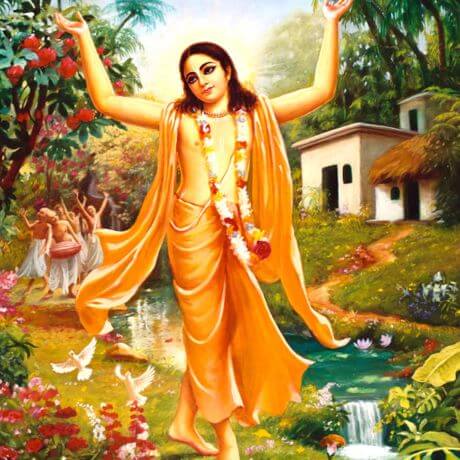
- Birth – 1486 AD
- Where: Bengal, in a village named Nadia
- Childhood name— Vishwambhar Nath
- Real name – “Nimai”
- First Guru – Ganga Das
- Real Guru – Keshava Bharati
- Sampradaya—Establishment of the moderate Gaudiya Sampradaya in Bengal.
- Chaitanya’s was a revivalist movement, not a syncretic one, a return to the worship of a radiant form of Vishnu, the loving and ecstatic Krishna.
- The Vaishnavites of Bengal did not attempt to reform Hinduism. Instead, they emphasized devotion to Krishna. Chaitanya, however, made disciples from all classes. He popularized the practice of group singing of devotional songs and ecstatic dances. His movement became popular in Bengal and Orissa.
- Vaad – Achintya Bhedabheda is the knowledge which is not understandable by logic. It means that which makes the impenetrable impenetrable and the impossible possible. That scripture-based knowledge is called “Achintya Gyan.”
- According to Mahaprabhu, the difference between the soul and Brahman cannot be explained by logic and intellect. The only way to understand is through scripture study.
- Every creature in the world is worthy of Krishna bhakti.
- The followers of Chaitanya Mahaprabhu considered him to be an incarnation of Vishnu and Krishna.
- Other names: Gauranga Mahaprabhu, Chaitanya, Baldev Vidya Bhushan
- His main disciple—Haridas—founder of Sakhi sect
- The thoughts and teachings of Chaitanya were compiled by Kaviraj Krishnadas under the name “Chaitanya Charitamrita.”
- Only 8 verses composed by him are available. These are called Shikshashtang.
- The originator of the Kirtan tradition. He was the first to sing Hare Ram Hare Ram Ram Ram Hare Hare, Hare Krishna Hare Krishna Krishna Krishna Hare Hare Hare Rama Hare Krishna
- Son of Shri Krishna made three idols—chest, feet, body
- The idols were hidden to save them from Mahmud Ghaznavi’s Mathura attack.
- Amer King Mansingh I built a temple in Vrindavan for these idols.
- Later, during the reign of Sawai Jai Singh II, the statues were brought to Jaipur.
- In Rajasthan, the Peeth of this sect is Govind Dev Ji (face) Jaipur, other Peeth is Gopinath Ji Temple (chest) Jaipur, Madan Mohan Ji Temple (foot) – Karauli –
- The founders of this Peeth in Rajasthan are considered to be Sanatan Goswami and Roop Goswami.
- The Kachwaha dynasty of Amer not only gave shelter to this faith but also considered Govind Dev Ji as the lord of their kingdom and called themselves his Diwan.
- In this tradition, it was Jeev Goswami who taught Kirtan to Meera Bai.
Ramanand: – (15th century)
- Credit for making the Bhakti movement popular
- Statement: Dravidian Bhakti originated from Ramanand
- Credit for bringing the Bhakti movement from South India to North India. Hence, he is called the Ram Setu of North and South Bhakti movements.
- Ramanand lived with Saint Raghavanand of Sri Sampradaya for some time and made him his guru.
- Guru – 1. Ramanand was a disciple of Ramanuja.
- Birth—In Allahabad in a Kanyakubj Brahmin family
- But this is not authentic because some scholars believe that he was born in the south.
- Father – Punyasadan
- Mother: Sushiladevi
- Worshiped Ram instead of Vishnu
- Some teachings of Ramanand are also in Adi Granth.
- Gave sermons of the Sagun Bhakti stream in the Hindi language, hence the most popular saints.
- Established coordination between Shaiva and Vaishnava in Prayag.
- Did not believe in caste system
- Opposed the caste system and external pomp and show and gave his teachings to people of all castes.
- Therefore, he considered all castes equal and made disciples from all castes.
- A total of 12 disciples (2 female disciples): Kabir (weaver), Sen (barber), Raidas (cobbler), Pipa (Rajput, Kshatriya), Sursuranand, Sukhanand, Dhanna (Jat), Narharidas, Anantanand, Bhavanand, Padmavati, Sursari etc.
- Those who had abandoned Hinduism and accepted Islam after being influenced by Ramanand’s ideas had embraced Hinduism again.
- In Rajasthan, the main seat of this sect is Galta Tirth, Jaipur, which is also known by the names Galav Tapobhoomi, Uttar Totadri, Monkey Valley, Banaras of Jaipur, second Kashi, etc. It was established by Krishna Das Payhari, and the sub-seat is Rewasa Dham Sikar; this seat was established by Agradas ji.
- The sadhus of this faith are called Bairagi.
- The Kachwaha dynasty of Amer also gave shelter to this dynasty.
- Major texts: –
- Vaishnavmatabj Bhaskar
- Ramrakshasrotratam tika
- Sidhhantpatal
- Gyan Leela
- Yoga Chintamani
- Satnam Panthi
Meera Bai:
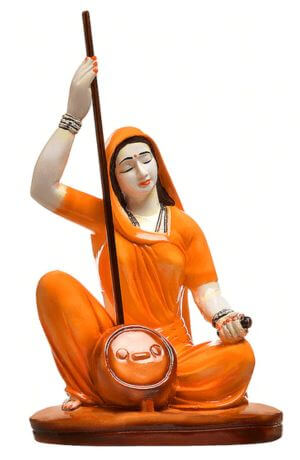
- Birth – 1498 AD
- Childhood name: Pemal De
- Where: Merta, Kudki, Pali (present-day Nagaur)
- Father – Raja Ratan Singh
- Husband – Bhojraj, son of Rana Sanga (married in 1516 AD)
- The great female saint of the Bhakti period, she is compared to Sufi female saint “Rabia.”
- Guru—Jeeva Swami—Chaitanya sect
- Spiritual Guru-Raidas/Ravidas
- After the death of her husband, Bhojraj, she got absorbed in Krishna Bhakti.
- Considered Krishna as her husband (beloved) and did sweet and graceful Bhakti
- Her bhakti is called Padavali.
- Language—It was a mixed Braj language of Rajasthani
- Rasa: Viyog Shringar and Shant
- She merged in the temple of Ranchhodrai in Dwarka. (Legend)
- Main texts:
- Narsi ji ro mairo [by inspiring Ratna Khati]
- Commentary on Geet Govind
- Raga Govind
- Meera Bai’s Malhar
- Raga Soratha
- Satyabhama Ro Rusno
- Rukmani Mangal
Kabirdas: –
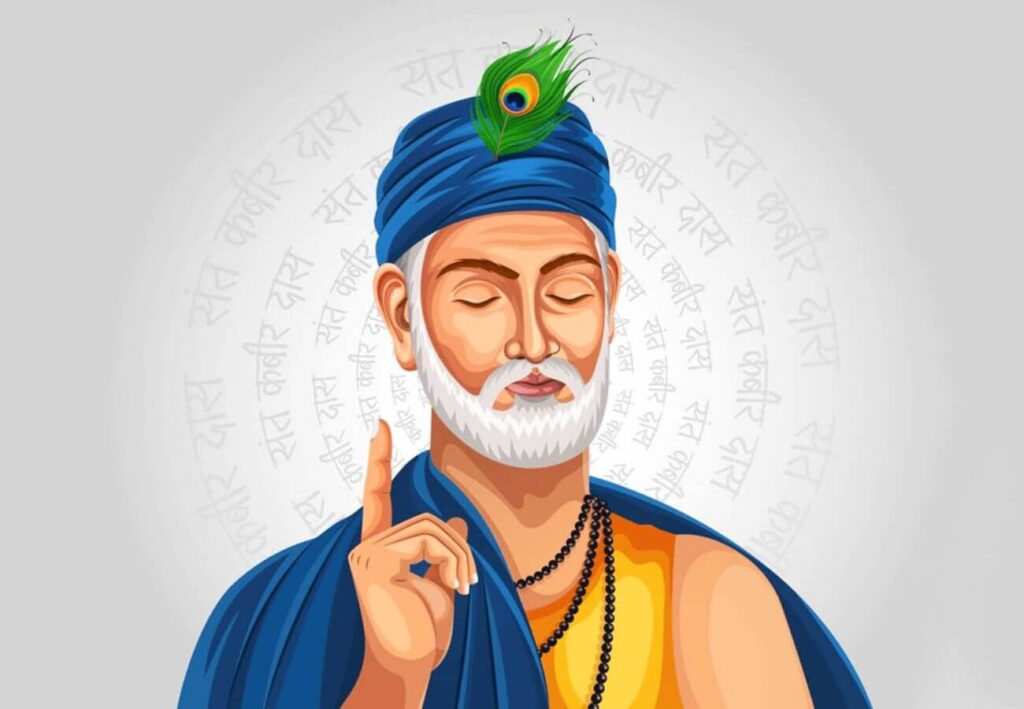
- Birth – 1440 AD (1398 AD is also considered the birth year.)
- Where—Kashi (Varanasi) at the confluence of Varuna and Assi rivers
- Mother – Unknown (But according to folklore, he was born to a widowed Brahmin woman who, out of fear of public disgrace, left him in a basket on the banks of the “Lahartara Pond.”)
- Upbringing—He was raised by Neeru and Neema (a weaver couple).
- Name – Kabir (Arabic word meaning “noble”)
- Guru – Ramanand [Learned Vedanta philosophy.]
- According to the popular Tazkira-e-Auliya-e-Hind (lives of Muslim saints), he was a disciple of Muslim Sufi Sheikh Taqi.
- Bhakti Marg—Nirguna Bhakti stream
- Kabir did not believe in the ideology of renunciation.
- The first saint of Nirgundhara who lived a householder’s life.
- Wife – Loi
- Son-Daughter – Kamal-Kamali
- Influence – Advaita/monotheism, pure dualism
- Fakkar saint of revolutionary ideology among all contemporary social reformers
- Kabir was a religious extremist who equally criticized the narrowness of sectarianism of both Hinduism and Islam. His message appealed greatly to the lower classes of the Hindu community. The most important features of his teachings were opposition to polytheism, idolatry, and the caste system. He equally condemned Muslim formalism.
- He was a true seeker of God and made every effort to break down the walls that existed between Hindus and Muslims. However, what attracted his followers the most was his deep conviction that he had found the way to God, accessible to all from the lowest to the highest class.
- He was a harsh critic of the social caste system.
- He did not support wealth accumulation and luxury.
- Kabir’s contemporary ruler Sikandar Lodi
- Abul Fazal called Kabir “Muwahid” (monotheist)
- In his last days, he went from Kashi to Maghar (UP).
- He composed verses and couplets but did not write any book.
- Kabir was called the “saint of saints.”
- Kabir’s verses are compiled in Guru Granth Sahib (Adi Granth).
- Kabir’s teachings are compiled in Bijak, which was compiled by his disciple (Dharamdas/Bhagdas).
- Kabir’s chhatri is in Maghar.
- Bijak:
- Sakhi Doha style, compilation of educational principles
- Shabd, Shabd, Pad style, love and inner meditation
- Ramaini Doha style, philosophical thoughts expressed
- Cult – Kabirpanth was established in Kabir Chaura (Kashi).
- After Kabir’s death, Dharamdas ascended the throne.
- Kabir’s main followers – Maluk Das (1574)
- Born in Allahabad. He propagated Kabir’s ideology the most.
- Dr. Hazari Prasad Dwivedi called Kabir “Yugpurush,” “Yugavatar,” “Yug Pravartak,” and “Dictator of speech.
Ravidas / Raidas:
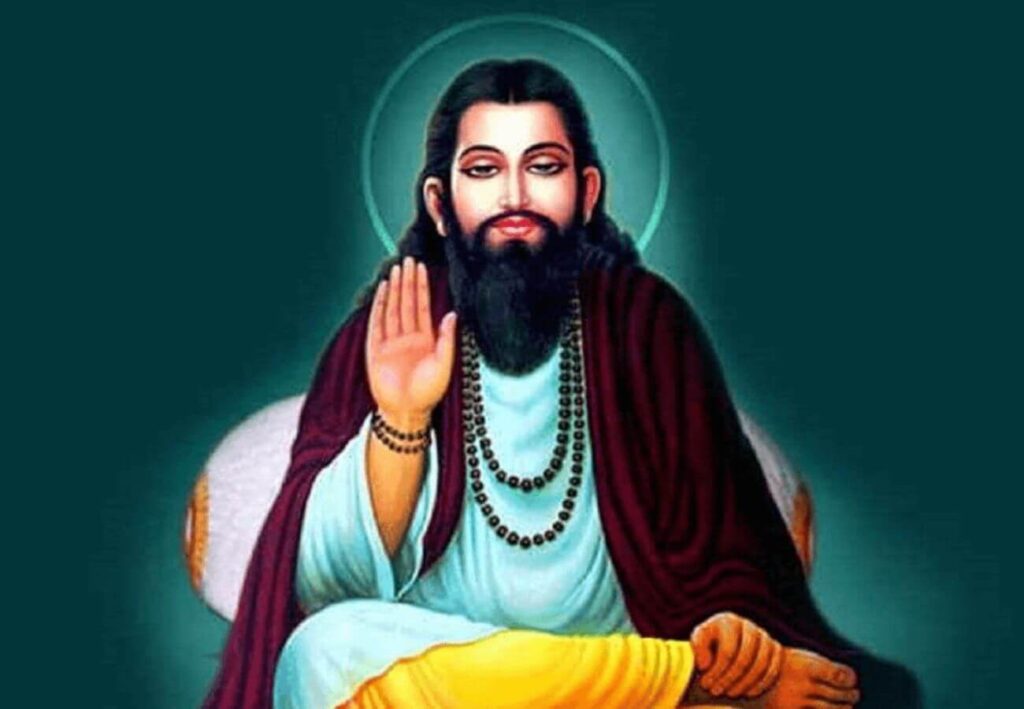
- Birth – Kashi in 1398 AD
- Father – Rahu (Chamar Caste)
- Mother—Karma
- Foster couple – Santokdas and Kalsadevi
- Wife – Lona
- Guru – Ramanand
- Source of information Kabir Parchai
- Emphasis on purity of mind.
- Raidas were against pilgrimage, fasting, bathing in rivers etc.
- Service to humanity is the true religion.
- He remained engaged in business throughout his life. Taught the society to attain salvation through karma.
- He gave sermons to Sikandar Lodi. He was a contemporary of Babar, Humayun, and Sher Shah Suri.
- Kabir and Raidas were both guru brothers.
- Kabirdas called Raidas the saint of saints.
- He founded the Raidas sect in Kashi.
- He was the spiritual guru of Chittor’s queen “Jhali” and devotee Shiromani Meera.
Tulsidas:
- Birth – 1511/1532, Rajapur, present name Kasganj
- Where: Rajapur, Banda district, UP
- Father – Atmaram Dubey
- Mother: Hulsi Devi
- Wife – Ratnavali
- Guru – Narharidas (of Ayodhya)
- Childhood name: Rambola
- Contemporary of Akbar
- Composed “Ramcharitmanas” in the Awadhi language in 1574 AD (1631 Vikram Samvat).
- Time taken in composition: 2 years 9 months 26 days
- Other name: Tulsi Ramayan
- Total verses—10902
- 7 chapters (longest): Ayodhya, Aranya, Kishkindha (shortest), Sundar Kand, Lanka/Yuddha, Uttar
- Tulsidas is called “Abhinav Valmiki.”
- Tulsi’s philosophy follows Vishishtadvaita
- Death of Tulsi – Assi Ghat (Kashi)
- Temple of Tulsi Ji—Kanch Mandir (Chitrakoot, Madhya Pradesh)—Idol is installed.
- Major texts
- Vinay Patrika (Tulsi’s last book)
- Vairagay Sandipani
- Dohavali
- Kavitavali and Krishna Geetavali
- Geetawali
- Parvati Mangal
- Janaki Mangal
- Ramlala Nahchu
- Barvai Ramayana
- Hanuman Bahuk
- Ramagya Prashan
Sur Das
- Birth – 1478 CE, either in Runkata (near Agra-Mathura) or Sihi village (near Delhi),
- Father – Ramdas
- Guru – Vallabhacharya (Vaishnava Saint)
- Associated with Akbar’s court, known as the blind poet of Agra.
- Bhakti Movement—A Saguna Bhakti saint devoted to Krishna Bhakti.
- Poetry – Inspired by Krishna’s life and childhood leelas.
- Philosophy – Love is a divine spiritual emotion, reflected in the Gopis’ devotion to Krishna, symbolizing the soul’s natural attraction to the Divine.
- Language—Composed his entire poetry in Braj Bhasha.
- Surdas ji is considered the sun of Hindi literature.
- The main theme of Surdas’s poems was the childhood pranks of Krishna.
- Major texts: –
- Sursagar—Most famous work/Was composed during Akbar’s time. It is the story of Shri Krishna’s life, which describes the events from his birth to his visit to Mathura.
- Sur Saravali – Acting
- Sahitya Lahari
- He was a contemporary poet of Akbar and Jahangir.
- Death – 1583 AD, Parasoli, Govardhan, Uttar Pradesh
- On the death of Sur, Goswami Vitthalnath said, “A ship is going towards Pushti Marg, so whoever has to take something, I will take it.”
Dadu Dayal:
- Birth/Place of Birth—1544-1603 AD Ahmedabad, on the banks of Sabarmati river
- Death- in Naraina (Jaipur)
- Father-Foster Father-Lodiram Brahmin
- Guru – Kabir’s best disciple (Vridvanand)
- Dadu Dayal is called the “Kabir of Rajasthan.”
- Dadu Dayal founded the “Dadupanth” in 1554 AD in Naraina (Naraina) near Jaipur. It is considered his main seat.
- He opposed idol worship and the caste system.
- Dadupanth has 5 branches: Khalsa, Naga, Khaki, Uttarade, Virakt
- Dadu’s teachings—”Dadu Ra Duha,” 5000 verses in “Dadu Vani”—in Dhundhari Sadhukkari language (Western Hindi)
- Satsang place of Dadupanth—Alakh Dariba
- Dadu preached the Dadupanth sect.
- Dadu had a total of 152 disciples.
- Dadu preached the Nipakh sect.
- Dadu’s 52 disciples are called 52 pillars.
- Prominent disciples: –
- Sundardas
- Garibdas
- Rajjab ji
- Miskindas
- Balind
- Bakhna
- Rajjab ji said, “This world is Veda; this creation is Quran.” After Dadu’s death, Garibdas ascended the throne.
- Instead of cremating the dead body, the Dadupanthis leave it in the jungle for animals to eat. (But nowadays cremation is prevalent.)
- Garibdas had fed many people with just one Kamandal and one bag.
- Akbar had called Dadu Dayal to Fatehpur Sikri for religious consultation. Influenced by him, Akbar banned cow slaughter.
Guru Nanak:
- Birth – 1469 AD
- Where: Talwandi (Punjab), called Nankanasahib.
- Father – Lal Kalyan Rai – Title “Mehtakalu Ji”
- Mother – Tripta Devi
- Wife – Sulkhana devi
- He was a saint of the Nirgun Bhakti tradition.
- He did not believe in casteism.
- He worshipped the Nirgun God and called him Akaal Purush.
- Guru Nanak’s disciple Mardana played sarangi.
- Guru Nanak himself sang bhajans with the rabab.
- Guru Nanak’s songs and teachings are compiled in the Aadi Granth, Guru Granth Sahib.
- Udasiyan—India, Afghanistan, Arabia, and Persia—traveling 4 times in these countries are called Udasiyan.
- He also visited Sri Lanka, Mecca, and Medina.
- After traveling to various countries, he finally started teaching in Kartarpur.
- Guru Nanak died in Kartarpur.
- A total of 10 gurus in Sikhism were called the first Guru Nanak and his disciple “Sikh.”
- Guru Nanak
- Guru Angad
- Guru Amar Das
- Guru Ramdas
- Guru Arjun Dev (compiler of Adi Granth)
- Guru Hargobind
- Guru Har Rai
- Guru Harkrishan
- Guru Tegh Bahadur
- Guru Gobind Singh (Foundation of Khalsa Panth
Narsi Mehta: (15th century)
- Born in Junagadh Talja village (Gujarat)
- Father: Krishna Damodar
- Wife – Manikbai
- Wrote 1 lakh couplets of Krishna devotion.
- Called the “Surdas of Gujarati literature.”
- Bhajan – Vaishnavjan to tene kahiye, peer parayi jane re…
- Mahatma Gandhi’s favorite, Narsiji, composed it.
- Major Texts: 9
- Shyamal Das’s marriage
- shringarmala
- Haar mala
- Surat Sangram
- Govindagaman
Shankardev: –
- Where from Assam—”Chaitanya Mahaprabhu of Assam.”
- He was a saint who was a devotee of Lord Shri Krishna but opposed idol worship.
- Sect – He founded the Eksharan sect.
- Nirgun saint—did not believe in renunciation.
- Did not believe in a female companion of God.
- The Bhagavad Purana was worshipped in his temples.
- Main book – Shankardev’s “Bhakti Ratnakara”
Bhakti movement in Maharashtra: –
- Inspirer :- Vithoba (God of Pandharpur, incarnation of Vishnu)
- Maharashtra’s religion was divided into 2 parts.
- Barkari/Varkari – People who perform Varkari Parikrama, people of gentle nature, religion of emotional people; they used to worship Krishna.
- Founder – Saint Tukaram
- Dharkari/Dharna belonged to the Ramdas sect and lived in one place. They worshipped Ram. They were ideological people.
- “Ramdas was the founder of Dharkari sect
- Major saints of Vithoba: Major saints of Varkari sect Gyandev, Namdev, Tukarama
Saint Gyaneshwar: (1285-1353 A.D.)
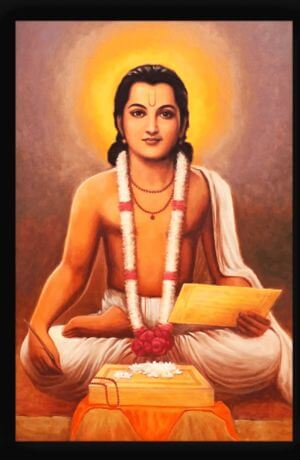
- Born in 1285 A.D. in Aurangabad, Maharashtra
- Guru – Nivruttinath
- Father – Vittapant
- Mother: Rukmani Bai
- Books of gyandev: –
- Commentary of Srimad Bhagavad Gita in the Marathi language is called “Gyaneshwari” and “Bhavartha Deepika.”
- Amritanubhava
- Changdev Prashasti
Saint Namdev: (1270-1350 A.D.)
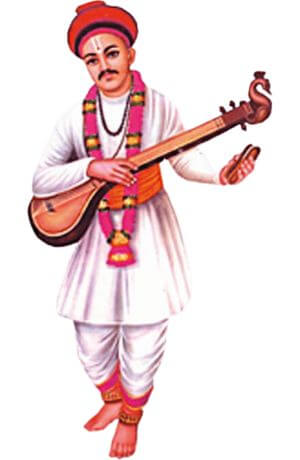
- Born October 26, 1270, in Pandharpur, MH, River Narsi Bamni village (on the banks of Krishna River).
- Father – Damaseth
- Mother – Gaundevi
- Wife – Rajabai
- Guru – Visoba Khechar (Vithoba)
- Namdev belonged to the Chhipa caste.
- Namdev was a dacoit in his childhood but became a saint after a change of heart.
- Namdev, an ardent devotee of Vithoba (an incarnation of Vishnu) of Pandharpur, spent most of his time in worship and sang praises with his followers, mainly in his own compositions.
- He wrote many abhangs (songs composed and sung by saints in the glory of God) in Marathi and Hindi.
- His message was to “love God and live life with all your devotion with dedication.”
- 61 Padyas (poems) are included in the Adi Granth.
- Debated with Sufi saints in Delhi.
- Namdev travelled to many places with Sant Gyaneshwar, and after his death, he left Maharashtra and settled in Dhoman village in the Gurdaspur district of Punjab.
- Both Hindus and Sikhs were devotees of Namdev.
Saint Tukaram
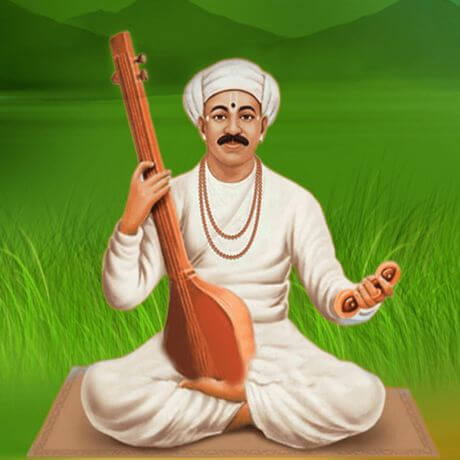
- Born – 1608 in a village near Pune [Maharashtra]
- Father: Bolhoba/Bahela, Mother: Kanakai
- Wife – Jijabai
- Caste—Despite being a Shudra, he himself worshipped Vithoba
- Book – Tukaram ri Vaani: He wrote his Abhangs in Marathi.
- He was a contemporary of Maratha Shivaji and saints like Sant Eknath and Ramdas.
- After his business life, he started spending his time singing devotional songs in praise of his favorite deity, Vithoba of Pandharpur.
- Tukaram believed in a formless God.
- According to him, it was not possible to achieve spiritual bliss with worldly activities. He gave importance to the omnipresence of God.
- He rejected Vedic sacrifices, rituals, pilgrimages, idol worship, etc. He preached the importance of purity, forgiveness, and mental peace.
- He spread the message of equality and brotherhood and tried to promote Hindu-Muslim unity.
Eknath ji: (1533-1599 AD)
- Born in Pethan, Aurangabad (Maharashtra)
- Guru – Janardan Swami
- Was influenced by Saint Gyaneshwar. Published a reliable issue of “Gyaneshwari.”
- Texts-
- Commentary on four verses of Bhagavad Gita
- Chatushloki Bhagwat
- Bhavarth Ramayana
- Rukmini Swayamvar
Samarth Guru Ramdas: (1608-1681 A.D.)
- He was the spiritual guru of Shivaji.
- He started the Parmarth sect.
- Major texts – Dasbodh



