

Centre-State Relations is an important topic in Indian Polity that deals with the distribution of powers and responsibilities between the Union and State governments. It is governed by constitutional provisions related to legislative, administrative, and financial relations. A balanced Centre-State relationship is essential for maintaining federal harmony and effective governance in India.
Centre-State Relations
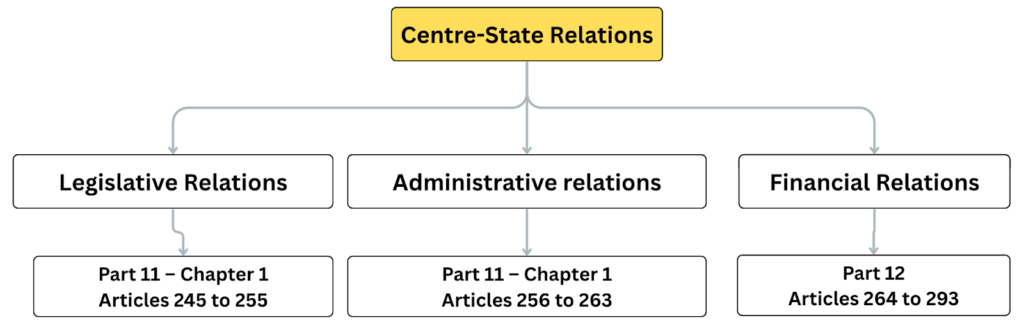
- The Indian Constitution is federal in nature, with legislative, executive and financial powers divided between the Centre and the states.
- However, the judicial system is single – it enforces both central and state laws.
- The Constitution views Centre-State relations from three perspectives:
- Legislative Relations
- Administrative Relations
- Financial relations
Articles related to Centre-State relations
| Article | Subject matter |
| Legislative Relations(Part 11 – Chapter 1)(Articles 245 to 255) | |
| 245 | Scope of laws made by Parliament and State legislatures |
| 246 | Subject matter for legislation by Parliament and State Legislatures |
| 247 | Power of Parliament to establish certain additional courts |
| 248 | residuary powers of legislation |
| 249 | Parliament’s power to legislate on matters in the State List in the national interest |
| 250 | Legislative power of Parliament on matters in the State List during an emergency |
| 251 | Inconsistency between laws made under Articles 249 and 250 and laws of the State Legislature |
| 252 | Legislation by Parliament with the consent of two or more states |
| 253 | Legislation to implement international agreements |
| 254 | Inconsistency between laws of Parliament and State Legislature |
| 255 | Adherence to procedural recommendations and approvals |
| Administrative Relations(Part 11 – Chapter 1)(Articles 256 to 263) | |
| 256 | Responsibilities of the States and the Union |
| 257 | Union control over the states in certain matters |
| 257-A | Deployment of Union forces in the states (repealed) |
| 258 | Power of the Union to delegate functions to the States |
| 258-A | Power of the States to entrust functions to the Union |
| 259 | Armed Forces in Part B States of the First Schedule (Repealed) |
| 260 | Jurisdiction of the Union outside India |
| 261 | Public activities, records and judicial proceedings |
| 262 | Adjudication of water disputes involving inter-state rivers or valleys |
| 263 | Provisions relating to Inter-State Council |
| Financial relations (Part 12)(Articles 264 to 293) | |
| 268 | Taxes levied by the Union and collected by the States |
| 268-A | Service tax: imposed by the union, collected by the state |
| 269 | taxes levied by the Union but assigned to the states |
| 270 | Distribution of taxes levied by the Union and the States |
| 271 | Union Surcharge |
| 272 | Distribution of taxes (repealed) |
| 273 | Subsidy for export duty on jute products |
| 274 | Supreme Court’s recommendation on tax bills |
| 275 | Grants to certain states |
| 276 | Taxes on profession, trade, calling and employment 277 Protection of earlier taxes |
| 278 | Financial Agreements relating to First Schedule Part-B (Repealed) |
| 279 | Calculating “Total Receipts” |
| 280 | Finance Commission |
| 281 | Recommendations of the Finance Commission |
| 282 | Sanction of expenditure by the Union/State |
| 283 | Consolidated Funds, Contingency Funds and Public Accounts |
| 284 | Security of money received by public servants |
| 285 | Exemption from state taxes on federal properties |
| 286 | Taxation restrictions on sale/purchase of goods |
| 287 | Exemption from tax on electricity |
| 288 | Tax exemption by states on electricity and water |
| 289 | Exemption from federal taxes on state income/property |
| 290 | Adjustment of expenses and pension |
| 291 | Privy Purses of the Rulers (Abolished) |
| 292 | Borrowing by the Government of India |
| 293 | Borrowing by State Governments |
Legislative Relations(Part 11 – Chapter 1)(Articles 245 to 255)
The Constitution divides legislative powers on two bases –
- Legislation: In terms of extent (Article 245)
- Legislation: In terms of subject-matter (Article 246)
Legislation: In terms of extent (Article 245)
Article 245 states the limits of the law-making power of the Parliament and the State Legislature.
Article 245(1):
- Parliament can make laws for the whole or any part of the territory of India.
- State legislatures can make laws for the whole or any part of their respective territories.
Article 245(2):
- Extraterritorial operation of the law made by the Parliament is also possible.
Doctrine of Extra-Territorial Operation
- Unlimited territorial jurisdiction of the Union Parliament
- No law shall be invalid merely because it applies outside India.
- Laws made by Parliament shall apply to persons and property situated within India, and may also apply to Indian citizens resident abroad and their property.
Doctrine of Territorial Nexus
- The state legislature can make laws only within the boundaries of its state, not outside.
- But if the law has a real and substantial nexus with the state, then it will be considered valid.
- The relationship between the state and the subject matter of the law should be real, not imaginary.
- Example :
- Religious Trusts Act –
- Some of the trust’s assets were outside the state.
- The SC ruled that since the trust and the trustees are in the state, there is sufficient connection and the Act is valid.
- Gujarat Land Act (Ceiling Law):
- Land held in other states was also counted for determining the land ceiling in Gujarat.
- The SC held it valid as there was a sufficient nexus between the objective of land reform and the state.
- Mumbai Competition Act:
- The company was incorporated outside the state but the competition and collection of money took place in Mumbai.
- SC said that there is sufficient connection, hence the state tax is valid.
- Religious Trusts Act –
Exception:
In some circumstances the power of the Parliament or the State Legislature is limited –
- Article 240: The President can make regulations for the Union Territories (such as Andaman and Nicobar, Lakshadweep, Dadra and Nagar Haveli and Daman and Diu, Puducherry).
- Scheduled Areas (5th Schedule): The Governor can direct that the laws of Parliament shall not apply to the Scheduled Areas.
- Autonomous Districts of Assam: The Governor can order non-implementation of the law of Parliament.
- The laws of Parliament can also apply to Indian citizens living outside India.
- Under certain circumstances, the law of the State Legislature can be applicable outside the State also.
- If there is overlapping between the Union List and the State List, the Union List will be given priority (Principle of Supremacy).
In terms of subject-matter (Article 246)
- The Seventh Schedule of the Constitution divides legislative subjects. It contains three lists:
- Union List – Exclusive Power of the Parliament.
- State List – Privileges of the State Legislature.
- Concurrent List – Rights of both Parliament and the States.
Article 246(1):
- Parliament has exclusive power to make laws on the Union List.
Article 246(2):
- Power on Concurrent List to both Parliament and State.
Article 246(3):
- Power of State Legislature over State List.
Article 246(4):
- Parliament can also make laws on areas which are not under any state, even if the subject is in the State List.
Article 246A –
- GST (101st Amendment, 2016)
Article 246A(1):
- Power of both Parliament and State Legislatures to make laws on GST.
Article 246A(2):
- Parliament alone has the exclusive power to make GST laws in relation to inter-state trade and commerce.
Article 247
- Empowers Parliament to establish additional courts for the better administration of laws relating to subjects in the Union List.
- This provision relates only to the Parliament and not to the State Legislature.
Residuary Powers – Article 248
- Parliament has the power to make laws on subjects which are neither in the State List nor in the Concurrent List.
- This provision has been taken from Canada (where the residuary powers are with the Centre).
- In the US, Australia and Switzerland, residual powers are held by the states.
- Under the Government of India Act 1935, this power was vested in the Governor-General.
- It is the function of the judiciary to decide whether a matter is residuary or not.
- Cybercrime is an example of a residual issue.
- The residuary subject is mentioned in Schedule 7, Union List, Entry 97 – “Any other matter”.
Legislative power of Parliament on the State List
- Generally, only the State Legislature has the right to make laws on the subjects of the State List.
- But the Constitution also gives this power to the Parliament under certain special circumstances.
Article 249 – In the national interest
- The Rajya Sabha can empower the Parliament to make laws on the State List.
- terms :
- The resolution must be passed by a 2/3 majority of the members present and voting in the Rajya Sabha.
- This resolution gives the Parliament the power to make laws on the State List.
- Duration :
- This power lasts for a maximum of one year.
- It can be extended by one year each time.
Article 250 – In case of emergency
- When emergency is imposed under Articles 352, 356, 360 of the Constitution, Parliament can also make laws on subjects in the State List.
- This law remains effective only for 6 months after the end of the emergency.
Article 251:
- Under Articles 249 and 250, if a law made by Parliament is inconsistent with any law of the State, the Parliamentary law will prevail.
Article 252 – On the request of the States
- If two or more states pass a resolution requesting Parliament,So the Parliament can make laws on the subjects in the State List.
- This law will apply only to those states that have requested it.
- Other states can also adopt this law later by passing a resolution through their legislature.
- Only Parliament can amend or repeal this law.
- In this situation, the states have voluntarily surrendered their legislative power to the Parliament.
- Only 2 times so far
- Example – Wildlife Protection Act, 1972
Article 253 – Compliance with international agreements
- Parliament has the power to make laws for the whole territory of India to give effect to any international treaty, agreement, convention or conference.
- In this, the Parliament can also make laws on the subjects of the State List.
- Example :
- United Nations (Privileges and Immunities) Act, 1947
- Geneva Convention Act, 1960
- Anti-Hijacking Act, 1982
Article 254 – Inconsistency
Article 254(1) :
- If there is a conflict between the law of Parliament and the State, the law of Parliament will prevail.
- shall be void to the extent it is against the law of the State.
Article 254(2) :
- Parliamentary law will also be effective on the Concurrent List.
- If the State has reserved a bill on any subject with the President and the President’s assent is obtained,
Then the law of that State will remain effective in that State, even if the law of Parliament is inconsistent with it.
Union-State Relations during the Emergency
- Under Article 352, the division of powers is suspended during a national emergency.
- The subjects of the State List become similar to the Concurrent List.
- The state legislatures remain, but Parliament also gets power on these matters.
- Article 250 extends the power of Parliament to the State List.
- Article 255: Treating the requirements regarding recommendations and prior approval as mere matters of procedure
Other circumstances in which Parliament can legislate on the State List
- Article 200:
- The Governor can reserve a bill for the consideration of the President.
- The President can reject the bill without giving any reason.
- Article 304(B):
- A bill to restrict inter-state trade, commerce and intercourse
- It can be introduced in the legislature only with the prior approval of the President.
- Article 356:
- If the constitutional system in a state is disrupted, the Parliament can also make laws on the subjects in that State List.
- Financial Emergency (Article 360)
- Money bills passed by the state during a financial emergency can be controlled with the permission of the President.
Schedule 7: Division of Powers
- Nature of division of power
- This division of powers is vertical.
- The Seventh Schedule of the Constitution (Schedule VII) divides powers between the Centre and the States.
- There are three lists in it –
- Union List
- Concurrent List
- State List
1. Union List
- According to Article 246, Parliament has the right to make laws on the subjects in the Union List.
- Topics of national importance have been included in it.
- Initially it had 97 entries.
- Even at present there are only 97 entries and 98 subjects, but –
- Entries 33 and 92 are repealed.
- Two new entries were added to entry 92 – 92A and 92B.
- The first entry in the Union List is Defence and the last (97th) entry is related to Residuary Subjects.
- 101st Amendment Act, 2017:
- Changes were made to the Seventh Schedule, specifically removing some entries from the Union List which are now covered under GST.
- Entries deleted from the Union List:
- Entry 92– “Sale or purchase tax (excluding taxes on property)”
- Entry 92C– “Power to levy taxes on services
- Amendment of entry number 84 of the Union List –
- The Central Government shall levy a duty of excise on the following goods manufactured or produced in India –
- Crude petroleum high speed diesel
- Motor Spirit
- Natural gas
- Aviation turbine fuel
- Tobacco and tobacco products
- These goods were earlier in Entry No. 64 of the State List. Omitted.
- The Central Government shall levy a duty of excise on the following goods manufactured or produced in India –
2. State List
- According to Article 246, the State Legislature has the right to make laws on the subjects in the State List.
- Topics of local importance have been included in it.
- Initially it had 66 entries.
- By the 42nd Constitutional Amendment (1976), 5 subjects were removed and included in the Concurrent List –
- Education,
- Forest,
- Measures and Weights
- Conservation of wild animals and birds,
- Administration of justice.
- (66 – 5 = 61 subjects left)
- 2 more subjects were removed by the 101st Constitutional Amendment (2016).
- At present, there are only 59 subjects left in the State List, but the number of entries is still 66.
- Entries No. 11, 19, 20, 29, 36, 52 and 55 are deleted.
- The first entry in the State List is Public Order.
3. Concurrent List
- Both the Union and the States can make laws on the subjects in this list.
- This list is adapted from Australia.
- Initially it had 47 entries and 47 subjects.
- Currently it has 47 entries and 52 subjects.
- By the 42nd Constitutional Amendment (1976) –
- 5 subjects were removed from the State List and added to it.
- Also a new subject was added – Population Control and Family Planning.
- Subjects added to the Concurrent List after the amendment –
- Administration of justice (Entry 11A)
- Forest (Entry 17A)
- Protection of wild animals and birds (Entry 17B)
- Population control and family planning (Entry 20A)
- Education (amendment of entry 25)
- Weights and Measures (Entry 31A) – Here “setting of standards” comes in the Union List.
- Conflict between federal and state law:
- If there is a conflict between the laws of the State and the Centre on any concurrent subject, the Central law will prevail.
- Exception: If the State Bill receives the assent of the President, it will remain in force in the State.
- The first subject of the Concurrent List is Criminal Law.
Interpretation and principles by the Supreme Court
- Some overlap is found in the entries of the lists, such as –
- “Water” is a subject in the State List.
- “Water Management” is a subject in the Concurrent List.
- The Supreme Court has been given the power to settle such disputes.
The Court developed several principles –
- Principle of supremacy of the Union
- The entries in the Union List have primacy over the State List and the Concurrent List.
- If a subject appears in both the Union and State lists, the Union list will prevail.
- Liberal interpretation of entries
- Each entry should be given the broadest possible meaning.
- But it should not happen that other entries become useless.
- Theory of Coordinating Economics
- The Court must maintain coherence and consistency while reading the entries in both the lists.
- Only when coordination is impossible does the primacy of the union apply.
- Doctrine of Pith and Substance
- The court looks at what is the real object and subject matter of a law.
- If the substance of the bill matches any of the lists, it will be considered valid.
- Example:
- Bengal Money Lending Act – Held valid despite its effect on promissory notes (Union List) because its essence was “money lending”.
- F.S. Balsara Case (1951) – Bombay Prohibition Act was held valid because its real purpose was prohibition of liquor, not import.
- Doctrine of Colourable Legislation
- When a legislature ostensibly makes laws within its own jurisdiction, but actually encroaches upon another area, it is called virtual legislation.
- Principle – “What cannot be done directly, cannot be done indirectly either.”
- The Bihar Land Reforms Act, 1950 was declared void on this basis.
Summary of the division of powers
- Union List (97 subjects) – Defence, Foreign Relations, Communications, Atomic Energy, Citizenship, War-Peace, Insurance, Railways, Post-Telegraph, Stock Market, Currency, Reserve Bank, Economic Planning, Census, Income Tax (Except Agriculture), United Nations, Lottery, Reserve Fund, Residuary Subject
- State List (59 subjects) – Public order, Police, Prisons, Land, Local Self-government, Public health, Excise, Agricultural income tax, Entertainment, Irrigation, Electricity, Gas, Irrigation
- Concurrent List (52 subjects)- Education, Forests, Judicial administration, Wildlife conservation, Weights and measures, Population control and family planning, Trade unions, Birth and death registration, Marriage and divorce, Factories, Sanitation and dispensaries, Inheritance, Industrial disputes, Price control, Internal research
Administrative Relations
(Part 11 – Chapter 1)(Articles 256 to 263)
Source and basis
- Part-XI (Chapter-II) of the Constitution regulates the administrative relations between the Centre and the States.
- Its basis is the Government of India Act, 1935.
- Article 73 – Executive power of the Centre.
- According to Article 73, the executive power of the Union extends to matters on which Parliament has the power to make laws.
- Article 162 – Executive power of the States.
- According to Article 162, the executive power of the State extends to those matters on which the State Legislature has the power to make laws.
Union control over the states
Article 256 – Obedience to laws of Parliament
- The federal executive can direct the states to comply with laws made by Parliament.
Article 257 – Unhindered executive
- The state will exercise its executive power in such a manner that it does not interfere with the powers of the federal executive.
- States are bound to follow the Centre’s directions on the following subjects:
- Maintenance of means of communication.
- Protection of railway property.
- Primary education in mother tongue for linguistic minorities.
- Implementation of schemes for the welfare of Scheduled Tribes.
Article 365: Action for disobeying a direction
- If Articles 256 and 257 are not followed, the constitutional machinery in that state can be declared to have failed under Article 365. In such a situation, the President can impose President’s rule under Article 356.
Article 258 – Entrustment of functions
- The President may, with the consent of the State, entrust to any State Government or its officers functions relating to the executive of the Union.
Article 258(A) – Delegation of functions by the States
- The Governor may, with the consent of the Government of India, delegate to the Union certain functions of the executive power of the State.
- This provision was added by the Seventh Amendment of 1956.
Article 259 – Repealed
Article 260 – Jurisdiction of the Union in relation to territories outside India
Article 261 – Recognition of acts of Government
- It is the duty of both the Central and State Governments to:
- Respect all government actions.
- Enforce final decisions of the courts of the country.
Water Dispute Resolution
Article 262 – Adjudication of disputes relating to waters of inter-State rivers and river basins
Article 262(1) –Parliament has the power to make laws to resolve disputes arising out of sharing of river waters between states.
Article 262(2) – may constitute a tribunal for conciliation.
- If Parliament wishes, it can prevent the Supreme and High Courts from interfering in such disputes.
- That is, the decision of the Water Disputes Tribunal is final. There is no review.
- River Water Disputes Act 1956
- Passed by Parliament under Article 262.
- Tribunals are formed with the consent of the states
Major inter-state water disputes
| River/rivers | Concerned state | Date of constitution of the Tribunal | Date of judgment |
| Krishna-I | Maharashtra, Andhra Pradesh, Karnataka | April 1969 | (Tribunal-I)May 1976 |
| Godavari | Maharashtra, Andhra Pradesh, Karnataka, Madhya Pradesh, Odisha | April 1969 | July 1980 |
| Narmada | Rajasthan, Madhya Pradesh, Gujarat, Maharashtra | October 1969 | December 1979 |
| Ravi-Vyas | Punjab, Haryana, Rajasthan | April 1986 | — |
| Cauvery | Kerala, Karnataka, Tamil Nadu, Puducherry | June 1990 | February 2013 |
| Krishna-II | Andhra Pradesh, Karnataka, Maharashtra | April 2004(Tribunal-II) | — |
| Mahadayi | Goa, Karnataka, Maharashtra | November 2010 | — |
| Vansdhara | Andhra Pradesh, Odisha | February 2010 | September 2017 |
| Mahanadi | Odisha, Chhattisgarh | March 2018 | — |
- Tribunals on river disputes have not been constituted for –
- Mandovi (Goa, Karnataka, Maharashtra)
Article 263 – Inter-State Council
- Established: By the President, for the public good.
- The President defines its structure, procedures and duties.
- Permanent secretariat established, appointed by the President.
- Structure and Meetings
- Chairman: Prime Minister.
- In the absence of a Cabinet Minister nominated by the Prime Minister.
- Minimum 10 members are required for the meeting (including the chairman).
- Conferences three times a year
- Member
- Prime Minister (Chairman).
- 6 nominated Cabinet Ministers (including Home Minister) – nominated by the Prime Minister
- Chief Ministers of all states.
- Chief Ministers of Union Territories (Delhi, Puducherry) and Administrators of the rest.
- nature and function
- Constitutional body, advisory in nature only.
- Work:
- Advice on investigation and settlement of disputes between the Union and the States and between the States.
- Discussion on common interests.
- Recommendations for coordination.
- It promotes co-operative federalism. Formation: First done by V.P. Singh Government (1990), on the recommendation of Sarkaria Commission.
- The President issued the order on 28 March 1990.
Article 311 – Protection of All India Services
- Special protection to officers of All India Services (IAS, IPS, IFS).
- Their salaries, allowances and service conditions are determined by the Centre.
- He holds office during the pleasure of the President.
- The state government cannot take action against them, whereas the administration of the states is run through these officers.
- Recruitment and training
- The recruitment and training for these services is done by the Central Government.
- These officers work both at the Centre and in the states.
- control system
- The central government has complete control.
- Immediate control is exercised by the State Government.
- History and constitutional recognition
- 1947: ICS was replaced by IAS, and IP was replaced by IPS.
- 1966: IFS (Indian Forest Service) was declared the third All India Service.
- Service Features
- State allocation of officers is done as per the requirement of the states.
- The salary and position are the same.
Article 312:Empowers Parliament to constitute new All India Services on the proposal of the Rajya Sabha.
The following instructions can also be given by the Centre to the states –
- Article 339 – Scheduled Tribes
- The President can give directions to the States regarding the formulation and implementation of schemes for the welfare of Scheduled Tribes.
- Article 350A – Linguistic minorities
- It is the duty of every State to provide adequate facilities for providing elementary education to children belonging to linguistic minorities in their mother tongue.
- Article 351 – HIndi language
- It is the duty of the Union to develop the Hindi language in such a way that it becomes the medium of expression of the composite culture of India and serves as the link language of the nation.
- Article 353 – Emergency powers
- During an emergency (Article 352), the central government can expand the powers of the executive and also affect the powers of the state governments.
- Article 355 – Duty of the Centre
- It is the duty of the Central Government to protect every state from external aggression and internal disturbance and to ensure that the government of every state is run in accordance with the Constitution.
Financial relations(Part 12)(Articles 264 to 293)
- The Centre-State Financial Relations (Part XII, Articles 268–293) of the Indian Constitution explains the financial relations between the Centre and the States.
Article 265: Provision for taxation
- No tax can be levied or collected without a law.(Prohibition of imposition of tax, not of duty)
- The power to levy taxes lies with the legislature.
- Federal taxes – are levied by the Parliament.
- Main federal taxes: income tax (except agricultural income), customs duties, export duties, corporation tax.
- State taxes – are imposed by the state legislature.
- Main State Taxes: Land Revenue (Lagaan), Agricultural Income Tax, Excise Tax, Toll Tax.
Article 266 Consolidated Fund and Public Account
- Consolidated Fund of India & States – Article 266(1)
- In this, all the revenue received by the Government of India, loans and the amount received from repayment of loans are deposited.
- There is also a provision for the consolidated funds of the states.
- Expenditure from the Consolidated Fund is possible only with the approval of Parliament.
- For this purpose, an Appropriation Bill is introduced.
- There are two types of expenses:
- ordinary expenses
- Charged Expenditure → It can be discussed in the Parliament, but not voted upon.
- Example: Salaries of the President, Vice President, Supreme Court Judges, etc.
- Public Account – Article 266(2)
- All the money that does not go into the Contingency Fund is deposited in it.
- Eg: Small Savings, Deposits, Provident Fund (PF).
- The money deposited in it does not belong to the government, the government is only the custodian.
- Permission of Parliament/Legislature is not required for making payment.
- It remains under the executive.
Article 267: Contingency Fund
- Article 267(1) deals with the Contingency Fund of India and Article 267(2) deals with the Contingency Fund of the States.
- Fund of imprest nature.
- It is used to meet sudden and unexpected expenses.
- Prior permission of Parliament is not required, but subsequent approval is mandatory.
- Under the President.
Articles 268 to 272: Apportionment of taxes
- Article 268 –
- Taxes levied by the Union
- Which are collected and spent by the states.
- Examples: Stamp duty, taxes on medicines and cosmetics.
- Article 269 –
- The Union levies and collects taxes
- But gives it to the states.
- Examples: Taxes on parcels of goods during inter-state trade, taxes on sale of newspapers, inheritance tax except on agricultural land.
- Article 270 –
- The Union levies and collects taxes
- But it is divided between the Union and the states.
- All taxes mentioned in the Union List
- on the recommendation of the Finance Commission
- After the 80th Amendment, all federal taxes are shared.
- Such as: Tax on income other than agricultural income, Income Tax, Corporation Tax, Customs Duty, etc.
- Article 271:
- Surcharge – Only the Centre receives it, states do not get a share.
- Total income as part of the Consolidated Fund of India
Article 271: Repealed
Grants from the Union to the States (Articles 273, 275,282)
- Article 273– Grant in lieu of export duty on jute products to Assam, Bihar, Odisha and West Bengal for 10 years after the commencement of the Constitution.
- For 10 years from the date of commencement of the Constitution
- Article 275 (Legal Grants)– Parliament gives grants to the states from the Consolidated Fund on the recommendation of the Finance Commission.
- Article 282 (Discretionary Grants) – The Central Government gives grants to the states for achieving plan goals/social works.
- Earlier on the recommendation of the Planning Commission, now by the NITI Aayog and the Finance Ministry.
- Discretionary grants often cause controversy.
Article 274: Taxation and Presidential Recommendation
- A taxation bill affecting the interests of the state can be introduced in Parliament only on the prior recommendation of the President.
Article 276: Taxes on professions, trades, callings and employments
- by the State Legislature
Article 277: Taxes legally in force before the Constitution come into force until Parliament makes a law.
Articles 292-293: Provisions for borrowing
- Article 292 – The Centre can borrow money from citizens and foreign governments on the credit of its Consolidated Fund.
- Article 293 – States can borrow within their territory.
Article 269A: GST
- Added by the 101st Amendment (2016).
- GST on inter-state trade/commerce is levied by the Union Government and then shared between the Union and the States.
- By Parliament by law, on the recommendation of the GST Council.
Article 279A: Constitution of the GST Council
- Formation –By the President (within 60 days of the Constitutional amendment coming into force).
- Structure:
- Chairman – Union Finance Minister
- First – Arun Jaitley
- Member – Union Minister of State for Finance
- Member – Finance/Taxation Minister of each State
- Permanent Invitee Member – Chairman, Central Board of Excise and Customs
- Chairman – Union Finance Minister
- The members elect the Vice-President from among themselves.
- Quorum for meetings: Half of the total members.
- Decision – ¾ majority of the weighted votes
- Weight of the vote of the Centre – ⅓
- Weightage of state votes – 2/3
- Significance: An important step towards Cooperative Federalism.
Article 280: Finance Commission
- Constitutional bodies.
- The President constitutes it every 5 years.
- Structure: 1 Chairman + 4 members.
- 4 members:
- Experienced in financial matters
- Experienced in legal matters
- Civil service veteran
- Experienced Accounting Service
- Chairman – A person having experience in public affairs.
- The qualifications for membership of the Finance Commission are determined by Parliament through law.
- First Finance Commission (1951) – Chairman K.C. Niyogi.
- 3rd – A.K. Chandra
- 13th – Dr. Vijay Kelkar
- 14th Finance Commission (2015-20) – Chairman YV Reddy.
- 15th Finance Commission (2020-25) – Chairman N.K. Singh.
- 16th Finance Commission (2026-27 to 2030-31) – Chairman Dr. Arvind Panagariya.
- Member –
- Mrs. Anne George Mathew
- Dr. Manoj Panda
- Shri T. Rabi Shankar
- Dr. Soumya Kanti Ghosh
- Secretary –
- Shri Ritwik Pandey
- Submitted its report to the Hon’ble President on 17th November 2025.
- Shri Ritwik Pandey
- Work
- Division of taxes between the Union and the States.
- Recommendation of grants to States under Article 275.
- Recommendation of financial assistance to Panchayats and Municipal bodies after the 73rd and 74th Amendments (1992).
- Suggestions on new subjects given by the President to strengthen the financial position of the country.
- The recommendations of the Commission are only advisory.
- Article 281 – The President causes the report of the Finance Commission to be presented to Parliament.
Trends in Centre-State Relations
Early status (1950–1967)
- From the implementation of the Constitution till the fourth general election (1967), the relations between the Centre and the States were generally cooperative and cordial.
- The reason for this was the dominance of Congress – there were Congress governments at the Centre and in most of the states.
- Whatever minor disputes arose between 1950–1967 were resolved as internal or family feuds.
Situation after 1967
- In the fourth general election (1967), the dominance of Congress weakened and non-Congress governments were formed in 9 states.
- After this, conflict started between the Centre and the states.
- Example:
- United Front Government of West Bengal
- DMK government in Tamil Nadu
- Akali Dal government in Punjab
- These governments demanded greater powers and autonomy for the states.
- Key slogans and statements:
- In 1970, the slogan of DMK leader and Chief Minister Karunanidhi –
- “Self Rule in the States and Composite Rule at the Centre”
- Another slogan – “India for Indians and Tamil Nadu for Tamils”.
- Andhra Pradesh Telugu Desam Party leader N.T. Rama Rao said, “The Centre is a myth.”
- In 1970, the slogan of DMK leader and Chief Minister Karunanidhi –
Major controversial topics
- Appointment of Governor and Article 356
| State | Chief Minister | Governor |
| Rajasthan(First major controversy 1967) | Mohanlal Sukhadia | Dr. Sampurnanand |
| West Bengal | Ajay Mukherjee | Dharamveer |
| Andhra Pradesh | N.T. Rama Rao | Ram Lal |
| Tamil Nadu | Jayalalithaa | Channa Reddy |
| Haryana | Chaudhary Devi Lal | GD Check |
| Uttar Pradesh | Kalyan Singh | Romesh Bhandari |
| West Bengal | Mamata Banerjee | Jagdeep Dhankhar |
- Article 356 (President’s Rule) – Dr. Ambedkar called it a “safety valve” and a “moribund article.” This article was misused to create the most strained tensions in center-state relations.
- Deployment of central forces in states
- Law and order is a subject in the State List.
- But the Centre often deploys central forces in states due to chaos.
- States oppose this as interference in their autonomy.
- According to Article 355, it is the responsibility of the Centre to protect the states from external aggression and internal disturbances.
- Role and Funding of the Planning Commission
- On 15 March 1950, the Planning Commission was formed on the recommendation of the K.C. Niyogi Committee.
- It was a non-constitutional and advisory body, headed by the Prime Minister.
- Main functions: Preparation of five-year plans.
- The National Development Council (NDC) was formed in 1952 – this was also a non-constitutional body.
- Gradually the Planning Commission began to behave like a “super cabinet”.
- States faced discrimination in plan expenditure and grants.
- States ruled by opposition parties alleged discrimination.
- Now the Planning Commission was abolished and NITI Aayog was formed from 1 January 2015.
Disputes between states
Belgaum controversy | Maharashtra +Karnataka |
|
Kasaragod dispute | Kerala +Karnataka |
|
Chandigarh controversy | Punjab + Haryana |
|
Rangapani area dispute | Assam+ Nagaland |
|
Committees for Jammu and Kashmir | |
|
Commissions formed on Centre-State relations and their proposals
1. First Administrative Reforms Commission (I ARC), 1966
- Formation: On January 5, 1966 under the chairmanship of Morarji Desai.
- When Morarji Desai became Deputy Prime Minister, the chairmanship was handed over to K. Hanumanthaiah.
- The Commission submitted a total of 13 reports, of which the 9th was on center-state relations. (22 recommendations)
- A team was formed under M.C. Setalvad to study the report of this commission.
- Major recommendations of the Commission
- Governor’s recommendations
- The Governor should be a person who has long experience in public life and administration and who is free from party prejudices.
- Consulting the Chief Minister before appointing the Governor is a healthy practice and should continue.
- The guidelines for the exercise of discretionary powers by the Governor should be decided by the Inter-State Council.
- If the Governor is convinced that the Council of Ministers does not have a majority in the Assembly, he can call a session of the Assembly.
- If the Chief Minister does not advise to call the session, then the Governor can call the session himself (Suo Motu).
- If the Council of Ministers is defeated on an important policy issue and the Chief Minister advises dissolution of the Assembly, the Governor must accept this advice.
- Upon completion of his term, the Governor should not be eligible for further reappointment.
- Retired judges should not be appointed as governors.
- But if a judge enters politics and becomes an MLA/public representative, he should not be considered ineligible for the post of Governor.
- Inter-State Council recommendations
- An Inter-State Council should be established under Article 263.
- Governor’s recommendations
- M.C. Setalvad Committee – 1966
- Constituted on the recommendation of Ist ARC.
- Objective: Consideration of the report on Centre-State relations.
- Chairman: N.C. Setalvad.
2. Rajamannar Commission, 1969
- Formation: In 1969, by the DMK government of Tamil Nadu (Chief Minister M. Karunanidhi).
- A three-member committee was formed to review Centre-State relations and to suggest amendments to the Constitution to provide autonomy to the states.
- Chairman: Dr. P.V. Rajamannar.
- other members: A.L. Mudaliar and Channa Reddy.
- Report: Introduced in 1971.
- The Central Government rejected the recommendations of this committee.
- Key Recommendations
- Inter-State Council and Centre-State Cooperation
- The Inter-State Council should be immediately established under Article 263.
- All states should have equal representation; all Chief Ministers/Representatives should be members and the Prime Minister should be the Chairperson.
- There should not be any Union Minister in it.
- Bills of national importance should be presented for discussion in the Council before being placed in the Parliament.
- The recommendations of the Council should be binding on the Centre and the States.
- Reforms related to the Governor
- The Governor should be appointed with the advice of the State Cabinet.
- The Governor should not get a second term.
- The Governor can be removed only after investigation by the Supreme Court.
- The powers of the Governor should be limited.
- The provision of the Council of Ministers remaining in office during the pleasure of the Governor should be abolished.
- Legislative Powers and Parliament-State Relations
- Residuary powers should be given to the states.
- The right to constitute/amalgamate the Legislative Council should be given only to the State Legislative Assembly.
- Articles 356, 357, 365 should be abolished.
- There should be no change in the boundaries of a state without the consent of the state.
- Recommendations related to finance and planning
- The Finance Commission should be made a permanent body and its recommendations should be binding.
- Planning Commission should be abolished.
- Reforms related to the judiciary
- The State Legislature should have the power to remove High Court judges.
- Inter-state river water disputes should be decided only by the Supreme Court.
- Rajya Sabha reforms
- Representation in the Rajya Sabha should not be based on population; all states should have equal representation.
- The system of nominated members in the Rajya Sabha should be abolished.
- Security and All India Services
- Forces like CRPF should be deployed in states only if the states themselves request it (amendment to Article 355).
- Article 312 should be removed to abolish All India Services.
- Union Council of Ministers Reforms
- There should be regional balance in the Central Cabinet.
- The number of ministers from any one state should not exceed 1/5 of the total number of ministers.
- Inter-State Council and Centre-State Cooperation
3. Anandpur Sahib Proposal,
- In 1973, the Akali Dal adopted a resolution regarding the religious and political demands of the states at a meeting held in Anandpur Sahib, Punjab.
- Recommendation: All subjects except defence, communications, foreign affairs, railways and currency should be handed over to the states.
- The Constitution should be given a truly federal form.
- States should get equal representation and rights at the Centre.
4. Memorandum of the Government of West Bengal (1977)
- In 1977, the West Bengal government (led by the Communists) published a memorandum on Centre-State relations and sent it to the Central Government.
- The Central Government rejected this memorandum.
- key points
- The word ‘Federation’ should be used in place of the word ‘Union’ in the Constitution.
- The powers of the Union Government should be limited only to defence, foreign affairs, currency, communications and economic coordination.
- The remaining subjects should be transferred to the State List.
- Residuary powers go to the State List.
- Articles 356, 357 and 360 should be abolished.
- States should get 75% of the central revenue.
- Rajya Sabha should be given equal rights as Lok Sabha.
- All India Services should be abolished; only Central and State Services should remain.
- Creation or reorganization of new states should take place only with the consent of the concerned states.
5. Sarkaria Commission, 1983
- Formed: June 1983, by Prime Minister Indira Gandhi.
- Chairman: Justice Ranjit Singh Sarkaria (Retired Supreme Court Judge).
- Other members: B. Sivaraman and Dr. S.R. Sen.
- The tenure of the Commission was extended four times.
- Final Report: October 1987
- Official publication: January 1988
- Major approaches
- Rejected the demand for reduction in the powers of the Central Government.
- He said that a strong role of the Centre is necessary for the unity and integrity of the nation.
- Main recommendations of the Sarkaria Commission
- Inter-State Council (Article 263)
- An Inter-State Council should be established under Article 263.
- Based on this recommendation, the V.P. Singh government formed the Inter-State Council in 1990.
- President’s Rule (Article 356)
- Article 356 should be used only as a last resort.
- The state assembly should be dissolved only after getting the approval of the Parliament.
- There is no need to remove Articles 200, 356, 357, 365.
- Concurrent List and Law Making
- The Central Government should consult the states before making laws on the Concurrent List.
- National Development Council
- The National Development Council should be reorganized and made the National Economic and Development Council.
- Regional Councils
- Regional councils should be formed.
- All India Services
- All India Services were considered essential.
- Recommended the creation of some new All India Services, such as
- Engineering,
- Medical,
- Education,
- Agriculture,
- Co-operation,
- Industry
- Article 200 related
- If the Governor reserves a bill for the opinion of the President, the President must take a decision within four months.
- linguistic
- Three language formula should be implemented in India.
- Deployment of central forces
- Before deploying Central Armed Forces in a State, the State should be consulted as far as possible.
- But this should not be binding on the counselling centre.
- Governor’s recommendations
- The Governor should be a person who is independent and impartial of local party politics.
- The tenure of the Governor should be fixed for 5 years, and he should not be removed before 5 years.
- The Governor should be a person from outside the state.
- The Chief Minister should be consulted before the appointment of the Governor.
- Inter-State Council (Article 263)
- Implementation status
- The Central Government has implemented 180 out of 247 recommendations.
- One of the most important recommendations was the establishment of the Inter-State Council in 1990.
6. Poonchhi Commission (2007 – Report 2010)
- Formed: 2007, by the Manmohan Singh government.
- Chairman: Madan Mohan Poonchhi (Former Chief Justice of India).
- Members: Dhirendra Singh, Vinod Kumar Duggal, Madhav Mohan, Amresh Bagchi.
- Report submitted: April 2010
- Total pages: 1456
- Sections: Divided into 7 sections
- Base Material:
- Sarkaria Commission Report
- Report of the Constitution Review Commission (NCRWC)
- Report of the Second Administrative Reforms Commission
- Objectives and scope of the Commission
- A comprehensive review of Centre-State relations in accordance with the Constitution.
- Making recommendations in the following areas:
- Legislative and administrative relations
- Role of the Governor
- Emergency provisions
- Financial relations
- Panchayati Raj Institutions
- Sharing of resources (such as inter-state river waters)
- Social and economic planning
- To make recommendations for accelerating socio-economic development in accordance with the spirit of the Constitution.
- To present a strategy to ensure good governance while maintaining national unity and integrity.
- Key recommendations
- The Commission made 310 recommendations, some of which touched on center-state relations. Some of the major recommendations are as follows:
- Governor’s recommendations
- Repeated the same recommendations as the Sarkaria Commission on the Governor.
- The post-poll alliance should be treated as one party so that there is no dispute in the appointment of the Chief Minister.
- There should be a process of impeachment in the Assembly to remove the Governor.
- The Governor should be appointed on the recommendation of a committee consisting of the Prime Minister, Home Minister, and Chief Minister (supporting the recommendation of the Constitutional Review Commission/Venkatachalaiah Commission).
- The tenure of the Governor should be fixed at 5 years.
- The arbitrary dismissal of governors was criticized.
- Article 200 related
- A bill reserved with the President under Article 200 should not be kept pending for more than 4 months.
- Financial and administrative reforms
- States should be given more financial autonomy.
- Panchayati Raj institutions should be strengthened.
- Recommendation to adopt GST (Goods and Services Tax).
- Emergency provisions
- Articles 355 and 356 should be amended.
- Emergency can also be used at the local level (district or specific area).
- The duration of emergency should not exceed 3 months.
- Concept of Permanent Emergency:
- The state government will continue to work.
- The Assembly will not be dissolved.
- Only the Centre will take action on specific issues.
- Internal Security and Councils
- For internal security, the National Unity Council should be made more powerful like in America.
- Its meeting should be mandatory at least once a year.
- The Inter-State Council should have the right to review/audit the laws made on the Concurrent List.
- Union-State Legislative Relations
- The Union should not have the right to make laws on the Concurrent List merely to prove parliamentary supremacy.
- Participation of states should be ensured while making laws on the Concurrent List.
- Judicial recommendations
- The decisions given by the Supreme Court in the S.R. Bommai case (1994) should be incorporated in the Constitution.
- Rajya Sabha related
- The powers of the Rajya Sabha should be increased so that the federal structure is strengthened.
- States should be given equal representation.
- The role of Rajya Sabha should be made more effective.
7. Bhagwan Sahai Committee (1971)
- Report was given only regarding Chief Ministers and Governors.
Current issues affecting Centre-State relations
(A) Goods and Services Tax (GST)
- GST is an indirect tax, based on the concept of “one nation, one tax”.
- It includes various central and state taxes:
- Central Taxes – Service Tax, Central Excise Duty, Customs Duty etc.
- State Taxes – Sales Tax, VAT, Entertainment Tax, Luxury Tax etc.
- GST was first recommended by the Kalkar Committee (2003).
- The 101st Constitutional Amendment (2016) provided for the implementation of GST and it was implemented across the country from 1 July 2017.
- Articles and provisions related to the 101st Amendment
- Article 246(A)(1): Both Parliament and State Legislatures can make laws relating to GST.
- Article 246(A)(2): Exclusive power of Parliament to make GST laws for inter-State trade and commerce.
- Article 269(A): GST shall be collected by the Centre on inter-State trade/commerce and shall be apportioned between the States and the Centre on the recommendation of the GST Council.
- Article 279(A): Constitution of the GST Council –
- Chairman: Union Finance Minister
- Members: Finance/Revenue Ministers of States and Union Territories.
- Function: Determination and distribution of tax rates.
(B) Citizenship Amendment Act (CAA),
- Amendment to the Citizenship Act, 1955.
- Key provisions:
- Hindu, Sikh, Buddhist, Jain, Parsi and Christian refugees from Afghanistan, Pakistan and Bangladesh (as of 31 December 2014) will not be treated as illegal migrants.
- Muslims were not included in this.
- Criticism:
- Violation of India’s secular image and Article 14 (Right to Equality).
- States like Kerala, Punjab, Chhattisgarh, West Bengal, Madhya Pradesh refused to implement it.
- Allegation: The Central Government made the law on religious grounds.
(C) Farmers’ Movement (2020-21)
- Three farm laws passed by the central government in Parliament:
- Agricultural Produce Trade and Commerce (Promotion and Facilitation) Act, 2020
- The Agriculture (Farmers Agreement and Price Assurance) Act, 2020
- Essential Commodities (Amendment) Act, 2020
- Dispute:
- Farmers called these “black laws” and exploitative.
- Punjab and other opposition states said – “Agriculture is a subject of State List (Entry-14), the right to make laws on it lies with the states, not the Parliament.”
- Due to protests, the central government eventually withdrew the laws.
(D) The COVID-19 pandemic
- The pandemic weakened Indian federalism and cooperative federalism.
- The Central Government issued “Adhoc Binding Guidelines” to the states – these were opposed by the states.
- First wave (March-July 2020): The economic condition of the states weakened, increasing dependence on the Centre.
- Second wave (April-May 2021):
- Centre-state conflict over vaccine distribution, oxygen supply and life-saving drugs.
- States’ allegation: Centre showed discriminatory and step-motherly treatment.
(E) CBI and Enforcement Directorate (ED)
- State leaders allege:
- The central government misuses these central agencies to suppress and intimidate opposition parties.
- This increased conflict in political unionism.
(F) 106th Constitutional Amendment Act, 2023 (Women’s Reservation Act, 2023)
- Passed by the Lok Sabha- September 20, 2023
- Passed by Rajya Sabha – September 21,
- Presidential approval – September 28, 2023
- Effective date – Will come into effect after the next census and delimitation
- Objective: Reservation of one-third (33%) of seats for women in the Lok Sabha and State Legislative Assemblies.
- background:
- This bill has been introduced in Parliament several times before:
- 1996: First introduced (Gita Mukherjee Committee)
- Then in 1998, 2009, 2010, 2014 respectively
- This bill has been introduced in Parliament several times before:
- Related Committees:
- Committee on the Status of Women in India (1971)
- Margaret Alva Committee (1987)
- Gita Mukherjee Committee (1996)
- Second Committee on the Status of Women (2013)
- Added paragraphs:
- Article 330A– 1/3 reservation for women in the Lok Sabha.
- Article 332A– 1/3 reservation for women in every state assembly.
- Article 239AA (as amended)– 1/3 reservation for women in Delhi Assembly.
- Article 334A (new)– This reservation will be effective after the next census and delimitation.
- Time period:The reservation will be for 15 years (extendable as per requirement).
- Rotation system:
- Re-determination of reserved seats after each delimitation.
History of women’s reservation
- 1996 – The HD Deve Gowda government introduced the 81st Amendment, but it was not passed.
- Atal Bihari Vajpayee Government – Tried in 1998, 1999, 2002, 2004, did not succeed.
- 2008 – Manmohan Singh government introduced the bill.
- 2010 – It was passed by the Rajya Sabha but was not introduced in the Lok Sabha.
- 2023 – The 106th Amendment was passed by the Narendra Modi government.
- Argument:
- In favor of:
- This amendment ensures women’s participation in political rights
- This is a historic step towards equality, gender justice and inclusive democracy.
- Diversity and balance in decision-making
- A major step towards ending discrimination in public life
- Against:
- Census 2021 is not yet complete
- There is no provision for reservation in the Rajya Sabha and Legislative Council.
- Questions about women’s political independence (like the Sarpanch-patriarch issue)
- In favor of:
Property, contracts, rights, liabilities, obligations and suits(Part-12)Chapter – 3Articles 294 to 300
- Article 294 –
- Succession to property, assets, etc.
- of the Native State + of the Dominion Government of India – in the Union Government
- provincial government – state government
- Article 296 –
- Rajgami (in the kingdom) or universal, inheritance of property
- Article 297 –
- valuables of the territories, oceans, etc.
- Article 298 –
- Power of the Union and the States to carry on trade
- Article 299 –
- All contracts of the Union and State Governments are made in the name of the President or the Governor.
- Article 300z-
- It gives legal personality to the Union of India and the States.
- Article 300(a) –
- No person shall be deprived of property except by authority of law.
Significant other
- In India, except West Bengal, all the state governments have given the right to collect estate tax on agricultural land to the Centre.
- There is no concurrent subject in respect of taxes.
- Taxes on residuary subjects – Centre such as gift tax and expenditure tax
- “Theory of Economic Development through Planning in India” – M. Visvesvaraya
- Taxing power of the states – shall not exceed Rs. 250.
- By 60th Amendment 1988 – Not exceeding 2500.
- Article 279
- Net Revenue – Calculation (Final by AG)
- Article 285(1)
- States have no power to tax Union property.
- Article 285(2)
- It can tax property that was owned before the Constitution came into force.
- Article 286
- Regarding restrictions on the imposition of tax by States on the purchase or sale of goods in certain cases.
- Article 287
- Prohibits the State Government from imposing tax on electricity used in the railways of the Government of India.
- Article 289
- It exempts the property and income of the states from Union taxes.
- But the Parliament can impose it if it wishes.
- Provisions regarding division of taxes between the Union and the States – can be suspended during national emergency.
- Press Council of India – is a quasi-judicial statutory body.
- Proposal for merger of Finance Commission and Planning Commission – M. V. Mathur



