

NITI Aayog is the premier policy think tank of the Government of India, established in 2015 to replace the Planning Commission, and is a key institution in Indian Polity. It aims to promote cooperative and competitive federalism by fostering collaboration between the Centre and States in policy formulation. The Aayog focuses on sustainable development, innovation, and evidence-based planning to achieve long-term national objectives.
NITI Aayog: Composition, Function, Objectives
- Official announcement: On August 15, 2014, the Modi government announced the dissolution of the Planning Commission and the establishment of the NITI Aayog.
- Installation: January 1, 2015
- The first meeting of NITI Aayog was held on 8 February 2015. This meeting was chaired by Prime Minister Narendra Modi.
- Heritage:NITI Aayog is the successor to the Planning Commission, but it is neither a constitutional nor a statutory body. It was established as a non-constitutional body.
- NITI Aayog, like the Planning Commission, is a body created by a tenure resolution of the Government of India (Union Cabinet).
- Work:NITI Aayog is the premier policy-making think tank of the Government of India, contributing to the formulation of strategic and long-term policies.
- Echoing the spirit of ‘cooperative federalism’, emphasis was laid on a ‘bottom-up’ approach to achieve the concept of maximum governance, minimum government.
- It does not have the authority to implement policies.
- It does not have the power to allocate funds, which is vested in the Finance Minister.
- The entire activities of NITI Aayog can be divided into four main parts:
- Policy and Programme Framework
- Cooperative federalism
- monitoring and evaluation
- Think tanks, and knowledge and innovation centers
- Two main hubs of NITI Aayog
- Team India Hub– Acts as an interface between the state and the centre.
- Knowledge & Innovation Hub– NITI Aayog works like a think tank.
Formation and Structure of NITI Aayog
Chairman:
- Prime Minister of India
Governing Council:
- Chief Ministers of all states
- Chief Ministers of Union Territories (with legislative assemblies, such as Delhi and Puducherry)
- Lieutenant Governors of other Union Territories
Regional Councils:
- Formed to resolve specific issues involving more than one state/region
- These are coordinated by the Prime Minister.
- Chairman – Chairman of NITI Aayog or his/her nominee
Special Invitees:
- Experts, scholars, practitioners nominated by the Prime Minister
- Having special knowledge/experience in the relevant field
Full-time Organizational Structure:
- Vice Chairman:
- Appointed by the Prime Minister, equivalent to a Cabinet Minister
- He attends cabinet meetings as a special invitee.
- He is the real executive head of the Commission.
- Full-time Members:
- Equivalent to a Minister of State
- Part-time Members:
- Maximum 2 from leading universities, research institutes, etc. (ex-officio members)
- Ex-officio Members:
- Up to 4 members of the Union Council of Ministers nominated by the Prime Minister
- Chief Executive Officer (CEO):
- Appointed by the Prime Minister for a fixed tenure, equivalent to the rank of Secretary
- Secretariat:
- As required
Reconstitution of NITI Aayog (July 16, 2024)
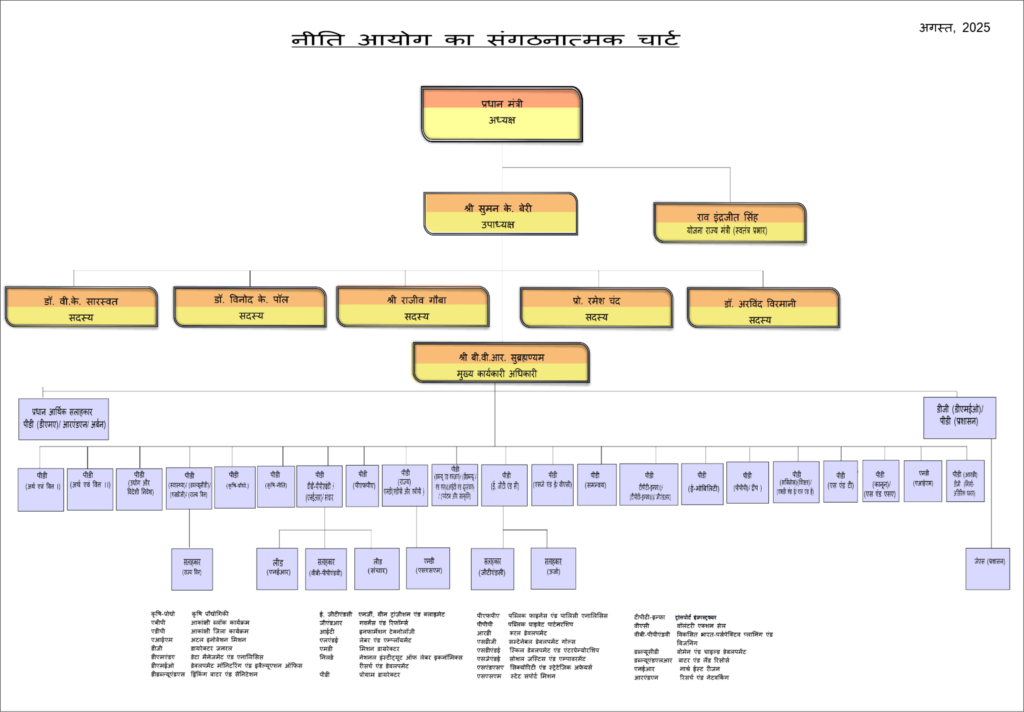
The Prime Minister approved the revised composition of NITI Aayog (National Institution for Transforming India) in continuation of the notifications dated 18.09.2021 and 15.11.2022. The new structure is as follows:
- Chairman:
- Prime Minister
- Vice-Chairperson:
- Shri Suman K. BerryTook over as Vice Chairman of NITI Aayog from 1 May 2022.
- Full-time Members:
- Shri V.K. SaraswatProf. Ramesh ChandDr. V.K. PaulShri Arvind VirmaniShri Rajiv Gauba – from 25.03.2025
- Ex-officio Members:
- Shri Rajnath Singh (Defence Minister)Shri Amit Shah (Home and Cooperation Minister)Shri Shivraj Singh Chouhan (Minister of Agriculture and Farmers Welfare; and Minister of Rural Development)Smt. Nirmala Sitharaman (Minister of Finance and Minister of Corporate Affairs)
- Special Invitees:
Vice Chairman of NITI Aayog
| S. No. | Name | tenure | fact |
| Shri Arvind Panagariya | 2015 to 2017 | First Vice President | |
| Rajiv Kumar | 2017 to 2022 | ||
| Suman K. Berry | From May 1, 2022 to the present | Current Vice President |
CEO of NITI Aayog
| S. No. | Name | tenure | fact |
| Amitabh Kant | 2016 to 2022 | First | |
| Parameswaran Iyer | July 2022 to February 2023 | Mr. Iyer, who was serving as the CEO of NITI Aayog, has been appointed as the Executive Director of the World Bank Headquarters in Washington DC, USA for a three-year term. | |
| BVR Subrahmanyam | March 2023 to present | Present |
(Minister of State for Planning (Independent Charge))
- Rao Inderjit Singh
Meetings
- It has been 10 so far.
- Tenth meeting (May 24, 2025)
- Chaired by: Prime Minister Narendra Modi
- Attendance: Chief Ministers of 24 states and Lieutenant Governors of 7 Union Territories
- Theme: “From Developed State to Developed India @2047”
- Beginning: Silence in memory of the victims of Pahalgam terror attack
- PM’s key points:
- Developed India is the aspiration of every Indian, not just the agenda of any party.
- India among top 5 economies, 250 million people out of poverty.
- Take advantage of the manufacturing mission, welcome foreign investment.
- Emphasis on education and skill development (AI, semiconductors, 3D printing, etc.); ₹60,000 crore skilling scheme.
- Cyber security, hydrogen and green energy were described as opportunities.
Principles of NITI Aayog
NITI Aayog operates on 7 principles of effective governance, which include:
- Pro-people agenda- A policy program that fulfills the aspirations of both the individual and the society.
- Active Responsiveness – Understanding the needs of citizens and responding quickly and effectively.
- Active civic engagement– Ensuring public participation in policy formulation and implementation.
- Women empowerment – To provide equal rights and opportunities to women in all aspects.
- Inclusivity – To give proper participation to Scheduled Castes, Scheduled Tribes, Other Backward Classes and Minorities in the development process.
- Equal opportunities for youth- To make the youth partners in nation building by giving them proper opportunities.
- Technology-based transparency- Use of technology to bring transparency, accountability and responsiveness in governance.
Specialized branches
- Research Branch: Build internal and regional expertise with subject matter experts.
- Consultancy Branch: Expert panels and problem solvers for central and state governments.
- Team India Branch: National cooperation and dialogue with representatives of states and ministries.
Objectives of NITI Aayog
- To develop a common vision for national development
- Promoting cooperative federalism
- Starting schemes from the village level
- national security focus
- Special attention to the underprivileged
- Long-term strategy formulation and monitoring
- Collaboration with think tanks and institutions
- Creating knowledge and innovation based systems
- Inter-departmental Coordination Forum
- Acting as a resource center
- Monitoring and review of programmes
- Technology and Capacity Building
- Implementing the development agenda
The key areas on which NITI Aayog focuses are:
- Enabling administration
- Agriculture and Farmers Welfare
- India’s active role in global partnership
- Middle class participation
- Use of Intellectual Property and Entrepreneurship
- The role of the Indian diaspora
- Safe Urbanization
- Technology-based good governance
Aiming towards empowering India
- Harnessing the power of youth
- Poverty alleviation
- Social equality
- Connecting villages with the development process
- Support to small businesses
- Protection of the environment and ecology
Standing Committees of NITI Aayog
- The Standing Committees of NITI Aayog are committees that are regularly constituted within the Commission to provide policy guidelines on specific subjects.
- Governing Council
- President: Prime Minister of India
- Members: Chief Ministers and Lieutenant Governors of all States and Union Territories
- Function: Discussion on national priorities, enhancing cooperation between the Centre and the States.
- Executive Council
- Chairman: CEO of NITI Aayog
- Members: All full-time members, experts, and senior officers of the Commission
- Function: To work out strategies for implementing the Commission’s plans.
- Major Thematic Area Committees
- These committees focus on areas such as health, education, agriculture, energy, sustainable development, and climate change.
- Members: Subject experts, officials from concerned ministries, members of NITI Aayog.
- SDG (Sustainable Development Goals) Committee
- Objective: To monitor India’s Sustainable Development Goals (SDGs).
- NITI Aayog is the nodal agency for SDGs.
- Governing Council
Special Task Force –
- NITI Aayog periodically forms special task forces to address specific issues. These are temporary in nature and work on a specific mission/problem and offer solutions.
- Examples of major task forces:Task Forces/Missions and their Objectives
- Agriculture Reforms Task Force – Agricultural market reforms, measures to double agricultural income
- Task Force on Employment Generation – To provide policy suggestions on employment generation
- Task Force on Elimination of Poverty – Formulating poverty alleviation strategies
- Mission on Transforming India’s Gold Market – To suggest improvements in the gold policy
- Task Force on Artificial Intelligence – Recommendations on increasing the use of AI in India
- National Nutrition Mission (POSHAN Abhiyaan) NITI Aayog leads the effort to reduce malnutrition
- Other examples:
- Aspirational Districts Programme Team
- Objective: Inclusive development of backward districts
- Implementation: Ranking of districts, real time data monitoring
- Atal Innovation Mission Team
- Supporting schools and startups to foster innovation
- Aspirational Districts Programme Team
Characteristics and role
| Standing Committees | Special Task Force |
| Long-term and institutional | Short-term and problem-specific |
| Regular meetings | Limited to project completion |
| Policy formulation and monitoring | Providing solutions and implementation suggestions |
Conclusion:
- Both the Standing Committees and Special Task Forces of NITI Aayog play a vital role in strengthening India’s policies and finding solutions to grassroots problems.
- This system makes NITI Aayog flexible, participatory, and innovation oriented.
Commitments of NITI Aayog
- Promoting cooperative federalism
- Motivating civic engagement
- Ensuring equitable access to development opportunities
- Adopt flexible and participatory governance
- Enhancing policy and programs through technological innovation
Important Initiatives of NITI Aayog
Aspirational Districts Programme:
- Launched: By the Prime Minister in January 2018.
- Objective: Rapid and effective development of the 112 most backward districts of the country.
- Key Features
- 3C model
- Convergence – Integration of central and state schemes.
- Collaboration – Cooperation of central, state and district administration.
- Competition – Healthy competition among districts (by monthly ranking).
- Focus Areas (5 topics)
- Health and Nutrition
- Education
- Agriculture and Water Resources
- Financial Inclusion and Skill Development
- Infrastructure
- 3C model
- Measurement System
- Based on 49 key performance indicators (KPIs).
- Delta Ranking – Comparison of progress each month.
- Progress and rankings are publicly available on the Champions of Change Dashboard.
SDGs –
- Nodal Agency –NITI Aayog is the main body for implementing SDGs (2030 Agenda) in the country.
- The spirit of federalismPromotion of cooperative and competitive federalism.
- Monitoring tools:
- SDG India Index – Performance and Ranking of States/UTs.
- North-Eastern Region District SDG Index – Assessment of the progress of districts in the North-Eastern states.
- National Multidimensional Poverty Index (MPI) – Data on multidimensional aspects of poverty at the state, UT and district levels.
E-AMRIT –
- Accelerated e-Mobility Revolution for India’s Transportation
- Objective – One-stop portal for all information on Electric Vehicles (EVs).
- Development – Under the Knowledge Exchange Programme by NITI Aayog with the UK Government.
- Agreement – Part of the UK-India Joint Roadmap 2030.
- Role –
- To make consumers aware of the benefits of EV.
- To complement the government’s EV initiatives.
- EV Initiatives in India –
- FAME योजना (Faster Adoption and Manufacturing of Hybrid & Electric Vehicles)।
- PLI Scheme (Production Linked Incentive) → Ecosystem for EV adoption ready.
- Future plans – Making the portal more interactive and user-friendly.
Shoonya Abhiyaan – Zero Pollution Mobility
- Launched by NITI Aayog.
- Meaning – Shoonya is a Sanskrit word meaning “zero” → the beginning of new opportunities.
- Objective –
- Increasing the use of electric vehicles (EVs) in urban delivery and ride-hailing services.
- Rapidly transitioning to zero-emission vehicles in the transportation sector.
NITI for States :
- Aarambh – An integrated platform launched by NITI Aayog.
- Objective -To ensure participation and cooperation of states towards “Developed India”.
Mission LiFE
- Background
- Mission LiFE (Lifestyle for Environment) was announced by Prime Minister Narendra Modi at the UNFCCC COP26 (Glasgow, 2021).
- Objective: To bring individual lifestyle and behaviour at the centre of tackling climate change.
- Nodal Agency –
- The Government of India appointed NITI Aayog as the Nodal/Implementing Agency of Mission LiFE.
- Building the P3 (Pro-Planet People) Community –
- NITI Aayog promotes this global network to encourage people to adopt eco-friendly lifestyles.NITI Aayog links Mission LiFE with the vision of “Developed India @2047”.
Project SATH-E (2017)
- beginning
- Launched by NITI Aayog in 2017.
- Objective: To create 3 “Role Model States” for the school education sector.
- Selected States: Jharkhand, Odisha and Madhya Pradesh.
Atal Innovation Mission (AIM)
- Installation: In January 2016, under NITI Aayog
- Objective:To promote innovation and entrepreneurship in India.
- Key Initiatives:
- Atal Tinkering Labs (ATL)
- Atal Incubation Centres (AICs)
- Current status:
- More than 10,000 ATLs are set up in India by 2024.
- There are 72 AICs operating, supporting over 3,500 startups.
- More than 1,000 startups have female founders.
- NITI Aayog, chaired by Prime Minister Shri Narendra Modi, has appointed Deepak Bagla as the new Mission Director of the Atal Innovation Mission (AIM). The appointment was made on July 21, 2025.
Prime Minister’s Wealth-Grain Agriculture Scheme:
- The Union Cabinet chaired by the Prime Minister Shri Narendra Modi has approved the Pradhan Mantri Dhan-Dhanya Krishi Yojana for a period of 6 years.
- This scheme will be implemented in 100 districts from 2025-26.
- Inspired by the Aspirational Districts Programme of NITI Aayog, this scheme is the first specific scheme focused on agriculture and allied sectors.
- The scheme will be implemented through 36 existing schemes of 11 departments, other schemes of the states and local partnership with the private sector.
National Development Council (NDC)
- Installation and status
- By executive order of the Government of India in August 1952.
- Not a constitutional or statutory body.
- Last meeting: 27 December 2012 (Approval of 12th Plan).
- News of it being discontinued on January 1, 2016, but no official decision.
- Structure
- President: Prime Minister of India
- Member:
- All Cabinet Ministers of the Central Government
- Chief Ministers of all states
- Administrators of all Union Territories
- Member of the Planning Commission (Niti Aayog)
- Secretary: Secretary of the Planning Commission/NITI Aayog
- Objective
- To ensure balanced and rapid development through equitable economic policies by strengthening national resources in collaboration with the states.
- Main functions
- To guide, review and evaluate national plans and resources to ensure achievement of goals.
- Process
- Policy Commission → Union Cabinet → NDC → Parliament → Publication in the Official Gazette after approval
- Critical assessment
- positive side –Platform for Centre-State coordination, State participation in national policies.
- negative side –Decisions were taken in advance, the Council was reduced to a mere ‘rubber stamp’.
- Key Comments
- M. Brecher – The NDC reduced the Planning Commission to a research body.
- H.M. Patel – It is not just an advisory body, but a policy making body.
- K. Santhanam – The NDC functions like a ‘super cabinet’.
- A.P. Jain – The NDC encroaches upon constitutional jurisdiction, whereas it should only be a forum for discussion.



