Lokpal is an anti-corruption ombudsman established under the Lokpal and Lokayuktas Act, 2013, and is an important institution in Indian Polity. It is empowered to inquire into allegations of corruption against public officials, including the Prime Minister, ministers, and Members of Parliament. The institution aims to promote transparency, accountability, and integrity in governance by addressing complaints of maladministration and corruption.
Lokpal: Objectives, Right and Role
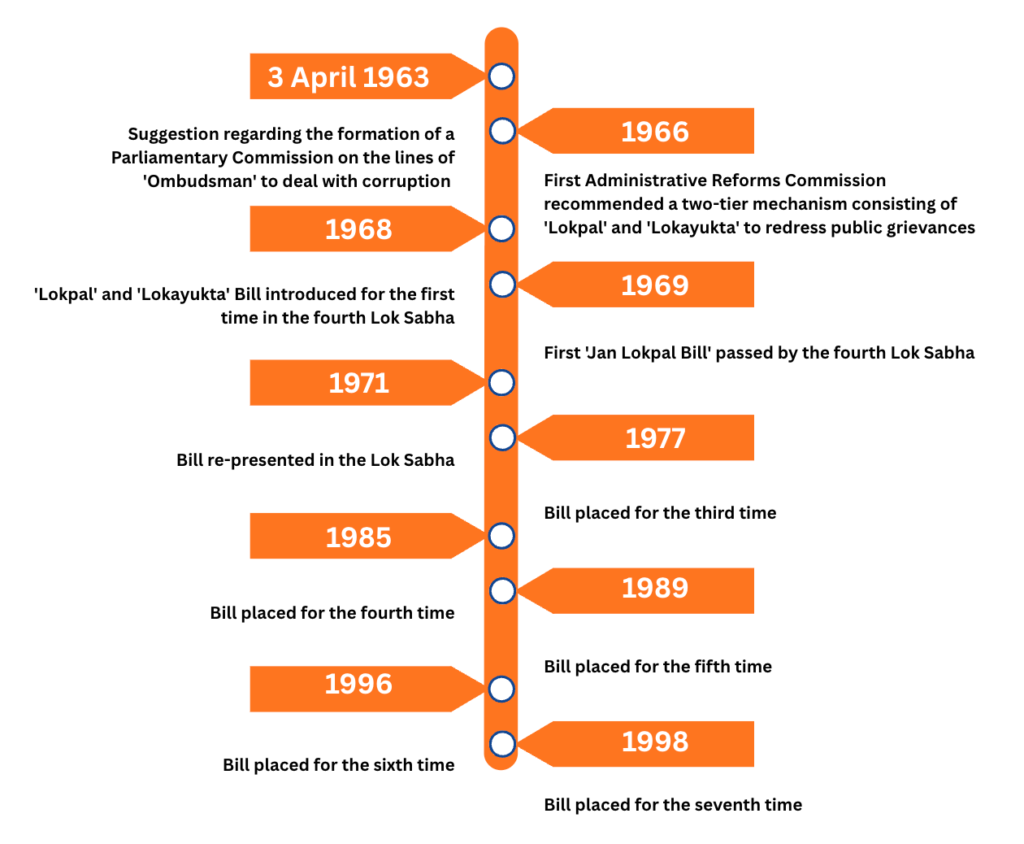
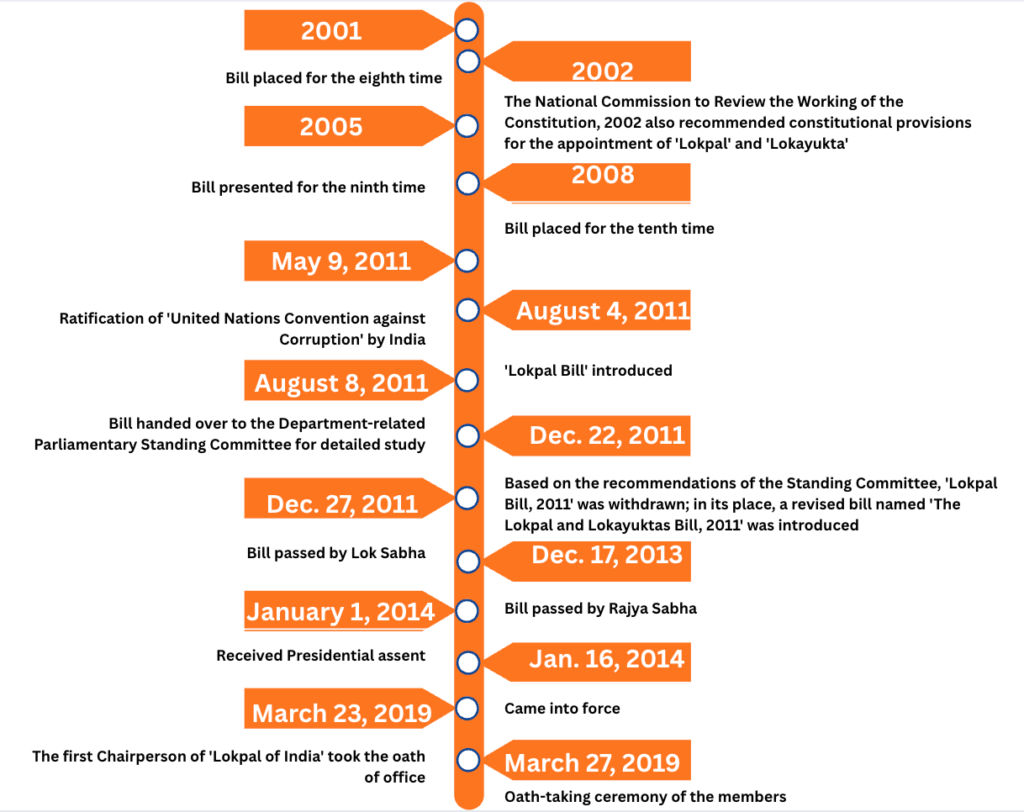
Formation of Lokpal in India – Timeline
Evolution of Lokpal and Lokayukta in India
Initial thoughts
The idea of a Constitutional Ombudsman in India first emerged in the early 1960s.
It was presented in the Parliament by Law Minister Ashok Kumar Sen in the year 1963.
Use of the term
The words Lokpal and Lokayukta were used by the renowned jurist Dr. L.M. Singhvi.
Recommendations of the Administrative Reforms Commission (1966-70)
In India, the Administrative Reforms Commission (1966–70) recommended the establishment of Lokpal at the central level and Lokayuktas in the states.
Lokpal: Investigates complaints against ministers and secretaries at the central and state levels.
Lokayukta: Investigates complaints against special high officials.
Like New Zealand, the Commission kept the courts out of the purview of the Lokpal-Lokayukta.
But in Sweden the courts also fall under the Ombudsman.
History of the Lokpal Bill
The Lokpal Bill was first introduced in the Lok Sabha in 1968.
It was passed by the Lok Sabha in 1968, but lapsed with the dissolution of the Lok Sabha.
After this, this bill was presented in the Lok Sabha several times and every time it became time-barred.
Establishment of Lokayukta in the states
Odisha passed an Act in this regard in 1970, but implemented it in 1983.
Maharashtra was the first state to establish a Lokayukta in 1971.
Venkatachalaiah Commission (2002)
In 2002, the Constitution Review Commission, headed by M. N. Venkatachaliah, recommended the appointment of the Lokpal and Lokayukta.
Also, the Commission suggested that the Prime Minister be kept out of the purview of the Lokpal.
Anna Hazare movement and pressure
The Bharat Movement against Corruption led by Anna Hazare put pressure on the then UPA government.
As a result, both the Houses of Parliament passed the Lokpal and Lokayuktas Bill, 2013.
The Lokpal and Lokayuktas Bill, 2013
Application of the Act
After being passed by both houses, the bill was assented to by the President on 1 January 2014.
This Act came into force from 16 January 2014.
The first Lokpal Day was celebrated on 16 January 2025 in Delhi Cantt, with the Chief Justice of India (CJI) as the chief guest.
Provisions for the States
The 2013 Act also provides that all state governments should establish Lokayuktas within one year of the Act coming into force.
Constitutional status
The institutions of Lokpal and Lokayukta are merely statutory bodies without constitutional status.
Structure of Lokpal
The Lokpal will have a Chairperson and a maximum of 8 members.
Chairman-
A serving or former Chief Justice of India or a Judge of the Supreme Court or any eminent person.
Four judicial members –
Who has either been a judge of the Supreme Court, or the Chief Justice of a High Court.
Four non-judicial members –
Who has special knowledge and expertise of at least 25 years in the fields of anti-corruption policy, public administration, vigilance, finance, law, management, insurance, banking etc.
Reservation Provisions:At least 50% of the members of the Lokpal will be from Scheduled Castes (SC), Scheduled Tribes (ST), Other Backward Classes (OBC), minorities and women.
Tenure:
The tenure of the Chairperson and members of the Lokpal institution is 5 years or till the age of 70 years.
Pay and Allowances:
The salary and allowances of the Chairman are the same as that of the Chief Justice of India, while the members get the same benefits as a judge of the Supreme Court of India.
Appointment of Chairman and Members
The Chairman and its members are appointed by the President on the recommendation of a committee. The committee consists of –
Prime Minister
Speaker of the Lok Sabha
Leader of the Opposition in the Lok Sabha
Chief Justice of India or a sitting Judge of the Supreme Court nominated by him
An eminent jurist nominated by the President on the recommendation of four members of the Selection Committee
Procedure for removal of Lokpal Chairperson/Members from office (Section 37):
Power to remove – Only the President can remove the Chairperson or a member of the Lokpal.
Reason – If the allegation of misbehavior against him is proved.
Petition condition – The removal process can begin when a petition signed by at least 100 MPs is submitted to the President.
Investigation – The President sends this petition to the Supreme Court.
Role of the Court – The Supreme Court investigates as per the prescribed procedure.
Report – If the Supreme Court in its report finds that the allegations are true and the member/chairman should be removed,
Final Order – The President then removes the Chairman or Member from office on the basis of that report.
Appointment of the first Lokpal
In March 2019, retired Supreme Court judge Pinaki Chandra Ghose was appointed India’s first Lokpal.
The Appointments Committee comprised Prime Minister Narendra Modi, Chief Justice of India Ranjan Gogoi and Lok Sabha Speaker Sumitra Mahajan.
The process of member appointment came into effect from 27 March 2019.
Lokpal Search Committee
The Department of Personnel and Training (DoPT) prepares the list of eligible candidates.
This list is sent to the Search Committee.
The committee shortlists the names and sends them to the selection committee headed by the Prime Minister.
The Selection Committee may accept or reject the names suggested by the Search Committee.
September 2018: A probe committee headed by former Supreme Court judge Ranjana Prakash Desai was formed.
Jurisdiction and powers of the Lokpal
Jurisdiction includes:
Prime Minister (with some exceptions)
Ministers
Member of Parliament
Group A, B, C, D officers of the Central Government
Officers of bodies/committees established by Central Act
Officers attached to institutions funded by the Central Government
Its annual income should be more than Rs 1 crore.
organizations receiving foreign donations
The institution has received donations of more than Rs 10 lakh from any foreign source in a year under the Foreign Contribution (Regulation) Act, 2010.
Limitations on the Prime Minister
Can only investigate allegations of corruption.
No powers in matters related to international relations, security, public order, nuclear energy and space.
Powers
To get all public servants to declare their assets and liabilities.
Power to entrust and direct investigation to CBI.
A CBI officer cannot be transferred without permission.
Powers like a civil court (commanding production of records, summoning witnesses, etc.).
Power to confiscate property acquired through corruption.
Recommendation for suspension/transfer of the concerned officer.
Power to order prevention of destruction of records.
Limitations/Drawbacks
Lokpal appointed 5 years after the 2013 Act was passed (2019) – lack of political will.
Only 16 states appointed Lokayuktas.
Appointments Committee dominated by political parties → not independent of political influence.
Definition of ’eminent jurist’ or ‘person of integrity’ is vague → arbitrariness possible.
Whistleblower protection is weak – the complainant may also face action.
Judiciary outside the purview of Lokpal.
No constitutional basis, nor adequate appeal mechanism.
The process of appointment of Lokayukta was left entirely to the states.
Complaints related to corruption cannot be filed after 7 years.
Timeframes for cases: Preliminary investigation: 90 days; Investigation: 6 months (extendable if necessary).
suggestions for improvement
Lokpal and Lokayukta should be given functional autonomy, adequate human resources and financial independence.
Appointments should be made in a transparent and fair manner.
Greater transparency, strengthening of RTI, and empowerment of citizens/groups.
Merely increasing the number of investigating agencies is not enough, administrative reforms are necessary.
No single institution should have excessive power → Accountability + decentralization is essential.
Lokpal-Lokayukta should be completely free from political and administrative influence.
The Lokpal and Lokayuktas (Amendment) Bill, 2016
In July 2016, Parliament passed amendments to the Lokpal and Lokayuktas Act, 2013.
In the absence of a recognised Leader of the Opposition, the leader of the largest opposition party in the Lok Sabha will be a member of the selection committee.
Section 44 of the Act 2013 was amended.
Now the requirement of property declaration within 30 days has been abolished.
Public servants will now declare their assets and liabilities in the form and manner prescribed by the government.
Trustees and board members must also declare their own assets and those of their spouses.
This provision will apply if they receive government funds exceeding Rs 1 crore or foreign funds exceeding Rs 10 lakh.