

Revenue Board is the highest appellate authority in the revenue administration system of the state and plays a crucial role in adjudicating land and revenue-related disputes. In Rajasthan Polity, it functions as a quasi-judicial body that ensures uniformity and efficiency in the implementation of land revenue laws. It also supervises and guides subordinate revenue courts and officers across the state.
Establishment and Legal Form of the Revenue Board
- Installation:Established on April 7, 1949 by His Excellency the Rajpramukh through Ordinance No. 22, 1949, after the creation of United Rajasthan.
- Enforcement Date:This ordinance came into force on November 1, 1949.
- Merger: It replaced the erstwhile revenue divisions of Bikaner, Jaipur, Jodhpur, Matsya, and East Rajasthan.
- Jurisdiction: It became the ‘Supreme Court’ in the state for appeal, revision and reference in revenue matters.
- In 1956, the Rajasthan Land Revenue Act, 1956 came into force, which replaced this ordinance.
- The Revenue Board is the highest revenue court in the state.
- The Revenue Board of Rajasthan is located in Ajmer.
- It consists of at least 5 members.
- The Assistant District Magistrate has the original jurisdiction in revenue matters.
- Appeals against the decisions of the Assistant District Magistrate can be made to the Revenue Appellate Authority.
Introduction of revenue boards in princely states
- Even before independence, some princely states had formed boards for administrative reforms:
- Bikaner: Revenue Board formed in 1909.
- Jaipur: Board of Revenue formed in
- Functions: In addition to land revenue, it also had duties such as customs, excise, protection of minors, and registration.
- The Jaipur division also served as the final appellate court.
Role:
- Acts as the apex court for revenue matters.
- Acts as the highest court of appeal, supervision and reference.
- The Board of Revenue is a quasi-judicial body which hears final appeals and revisions in revenue-related matters.
Major Revenue and Land Reform Acts of Rajasthan
| S.No. | Name of the Act | Year | Specifications/Importance |
| 1. | Rajasthan Tenancy Act | 1955 | The main laws related to tenants’ rights and land holdings. |
| 2. | Rajasthan Land Revenue Act | 1956 | For land revenue administration, records and formation of boards. |
| 3. | Agricultural Land Utilization Act | 1956 | To ensure proper use of agricultural land. |
| 4. | Rajasthan Royal Property Regulation Act | 1956 | For managing escheats. |
| 5. | Rajasthan Land Reforms and Jagir Repossession Act | 1952/1959 | For the abolition of the zamindari system and re-acquisition of land. |
| 6. | Rajasthan Public Demand Recovery Act | 1952 | For the process of recovery of government dues. |
| 7. | Rajasthan Zamindari and Biswedari Abolition Act | 1959 | To end the Zamindari and Biswedari system. |
| 8. | Rajasthan Land Reforms and Landowner Property Acquisition Act | 1963 | To acquire the property of big landowners. |
| 9. | Rajasthan Colonization Act | 1954/1971 | For land allotment and settlement in irrigated areas (like IGNP). |
| 10. | Jaipur mourning rules | 1945 | Old rules related to succession (Matmi) of Jaipur State. |
| 11. | Indian Treasure Trove Act | 1878 | Laws relating to buried treasure or antiquities. |
Administrative Structure of the Board of Revenue
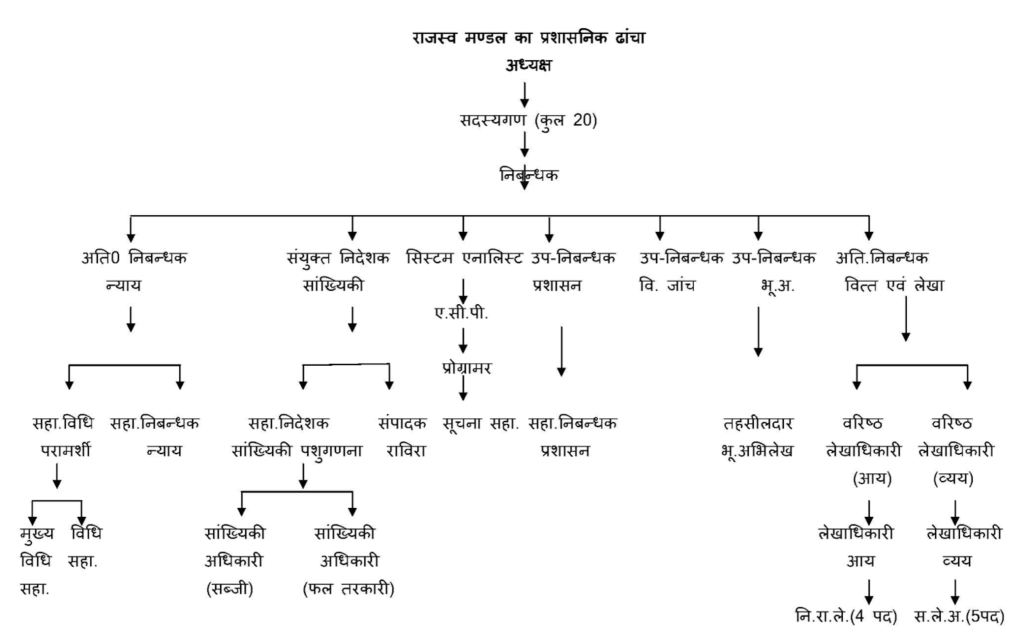
Powers of the Board of Revenue:
- Transfer of powers conferred on the State Government in various Acts.
- Implementation of these powers including decision making in revenue matters.
Administrative Functions:
- Maintenance and supervision of land records, which is not a judicial but an administrative function.
- Plays an active role in revenue matters representing the State Government.
Major Functions:
- Appeal: Hearing of appeals against decisions given by lower courts.
- Monitoring: Monitoring the functioning of subordinate courts.
- Reference: Disposal of referred cases.
Subordinate Revenue Court
- The following courts are subordinate to the Revenue Board:-
- Divisional Commissioner -7
- District Collector
- Additional District Collector
- Revenue Appellate Authority
- Land Management Ex-Officio Revenue Appellate Authority
- Sub-Divisional Officer
- Assistant Collector
- Tehsildar
Patwari
- The Patwari system was started during the time of Sher Shah Suri.
- This system was later continued by the Mughal Emperor Akbar and the British colonial rule.
- In 1814, the main function of the Patwari was to preserve village records and collect important information, such as information about the village headman and other prominent persons.
- Main functions:
- Maintenance of Land Records:
- Maintenance of Crop Records:
- Mutation recording: Whenever the ownership of the land changes (for example in case of sale or inheritance), the Patwari records the mutation (transfer of ownership).
- Preparation of Statistical Returns:
- Land records
- Work related to Panchayati Raj institutions
- emergency assistance
- Note : The work related to taxes and fees is the work of the village servant.
Role of Tehsildar:
- Land Revenue
- Land record
- Sub-Treasurer
- Registration
- Revenue disputes
- rationing
Rajasthan Tenancy Act
- This Act may be called the Rajasthan Tenancy Act, 1955.
- It will be expanded throughout the state of Rajasthan.
- It shall come into force on such date as the State Government may, by notification in the Official Gazette, specify.
- This Act came into force from 15 October 1955.
- It came into effect from 15 June 1958 for Abu, Ajmer and Sunel areas.
Section 5: Definitions
- Agricultural Year: The agricultural year shall be the year beginning on 1 July and ending on 30 June.
- Agriculture: Agriculture will include horticulture, animal husbandry, dairy farming, poultry farming and forest development.
- Cultivator: A cultivator is a person who does agricultural work himself or through his family members or servants or helpers and this farming is his main source of livelihood.
The Rajasthan Land Revenue Act, 1956
The Rajasthan Land Revenue Act, 1956 (Act No. 15) :
- It is called the “Rajasthan Land Revenue Act, 1956”, which applies to the entire state of Rajasthan.
- The provisions of this Act do not affect other important laws like the Rajasthan Land Reforms and Jagir Repossession Act, 1952 and the Ajmer Arbitrators Abolition Act, 1955.
- It is a comprehensive Act intended to consolidate and amend the land-related laws of the state of Rajasthan. The Act provides detailed provisions for the appointment, duties, and powers of revenue courts, revenue officers, and village servants. It also establishes land records, the preparation and maintenance of maps, revenue and rent assessments, the division of estates, and the procedure for revenue collection.
Key Points:
- A Board of Revenue has been established for the state of Rajasthan. It consists of a chairman and a maximum of 20 members. The board handles appeals, revisions, and references.
- The state is divided into divisions, districts, and sub-tehsils for revenue and general administration. The state government determines the boundaries of these divisions and their administrative jurisdictions.
- Divisional commissioners, collectors, tehsildars, and other revenue officials are appointed to oversee land and revenue matters. Their tenure, jurisdiction, and powers are also specified in the Act.
- The Revenue Courts and officers handle all judicial and administrative matters relating to revenue. The composition and procedures of the Courts are determined by the provisions of the Act.
- The maintenance of land records in the state is a key function, performed by the Collector and the Director of Land Records. The resolution of land disputes and land reform proceedings also fall under the scope of this Act.
- The Act also provides for the settlement of land revenue, division of estates, and determination of rates of revenue.
- The procedure for appealing against the decisions of the Board and other revenue courts and the powers of the Appellate Court are also included in this Act.



