

Panchayati Raj and Municipal Administration is an important topic under Rajasthan Polity that explains the structure and functioning of local self-government in rural and urban areas. It covers Panchayati Raj Institutions and municipal bodies, highlighting their roles in grassroots governance and development. Understanding this topic helps in analyzing decentralization, local administration, and democratic participation in Rajasthan.
The concept of local government
- Meaning of local self-government:- Local self-government is a system of administration where local bodies directly elected by the people manage the affairs of local communities such as villages, towns or cities.
- The concept of local government strengthens the fundamental principles of democracy – “meaningful participation and purposeful accountability”.
- This is the level of governance that is closest to ordinary citizens and provides them with an opportunity to participate in local issues.
Important Statement:-
- Jawaharlal Nehru –“Local self-government is and must be the basis of a true system of democracy.”
- Lord Bryce“Local self-government serves as a training ground or school for democracy.”
- D. Tocqueville –“The local assemblies of citizens are the real power of free nations.”
- Mahatma Gandhi –“Local institutions are laboratories for the study of psychological attitudes.”
Evolution of the concept of local government in India
- early development: The British first established the Madras Municipal Council in 1667, which was given the status of a municipal corporation in 1687.
- Beginning in Rajasthan: The first municipality of Rajasthan was established in Mount Abu in 1864.
- Lord Mayo’s Decentralisation Proposal (1870): Took initiative of decentralization for the development of local governance.
- Contribution of Lord Ripon (1882): Lord Ripon (1880-1884), known as the “Father of Local Self-Government in India,” established district boards, village panchayats, and judicial councils. His 1882 resolution is considered the “Magna Carta” of local self-government.
- Royal Commission (1907): This commission, formed under the chairmanship of Hobhouse, submitted its report on local self-government in 1909.
- The Government of India Act of 1919 (Montague-Chelmsford Act): This Act gave statutory form to local self-government and included it in the transferred subjects.
- Bikaner’s initiative: Bikaner was the first state in Rajasthan to enact the Gram Panchayat Act in 1928. Subsequently, Jaipur, Sirohi, Bharatpur, and Karauli enacted Gram Panchayat Acts.
Modern period and place in the Constitution
- Government of India Act of 1935: Local self-government was placed in the State List.
- A review of local government institutions began in 1987.
- In 1989, the P.K. Thungan Committee recommended giving them constitutional recognition.
- The 73rd and 74th Constitutional Amendments were passed in 1992, giving constitutional status to Panchayati Raj institutions and urban local bodies.
- Article 40 (Directive Principles of State Policy):The state was directed to constitute village panchayats and give them autonomy.
- Gandhiji’s Gram Swaraj:Gandhiji proposed the concept of Gram Swaraj in his book “My Picture of Free India”, which mentioned self-reliant villages.
Note :1964-67 – Dismantling of first generation Panchayati Raj institutions
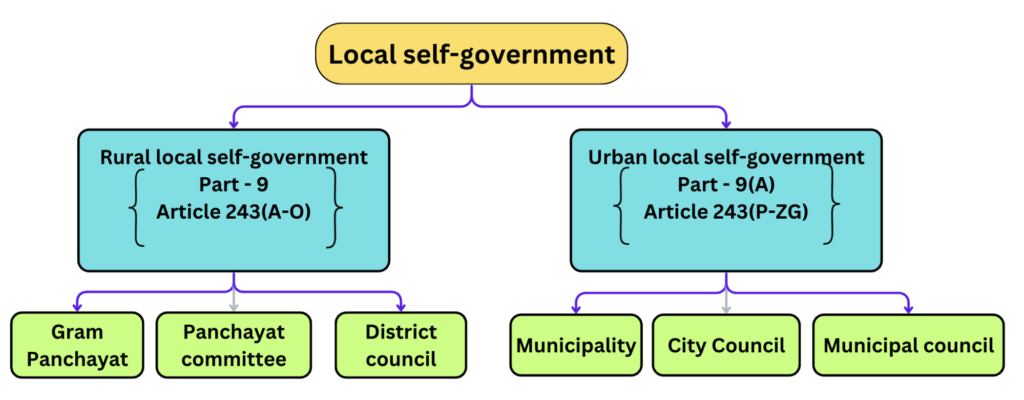
Rural Local Self-Government (Panchayati Raj)
- “Give power to the people of the villages and the Panchayats, they will make thousands of mistakes, but there is no need to panic.”Nehru
- Mahatma GandhiAccording to him, “The soul of India resides in the villages, therefore make the villages self-reliant.
- The Gram Sabha is envisioned as an institutional forum for villagers to ensure that every voice in the village is heard. The needs and concerns of every section of society are addressed. The objective of Panchayati Raj is to establish democratic values as a socio-economic and political system at the grassroots level through the decentralization movement. Mahatma Gandhi said, “If villages perish, India perishes.”
Development of Panchayati Raj System
- To increase public participation in rural development, the Community Development Programme was implemented on October 2, 1952, following the recommendations of the K.M. Munshi Committee. The National Extension Scheme was implemented on October 2, 1953.
- These programs were funded by the Ford Foundation in the United States. However, due to excessive government interference (bureaucracy) and a lack of public participation, these programs failed.
1. Balwant Rai Mehta Committee (1957):
- Formation –January 1957 (by the Planning Commission, during the tenure of Prime Minister Jawaharlal Nehru.)
- Report submitted –On 24 November 1957, the National Development Council was
- Title of the report –‘Democratic decentralization’
- Objective – To evaluate/investigate the failures of the Community Development Programme and the National Extension Service Programme and to suggest measures for their better implementation.
- In his report, Balwant Rai Mehta criticized both programs as failures due to administrative interference and recommended that people’s participation in community work be organized through statutory representative bodies. He recommended the implementation of democratic decentralization in India.
- On the recommendation of Balwant Rai Mehta Committee, the then Prime Minister Jawahar Lal Nehru first launched the ‘three-tier Panchayati Raj’ system on October 2, 1959 from Bagdari village of Nagaur district (Rajasthan).
- The Panchayati Raj system was implemented in Andhra Pradesh state (Shadnagar block of Mahbubnagar district) on October 11, 1959.
- Thus, the first state to implement the Panchayati Raj system was Rajasthan and the second was Andhra Pradesh.
- On October 11, 1959, Andhra Pradesh became the first state in India where elections for Panchayat Raj institutions were held.
- The term democratic decentralization was coined by Balwant Rai Mehta, hence he is called the father of democratic decentralization.
- Balwant Rai Mehta is called the architect of Panchayati Raj in India.
- Main recommendations of Balwant Rai Mehta Committee –
- Three-tier Panchayati Raj should be established.
- Gram Panchayat at the village level (per 1,000 population)
- Panchayat Samiti at the block level (per 5 thousand population)
- Zila Parishad at the district level (one per 50 thousand population)
- The Panchayat Samiti level, the intermediate level, will be the mainstay of Panchayati Raj, with special emphasis on the Panchayat Samiti. The Panchayat Samiti (block level) will serve as the executive body, while the Zila Parishad will have an advisory, coordinating, and supervisory role.
- Elections to the Gram Panchayat will be direct, while those to the Panchayat Samiti and Zila Parishad will be indirect.
- The District Collector should be the Chairperson of the Zila Parishad.
- Adequate resources should be transferred to these institutions for effective functioning and powers should be centralized in future.
- Three-tier Panchayati Raj should be established.
Note :
- In a state with a population of less than 20 lakhs, the Panchayati Raj structure can be two-tier, that is, there will be no block level (Panchayat Samiti) there.
- After 1965, irregularities arose in the elections of the Panchayati Raj system in the country. To address this, various committees and task forces were formed, which submitted their recommendations to the government.
- Reasons for the decline of the Panchayati Raj system after 1965
- lack of funds
- Lack of political consciousness
- Internal differences
- Lack of regular election system
- nominal decentralization of powers
- G. Ramachandran Committee – Committee on Panchayati Raj Training Centers, formed in 1966
- Daya Chaubey Committee – Committee on Community Development and Panchayati Raj, formed in 1976
2. Ashok Mehta Committee (1977):
- Formation –In December 1977, the Janata Party government constituted a committee on Panchayati Raj institutions under the chairmanship of Ashok Mehta.
- Report – In August 1978
- Objective – Made 132 recommendations to revive and strengthen the declining Panchayati Raj system in the country.
- Recommendations –
- The three-tier Panchayati Raj system should be transformed into a two-tier system. That is, Mandal Panchayats should be formed in place of Gram Panchayats.
- The Committee gave utmost importance to the district level and considered it the executive body responsible for the formulation of plans at the district level.
- The “Nyaya Panchayat” should be established as a separate body from the Vikas Panchayat. It should be chaired by a qualified judge.
- Panchayati Raj institutions should be given constitutional recognition.
- All officials, including the District Collector, should be placed under the Zila Parishad.
- Elections to these institutions should be conducted on a party basis. The official participation of political parties at all levels in Panchayat elections should be ensured.
- Seats in Panchayats should be reserved for SC and ST communities in proportion to their population.
- One-third of the seats in Panchayats should be reserved for women.
- The role of voluntary organizations should be increased in the Panchayati Raj system.
- Panchayati Raj institutions should be given the power to levy taxes and raise their own resources.
- Regular social audits of Panchayati Raj institutions should be conducted through district-level agencies.
- State governments should avoid unnecessary interference in the programs of Panchayati Raj institutions.
- The establishment of a “Panchayati Raj Finance Corporation” was suggested.
- Elections to Panchayats should be mandatory within six months of their dissolution.
- The responsibility for elections to Panchayati Raj institutions should be entrusted to the Chief Electoral Officer of the state, who should consult the Chief Election Commissioner.
- A Panchayati Raj Department should be established in each state.
- A Panchayati Raj Minister should be appointed in the State Council of Ministers to oversee the affairs of Panchayati Raj institutions.
Note :
- Due to the dissolution of the Janata Party government, no action could be taken on the recommendations of the committee at the central level.
- Karnataka, West Bengal and Andhra Pradesh took steps to revive Panchayati Raj institutions keeping in mind the recommendations of the Committee.
- The committee called the period from 1959 to 1969 as the period of rise of Panchayati Raj.
- In 1978, a private bill related to Panchayati Raj was introduced in the Parliament.
3. Dantewala Committee (1978) :
- The Dantewala Committee was a committee appointed by the Government of India in 1977 to suggest an institutional and conceptual framework for block planning. The committee submitted its report in 1978.
- The Dantewala Committee primarily dealt with block/section-level planning and rural credit.
- It recommended that the formulation of plans (planning) at the block/section-level should be the cornerstone of rural development in India.
- It also recommended the establishment of Regional Rural Banks (RRBs) to provide credit to the rural poor.
- Emphasis was laid on integrating village, district and national level schemes by linking them together.
4. Hanumantha Rao Working Group (1984)
- In 1984, a Working Group on District Planning was constituted under the chairmanship of C.H. Hanumantha Rao.
- Recommended the creation of a separate District Planning Body under a Minister or Collector.
- Suggested ensuring the Collector’s important role in decentralized planning.
- Recommendation to take active cooperation of Panchayati Raj institutions in the planning process.
5. G.V.K. Rao Committee (1985):
- In 1985, the Planning Commission appointed a committee headed by G.V.K. Rao to review the existing administrative system for rural development and poverty alleviation programs. The committee reported in 1986.
- The committee found that the growing influence of bureaucracy in the Panchayati Raj system had weakened the democratic development process. As a result, Panchayati Raj institutions were described as “rootless weeds.”
- The committee made several important recommendations to strengthen and revitalize the Panchayati Raj system, which were as follows:
- The Panchayati Raj system should be given constitutional status.
- Panchayati Raj should be made four-tier:
- (i) Gram Sabha at the village level
- (ii) Mandal Panchayat at Mandal level
- (iii) Zila Parishad at the district level
- (iv) State Development Council at the state level (headed by the Chief Minister).
- The district-level body, the Zila Parishad, should be given the most important place in democratic decentralization.
- The post of District Development Commissioner should be created as the Chief Executive Officer of the Zila Parishad.
- For effective district planning decentralization, some state-level planning functions should be transferred to the district level.
- Regular elections should be held in Panchayati Raj institutions.
- In this, emphasis was laid on the participation of voluntary organizations in the decentralization process.
- In its plan for decentralized regional administration, the Committee gave Panchayati Raj a key role in local planning and development. This is where the G.V.K. Rao Committee Report (1986) differs from the Dantwala Committee Report (1978) on block-level planning and the Hanumantha Rao Committee Report (1984) on district planning.
- Note
- This committee is also known as Card Committee.
6. L.M. Singhvi Committee (1986):
- In 1986, the Rajiv Gandhi government constituted a committee under the chairmanship of L.M. Singhvi to prepare a concept paper on “Revival of Panchayati Raj Institutions for Democracy and Development”.
- Recommendations –
- Panchayati Raj institutions should be granted constitutional recognition.
- It recommended constitutional provisions for regular, free, and fair Panchayati Raj elections.
- Nyaya Panchayats should be established for groups of villages.
- The Gram Sabha should be established as a unit of direct democracy. It described the Gram Sabha as the embodiment of direct democracy.
- Judicial agencies should be established to resolve disputes related to the election, dissolution, and functioning of Panchayati Raj institutions.
- Laxmi Mal Singhvi was a renowned jurist from Jodhpur.
- On the recommendation of the Singhvi Committee, Panchayati Raj was given constitutional status, which came into effect on April 24, 1993, under the 73rd Constitutional Amendment of 1992.
- The term Lokpal was first used by Laxmi Mal Singhvi.
The 18th Pravasi Bharatiya Divas Convention
- was held in Bhubaneswar, Odisha, from January 8-10, 2025, in collaboration with the Government of Odisha.
- The theme for 2025 is: “Contribution of Overseas Indians to a Developed India.”
- The Pravasi Bharatiya Divas Convention has been held annually since 2003, although the format was revised in 2015, and it is now celebrated once every two years.
- The first Pravasi Bharatiya Divas was celebrated in New Delhi from January 7-9, 2003.
7. P. K. Thungon Committee (1988):
- In 1988, a sub-committee of the Consultative Committee of Parliament was constituted under the chairmanship of P. K. Thungon to examine the political and administrative structure.
- In this committee, suggestions were given to strengthen the Panchayati Raj system.
- Recommendations –
- Panchayati Raj institutions should have constitutional recognition.
- Panchayati Raj institutions should have a fixed tenure of five years.
- The maximum duration of a super session of an institution should be six months.
- There should be reservation according to population at all three levels of Panchayati Raj.
- There should be reservation for women also.
- On the recommendation of this committee, bills were prepared to give constitutional status to these institutions.
- In 1989, the 64th Constitutional Amendment Bill for Panchayat Raj institutions and the 65th Constitutional Amendment Bill to give constitutional status to municipalities were introduced in the Lok Sabha.
8. Gadgil Committee (1988):
- In 1988, a Policy and Programme Committee was formed by the Congress Party under the chairmanship of V.N. Gadgil.
- This committee was asked to consider the question “how the Panchayati Raj institutions can be made effective.”
- Recommendations–
- Panchayati Raj institutions should be given constitutional status.
- The tenure of Panchayati Raj institutions should be fixed at five years.
- There should be reservation for Scheduled Castes, Scheduled Tribes and women.
- Panchayati Raj institutions will have the right to impose, collect and collect taxes.
9. Hanumantha Rao Committee (1983)
10. Harlal Singh Kharra Committee (1990)
Constitutionalization efforts
- Following the recommendations of the M.L. Singhvi Committee and the P.K. Thungon Committee, Rajiv Gandhi’s government introduced the 64th and 65th Constitutional Amendment Bills in the Lok Sabha in July 1989 to give constitutional recognition to local and urban bodies respectively.
- After being passed in the Lok Sabha, it could not be passed in the Rajya Sabha on the issue of increasing interference of the Centre in the federal system.
- Rajiv Gandhi is called the father of modern Panchayati Raj.
- Then, in 1992, Prime Minister Narasimha Rao’s government passed the 73rd Constitutional Amendment, granting constitutional status to panchayats, which came into effect on April 24, 1993. Following this amendment, states were mandated to establish Panchayati Raj institutions.
- The bill was passed by the Lok Sabha on December 22, 1992. It was ratified by 17 states because Panchayati Raj was a Seventh Schedule subject that required approval by a special majority of Parliament and more than half of the states.
Before the Constitutional Amendment, the following were the problems related to local self-government:
- Elections not being held on time.
- The functions of the institutions were not defined.
- Lack of money.
- Excessive interference by state governments.



