

Political Evolution & Phases is an important topic under Rajasthan Polity that explains the evolution of political dynamics in the state from independence to the present. It highlights key phases such as one-party dominance, coalition politics, and the emergence of a two-party system. Understanding these phases helps aspirants analyze electoral trends, leadership changes, and the overall development of Rajasthan’s political landscape.
Various Phases of Political Competition in Rajasthan
Despite India having a unified constitution and a uniform legal system, the political trends and conditions of each state depend on its historical background, social, and economic structure. Rajasthan’s politics also holds special significance from this perspective.
Rajasthan Pradesh Congress Committee
- In 1948, the Rajasthan Regional Council of the All India States’ People’s Conference was transformed into the Rajputana Pradesh Congress Committee, thereby marking the formal inauguration of the Pradesh Congress Committee in Rajasthan.
- Gokul Bhai Bhatt was appointed as the first President of the Pradesh Congress Committee.
- Current President: Govind Singh Dotasra (Since 2020)
- 1966: A major split occurred within the Congress; displeased with Sukhadia, leaders such as Kumbha Ram Arya, Kamla, Daulat Ram Saharan, Harishchandra Singh, and Bhim Singh Mandawa joined forces to form the Janata Party.
- In 1980, the name of Congress (I) was changed to the Indian National Congress.
- 1971: Lakshmi Kumari Chundawat became the first—and to date, the only—woman President of the Pradesh Congress Committee.
Location of Rajasthan in independent India
- Rajasthan was ruled by native kings for a long time, and in British India, the state struggled to gain control from the British.
- In independent India, Rajasthan underwent a process of merger in several stages to reach its present form.
- March 18, 1948: The ‘Matsya Union’ was formed through the merger of Alwar, Bharatpur, Dholpur, and Karauli, on the advice of Kanhaiyalal Maneklal Munshi.
- March 25, 1948: The ‘Rajasthan Union’ was formed through the merger of the princely states of Kota, Bundi, Jhalawar, Banswara, Dungarpur, Pratapgarh, Kishangarh, Tonk, and Shahpura.
- April 18, 1948: ‘United Rajasthan’ was established through the merger of the princely state of Udaipur.
- The princely states of Jaipur, Jodhpur, Bikaner, Jaisalmer and Sirohi continued to exist separately till now.
- March 30, 1949: ‘Vrihad Rajasthan’ was formed through the merger of the princely states of Jaipur, Jodhpur, Bikaner, and Jaisalmer, and was inaugurated by Sardar Patel.
- Matsya Union was earlier independent, but had not yet become a part of Greater Rajasthan.
- The situation of Dholpur and Bharatpur is uncertain; it could not be decided whether they should be included in Uttar Pradesh or Rajasthan.
- May 15, 1949: Matsya Union became a part of Rajasthan.
- There was a dispute over the merger of Sirohi, with the Rajasthani and Gujarati leadership unable to reach a decisive position.
- Sirohi was divided, Abu and Dilwara were assigned to Bombay Province, and the remaining part was merged with Rajasthan on 7 February 1950.
- There was a strong reaction among the residents of Rajasthan against this decision.
- During the reorganisation of states in 1956, parts of Sirohi were again merged into Rajasthan.
- November 1, 1956: Ajmer, which was a ‘Part C’ state, was merged into Rajasthan.
- Rajasthan attained its present form through the merger of the territories of 19 princely states and 3 Chiefships (Lawa, Neemrana, and Kushalgarh).
- These areas became free from autocracy and achieved a democratic and independent environment.
- Thus Rajasthan became a unit like other units of the Union of India.
Analysis of state politics
Before the first assembly elections in Rajasthan (30 March 1949 – 3 March 1952)
- On March 30, 1949, Sardar Vallabhbhai Patel laid the foundation stone of the State of Rajasthan at the City Palace in Jaipur.
- He administered the oath of office to Sawai Man Singh (II), the ruler of the Jaipur princely state, as Rajpramukh, and to Bhim Singh, the ruler of Kota, as Up-Rajpramukh.
- On March 30, 1949, Sawai Man Singh (II) administered the oath to Hiralal Shastri as the first Prime Minister (Chief Minister) of Rajasthan. Before January 26, 1950, the designation for the head of government was ‘Prime Minister.’
- Due to a lack of proper arrangements in the oath-taking ceremony, many leaders, including Jai Narayan Vyas, Manikya Lal Verma, and Mohanlal Sukhadia, boycotted it.
- Rajasthan was a ‘B’ category state from 30 March 1949 to 1 November 1956.
- Category ‘B’ states had legislative assemblies and elected legislators. However, the executive was headed by a Rajpramukh, who was responsible to the Ministry of States of the Government of India.
- Following the reorganisation of states on November 1, 1956, the position of ‘Rajpramukh’ was abolished and replaced by ‘Governor’ (7th Constitutional Amendment, 1956).
- Shri Gurumukh Nihal Singh was appointed as the first Governor of Rajasthan on October 25, 1956. He assumed office on November 1, 1956.
A section-wise analysis of Rajasthan politics after the first assembly elections
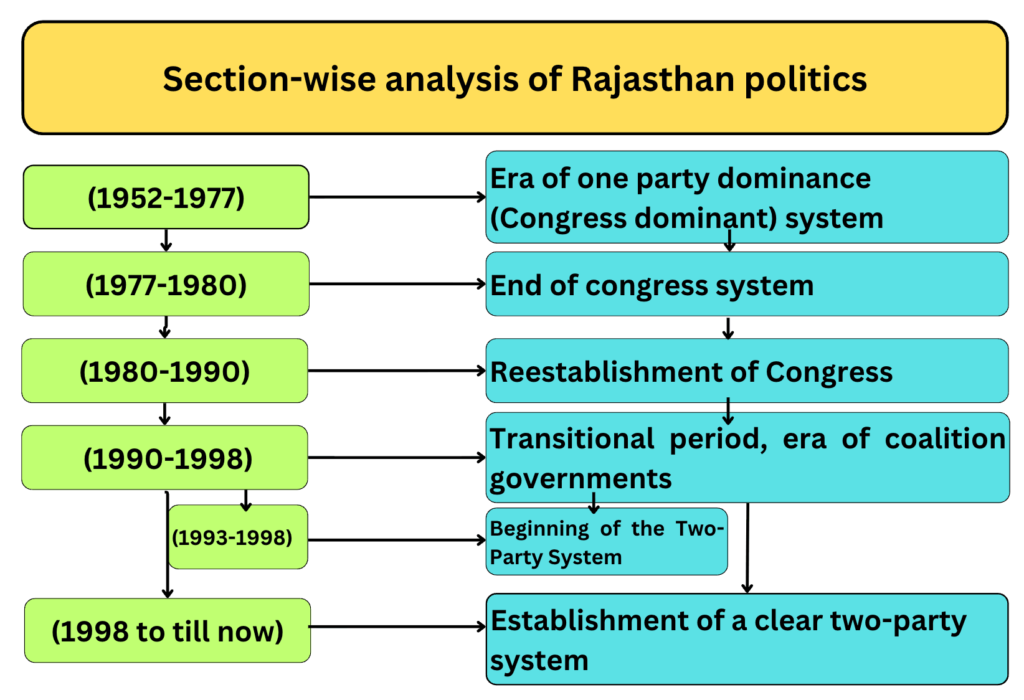
Era of one-party dominance (Congress dominance) – (1952-1977)
- From 1952 to 1977, Rajasthan’s politics remained dominated by the Congress, a phenomenon that Prof. Rajni Kothari termed a “one-party dominance system.”
- The period (1949-1954) is called the era of civil war or infighting in the Congress.
- From 1949 to 1954, six cabinets were formed, which clearly showed political instability.
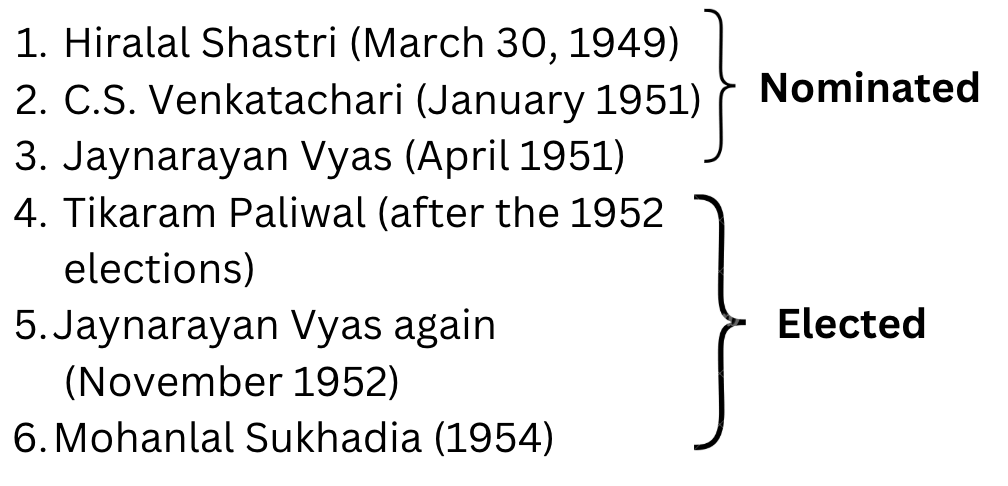
- Hiralal Shastri (30 March 1949) – With the support of Sardar Patel and Gokulbhai Bhatt, he became the Chief Minister (then designated as Prime Minister). After Hiralal Shastri became Chief Minister, Jayanarayan Vyas and Manikya Lal Verma launched a campaign against him
- Venkatachari (January 1951) – After Patel’s death, the Vyas-Verma faction became active. Opposition from Jayanarayan Vyas and Manikya Lal Verma led to Shastri’s removal and the appointment of Venkatachari, who was Secretary to the Ministry of State, Government of India.
- Jayanarayan Vyas (April 1951) – He was made the Chief Minister because he was close to Nehru.
- Tikaram Paliwal (after 1952 elections) – Vyas lost the election, so Paliwal became Chief Minister. He was sworn in on March 3, 1952.
- Again Jayanarayan Vyas – After becoming an MLA, Paliwal was removed and Vyas was reappointed Chief Minister. The inclusion of feudal-minded MLAs led to growing discontent within the party. Leaders like Manikya Lal Verma, Mohanlal Sukhadia, and Kumbha Ram Arya rose in opposition. Vyas was defeated in the 1954 legislative party elections, and Mohanlal Sukhadia became Chief Minister.
- Mohanlal Sukhadia (1954) – Became Chief Minister after Vyas’s defeat in the legislative party elections.
- There was stability in the Congress after Sukhadia became the Chief Minister in 1954.
- The elections of 1957 and 1962 were fought under the leadership of Sukhadia in which Congress got a clear majority and Sukhadia became the Chief Minister.
- 1967 elections – Congress did not get majority, President’s rule was imposed for 45 days.
- Government formed again in 1967 – Sukhadia became the Chief Minister again.
- In the 1969 presidential election, he supported Neelam Sanjiva Reddy instead of V.V. Giri, which angered Indira Gandhi and she forced Sukhadia to resign in 1971 and made Barkatulla Khan the Chief Minister.
- Congress got a huge majority in the 1972 elections.
- Barkatullah Khan became the Chief Minister, but died after a year.
- Haridev Joshi was appointed Chief Minister in October 1973. He remained Chief Minister until the imposition of President’s Rule for the second time on April 29, 1977.
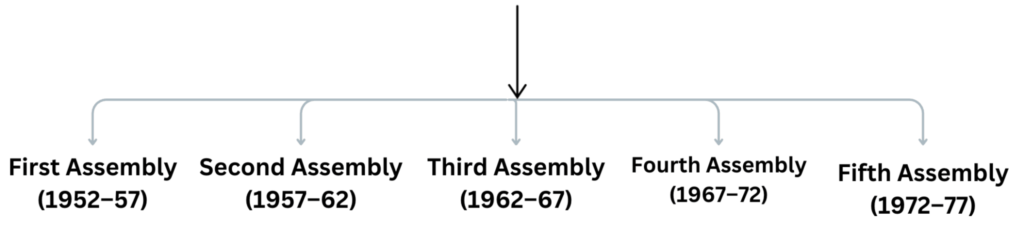
First Assembly (1952–57)
- The first assembly elections were held under the leadership of Chief Minister Jayanarayan Vyas.
- This election involved 160 seats in the Legislative Assembly and 22 seats in the Lok Sabha. A total of 616 candidates contested the election for the 140 Assembly constituencies. There were 20 two-member constituencies and 120 single-member constituencies. Of these, 139 Assembly constituencies were reserved for the General Category, while one Assembly constituency was reserved for Scheduled Tribes; however, no seats were reserved for Scheduled Castes.
- Apart from Congress, other political parties like Bharatiya Jana Sangh and Ram Rajya Parishad participated in Rajasthan.
Separate Assembly for Ajmer-Merwara
- Ajmer-Merwara: Had a separate 30-member Legislative Assembly (Dhara Sabha), consisting of 6 bi-member and 18 single-member constituencies.
- Ajmer-Merwara was not a part of Rajasthan.
Elections and results:
- In this election, out of 160 seats, seven Congress candidates were elected unopposed. Consequently, voting took place for 153 seats.
- Seats Won —
| Party | Seats won |
| Indian National Congress | 82 (07 Unopposed) |
| Ram Rajya Parishad | 24 |
| Bharatiya Jana Sangh | 8 |
| Farmers’ Lok Party | 7 |
| Hindu Mahasabha | 2 |
| Kisan Mazdoor Praja Party | 1 |
| socialist Party | 1 |
| Independent | 35 |
| Total | 160 |
- The total voter turnout was 36.69%.
- The percentage of invalid votes was 2.31%.
- Candidates of the Communist Party (11), KGSP (6), Forward Bloc (1) and Scheduled Caste Federation (1) were unsuccessful.
- Congress got only 11 seats out of 22 Lok Sabha seats.
Defeat/victory of big leaders
- Jaynarayan Vyas contested the election from two constituencies but lost in both.
- Jodhpur B – against Madho Singh of the Ramrajya Parishad
- Jalore A – against Maharaja Hanwant Singh
- Tikaram Paliwal contested the election from two constituencies and won from both.
- Mahua
- Malarnachaur
- He then vacated the Malarna seat, and a by-election was held in 1952, in which V. Singh of the Congress party won. Paliwal was the first candidate to win two seats.
- Hiralal Shastri did not contest the election.
- Gokulbhai left politics and joined the Sarvodaya movement.
- Manikyalal Verma won the by-election after losing the Lok Sabha elections.
- Four women participated, and all four lost.
- Chiranji Bai
- Virendrabai
- Shantabai
- Rani Devi
- Members elected unopposed
- Six candidates were elected unopposed, all from the Indian National Congress party, including
- Shri Ghasiram Yadav
- Shri Sampat Ram
- Shri Jaichand
- Shri Laxman Bhil
- Shri Hazari Lal
- Shri Hariram
- Six candidates were elected unopposed, all from the Indian National Congress party, including
Formation of the first assembly
- Voting took place from January 4 to January 24, 1952.
- The first Legislative Assembly was constituted on February 23, 1952.
- On March 3, 1952, the state’s first elected democratic government was formed.
- The Congress elected Tikaram Paliwal as the leader of the legislative party.
- During the five-year tenure of the first Legislative Assembly—which commenced in 1952—there were four power struggles for the post of Chief Minister, and the Chief Minister was changed three times during this period.
- Tikaram Paliwal
- Jaynarayan Vyas
- Mohanlal Sukhadia
Swearing-in of members
- Date: February 23, 1952
- Rajpramukh: Sawai Mansingh administered the oath to all the members.
Tikaram Paliwal Cabinet (3 March 1952)
- The first meeting was held on 29 March 1952 at Sawai Mansingh Town Hall in Jaipur.
- Narottam Lal Joshi was elected as the first Speaker of the Rajasthan Legislative Assembly on March 31, 1952, having won the election from Jhunjhunu on a Congress ticket.
- The main officials of the first assembly:
- Chief Minister – Tikaram Paliwal
- Speaker of the Legislative Assembly – Narottam Lal Joshi
- Deputy Speaker of the Legislative Assembly – Lal Singh Shaktawat
- Leader of the Opposition: Jaswant Singh (Independent), Tansingh
- Ramkishore Vyas, Mohanlal Sukhadia, Ramkaran Joshi etc. became ministers in the government.
- On 31 October 1952, this government resigned so that Jai Narayan Vyas could be made the Chief Minister.
Jayanarayan Vyas Cabinet (November 1, 1952)
- The seat held by Chandmal Mehta, the MLA for the Kishangarh constituency, was vacated to accommodate Jaynarayan Vyas.
- In August 1952, Jaynarayan Vyas won the by-election for the MLA seat from the Kishangarh constituency.
- On November 1, 1952, Jaynarayan Vyas was appointed as the Chief Minister of Rajasthan.
- Tikaram Paliwal became the Deputy Chief Minister.
- Smt. Yashoda Devi achieved victory in the by-election from Banswara in 1953. She became the first female MLA of the Rajasthan Legislative Assembly.
Mohanlal Sukhadia Cabinet (November 13, 1954)
- Mohanlal Sukhadia, Kumbharam Arya and Mathuradas Mathur raised the banner of revolt under the leadership of Manikyalal Verma.
- In view of the growing discontent, the Congress high command instructed Jayanarayan Vyas to gain the confidence of the legislative party.
- On 6 November 1954, Mohanlal Sukhadia defeated Vyas by 8 votes in the Congress Legislature Party meeting.
- On 13 November 1954, Mohanlal Sukhadia formed his government.
- 1954: Kamla Beniwal became the second woman MLA from Virat Nagar by-election and also the first woman minister (Deputy Minister).
Merger of Ajmer with Rajasthan (1956)
- Ajmer was merged with Rajasthan in 1956.
- Ajmer’s 30-member Legislative Assembly was merged into the Rajasthan Legislative Assembly, of which Haribhau Upadhyay was the Chief Minister.
- The number of members in this Legislative Assembly
- Congress – 20
- Bharatiya Jana Sangh – 3
- Independent – 4
- Purusharthi Panchayat – 3
- The number of members remained 190 till the second assembly elections.
- In a show of strength between Haribhau Upadhyay and Sukhadia for the post of Chief Minister, Haribhau withdrew his name at the last moment and Mohanlal Sukhadia was again elected the leader of the party and remained the Chief Minister.
Other
- November 1, 1956: With the merger of Ajmer-Merwara, the number of assembly members increased to 190.
- By-elections were held in 17 constituencies during the tenure of the first assembly.
- This marks the highest record for by-elections to date.
- Sessions: A total of 12 sessions and 303 meetings were held.
Second Assembly (1957 – 1962)
- The membership of the first assembly was 160.
- After the reorganization of states on November 1, 1956, Ajmer State was merged into Rajasthan.
- 30 members of Ajmer Assembly were included in the Rajasthan Legislative Assembly.
- Thus, by the general elections of 1957, the number of members of the Rajasthan Legislative Assembly increased to 190.
- Subsequently, the assembly constituencies were redelimited, resulting in a reduction in the number of members to 176.
- When the second assembly elections were held in 1957, Jayanarayan Vyas was the state Congress president and Mohan Lal Sukhadia was the Chief Minister.
- Before the second general election in 1956, small landlords launched the ‘Landowners’ movement.
- To date, the highest number of sittings (306) was held during the Second Legislative Assembly.
Elections and results:
- In this election, out of 176 seats, 5 seats were won unopposed.
- Therefore, elections were held for only 171 seats.
- Seats Won —
| Party | Seats won |
| Indian National Congress | 119 (5 unopposed) |
| Ram Rajya Parishad | 17 |
| Bharatiya Jana Sangh | 6 |
| Praja Socialist Party | 1 |
| Communist Party of India | 1 |
| Independent | 32 |
| Total | 176 |
Formation of the Second Legislative Assembly
- The Second Legislative Assembly was constituted on April 2, 1957.
- Following the election results, Shri Mohanlal Sukhadia, the leader of the Congress Legislature Party, formed his cabinet on April 11, 1957.
- This cabinet remained in office until March 11, 1962.
By-election:
- A total of 6 by-elections were held during the period of the Second Assembly (1957–1962), including two by-elections held in the Mahua area of Sawai Madhopur district.
- After this, the political influence of Ram Rajya Parishad and Jan SanghIt began to weaken and the Swatantra Party emerged.
Ram Rajya Parishad Rise
- In 1948, Karpatri Maharaj (Swami Hariharanand Saraswati) founded this party with the concept of a ‘Hindu Rashtra’.
- It was the first party in the politics of Rajasthan to accord prominence to religious issues.
Rise of the Bharatiya Jana Sangh
- The Bharatiya Jana Sangh was founded on October 21, 1951.
- Founding President: Dr. Syama Prasad Mookerjee
- The Jana Sangh was established with the support of the Rashtriya Swayamsevak Sangh (RSS), which gave it the identity of a Hindutva-oriented nationalist party.
Rise of the Swatantra Party
- The rise of the Swatantra Party was an important event in the politics of Rajasthan.
- Political party founded by C. Rajagopalachari in 1959.
- This party was established by the kings and maharajas of former princely states.
- The party’s aims included encouragement of private trade, nationalisation of private enterprises, land ceiling and opposition to Congress policies.
- The Swatantra Party was committed to social justice and supported equal opportunities for all, without discrimination on the basis of religion, caste, or political affiliation.
- Maharani Gayatri Devi of Jaipur joined the party in 1961 and became the national vice-president of the party.
Third Assembly (1962–67)
- In this election, the constituencies were redrawn.
- The two-member constituencies were abolished and all constituencies were made single-member.
Elections and results:
- Elections were held on 176 seats in this election.
- Seats obtained –
| Party | Seats won |
| Indian National Congress | 88 |
| Swatantra Party | 36 (Became the second largest party in the state.) |
| Bharatiya Jana Sangh | 15 |
| Communist Party of India | 5 |
| Socialist Party | 5 |
| Ram Rajya Parishad | 3 |
| Praja Socialist Party | 2 |
| Independent | 22 |
| Total | 176 |
Formation of the Third Assembly
- The Third Legislative Assembly was constituted on March 3, 1962.
- The new Cabinet, under the leadership of Mohanlal Sukhadia, was sworn in on March 12, 1962.
- This Cabinet remained in office until March 13, 1967, when President’s Rule was imposed in the state.
By-election:
- A total of 5 by-elections were held during the Third Assembly (1962–1967).
Fourth Assembly (1967–1972)
- Indira Gandhi was the Prime Minister of India at the time of the 1967 elections.
- Due to opposition unity, Congress faced defeat in most of the North Indian states.
Elections and results:
- Following the new delimitation, the number of Legislative Assembly members increased from 176 to 184.
- Seats obtained –
| Party | Seats won |
| Indian National Congress | 89 |
| Swatantra Party | 49 |
| Bharatiya Jana Sangh | 22 |
| United Socialist Party | 8 |
| Independent | 16 |
| Total | 184 |
- Out of a total of 184 seats, the Congress won 89 seats, which was 4 seats short of a majority.
- In this election, no candidate was elected unopposed.
- The Swatantra Party emerged as the second-largest party in the Legislative Assembly.
- All opposition parties and independent legislators collectively claimed the support of 96 seats.
- Governor Sampurnanand invited Mohanlal Sukhadia, the leader of the largest party, to form the government—a move opposed by the opposition.
- Police opened fire during protests held at Johari Bazaar, Jaipur, resulting in the deaths of nine people.
- The Beri Commission was constituted to investigate this incident.
- In light of the prevailing atmosphere of anarchy and protest, Sukhadia declined to form the government.
- In 1967, instead of offering the opposition parties an opportunity to form the government, the then-Governor Sampurnanand recommended the imposition of President’s Rule to the Central Government.
- Due to the instability and unrest within the state, President’s Rule was imposed on March 13, 1967, and the Legislative Assembly was suspended—though it was not dissolved.
- President’s Rule remained in force for approximately 45 days.
- On April 15, 1967, Governor Dr. Sampurnanand’s tenure came to an end.
- On April 16, 1967, the new Governor, Sardar Hukam Singh, assumed office.
- During the period of President’s Rule, Sukhadia secured a majority by orchestrating defections. On April 26, 1967, Governor Sardar Hukam Singh administered the oath of office as Chief Minister to Sukhadia.
- On October 22, 1967, Sukhadia expanded his cabinet once again, administering the oath to four Parliamentary Secretaries. This marked the first instance in Rajasthan where the posts of Minister of State and Parliamentary Secretary were formally instituted.
- During the 1969 Presidential election, Sukhadia supported the official Congress candidate, Neelam Sanjeeva Reddy.
- He aligned himself with the “Syndicate Congress” rather than Prime Minister Indira Gandhi’s “Indicate Congress.”
- Acting on the directives of Prime Minister Indira Gandhi, Mohanlal Sukhadia tendered his resignation from the cabinet on July 8, 1971. Thus, Sukhadia led the state for 17 years and set a record that remains unbroken to this day.
- Following Sukhadia’s resignation, Barkatullah Khan was appointed as Chief Minister.
- Barkatullah Khan’s appointment marked the beginning of the Congress High Command’s interference—a practice that continues even today.
- On July 9, 1971, Barkatullah Khan’s cabinet was sworn in.
- On September 4, 1971, Onkarlal Chauhan was inducted into the cabinet; however, he was not a member of the Legislative Assembly. Consequently, he was compelled to resign on March 3, 1972.
Fifth Assembly (1972–1977)
- The 1972 assembly elections were held against the backdrop of the Bangladesh Liberation War.
- At this time Indira Gandhi was the sole leader of Indian politics.
- At the time of the elections, Barkatulla Khan was the Chief Minister of Rajasthan.
Elections and results:
- Out of the total 184 constituencies of the Assembly, Congress candidate Nidishrai Dangi was elected unopposed from Desuri (reserved Scheduled Caste) constituency of Pali district.
- Thus, voting took place in 183 constituencies.
- Seats obtained –
| Party | Seats won |
| Indian National Congress | 145 (Historically won seats) + 01 (unopposed) |
| Swatantra Party | 11 |
| Bharatiya Jana Sangh | 8 |
| Communist Party of India (CPI) | 4 |
| Socialist Party | 4 |
| Independent | 11 |
| Total | 184 |
- Congress won a record 145 seats (out of a total of 184).
- The Independent Party came second, winning 11 seats.
- This was the biggest victory for the Congress in terms of assembly seat percentage, as in 1998 the Congress had won 153 seats, but the total seats were 200.
Formation of the Fifth Legislative Assembly
- Following the assembly elections, Barkatullah Khan was unanimously elected as the leader of the Congress Legislature Party.
- The Fifth Legislative Assembly was constituted on March 15, 1972.
- Barkatullah Khan took the oath of office as Chief Minister for the second time on March 16, 1972.
- He passed away suddenly on October 11, 1973, thereby becoming the only Chief Minister of Rajasthan to die while holding office.
- On the same day, Haridev Joshi was sworn in as Chief Minister.
- On October 22, 1973, a contest for the post of Chief Minister took place between Haridev Joshi and Ram Niwas Mirdha during a meeting of the Congress Legislature Party.
- Having secured a majority, Haridev Joshi once again took the oath as Chief Minister on October 25, 1973 (on the day of Diwali).
- Haridev Joshi served as Chief Minister until 1977.
- This Legislative Assembly witnessed both the imposition of Article 352 (National Emergency) and President’s Rule.
- Article 352 (National Emergency):
- During the period of 1975–77, Indira Gandhi imposed a state of Emergency in the country on the grounds of internal disturbance.
- At that time, Sardar Jogendra Singh was the Governor of Rajasthan, and Haridev Joshi was the Chief Minister.
- In Rajasthan, this Emergency lasted for 54 days.
- Political arrests, draconian government policies, repression, and the infringement of civil liberties took place, rendering the government unpopular.
- Article 356 (President’s Rule):
- Following the end of the state of Emergency prevailing in the country in February 1977, and subsequent to the Lok Sabha elections held in March 1977—which saw the Janata Party assume power at the Centre (marking the first non-Congress government at the national level)—Acting Governor Vedpal Tyagi dismissed the government led by Haridev Joshi and dissolved the Legislative Assembly on April 29, 1977.
- Consequently, President’s Rule was imposed in the state (for the second time since 1967).
- This Legislative Assembly had been the longest-serving Assembly in the history of Rajasthan.
- Article 352 (National Emergency):
By-election:
- By-elections were held in a total of five constituencies during this period.
Rise of the Janata Party
- After the end of the Emergency, leaders of various opposition parties like Congress (O), Jan Sangh, Bharatiya Lok Dal, and Socialist Party formed a new party “Janata Party”.
- The Janata Party played the role of resistance to the Congress at the national and state levels.
End of the Congress system (1977–1980)
Sixth Assembly (1977–1980)
- The 1977 election was a public mandate against the Emergency (1975–77) imposed by Indira Gandhi.
- In the elections held following the Emergency, the Congress faced defeat at both the central and state levels.
- In the 1977 Lok Sabha elections, the Congress managed to win only 1 out of the 25 seats.
- Nathuram Mirdha was the sole Member of Parliament to win from Nagaur on a Congress ticket.
- The Janata Party secured victory in the remaining 24 Lok Sabha seats in Rajasthan.
Election results:
- Prior to the elections, delimitation took place, increasing the number of seats in the Rajasthan Legislative Assembly from 184 to 200. Of these, 33 seats were reserved for Scheduled Castes and 24 for Scheduled Tribes.
| Party | Seats won |
| Indian National Congress | 41 |
| Janata Party | 152 |
| Communist Party of India (CPI)(M) | 1 |
| Communist Party of India (CPI) | 1 |
| Independent | 5 |
| Total | 200 |
- The Janata Party won 152 seats and obtained a three-fourth majority.
- There was a possibility of a two-party system emerging in Rajasthan instead of multi-party politics, but it could not be fully established.
Formation of the Sixth Assembly
- The Sixth Legislative Assembly was constituted on June 22, 1977.
- A contest for the leadership of the legislative party took place between Bhairon Singh Shekhawat and Master Adityendra, in which Bhairon Singh Shekhawat emerged victorious.
- On June 22, 1977, Shekhawat took the oath as the state’s first non-Congress Chief Minister.
- Shekhawat constituted the Beri Commission to investigate corruption within the previous Congress governments.
- When Bhairon Singh Shekhawat took the oath as Chief Minister, he was not a Member of the Legislative Assembly (MLA); rather, he was a Member of Parliament (MP) in the Rajya Sabha representing Madhya Pradesh.
- Subsequently, on October 18, 1977, he secured membership in the Legislative Assembly by winning a by-election from the Chhabra constituency in the Kota district.
- Maharawal Laxman Singh became the Speaker of the Sixth Legislative Assembly, making him the first non-Congress Speaker of the Assembly.
- Following his resignation, Gopal Singh Ahor was appointed as the Speaker of the Legislative Assembly.
- Later, Gopal Singh Ahor went on to become the Governor of Goa.
- Leaders such as Maharawal Laxman Singh and Daulat Ram Saharan moved a no-confidence motion against their own government.
- However, the motion failed, and the government remained stable.
- The Janata Party government was unable to complete its full five-year term.
- In 1980, following the formation of Indira Gandhi’s Congress government at the Centre, President’s Rule was imposed in Rajasthan.
- Subsequently, on February 16, 1980, Governor Raghukul Tilak dismissed Bhairon Singh Shekhawat’s government and dissolved the Legislative Assembly.
- This marked the third instance of President’s Rule in Rajasthan, following those in 1967 and 1977.
- Its duration was the shortest in the history of Rajasthan.
- The Sixth Legislative Assembly was the first in Rajasthan to witness mid-term elections.
- Following the mid-term Lok Sabha elections in January 1980, the Congress (I) government assumed power at the Centre.
- The Congress party dissolved the Legislative Assemblies of several states, including Rajasthan.
- The experiment of a united opposition against the Congress did not prove successful.
Rise of the Bharatiya Janata Party (BJP)
- Following the failure of the Janata Party, a new party, the Bharatiya Janata Party (BJP), was formed by Janata Party members in 1980.
- With the issues of Ram Mandir and Hindutva, the Bharatiya Janata Party (BJP) started increasing its influence in politics.
- At the inaugural session of the BJP in Mumbai in 1980, Atal Bihari Vajpayee said that the BJP was not a new form of the Jan Sangh, but represented the aspirations of Jayaprakash Narayan.
Restoration of Congress (1980-1990)
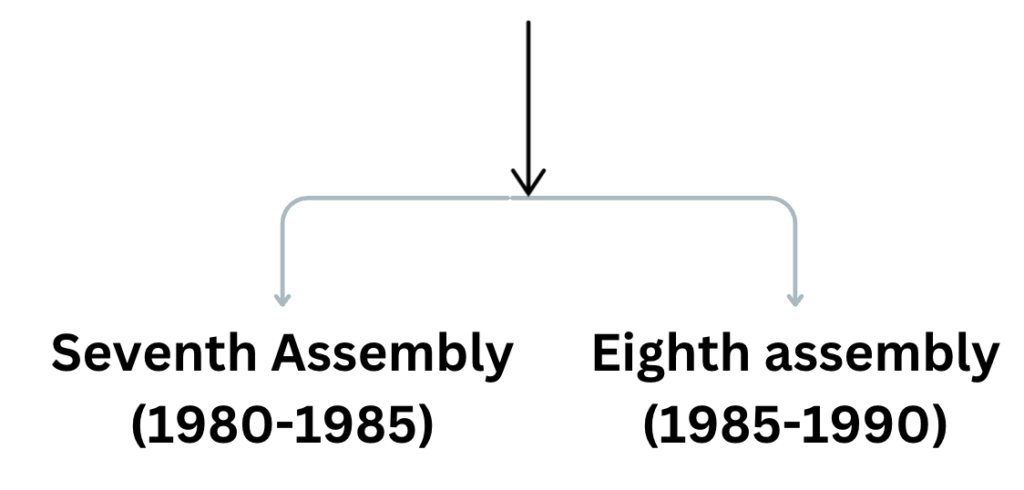
- Internal democracy in the Congress ended with the victory of Indira Gandhi in 1971.
- After 1970, the party came completely under the dominance of the Gandhi family.
- From 1970 to 1990, only the people nominated by Indira Gandhi, Sanjay Gandhi and Rajiv Gandhi became the Chief Ministers of Rajasthan.
- The Janata Party disintegrated in 1980, weakening the opposition.
- With the issues of Ram Mandir and Hindutva, the Bharatiya Janata Party (BJP) started increasing its influence in politics.
- Between 1980 and 1990, there was competition among various factions in the Congress to gain the attention of the high command.
- The Bofors gun scandal created an atmosphere against the Congress and ultimately weakened its hold.
- In the assembly elections (1980 and 1985) Congress formed the government with a clear majority.
- In these 10 years, 6 different Congress ministries were formed, which led to instability.
- Rajasthan had six chief ministers during this period:
- Jagannath Pahadia (1980–81)
- Shiv Charan Mathur (1981–1985)
- Hiralal Devpura (1985, 15 days)
- Haridev Joshi
- Shiv Charan Mathur again
- Again Haridev Joshi
Seventh Assembly (1980–1985)
- The 1980 assembly election was Rajasthan’s first mid-term election (the second was held in 1993).
- Elections and results:
| Party | Seats won |
| Indian National Congress (I) | 133 |
| Bharatiya Janata Party (BJP) | 32 |
| Communist Party of India (CPI)(M) | 1 |
| Communist Party of India (CPI) | 1 |
| Indian National Congress (U) | 6 |
| Janata Party (SECULAR) – CH. CHARAN SINGH | 7 |
| Janata Party (JP) | 8 |
| Independent | 12 |
| Total | 200 |
- Congress won 133 seats.
- The newly formed Bharatiya Janata Party (BJP) won 32 seats.
Formation of the Seventh Assembly
- The Seventh Legislative Assembly was constituted on June 6, 1980, following the dissolution of the Sixth Legislative Assembly.
- The Seventh Legislative Assembly saw three Chief Ministers –
- Jagannath Paharia
- Shivcharan Mathur
- Hiralal Devpura.
- On June 5, 1980, at a meeting held in New Delhi in the presence of Sanjay Gandhi, Jagannath Pahadia was elected leader of the Congress (I) Legislative Party.
- On June 6, 1980, he took the oath as Chief Minister in Jaipur.
- At this time, Pahadia was not a member of the Legislative Assembly; he was serving as a Member of Parliament in the Lok Sabha from the Bayana (Bharatpur) constituency and as a Union Minister.
- On November 23, 1980, he was elected as an MLA after winning the election from the Weir (Bharatpur) Assembly seat, which had fallen vacant following the resignation of his wife, Shanti Pahadia.
- Following the death of Sanjay Gandhi, protests against Pahadia began.
- Due to internal dissent and factionalism within the ruling party, and acting on the directives of the Congress (I) high command, the Pahadia ministry (which had served for 13 months) tendered its resignation on July 12, 1981; the resignation was accepted on July 13, 1981.
- Following Pahadia’s resignation, Shiv Charan Mathur was elected as the new leader at a meeting of the Congress (I) Legislative Party held on July 14, 1981.
- On July 14, 1981, he took the oath as Chief Minister, and this ministry continued to function until 1985.
- On February 21, 1985—during an election campaign in Deeg—an unstable situation arose following the death of independent candidate Raja Man Singh in a police shooting incident. To address this crisis, and acting on the directives of the Congress high command (Rajiv Gandhi), Shiv Charan Mathur resigned—along with his entire cabinet—on February 23, 1985.
- On February 23, 1985, Hiralal Devpura was appointed as Chief Minister, and he took the oath of office on the very same day.
- This ministry remained in office until March 10, 1985, when the election results were declared and a new government was formed.
- His tenure lasted for a mere 15 days, marking the shortest term served by a Chief Minister in the history of Rajasthan.
By-election:
- A total of four by-elections were held during the Seventh Assembly (1980–1985).
Eighth Assembly (1985–1990)
Elections and results:
| Party | Seats won |
| Indian National Congress (INC) | 113 |
| Bharatiya Janata Party (BJP) | 39 |
| Communist Party of India (CPI) | 1 |
| Lok Dal | 27 |
| Janata Dal | 10 |
| Independent | 10 |
| Total | 200 |
- The BJP established itself as the principal opposition in the electoral politics of Rajasthan.
- The BJP witnessed an increase in both its seat tally and vote share, shifting the state’s politics from the Congress’s one-party dominance toward a two-party system.
Formation of the Eighth Assembly
- On March 9, 1985, the notification for the constitution of the Eighth Legislative Assembly was issued.
- The Eighth Legislative Assembly saw three Chief Ministers.
- Haridev Joshi
- Shivcharan Mathur
- Haridev Joshi again.
- On March 9, 1985, Haridev Joshi was elected leader of the Congress (I) Legislative Party.
- On March 10, 1985, he assumed the reins of the state for the second time and took the oath of office as Chief Minister.
- On September 4, 1987, the ‘Roop Kanwar Sati incident’ occurred in the village of Deorala in Rajasthan’s Sikar district. The opposition launched a fierce offensive over this issue.
- On January 18, 1988, acting on the directives of the Congress (I) high command, Haridev Joshi submitted the resignation of his cabinet to the Governor.
- This resignation was accepted on January 20, 1988.
- Following Haridev Joshi’s resignation, Shiv Charan Mathur became Chief Minister for the second time on January 20, 1988.
- During Shiv Charan Mathur’s tenure, dissent emerged within the Congress (I) Legislative Party.
- On March 17, 1989, the dissident legislators boycotted the Assembly proceedings and pressed for a change in leadership.
- In the 9th Lok Sabha elections (November 1989), the Congress (I) suffered an unprecedented defeat. The Congress failed to secure a single seat in Rajasthan (losing all 25 out of 25 seats). Consequently, the Mathur cabinet tendered its resignation on November 29, 1989, which was accepted by the Governor on the very same day.
- Following the crushing defeat in the elections, Shiv Charan Mathur stepped down.
- After Mathur’s resignation, on December 3, 1989, Haridev Joshi was once again elected leader of the Congress (I) Legislative Party.
- Haridev Joshi was recalled from his post as Governor of Assam to serve as the Chief Minister of Rajasthan for the third time.
- He was invited by the Governor to take the oath of office; however, the Governor failed to arrive at the scheduled time for the swearing-in ceremony, thereby precipitating a constitutional crisis.
- The reason behind this incident was that the President had not yet accepted Joshi’s resignation from the post of Governor of Assam; consequently, Governor Sukhdev Prasad postponed the swearing-in ceremony by one day.
- Subsequently, the President accepted Joshi’s resignation.
- On December 4, 1989, Governor Sukhdev Prasad administered the oath of office as Chief Minister to Haridev Joshi for the third time.
Era of Coalition Governments (Transition Period) (1990-98)
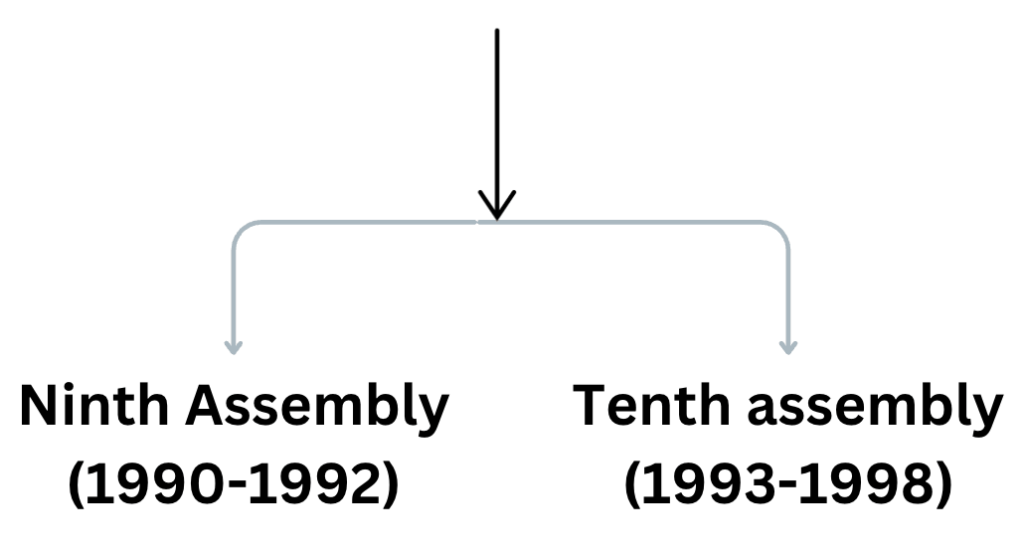
- Both times BJP did not get a clear majority, due to which instability persisted.
- During this period there were minority governments, due to which the dignity of the post of Chief Minister was affected.
- To save the government, the cabinet had to be expanded unnecessarily.
- Incidents of defection increased, leading to political instability.
- The rise of the Janata Dal in 1989 had created the possibility of the emergence of a third force in Rajasthan, but this possibility soon ended due to the split of the Janata Dal in the state and its disintegration at the national level.
Ninth Assembly (1990-1992)
Elections and results:
- The 200 seats in the Assembly were kept unchanged.
| Party | Seats won |
| Indian National Congress (INC) | 50 |
| Bharatiya Janata Party (BJP) | 85 |
| Communist Party of India (CPI(M)) | 1 |
| Janata Dal | 55 |
| Independent | 9 |
| Total | 200 |
- Fractured mandate: The BJP emerged as the single largest party, winning 85 seats. The Janata Dal came in second with 54 seats, and the Congress came in third with 50 seats.
- Like in 1967, no party got a clear majority.
- After the results of the ninth assembly elections were declared and Congress (I) did not obtain a majority, the Joshi cabinet submitted its resignation to the Governor on 1 March 1990, which was accepted the same day.
- Bhairon Singh Shekhawat of the BJP was elected from two seats (Chhabra and Dholpur), reducing the BJP’s membership to 84.
Formation of the Ninth Legislative Assembly
- On March 2, 1990, the Governor issued a notification regarding the constitution of the Ninth Legislative Assembly.
- On March 3, 1990, Bhairon Singh Shekhawat was elected as the leader of the BJP Legislative Party.
- The BJP formed a government in alliance with the Janata Dal, and on March 4, 1990, Bhairon Singh Shekhawat became Chief Minister for the second time (his first tenure was from 1977 to 1980).
- The year 1990 witnessed instability in national politics:
- On October 23, 1990, in Bihar, Lalu Prasad Yadav halted Lal Krishna Advani’s “Ram Rath Yatra.”
- Consequently, the BJP withdrew its support from the government led by Prime Minister V.P. Singh (Janata Dal).
- In retaliation, the Janata Dal withdrew its support from the Shekhawat government in Rajasthan.
- A split occurred within the Janata Dal, leading to the formation of a new faction named “Janata Dal (Digvijay),” which extended its support to the Shekhawat government, thereby saving it.
- On November 8, 1990, a special session of the Legislative Assembly commenced, during which Chief Minister Shekhawat moved a one-sentence motion of confidence: “This House expresses its confidence in the present government.”
- Following a debate on the motion of confidence, a division of votes took place, resulting in 116 votes in favor of the government and 80 against it.
- On December 6, 1992—following the demolition of the Babri Masjid—the Governor submitted a report citing the State Government’s failure to effectively curb the activities of five banned organizations, as mandated by the Central Government. Acting on the recommendation of Prime Minister Narasimha Rao, President Shankar Dayal Sharma dismissed the BJP-ruled governments of Rajasthan, Madhya Pradesh, Uttar Pradesh, and Himachal Pradesh.
- The Shekhawat government in Rajasthan was also dismissed, and the Legislative Assembly was dissolved on December 15, 1992.
- Bhairon Singh Shekhawat’s second government (1990–1992), too, failed to complete its full term, and President’s Rule was imposed.
- This marked the fourth instance of President’s Rule being imposed in Rajasthan (following the years 1967, 1977, and 1980). M. Chenna Reddy was the Governor.
- The Ninth Legislative Assembly was the second Assembly of Rajasthan that did not complete its full term (the first incomplete Assembly was the Sixth Assembly, 1977–1980).
- Mid-term elections were announced in 1993.
By-election:
- A total of five by-elections were held in the state during the Ninth Assembly (1990–1992).
Tenth Assembly (1993–1998)
- Following the lifting of President’s Rule in 1993, Rajasthan held mid-term elections for the second time.
- The 1993 elections ushered in a new trend in Rajasthan’s party politics— ‘bipartisan system’—which persists to this day.
- Since 1993, the BJP and the Congress have remained the two dominant political parties in Rajasthan’s politics.
- The influence of other parties has remained limited, and they have been unable to build a strong mass base.
Elections and results:
| Party | Seats won |
| Bharatiya Janata Party (BJP) | 95+1 (in by-elections) |
| Indian National Congress (INC) | 76 |
| Communist Party of India (CPI(M)) | 1 |
| Janata Dal (United) (JD(U)) | 6 |
| Independent | 21 |
| Total | 200 |
- On October 12, 1993, the Election Commission of India issued a notification for the elections to the Tenth Legislative Assembly.
- Fragmented mandate: In these elections held against the backdrop of Ram Mandir and Babri demolition, BJP won 95 seats, while Congress came second with 76 seats.
- The Janata Dal split after the election, with 3 of its 6 members joining the BJP.
- This increased the BJP’s membership to 98, while the Janata Dal’s membership dropped to three.
Formation of the Tenth Legislative Assembly
- Following the election results, the Election Commission of India announced the constitution of the new Legislative Assembly and the names of the elected legislators on December 4, 1993.
- On the same day, the Union Ministry of Home Affairs announced the lifting of President’s Rule in the state.
- As no single party secured a clear majority, a BJP government was formed with the support of independent candidates, and on December 4, 1993, Bhairon Singh Shekhawat became Chief Minister for the third time.
- Harishankar Bhabhra, who had served as the Speaker of the Legislative Assembly from 1990 to 1992, was re-elected as Speaker; however, two years later, he resigned from the post to assume the office of Deputy Chief Minister.
The main reason for bipartisan politics:
- The anti-incumbency factor came into effect, in which issues like employment, inflation and women’s safety were given priority.
Establishment of a clear two-party system (1998 to present)
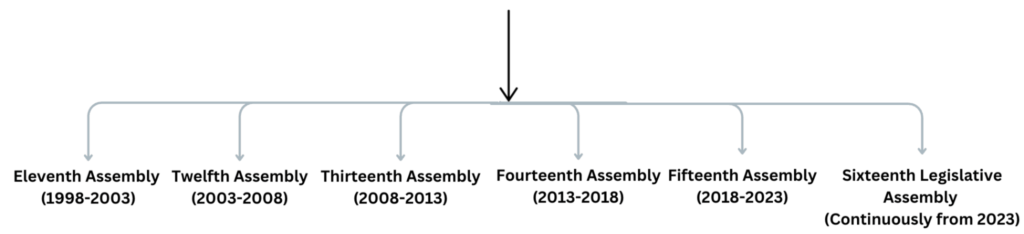
- State politics has not only been bipartisan since 2003, but has become a direct contest between two individuals.
- On one hand, Vasundhara Raje was the main face from the BJP, while on the other hand, the leadership of Congress remained in the hands of Ashok Gehlot.
- In the elections after 2003, the process of change of power between BJP and Congress continued.
- The BSP won six seats each in 2008 and 2018, but it has not been able to establish a permanent support base as the third largest party.
Political period:
- Congress government formed:
- Eleventh Assembly (1998–2003)
- Thirteenth Assembly (2008–2013)
- Fifteenth Assembly (2018–2023)
- BJP government formed:
- Twelfth Assembly (2003–2008)
- Fourteenth Assembly (2013–2018)
- Sixteenth Legislative Assembly (continuously from 2023)
Eleventh Assembly (1998–2003)
- In the November 1998 elections, the public was upset over rising onion prices, which caused losses to the Shekhawat government.
- Due to this, BJP had to face a crushing defeat in the 1998 assembly elections.
- The elections to the 11th Legislative Assembly were held in 1998 after the elections to the 12th Lok Sabha.
Elections and results:
| Party | Seats won |
| Indian National Congress (INC) | 153 |
| Bharatiya Janata Party (BJP) | 33 |
| Bahujan Samaj Party (BSP) | 2 |
| Communist Party of India (CPI(M)) | 1 |
| Rashtriya Janata Dal | 1 |
| Janata Dal (United) (JD(U)) | 3 |
| Independent | 7 |
| Total | 200 |
- The elections were held under the leadership of Congress State President Ashok Gehlot.
- The Congress won 153 seats, its highest ever in Rajasthan (the previous tally was 145 in 1972).
- BJP could win only 33 seats.
Formation of the Eleventh Legislative Assembly
- On December 1, 1998, the notification for the constitution of the Eleventh Legislative Assembly was issued.
- The Congress Legislature Party unanimously elected Ashok Gehlot as its leader.
- Gehlot assumed the reins as the Chief Minister of the state.
- Gehlot was not a sitting legislator; rather, he was a Member of Parliament (Lok Sabha) representing the Jodhpur constituency. Subsequently, the Sardarpura Assembly seat in Jodhpur was vacated for him. At that time, the Congress MLA representing Sardarpura was Mansingh Devra. On February 22, 1999, a by-election was held in the Sardarpura area of Jodhpur city, in which Ashok Gehlot emerged victorious.
- Parasram Maderna became the Speaker of the Legislative Assembly.
- During the final years of the tenure, Banwari Lal Bairwa and Smt. Kamla Beniwal were appointed as Deputy Chief Ministers.
By-election
- During the tenure of the eleventh assembly, by-elections were held in a total of 13 assembly constituencies.
- First of all,
Number of women MLAs:
- The number of women MLAs in the Assembly was 14.
Twelfth Assembly (2003–2008)
- The tenure of the Eleventh Legislative Assembly was until January 3, 2004; however, the Election Commission conducted the elections for the Twelfth Legislative Assembly one month early, on December 1, 2003.
- The counting of votes took place on December 4, 2003, and the new government assumed office on December 8, 2003.
- Electronic Voting Machines were used for the first time in this election. The number of polling stations stood at 35,703.
Elections and results:
| Party | Seats won |
| Indian National Congress (INC) | 56 |
| Bharatiya Janata Party (BJP) | 120 |
| Indian National Lok Dal (INLD) | 4 |
| Bahujan Samaj Party (BSP) | 2 |
| Communist Party of India (CPI(M)) | 1 |
| Lok Jan Shakti Party | 1 |
| Rajasthan Social Justice Forum | 1 |
| Janata Dal (United) (JD(U)) | 2 |
| Independent | 13 |
| Total | 200 |
- BJP won 120 seats, while Congress was reduced to 56 seats.
- This was the first time the BJP had won a clear majority in Rajasthan. The Bhairon Singh Shekhawat governments formed in 1990 and 1993 did not have absolute majorities.
- In the 2003 elections, the Gehlot government was defeated due to Jat reservation and resentment of government employees.
- The BJP benefited from the strategy of ‘Parivartan Yatras’, ‘change in attire’ and ‘participation of women’.
Formation of the 12th Legislative Assembly
- On December 5, 2003, the Eleventh Legislative Assembly was dissolved, and a notification was issued for the constitution of the Twelfth Legislative Assembly.
- Within the Bharatiya Janata Party (BJP), Vasundhara Raje was elected as the leader of the legislative party.
- On December 8, 2003, she took the oath of office as the state’s thirteenth Chief Minister.
- Vasundhara Raje became the Chief Minister, and Sumitra Singh became the Speaker of the Legislative Assembly.
- This marked the first time that the state’s two top constitutional posts were held by women.
- A year later, Pratibha Patil became the Governor, bringing all three major posts under the control of women.
- In the 2003 elections, Electronic Voting Machines (EVMs) were used across the entire state for the first time.
- Twelve women legislators were elected to the Twelfth Legislative Assembly.
Thirteenth Assembly (2008–2013)
- Delimitation led to changes in the reserved assembly constituencies for Scheduled Castes (SC) and Scheduled Tribes (ST).
- Currently in Rajasthan –
- In the Legislative Assembly, 34 seats are reserved for SCs and 25 for STs.
- In the Lok Sabha, 4 seats are reserved for SCs and 3 for STs (out of a total of 25).
Elections and results:
| Party | Seats won |
| Indian National Congress (INC) | 96 |
| Bharatiya Janata Party (BJP) | 78 |
| Bahujan Samaj Party (BSP) | 6 |
| Communist Party of India (CPI(M)) | 3 |
| Democratic Socialist Party | 1 |
| Samajwadi Party | 1 |
| Janata Dal (United) (JD(U)) | 1 |
| Independent | 14 |
| Total | 200 |
- No party won a clear majority in the 2008 elections.
- 28 women became MLAs (13 each from Congress and BJP, 2 independents).
Formation of the Thirteenth Legislative Assembly
- On December 11, 2008, the notification for the constitution of the Eleventh Legislative Assembly was issued.
- With the support of independents and the BSP, the Congress formed the government; on December 13, 2008, Ashok Gehlot took the oath of office for the second time as the state’s 23rd Chief Minister.
- Dipendra Singh Shekhawat became the Speaker of the Legislative Assembly.
- Subsequently, the BSP merged with the Congress.
Fourteenth Assembly (2013–2018)
Elections and results:
- In 2013, elections were held for only 199 seats. During this period, BSP candidate Jagdish Meghwal died of a heart attack in the Churu assembly constituency.
| Party | Seats won |
| Bharatiya Janata Party (BJP) | 163 |
| Indian National Congress (INC) | 21 |
| Independent | 7 |
| National People’s Party (NPP) | 4 |
| Bahujan Samaj Party (BSP) | 3 |
| National Unionist Zamindara Party (NUZP) | 2 |
| Communist Party of India (CPI(M)) | 0 |
| Samajwadi Party (SP) | 0 |
| Janata Dal (United) (JD(U)) | 0 |
| Total | 200 |
- The BJP won a record 163 seats, the highest number of seats won by any party till date.
- Congress had its worst performance ever, winning only 21 seats.
- 28 women became MLAs (like the 13th Assembly).
Formation of the Fourteenth Legislative Assembly
- On December 11, 2013, the notification for the constitution of the Eleventh Legislative Assembly was issued.
- On December 11, 2013, Smt. Vasundhara Raje became the Chief Minister for the second time, securing an overwhelming majority.
- Kailash Meghwal (SC) became the first Scheduled Caste Speaker of the Rajasthan Legislative Assembly.
- As in 2003, elections were conducted across the entire state using EVMs this time as well.
Rajasthan 2014 Lok Sabha Election Results
- Bharatiya Janata Party (BJP) won all 15 Lok Sabha seats from Rajasthan.
Fifteenth Assembly (2018–2023)
Elections and results:
- Elections were held for 199 seats (on the Ramgarh seat, due to the demise of the BSP candidate, the Returning Officer postponed the polling until a date to be notified later, pursuant to Sub-section (1)(c) of Section 52 of the Representation of the People Act, 1951. A by-election for this seat was conducted on January 28, 2019. In the by-election, the Congress party’s Sufiya Zubair emerged victorious).
| Party | Seats won |
| Indian National Congress (INC) | 100 |
| Bharatiya Janata Party (BJP) | 73 |
| Bahujan Samaj Party (BSP) | 6 |
| Rashtriya Loktantrik Party (RLTP) | 3 |
| Bharatiya Tribal Party (BTP) | 2 |
| Communist Party of India (CPI(M)) | 02 |
| Rashtriya Lok Dal (RLD) | 1 |
| Independent (IND) | 13 |
| National Unionist Zamindara Party (NUZP) | – |
| National People’s Party (NPP) | – |
| Total | 200 |
- No party got a clear majority.
- Congress formed the government with the support of BSP and independents.
- Ashok Gehlot: Chief Minister
- Sachin Pilot: Deputy Chief Minister
- CP Joshi: Speaker of the Legislative Assembly
- Women MLAs:
- Initially, 23 women won.
- Following the by-elections, the number rose to 27 (in 2013 and 2008, there were 28 women each).
- Victorious Women MLAs:
- Congress: 15
- BJP: 10
- RALOPPA: 1
- Independent: 1 (Ramila Khadia, Kushalgarh – Banswara)
- 8 women MLAs from Scheduled Caste and 3 women MLAs from Scheduled Tribe were elected.
- Voter turnout: 74.72% (down 0.95% from the previous election, 75.67% in 2013).
- Female voting was 0.86% higher than male voting.
- Vote percentage:
- Congress: 39.30%
- BJP: 38.77% (6.37% less votes than last time, loss of 91 seats)
- Congress gained 6.23% more votes and 79 seats.
- Highest voter turnout: Pokhran (Jaisalmer) 87.45%.
- Lowest voter turnout: Pali district 64.65%.
- In September 2019, six BSP MLAs merged with the Congress, which was approved by the Assembly Speaker.
Formation of the Fifteenth Legislative Assembly
- On December 12, 2018, the notification for the constitution of the 15th Legislative Assembly was issued.
- Kalyan Singh administered the oath of office as Chief Minister to Ashok Gehlot; the swearing-in ceremony was held at the Albert Hall (Ramniwas Bagh).
- Jodhpur elected the highest number of female MLAs, with 4 women being chosen.
- Pro-tem Speaker: Gulab Chand Kataria (who later became the Leader of the Opposition).
- Government Chief Whip: Mahesh Joshi.
- Largest Victory Margin: BJP candidate Kailash Meghwal from Shahpura (Bhilwara)—by a margin of 75,542 votes (he was also the oldest sitting MLA).
- Smallest Victory Margin: BJP candidate Jhabar Singh from Asind (Bhilwara)—by a margin of 154 votes.
Rajasthan 2019 Lok Sabha Election Results
| Party | Seats won |
| Bharatiya Janata Party (BJP) | 24 |
| Indian National Congress (INC) | 0 |
| Bharatiya Tribal Party (BTP) | 0 |
| Communist Party of India (CPI(M)) | 0 |
| Rashtriya Loktantrik Party (RLTP) | 1 |
| Total | 25 |
Sixteenth Legislative Assembly (continuously from 2023)
- The election for the Sri Karanpur Assembly seat in Sri Ganganagar district was postponed following the demise of the Congress party’s candidate, Gurmeet Singh Kunner.
- In the subsequent election held for the Sri Karanpur seat on January 5, 2024, Congress candidate Rupinder Singh Kunner defeated the BJP candidate, Surendrapal Singh TT. To secure this seat, the BJP had bestowed a ministerial berth upon its candidate, Surendrapal Singh TT, even before the election took place.
Party | ElectionSign | Voting on 199 seats(November 25, 2023) | Voting on the remaining 01 seat200-seat status after (January 6, 2023) | Current situation(After the by-election) | |
| Seats won | Seats won | Vote share percentage | |||
| Bharatiya Janata Party (BJP) | Lotus | 115 | 115 | 42.1 % | 118 |
| Indian National Congress (INC) | Hand | 69 | 70 (01 seat) Congress won) | 40 % | 67 |
| Bharti Adivasi Party (BAP) | Hockey ball | 3 | 3 | 2.4 % | 4 |
| Bahujan Samaj Party (BSP) | Elephant | 2 | 2 | 1.8 % | 2 |
| Rashtriya Lok Dal (RLD) | hand pump | 1 | 1 | – | 1 |
| Rashtriya Loktantrik Party (RLTP) | bottle | 1 | 1 | 2.4 % | 0 |
| Independent (IND) | – | 8 | 8 | 7.5 % | 8 |
| Communist Party of India (CPI(M)) | Hammer, Sickle and Star | – | – | – | – |
| National Unionist Zamindara Party (NUZP) | Phone | – | – | – | – |
| National People’s Party (NPP) | Book | – | – | – | – |
| Total | – | 199 | 200 | – | 200 |
- Total 200 seats
- General -141
- Scheduled Castes – 34
- Scheduled Tribes – 25
- Before the by-election in the 16th Assembly, the number of women MLAs was 20.
- Shanta Meena of the BJP won the Salumbhar assembly seat in the by-election, increasing the number of women MLAs to 21. The BJP now has ten women MLAs. The Congress has nine women MLAs. Two MLAs were elected as independents.
Formation of the Sixteenth Legislative Assembly
- On December 4, 2023, the notification for the constitution of the 16th Legislative Assembly was issued.
- Bhajan Lal Sharma took the oath as the new Chief Minister of Rajasthan on December 15, 2023, alongside Dia Kumari and Dr. Prem Chand Bairwa, who took the oath as Deputy Chief Ministers.
1. Voting and counting of votes
- Elections for the 16th Legislative Assembly in Rajasthan were held on 25 November 2023.
- The vote counting took place on 3 December 2023.
- Total voter turnout: 75.45% (0.73% higher than 2018’s 74.71%).
- Voting by postal ballot: 0.83%.
- Voting by EVM: 74.62%.
- Male voters: 74.53%
- Female voters: 74.72%
2. Voter turnout in constituencies
- Most voted:
- Kushalgarh (88.13%) – was 86.13% in 2018.
- Pokhran (87.79%) – was 87.50% in 2018.
- Tijara (86.11%) – was 82.08% in 2018.
- Lowest voter turnout:
- Ahor (61.24%) – was 61.53% in 2018.
- Marwar Junction (61.29%) – was 60.42% in 2018.
- Sumerpur (61.44%) – was 60.89% in 2018.
- More women voters:
- Pokaran (88.23%), Kushalgarh (87.54%), Tijara (85.45%).
- Fewer women voters:
- Jodhpur (62.97%), Todabhim (63.22%), Bamanwas (63.63%).
3. Rise and fall in voter turnout
- Highest growth:
- Baseri (+9.6%), Taranagar (+7.65%), Aspur (+7.01%).
- The biggest decline:
- Phalodi (-7.15%), Hindaun (-6.10%), Jaisalmer (-4.79%).
4. Total Voting Numbers
- Total votes polled through EVMs: 3,92,11,399.
- Female votes: 1,88,27,294.
- Male Votes: 2,03,83,757.
- Third Gender Votes: 348.
- Valid votes: 3,98,30,823 (99.89%).
- Invalid votes: 43,783 (0.11%).
- Total votes polled: 3,98,74,606 (75.33%).
- Registered voters: 5,29,31,152.
5. Performance of political parties
- Bharatiya Janata Party (BJP): 115 seats (majority).
- Congress: 69 seats.
- Other parties and independents: 15 seats.
6. Political Trends and Socio-Demographics
- Caste equation:
- Jat, Gurjar, OBC and ST voters inclined towards BJP.
- Congress’s hold on Scheduled Caste and Scheduled Tribe voters weakened.
- Women voters:
- BJP’s women-centric schemes attracted support from women.
- Young voters:
- The impact of BJP’s employment and development policies was visible.
Rajasthan 2024 Lok Sabha Election Results
| Party | Seats won |
| Bharatiya Janata Party (BJP) | 14 |
| Indian National Congress (INC) | 8 |
| Bharat Adivasi Party (BAP) | 1 |
| Communist Party of India (CPI(M)) | 1 |
| Rashtriya Loktantrik Party (RLTP) | 1 |
| Total | 25 |



