

The unification of Rajasthan is an important theme in Rajasthan’s history, in which various princely states were unified after independence to form a single, powerful state. The phased unification, which took place between 1948 and 1956, laid the foundation for administrative stability, political unity, and regional development. This process shaped the character of modern Rajasthan.
This post is written for the RAS Prelims examination; click here to read the detailed version for the RAS Mains exam.
Integration Of Rajasthan
At the time of independence, the political situation of Rajasthan was:
- 19 Princely States
- 3 Chiefships
- 1 Union Territory (Chief Commissionary)
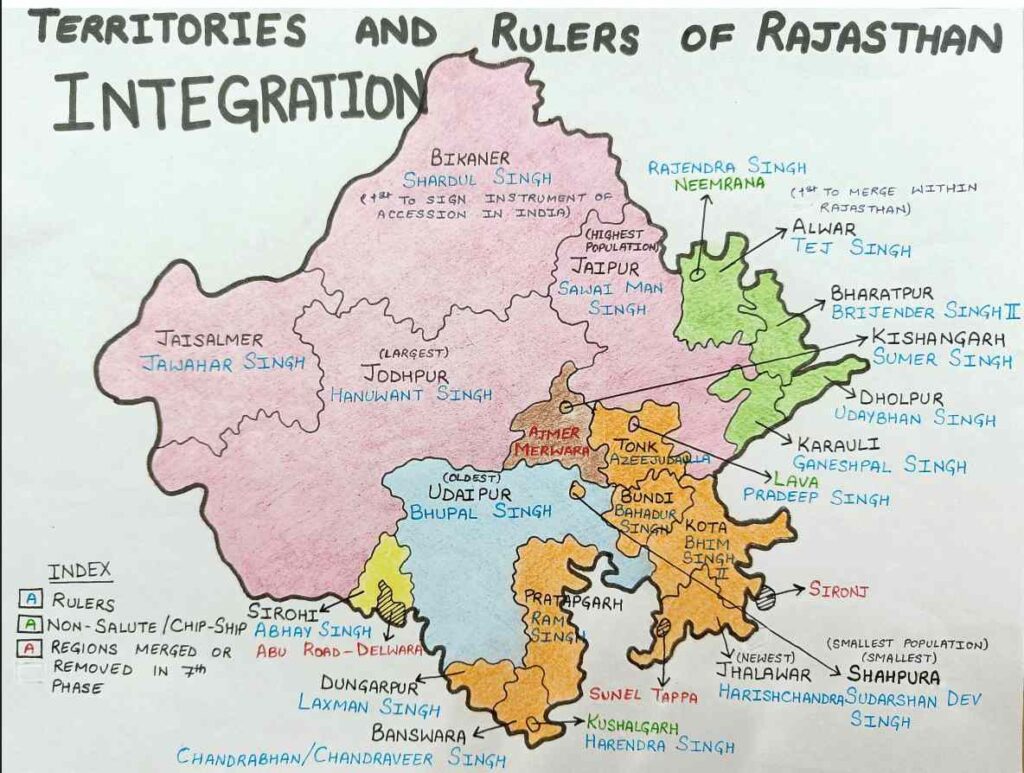
Princely States of Rajasthan (19 Princely States), At the time of independence
Rulers of Princely States at the Time of Integration or Independence
| Princely State | Ruler |
| Mewar/Udaipur Marwar / Jodhpur Jaipur Bikaner Alwar Dholpur Bharatpur Kota Bundi Jhalawar Banswara Dungarpur Kishangarh Shahpura Sirohi Jaisalmer Pratapgarh Tonk Karauli | Bhupal Singh Hanwant Singh Sawai Man Singh II Shardul Singh Tej Singh Udaybhan Singh Brijendra Singh II Bhim Singh II Bahadur Singh Harish Chandra Chandraveer Singh Laxman Singh Sumer Singh Sudarshan Dev Abhay Singh Jawahar Singh Ram Singh Aziz-ud-Daula Ganesh Pal |
Chiefships of Rajasthan at the Time of Independence (3 Chiefships)
- Neemrana Chiefship – Separated from Alwar Princely State
- Kushalgarh Chiefship – Separated from Banswara Princely State
- Lava Chiefship – Separated from Tonk Princely State
Union Territory of Rajasthan at the Time of Independence
- Ajmer–Merwara – At the time of independence, there was only 1 Union Territory in Rajasthan.
Concept of Rajasthan Union
- Maharana Bhupal Singh of Mewar wanted to form the “Rajasthan Union” by merging the princely states of Rajasthan, Malwa, and Saurashtra.
- For this purpose, two conferences were organized in Udaipur:
- Udaipur Conference – 1946 AD
- Udaipur Conference – 1947 AD
- K.M. Munshi was the constitutional advisor to Maharana Bhupal Singh.
Princely Secretariat
- The Princely Secretariat was established on July 5, 1947 AD.
- Chairman – Sardar Vallabhbhai Patel
- Secretary – V. P. Menon
- On July 18, 1947 AD, the Indian Independence Act, 1947 was passed.
- Under Section 8 of this Act:
- All treaties made between the Kings and the British were terminated.
- Declaration of the Princely Secretariat:
- Princely states that have a population of more than 1 million (10 Lakh) and
- An annual income of more than 10 million (1 Crore) can maintain their independent existence.
- There were 4 such princely states in Rajasthan:
- Mewar State – King: Bhupal Singh
- Jaipur State
- Jodhpur State
- Bikaner State
Instrument of Accession
- August 7, 1947 AD –
- Maharaja Shardul Singh of Bikaner signed the Instrument of Accession.
- Bikaner was the first princely state of Rajasthan to sign the Instrument of Accession with India.
- August 14, 1947 AD –
- Maharaja Udaybhan Singh of Dholpur signed the Instrument of Accession.
- Dholpur was the last princely state of Rajasthan to sign the Instrument of Accession.
- Maharawal Chandraveer Singh of Banswara, while signing the Instrument of Accession, said: “I am signing my death warrant.
Integration of Rajasthan: At a Glance
| Phase | Name | Capital | Inaugurator | Prime Minister / CM | Rajpramukh | Regions |
| First | Matsya Union (17–18 March 1948) | Alwar | N.V. Gadgil | Shobha Ram Kumawat | Udaybhan Singh (Dholpur) | Alwar, Bharatpur, Karauli, Dholpur |
| Second | East Rajasthan Union (25 March 1948) | Kota | N.V. Gadgil | Gokul Lal Asawa | Maharao Bhim Singh (Kota) | Kota, Bundi, Tonk, Jhalawar, Dungarpur, Banswara, Pratapgarh, Kishangarh, Shahpura, Kushalgarh Chiefship |
| Third | United Rajasthan (18 April 1948) | Udaipur | Jawaharlal Nehru | Manikya Lal Verma | Bhupal Singh (Mewar) | East Rajasthan Union + Udaipur |
| Fourth | Greater Rajasthan (30 March 1949) | Jaipur | Vallabhbhai Patel | Hiralal Shastri | Sawai Man Singh-II | Jaipur, Jodhpur, Bikaner, Jaisalmer |
| Fifth | United Greater Rajasthan (15 May 1949) | Jaipur | — | Hiralal Shastri | Sawai Man Singh-II | Greater Rajasthan + Matsya Union |
| Sixth | Rajasthan (26 January 1950) | Jaipur | — | Hiralal Shastri | Sawai Man Singh-II | Sirohi (Excluding Abu) |
| Seventh | Modern Rajasthan (1 November 1956) | Jaipur | — | Mohan Lal Sukhadia | Gurumukh Nihal Singh (Governor) | Ajmer, Abu-Delwara, Sunel-Tappa |
Commissions / Committees of Rajasthan Integration
| S.No. | Commission / Committee | Year | Chairman | Objective / Task |
| 1 | Rajasthan Integration Committee | 1947 | V. P. Menon | Planning the merger of princely states |
| 2 | Matsya Union Committee | 1948 | N. V. Gadgil | Process of forming the Matsya Union |
| 3 | Shankar Rao Deo Committee | 1949 | Shankar Rao Deo | Merger of Matsya Union into Greater Rajasthan |
| 4 | B. R. Patel Committee | 1949 | B. R. Patel | Determination of the Capital (Jaipur) |
| 5 | Sirohi Merger Committee | 1949–50 | Under supervision of Vallabhbhai Patel | Decision on the division of Sirohi |
| 6 | State Reorganisation Commission | 1953 | Fazal Ali | Linguistic reorganization of states |
| 7 | Muni Jin Vijay Suri Committee | 1956 | Muni Jin Vijay Suri | For the inclusion of Abu–Delwara into Rajasthan |
| 8 | Satyanarayan Rao Committee | 1956 | Satyanarayan Rao | Capital and Administrative balance |
| 9 | Dhar Commission | 1948 | S. K. Dhar | Formation of states on a linguistic basis |
| 10 | J. V. P. Committee | 1949 | Nehru–Patel–Pattabhi Sitaramayya | Reconsideration of linguistic states |
First Phase of Rajasthan Integration
Name of Rajasthan: Matsya Union
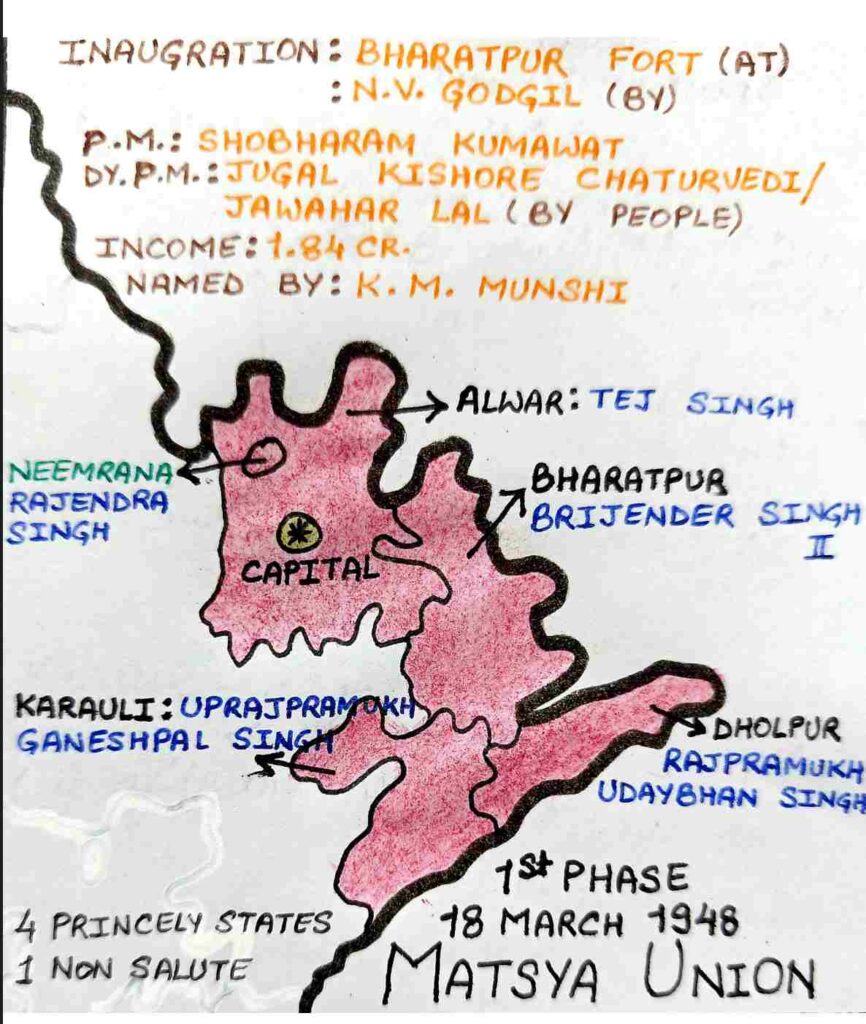
- included in Matsya Union
- Dholpur Princely State
- Karauli Princely State
- Alwar Princely State
- Bharatpur Princely State
- Neemrana Chiefship
- Constitutional Positions –
- Rajpramukh – King Udaybhan Singh of Dholpur
- Up-Rajpramukh – King Ganeshpal of Karauli
- Capital – Alwar
- Inauguration – 18 March 1948 AD
- Inaugurator – N. V. Gadgil
- Location – Bharatpur
- Cabinet –
- Prime Minister – Shobharam Kumawat (Alwar)
- Deputy Prime Minister – Jugal Kishore Chaturvedi
- Other Ministers – Gopilal Yadav, Chiranji Lal Sharma, Dr. Mangal Singh, Master Bholanath
- Population – 1.8 million (18 Lakh)
- Income – 18.4 million Rupees (1.84 Crore)
- Other Facts – The Government of India had already established control over the princely states of Alwar and Bharatpur.
Second Phase of Rajasthan Integration –
Name of Rajasthan – East Rajasthan Union (Rajasthan Union) –
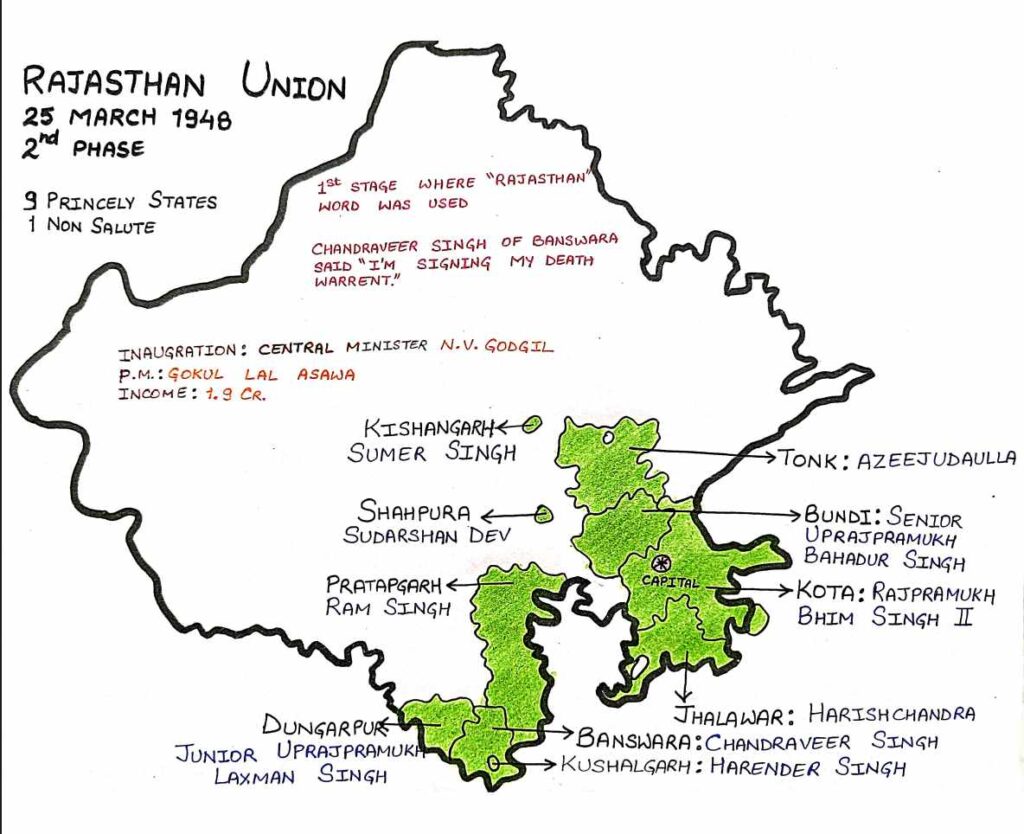
- Included Princely States/Chiefship –
- Kota – Hadoti
- Bundi – Hadoti (King – Bahadur Singh)
- Jhalawar – Hadoti
- Dungarpur – Vagad
- Banswara – Vagad
- Pratapgarh – Vagad
- Tonk – The only Muslim princely state in Rajasthan
- Kishangarh
- Shahpura (King – Sudarshan Dev)
- Kushalgarh Chiefship
- Constitutional Positions –
- Rajpramukh – King Bhim Singh of Kota
- Senior Up-Rajpramukh – King Bahadur Singh of Bundi
- Junior Up-Rajpramukh – King Laxman Singh of Dungarpur
- Capital – Kota
- Inauguration – 25 March 1948
- Inaugurator – N. V. Gadgil
- Location – Kota
- Cabinet – Prime Minister – Gokul Lal Asawa (Shahpura)
- No other ministers were appointed because it had become clear that Mewar would also join this union.
- Population – 2.35 million (23.5 Lakh)
- Income – 19 million Rupees (1.90 Crore)
- Other Facts – Full name of N. V. Gadgil – Narhari Vishnu Gadgil
- The Government of India wanted to merge Shahpura and Kishangarh into Ajmer–Merwara, but both opposed it.
Third Phase of Rajasthan Integration –
Name of Rajasthan – United States of Rajasthan
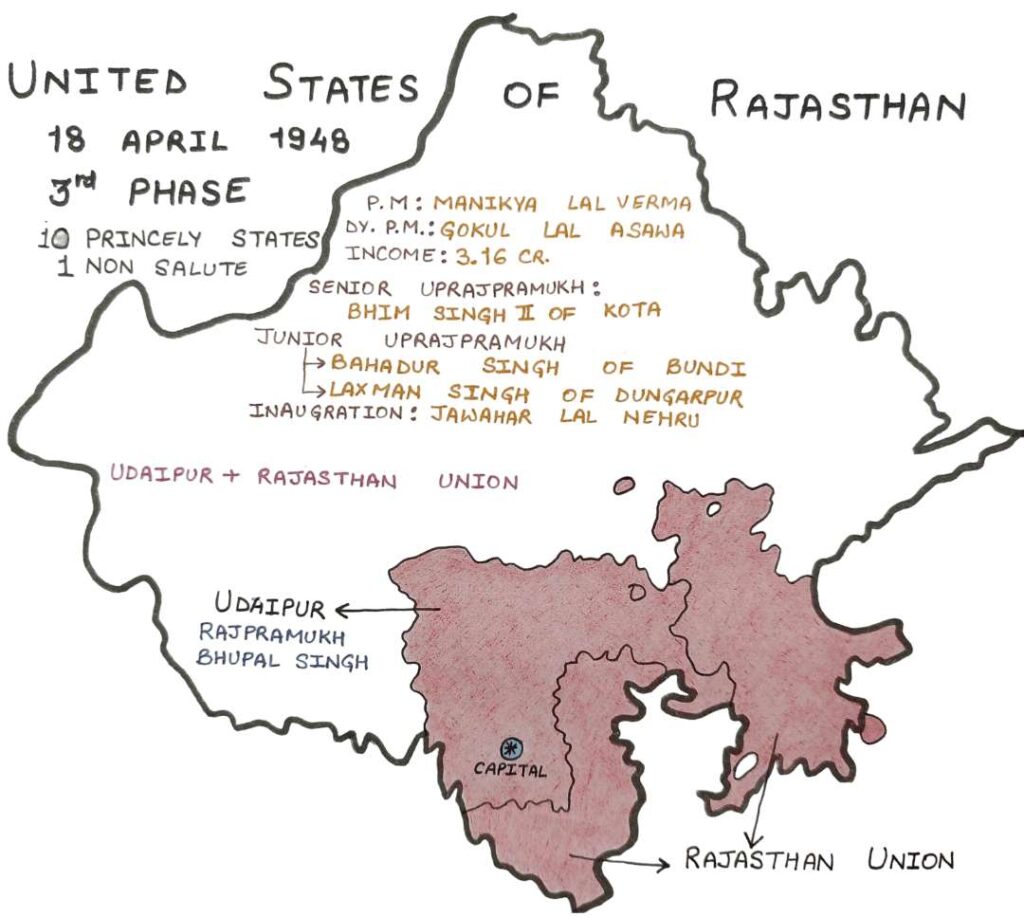
- Included Units –
- East Rajasthan Union (9 Princely States + 1 Chiefship)
- Mewar Princely State (Capital – Udaipur)
- Inauguration – 18 April 1948 AD
- Inaugurator – Pt. Jawaharlal Nehru
- Location – Udaipur
- Constitutional Positions –
- Rajpramukh – Maharana Bhupal Singh (Mewar)
- Senior Up-Rajpramukh – King Bhim Singh of Kota
- Junior Up-Rajpramukh –
- King Bahadur Singh of Bundi
- King Laxman Singh of Dungarpur
- Capital – Udaipur
- Session Arrangements – 3 Sessions per year
- 2 – In Udaipur
- 1 – In Kota (Special efforts were to be made for the development of Kota.)
- Cabinet –
- Prime Minister – Manikya Lal Verma
- Deputy Prime Minister – Gokul Lal Asawa
- Other Ministers – Abhin Hari, Bhogilal Pandya, Brij Sunder Sharma, Bhurelal Baya, Prem Narayan Mathur, Mohan Lal Sukhadia
- Privy Purse (Demand of Maharana Bhupal Singh – 20 Lakh) –
- Privy Purse – 10 Lakh
- Rajpramukh Salary – 5 Lakh
- Religious Grant – 5 Lakh
- Total – 20 Lakh Rupees
- Other Facts – Dr. Ram Manohar Lohia formed the Rajasthan Movement Committee.
Fourth Phase of Rajasthan Integration –
Name of Rajasthan – Greater Rajasthan
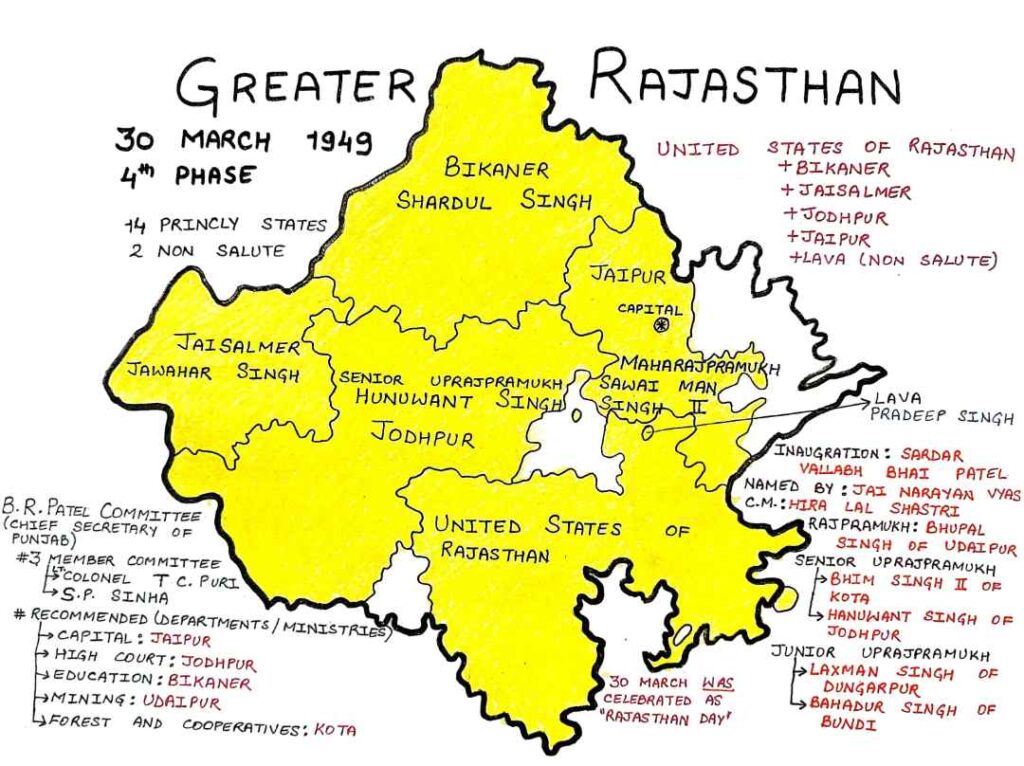
- Included Princely States –
- United Rajasthan
- Jaipur
- Jodhpur
- Bikaner
- Jaisalmer
- Inauguration – 30 March 1949 AD (Chaitra Shukla Ekam, Vikrami Samvat 2006)
- Inaugurator – Sardar Vallabhbhai Patel
- Location – Jaipur
- 30 March = Rajasthan Day
- Constitutional Positions –
- Maharajpramukh – Maharana Bhupal Singh
- Rajpramukh – Sawai Man Singh-II
- Senior Up-Rajpramukh –
- King Hanwant Singh of Jodhpur
- King Bhim Singh of Kota
- Junior Up-Rajpramukh –
- King Bahadur Singh of Bundi
- King Laxman Singh of Dungarpur
- Prime Minister – Hiralal Shastri
- Other Ministers – Siddharaj Dhadda, Raghuvardayal Goyal, Brij Sunder Sharma, Prem Narayan Mathur, Vedpal Tyagi, Rao Raja Hanwant Singh, Nar Singh Kachhawa, Phool Chand Bafna
- Capital Dispute – B. R. Patel Committee
- Members:- B. R. Patel – Chairman
- H. C. Puri
- H. P. Sinha
- Decision:-Capital – Jaipur
- High Court – Jodhpur
- Privy Purse –
- Jaipur – 1.8 million (18 Lakh)
- Jodhpur – 1.75 million (17.50 Lakh)
- Bikaner – 1.7 million (17 Lakh)
- Other Facts – 19 July 1948 – Lava Chiefship was merged into Jaipur.
Fifth Phase of Rajasthan Integration –
Name of Rajasthan – United Greater Rajasthan
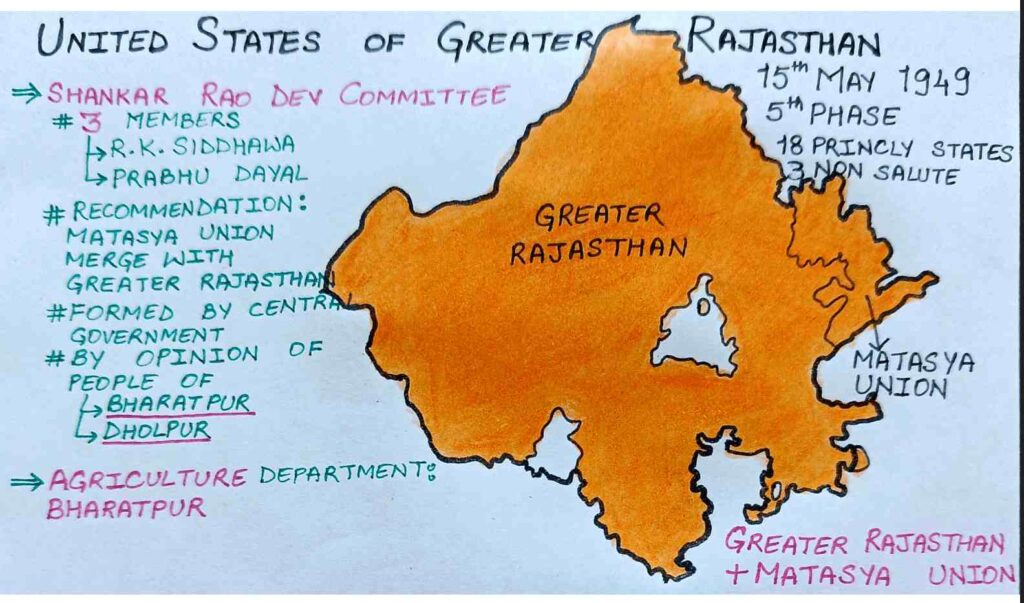
- Included Units –
- Greater Rajasthan
- Matsya Union
- Merger of Matsya Union – On the recommendation of the Shankar Rao Deo Committee.
- Members:- Shankar Rao Deo (Chairman), Prabhudayal, R. K. Sidhawa
- 15 May 1949 – Merger of Matsya Union.
- Shobharam Kumawat was included in the Hiralal Shastri cabinet.
Sixth Phase of Rajasthan Integration –
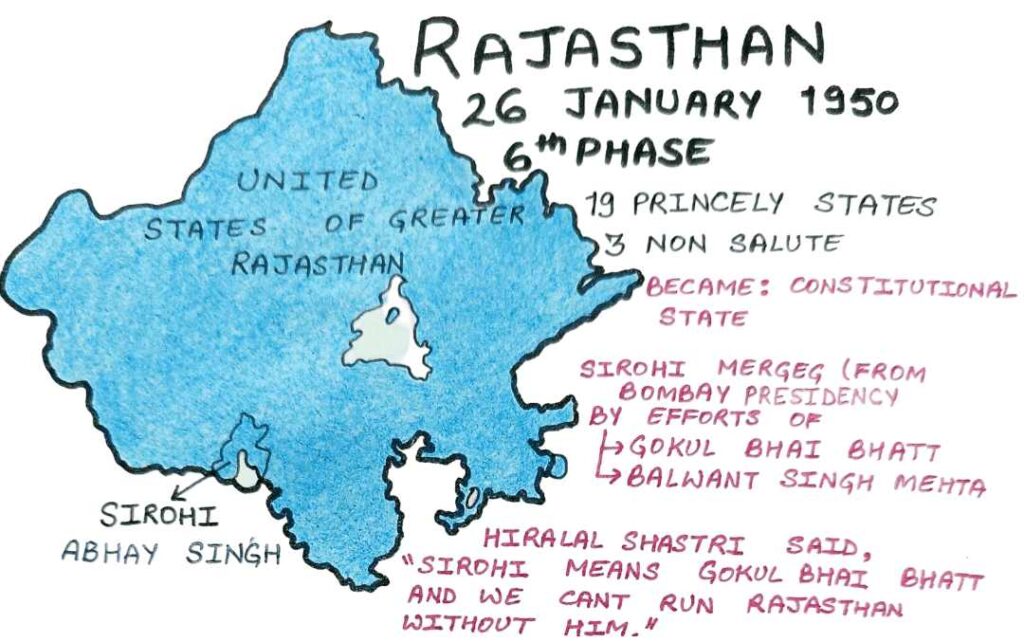
- Division of Sirohi Princely State
- Abu and Delwara along with 89 villages were merged into Bombay State.
- The remaining Sirohi was merged into Rajasthan.
- Hathal, the village of Gokul Bhai Bhatt, remained in Rajasthan.
- Patel’s Statement – “The people of Rajasthan wanted Gokul Bhai Bhatt, so we have given him.”
- 26 January 1950 – The sixth phase of Rajasthan integration was completed.
- The name of the state became “Rajasthan”.
- Hiralal Shastri – First nominated Chief Minister.
- Nominated Chief Ministers – * Hiralal Shastri – First
- Appointed:
- C. S. Venkatachari (ICS) – Second
- Jai Narayan Vyas – Third
- Elected Chief Ministers – * Tikaram Paliwal – First
- Jai Narayan Vyas – Second
- Mohan Lal Sukhadia – Third
Seventh Phase of Rajasthan Integration –
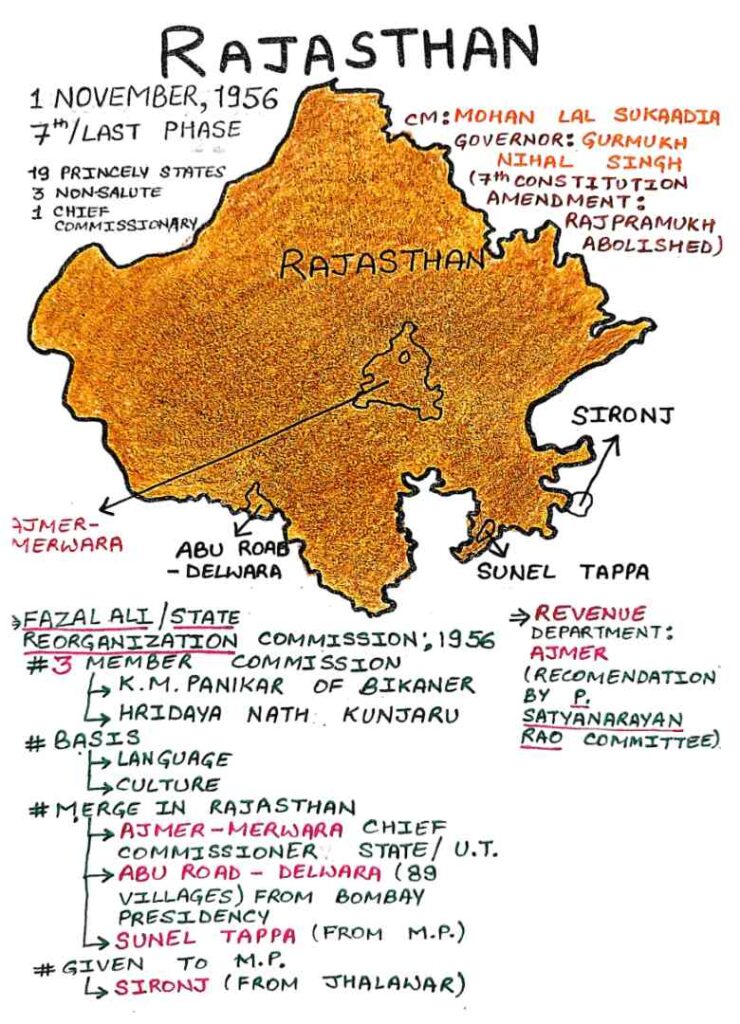
- 1 November 1956
- Based on the recommendations of the State Reorganisation Commission:
- Abu and Delwara → Rajasthan
- Ajmer–Merwara → Rajasthan
- Sunel-Tappa (M.P.) → Rajasthan
- Sironj → Madhya Pradesh
- Integration of Rajasthan completed.
- Chief Minister – Mohan Lal Sukhadia
- Muni Jin Vijay Suri Committee –
- Objective – Merger of Abu-Delwara
- Members:-
- Muni Jin Vijay Suri – Chairman
- Dashrath Sharma – Member
- Ajmer–Merwara –
- Previously a Union Territory.
- Had a 30-member Dhara Sabha (Legislative Assembly).
- Chief Minister – Haribhau Upadhyaya (opposed the merger).
- Ajmer → Became the 26th district of Rajasthan.
- Capital Dispute –Satyanarayan Rao Committee –
- Members: – Satyanarayan Rao (Chairman), V. Vishwanathan, B. K. Gupta
- Decision –
- Capital – Jaipur
- Revenue – Ajmer
- Education – Bikaner
- Agriculture – Bharatpur
- Forest and Cooperative – Kota
- Minerals – Udaipur
- Fact of 1 November 2000 – Upon the separation of Chhattisgarh from Madhya Pradesh, Rajasthan became the largest state in India by area.
- Before this, Madhya Pradesh was the largest.
Other Important Constitutional Facts –
- 7th Constitutional Amendment (1956) – Abolished the post of Rajpramukh.
- First Rajpramukh of Rajasthan – Sawai Man Singh-II
- Last Rajpramukh of Rajasthan – Sawai Man Singh-II
- 26th Constitutional Amendment (1971) – Abolished the Privy Purse of the Kings.



