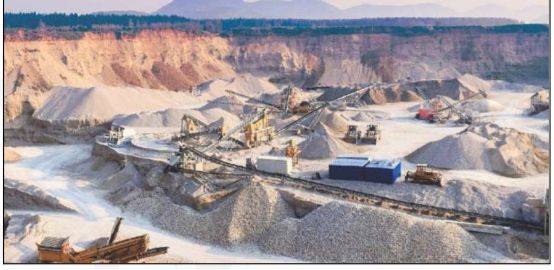
Rajasthan minerals – Metallic & Non-Metallic form a major pillar of Rajasthan Geography, as the state is one of India’s richest mineral regions with wide geological diversity. Rajasthan possesses abundant deposits of both metallic minerals such as copper, lead, zinc and iron, and non-metallic minerals like marble, limestone, gypsum and phosphorite. This mineral wealth supports mining-based industries, contributes to state revenue, and plays a key role in regional industrial development.
Mineral Profile of Rajasthan
Mining Sector in Rajasthan
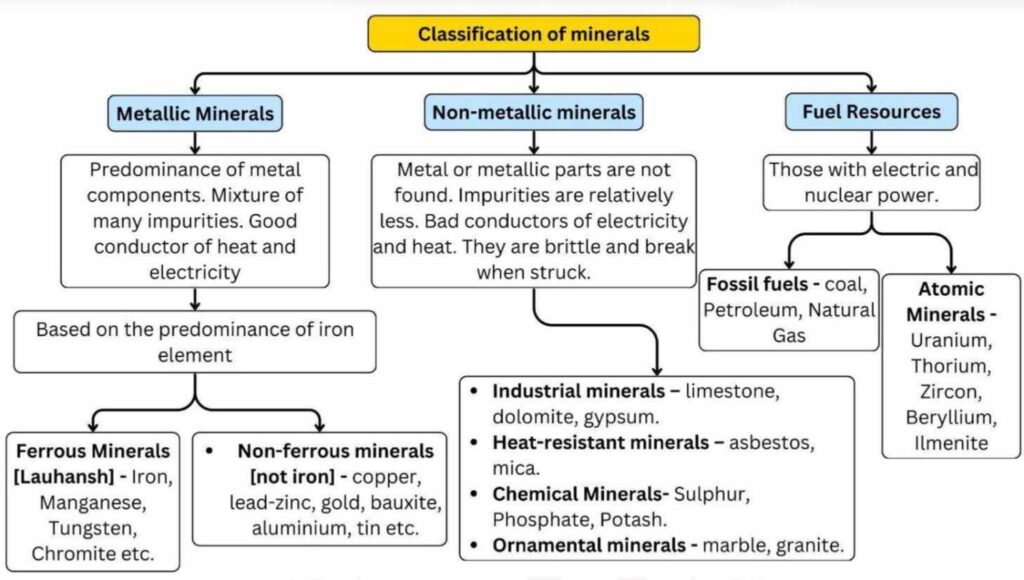
- Rajasthan is one of India’s richest states in terms of mineral resources, with deposits of 81 types of minerals, 58 of which are actively mined [22 major & 36 minor] + [ 57 Centre Right & 24 State’s Right].
- Rajasthan contributes 22% in total mineral production in Rajasthan, and is first in production in non-metallic minerals. [15% metallic, 25% non – metalic] and Rank 2nd in Storage of Minerals 1st – Jharkhand
- Rajasthan ranks 3rd in mineral production, 1st – Orissa, 2nd – Chhattisgarh.
- In terms of Mineral Revenue, Rajasthan ranks 3rd.
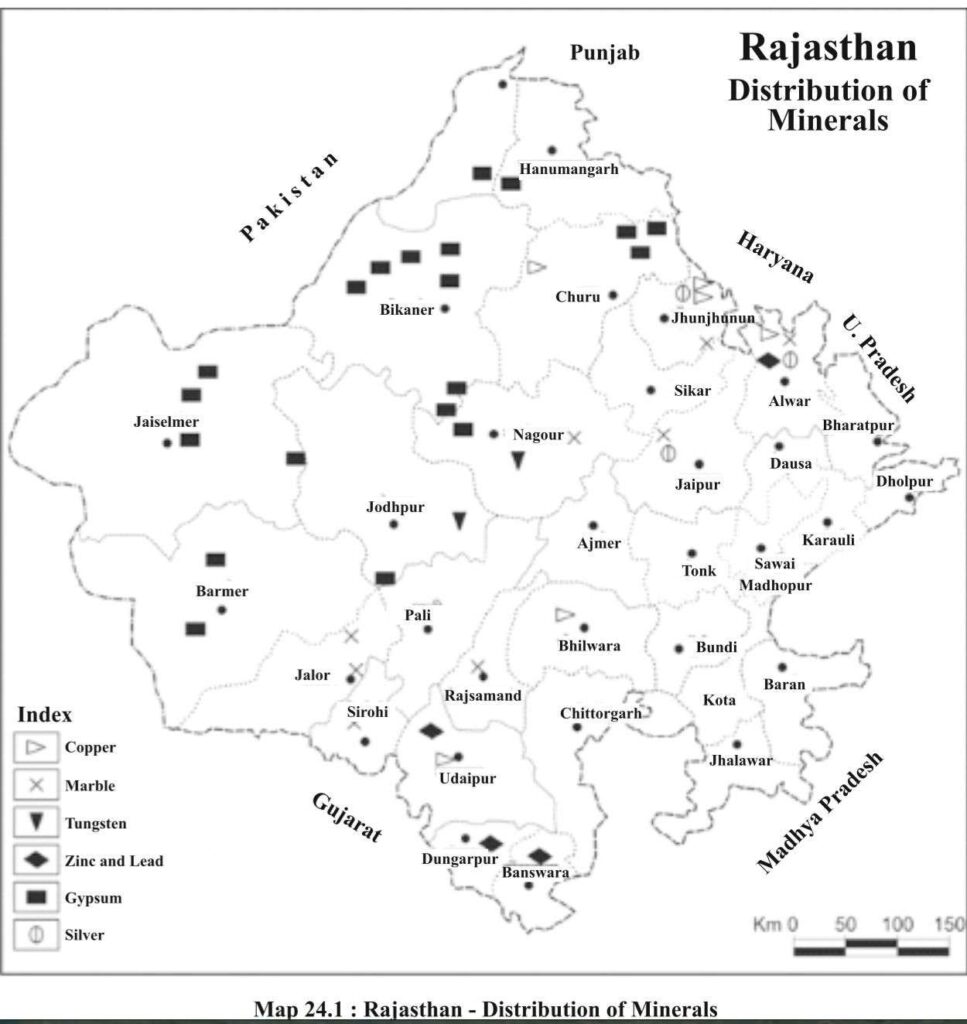
- The State is the sole producer of Lead & Zinc ores, Selenite and Wollastonite and leads the country in the production of Silver, Calcite and Gypsum.
- The State is also the leading producer of Ball Clay, Phosphorite, Ochre, Steatite, Felspar and Fire Clay in the country.
- Additionally, Rajasthan is a major producer of
- dimensional stones like Marble, Sandstone and Granite, as well as cement-grade and steel-grade limestone.
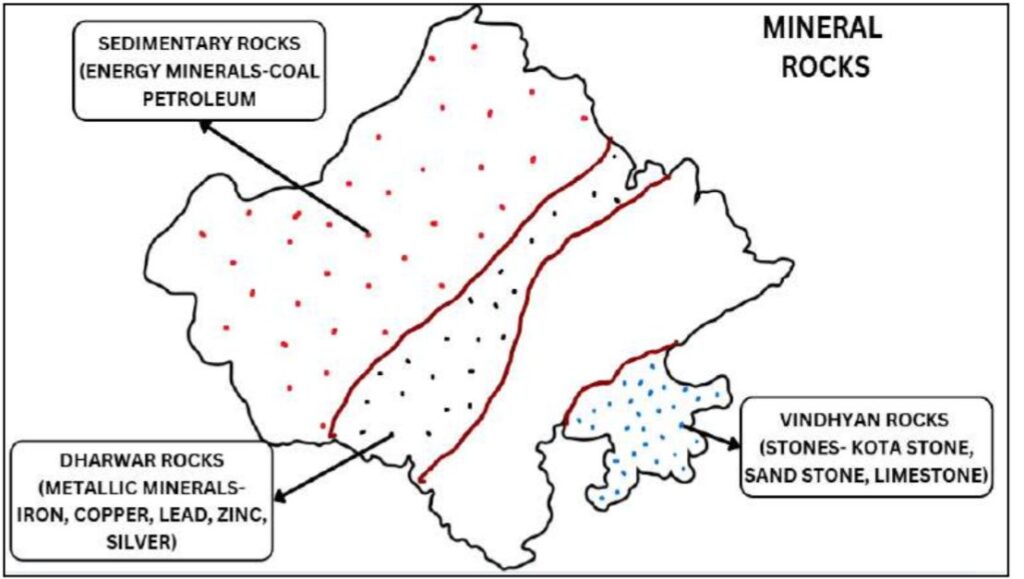
Mineral rocks of Rajasthan
Sedimentary Rocks
- Formed from pre-existing rocks or living organisms. Most of the non-metallic and energy minerals are found here (Petroleum, Natural Gas & Coal).
Dharwar Rocks
- These are the oldest Metamorphic sedimentary rocks (formed from Archean Rocks). Abundance of metallic mineral reserves, maximum revenue-generating rocks. (Minerals – Copper, Iron, Ore, Lead-Zinc, Silver )
Vindhya Rocks
- Composed of building stones which are mostly non-fossiliferous (Ex, Kota stone, Sand stone, Red stone, & Limestone )
Metallic Minerals
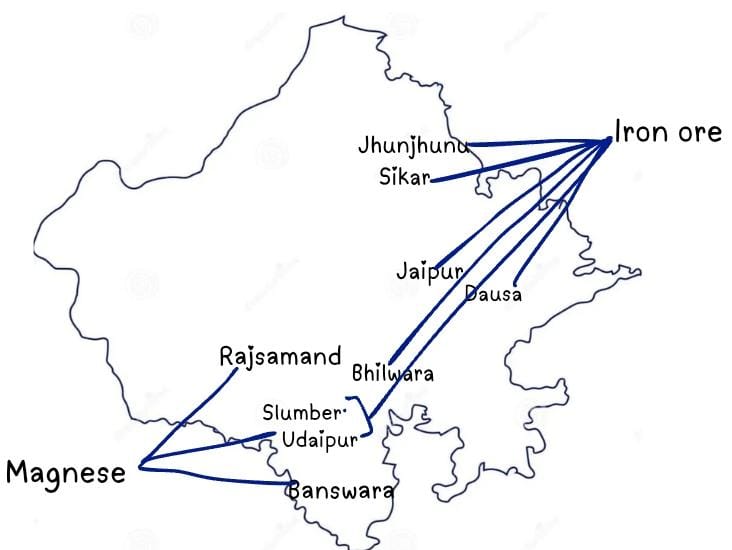
Iron Ore:- (Mainly Magnetite and Hematite)
- Jaipur – Morija – Banol
- Dausa – Neemla (at present in Jaipur), Raisela
- Jhunjhunu – Dabla – Singhana
- Sikar – Dabla- Thoi, Neem ka thana, Banno – ki -Dhani
- Udaipur – Thur Hunder
- Salumber – Nathara Ki Pal,
- Bhilwara – Tiranga Region, Pur Baneda, Jahangir
- Important Point – India is the highest producer of Sponge Iron
- Uses – Industrial development, electrical equipment, automobile industry.
Manganese
- Main ore – Sylomelin, Pyrosulite, Brunite, Megenite. Manganese is called “Jack of all trades”.
- Banswara – Timyanmori, Leelawani, Kalakhuta, Naradiya Talwara, Bhatara – Tamesar, Kasala, Siwaniya, Khunta, Intala, Roopakhedi.
- Udaipur – Saruppura, Chhoti sar and Badi sar.
- Rajsamand – Negadiya
- Uses – Steel making, tools and colour making.
Lead-Zinc:-
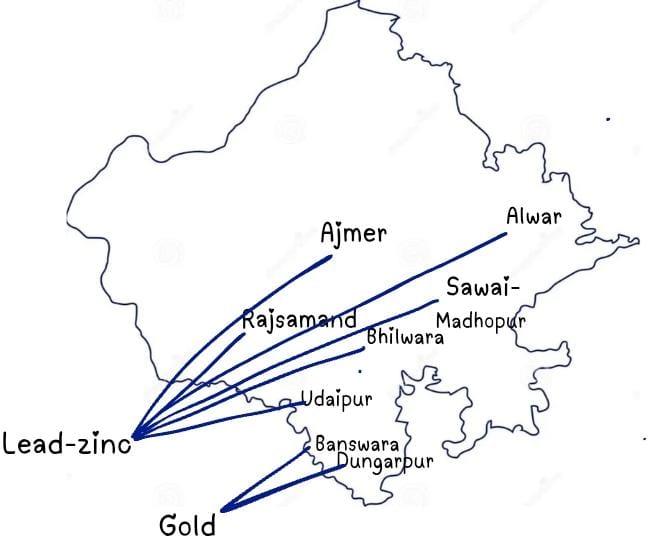
- This is extracted from mixed ore galena. Apart from this, Calamine, Zincite, and Willemite are the main ores.
- Zinc– Galena, pyrotite
- The deposits of lead-zinc are found in the Archaean and Proterozoic rocks.
- Udaipur – Jawar – Debari, Mochia Magra
- Rajsamand – Rajpura Dariba, Railmagra, Sindesar – Khurd
- Bhilwara – Gulabpura – Agucha, Rampura – Agucha, Purabneda, Samodi, Devas, Devpura.
- Sawai Madhopur – Chauth Ka Barwara
- Alwar – Gudha – Kishoridas Pura
- Ajmer – Sawar, Kayad, Ghughra ghati, Lohakhan
- Lead- Highest production in Rajsamand.
- Zinc – Highest production in Bhilwara.
- Uses of Lead – Manufacturing of dry cells, bullets, and making colours.
- Uses of Zinc – Making medicines, the automobile industry, and making colours.
Gold
- Metallic mineral
- Banswara – Anandpur – Bhukia and Jagpura – Bhukia, Ghotiya, Amba, Delwara, Timaran mata, Hinglaaj mata, Dhaghucha, Bharkundi, Tartaai, Pathara.
- Dungarpur – Dabar ki pal , Sahpura – Kotadi ki Devtalaai
- Note:- Latest gold deposits have been found in ‘Ghotia Amba’ of Banswara.
- Recently, Kankaniya in Banswara and Dagocha in Salumber were in the news due to the First gold block exhibition.
Copper
- It is the non ferrous metal. Mainly found in the veins of the igneous and metamorphic rocks.
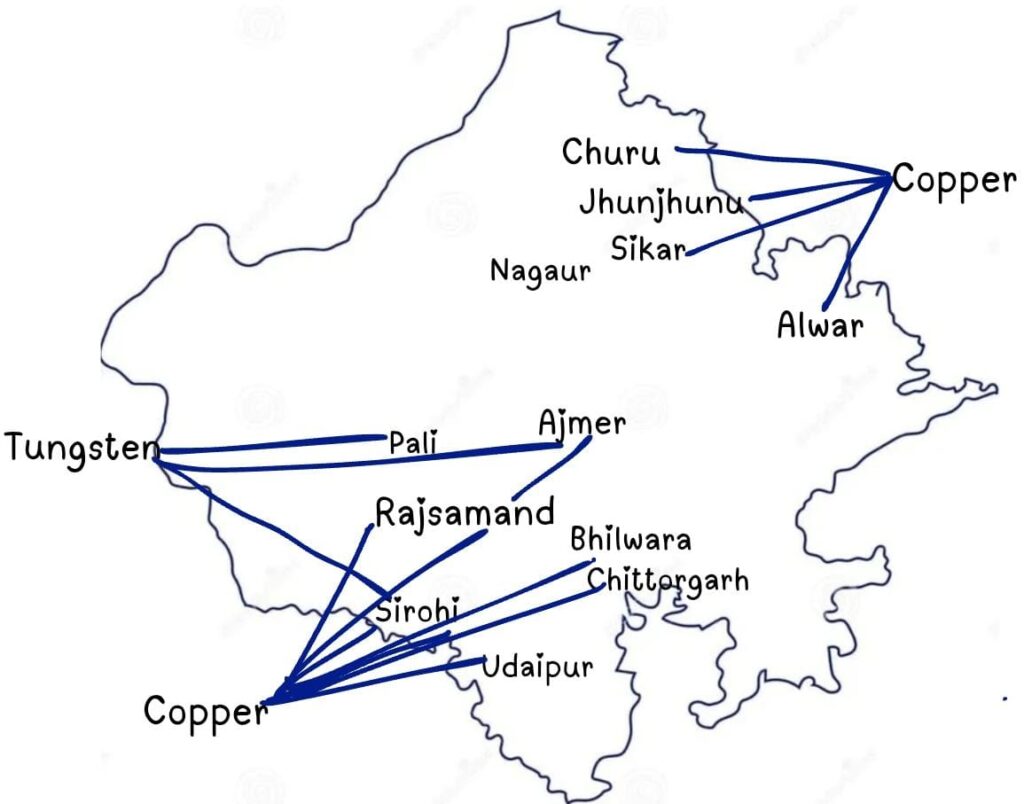
- Jhunjhunu – Khetri – singhana, Madan – Kudan (highest deposit), Chandmari, Kolihan, Banbas, Dholamala, Chichori, Satkui, Surhari.
- Sikar – Raghunathpura , Toda – Ramlias (Neem Ka Thana) (Banno Ki Dhani )
- Alwar – Kho – Dariba, Pratapgarh village and Bhagoni.
- Udaipur – Anjani – Umara, Bedawal, Chhani, Nandbel, Akola, Debari.
- Churu (Bidasar) Kheda
- Sirohi – Delwara – Kirowali, Goliya, Pepela, Basantgarh, Dari
- Rajsamand – Rail Magra, Majera, Gopalpura.
- Bhilwara – Devtalai, Pur Daruba, Baneda.
- Ajmer – Hanaitiya, Taragarh, Chainpoora, Gafa
- Chittorgarh – Bhagal, Bari, Akola
- Uses- Electrical equipment, wires, utensils
Tungsten
- It is obtained from Wolframite ore. It is found in granite and pegmatite rocks.
- Nagaur– Degana
- Pali – Nana karab, Barbara,
- Sirohi – Balda, Abu, Revdar, Walda, Deva – ka beda, Udavarya
- Ajmer – Bijathal, Pipariya, Sevaria
- Uses – Electric Bulbs, making bullets.
Non – Metallic Minerls
Asbestos
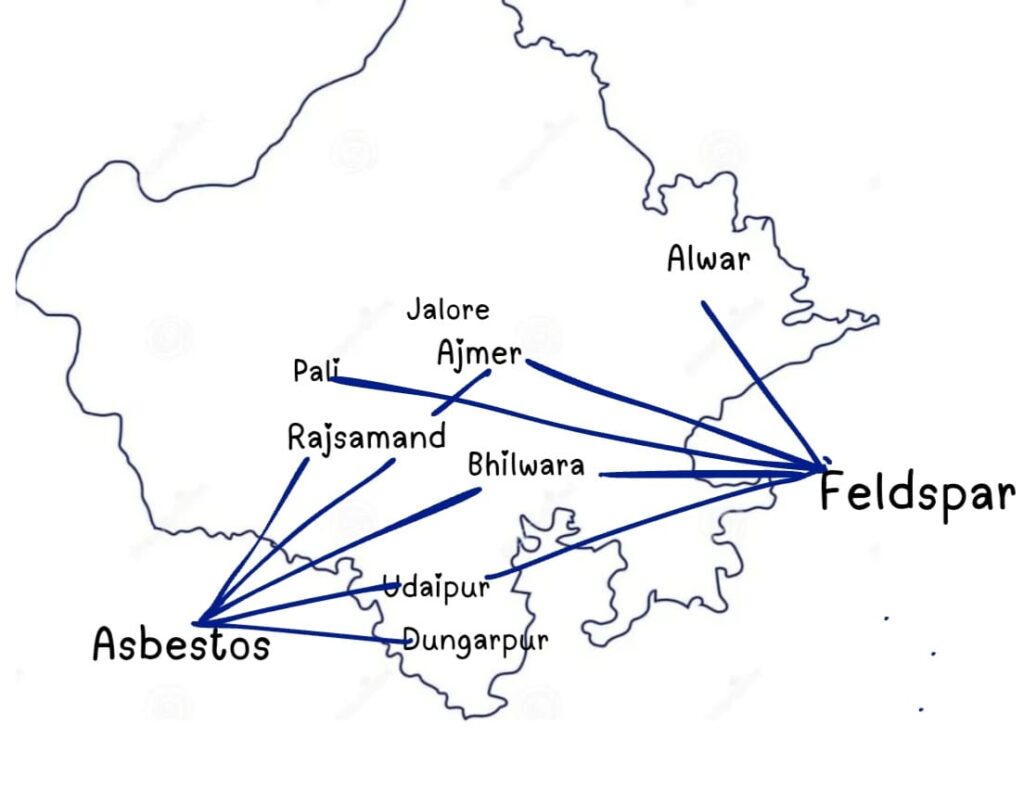
- Udaipur – Kherwara, Rishabhdev
- Rajsamand – Bhudan Deepti, Mokhampura, Jawad (Rajsamand tehsil), Devgarh, Amet, Kumbhalgarh, Nathwara
- Ajmer – Kanvalai, Kotra, Arjunpura, Nagelav, Nai Khurd, Kotri, Lacchipura, etc., areas.
- Bhilwara – Barana – Salwada area in Asind tehsil.
- Dungarpur – Dewal, Jakol, Piprada, Malwa.
- Uses– Insulator devices, the building industry.
Feldspar
- It is a minor mineral.
- Ajmer – Bandarsindri, Foysagar, Tilora-Piproli Makrera, Rajgarh, Beawar, Jawaja, Kishanpura, Masuda, Pisangan, Nalupatan area, Loharwada.
- Bhilwara – Jahazpur
- Pali – Chanodia
- Alwar – Talarpur, Khairthal.
- Udaipur – Lasadiya, Girwa, Kurabad and Gogunda.
Fluorite/Fluorspar
- Dungarpur – Mando ki Pal, Kahila
- Jalore – Bhinmal
- Udaiur – Kala magra, Jhalara
- Ajmer – Mundoti, Tilori
Mica:- ‘ Minor Mineral’.
- Bhilwara Belt – Bhilwara, Deoli, and Tonk.
- Kunariya Gangapur – Mandal Belt.
- Bakaliya – Kishangarh Belt.
- Important location:-
- Bhilwara: Danta, Bhunas, Baneda, Phulia
- Tonk – Barala, Dhauli, Mankhand
- Ajmer: Arai, Dadia (Kishangarh tehsil), Baghsuri, Ramsagar, Tihari (Ajmer tehsil), Bagera-Tuniya, Para (Kekri tehsil), and Kespura(Byawar tehsil).
- Uses– Electric devices, making polythene construction of buildings.
Gypsum and Selenite
- Another name of Gypsum is Harsauth, Selkhadi, Godanti, Khadia.
- Balotara – Kavash
- Barmer – Uttarlai
- Bikaner Lunkaransar, Dulmera, Kajuwala, Jamsar, Jagsari, Kolayat, Poogal, Satha.
- Nagaur – Bhadwasi, Phalsoond, Maddana, Goth Mangalod, Pilanwasi, Dhakoria.
- Uses – In the cement industry, making POP and chemical fertilisers.
Rock Phosphate
- Udaipur – Jhamarkotda, Maton, Belagarh, Bhindar, Khar – Barian Ka Gudha, Dakan – Kotda, Neemach Mata, Amberi, Dhaul ki Pati, Ajbara – Adwas area, Bedwas – Pratapnagar, Mahuri.
- Jaisalmer – Birmania, Lathi region, Fatehgarh.
Potash
- The main ore of potash is sylvite.
- Rajasthan accounts for the majority (91%) of the country’s total potash reserves.
- Nagaur, Sri Ganganagar, Hanumangarh, and other areas of Bikaner district.
Silica sand/Glass sand
- Maximum production is in Jaipur.
- Jaipur – Samod, Sangot, Manota, Kundal
- Sawai -Madhopur – Elanpura, Narayanpur, Naroli
- Baran – Atru and Chhabada tehsils
- Barmer – Shiv tehsil.
- In Bharatpur, silica sand is found in three belts – Ghatri belt, Agawali belt and Kaman belt.
- Bundi – Barodia, Tikarda and Dhoolsagar.
- Dausa – Kundal, Dantali and Jirota.
Clay Minerals
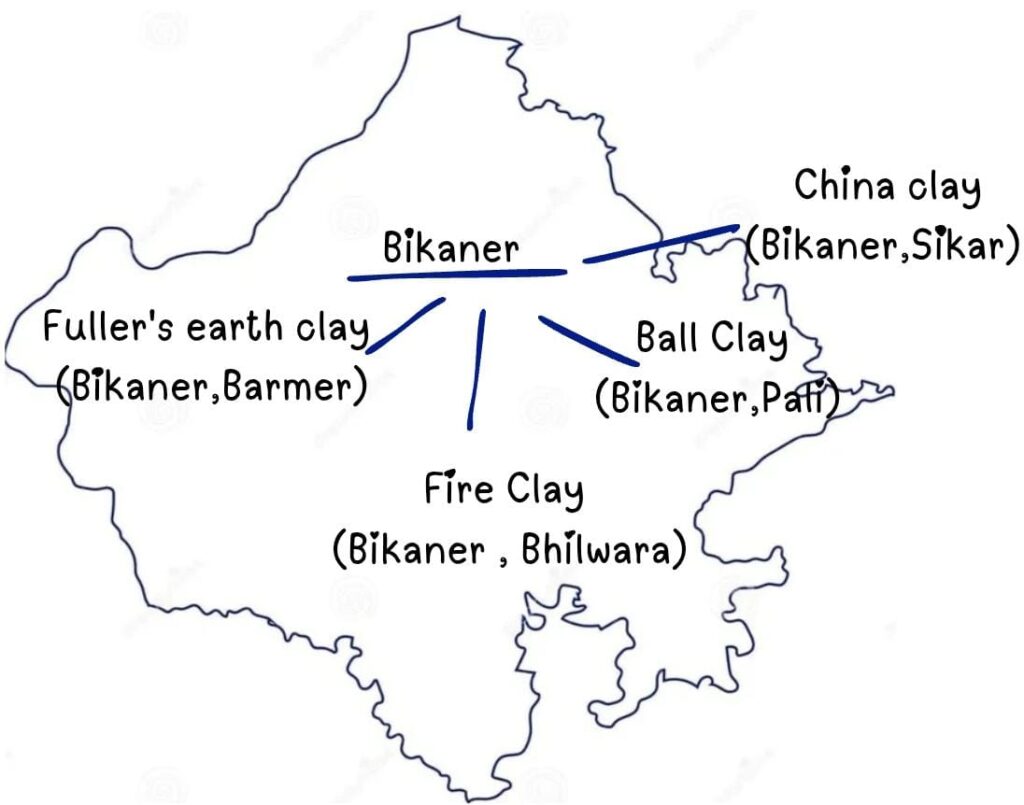
Ball clay
- It is a minor mineral.
- Bikaner – Naal, Gajner, Kolayat
- Pali – Kharadi (Jitaran Tehsil), Desuri
China clay (kaolin)
- Bhilwara – Kakaroliya, Bhimai Kheda, Chandpura (Kotri tehsil), Jikli, Amlada (Jahazpur tehsil), and Mangrop.
- Jaipur – Buchara, Asthal, Fatehpura, Toda, Khedloni, Kishorpura, Sonarupa, Gol, Jonpura, Pranamdass ka Bagh.
- Udaipur – Khabariya ka Guda.
- Barmer – Ganga village of Shiv tehsil and Bathiya – Chhapa in Barmer tehsil.
- Nagaur – Khajwana region.
- Chittorgarh – Bansri, Sawa, Chouthpura, Sahlawa, Kyariya.
Fireclay
- It is a ‘Minor mineral’. In Rajasthan, found in Bikaner and Sharadhana in Nagaur.
- Fuller’s Earth (Multani Mitti) is a minor mineral. It is also called ‘Bleaching Clay’.
Building stones in Rajasthan
Marble
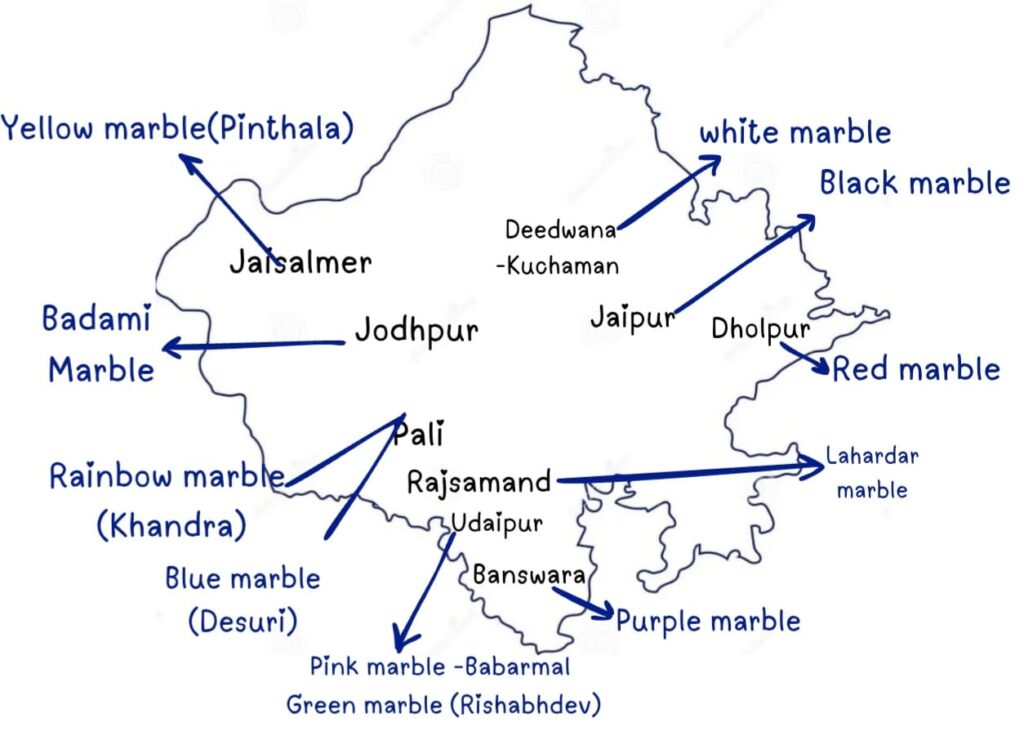
- Mainly found in Nagaur, Rajsamand, Jodhpur, Jaisalmer, Udaipur, Pali, Kotputli-Behror, Bharatpur.
- Yellow Marble – Pithala (Jaisalmer)
- Green Marble – Rishabhdev (Udaipur)
- Pink Marble – Babarmal (Udaipur)
- Rainbow – Colour Marble – Padarla (Pali)
- White Marble – Makrana (Deedwana-Kuchaman)
- Black Marble – Bhainslana (Jaipur )
- Badami marble – Jodhpur
- Blue Marble -Desuri, Pali
- Purple Marble – Tripur Sundar (Banswara)
- Lehardaar marble – Rajasamand
- Red marble- Dholpur
- Maximum production of marble in the Rajasamand District.
- Makrana (Deedwana-Kuchaman) is famous for its white marble in the world.
- Kishangarh (Ajmer) is the marble market.
Granite
- Black – Kaladera (Jaipur)
- Pink and grey granite – Jalore.
- Green, Pink and Mercury Red: Siwana area and Mungeria (Barmer)/(Balotara)
- Yellow – Pinthala village (Jaisalmer).
- Jalore is famous as the ‘Granite city of Rajasthan’
- The Chhapan hills of Rajasthan are famous for Granite production.
Sandstone
- It is a sedimentary rock. It is a minor mineral.
- Bharatpur – Bansi – Paharpur
- Jodhpur – Soorsagar, Balsamand
- Karauli – Sapotara
- Dholpur sandstone is mainly found in Bari, Basadi and Sarmathura.
- Kota stone – Kota
- Slate Stone – Alwar
- Red stone – Dholpur
Talc/Steatite/Soapstone
- It is a ‘Minor Mineral.’
- Udaipur – Rishabhdev, Jhalol, Devpura – Saloj
- Rajsamand – Kagdar, Odan region
- Dungarpur – Deval and Thana
Limestone
- It is found in sedimentary rocks.
- Occurrence in Rajasthan:
- Chemical Grade: Sojat, Bilara, Borunda Belt (Jodhpur), Gotan – Mundwa (Nagaur).
- Cement Grade – Anjanikheda, Kapasan (Chittorgarh), Lakheri – Indragarh, Khatiari, Satoor – Haripura, Ganpatpura, Kuagaon – Pholai, Dalelpura – Bhairopura – Mej River – Piplaji area (Bundi) Sam (Jaisalmer), Sabla-Lobariya, Anspur (Dungarpur)
- Steel Grade: Sanu (Jaisalmer)
- Bhilwara – Mandalgarh, Balev-Gopalpura, Amargarh (Jahazpur) and Amarpura areas.
- Banswara- Both cement – Grade and high – grade limestone are found. The Khamera – Undwala Belt in Banswara has significant limestone reserves.
Precious stones
Diamond
- Pratapgarh – Kesarpura.
- Uses – making jewellery and the glass cutting industries.
Emerald – (Pana, Green Fire, Markat)
- Rajsamand – Kala Gumaan, Tikki Godhbor, Neemdi and Bargulla villages in Kumbhalgarh tehsil, Magguda in Nathdwara tehsil, and Kanji ka Kheda area in Amet tehsil.
- Udaipur – Gogunda
- Ajmer– Bubani village, Muhami, Gudas, Rajgarh etc.
Garnet
- It is also called ‘Rakt Mani’. It is of two types – Abrasive and Gem.
- Gem variety Garnet found in Rajasthan: Tonk, Ajmer, Udaipur, Bhilwara, Jaipur.
- Tonk has the largest reserves of gem garnet. In Tonk, it is found in Rajmahal, Gonri, Kushalpura and Devkheda.
- Ajmer – garnet is found in Sarwad, Chaurasiyawas Makadwali area, Baghsuri, Bandanwada and Nad – Sarsari area.
- In Rajasthan, the highest production of Garnet (Abrasive) is in Bhilwara. There are large reserves of Abrasive Garnet in Bhilwara. It is found in Kadnapura, Rupaheli, Agucha Koduta, Deori and Samodi in Bhilwara.
Monopoly Minerals
- Wollestonite- Bel ka Magra (Sirohi)
- Uses – In making Tiles and cement sheets.
- Jaspar – Jodhpur
- Jodhpur, its deposits are located in Mathania, Osian, Runija, Sopa, Mogra, Lawera, Tamatia and other areas.
- Lead – Zinc
- Gypsum
- Garnet
- Emerald
Mineral oil
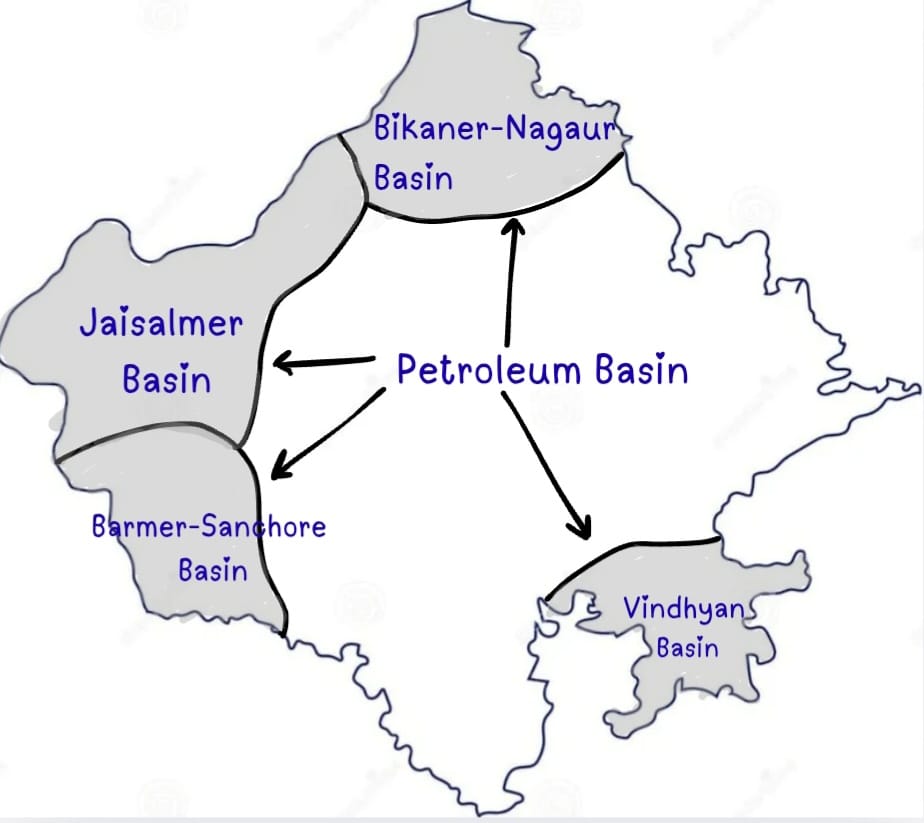
- Mineral oil basins – (4 Petroleum basins in 14 districts)
- Rajasthan is the largest petrol-producing region in the country after Bombay High.
- “Mangala” is the first petroleum well of Rajasthan (Barmer) started from 29 August, 2009.
| Petroleum Basin | Features |
Barmer – Sanchore Basin | Districts – Barmer, Sanchore & Jalore Company – ONGC & Vedanta Energy (Cairn Energy) Largest reserve and production of mineral oil. |
Jaisalmer Basin | District – Jaisalmer Company – ONGC & PDVSA (Venezuela, South America) |
Bikaner – Nagaur Basin | District:- Bikaner, Nagaur, Didwana-Kuchaman, Sri-Ganganagar, Hanumangarh and Churu Company:- OIL (Oil India Ltd) & ESSAR (Nayara) |
Vindhyan Basin | Districts:- Kota, Bundi, Chittorgarh, Bhilwara, Baran, Jhalawar Company: ONGC and Vedanta |
Mineral Oil Production
- Barmer
- Mangala – Nagana
- Saraswati – Koshlu
- Rageshwari – Gudamalani
- Aishwarya – Baytu
- Other – Kameshwari, Bhagya, Shakti, Vijaya
- Jaisalmer
- Baghewala, Tanot, Sadhewala, Chinewala
- Bikaner
- Tuwariwala, Poonam
Natural Gas Production in Rajasthan
- Jaisalmer
- Ghotaru, Ramgarh, Manohari Tibba, Dandewala, Gamanewala, Tanot
- Bikaner
- Rageshwari – Gudamalani
Coal – Maximum lignite type coal
- Barmer – Kapuradi, Jalipa, Giral and Bhadresh.
- Bikaner – Bithnok, Barsingsar, Palana (Largest coal region), Gudha
- Nagaur – Merta City, Igyar, Mata – Sukh and Kasnau.
Atomic Minerals of Rajasthan
Uranium
- Udaipur – Umara
- Sikar – Khandela – Rohilla, Suhagpura
- Ajmer – Kishangarh
- Baran – Ramgarh
- Bhilwara – Bhunans
Thorium
- Major locations in Rajasthan: Ajmer and Barmer
- Thorium reserves in Ajmer: Taktpura, Jetpura (Bajta), Thekdi.
- Pali – Bhadrawan,
- Bhilwara – Sardarpura.
- The largest thorium reserves in the world are found in India. Brazil holds the second position.
Beryllium
- Jaipur – Gujarwada
- Ajmer – Bandar – Sindri
- Udaipur – Shikarbadi
- Bhilwara
Mining Institutions
Rajasthan State Mineral Development Corporation (RSMDC)
- Constituted in 1980, with the Rajasthan state Mines and Minerals Department.
Hindustan Zinc Limited – In 1966 (Debari – Udaipur)
- Zinc Smelter Plant established in Chanderia (Chittorgarh)
Hindustan Copper Limited – 1967
- Headquarters – Khetari (Jhunjhunu)
Rajasthan State Mineral Exploration Trust
- Reformation of the Mines and Geology department, mineral prospecting and exploration, departmental strengthening, technological innovation, technical consultancy, logistic support, business development.
District Mineral Foundation Trust (DMFT)
- District Mineral Foundation (DMF) is a trust set up as a non-profit body, in those districts affected by the mining works, to work for the interest and benefit of persons and areas affected by mining-related operations.
Petroleum Refinery Pachpadara(Balotara)
- Partnership – HPCL (74%): State Government (26%)
- Capacity:- 9 MMTPA (Million Metric Tonne Per Annum)
- This is the first refinery of Rajasthan and the 26th refinery of the country. The standard of this
- The refinery is BS-VI. A petrochemical complex will be set up along with the refinery.
Mineral Policies of Rajasthan
- 1st Mineral policy 1978
- 2nd Mineral Policy 1991
- 3rd Mineral Policy 1994
- 4th Mineral Policy 2011
- 5th Mineral policy 2015 (4th june,2015)
6th Mineral policy 2024 (9 December 2024) (Latest)
- Objectives
- Maximising the economic benefits of our mineral wealth
- Attracting investments & creating employment opportunities
- Sustainable mining practices
- Equitable benefit – sharing with communities impacted by mining activities
- Integrates advanced technologies to improve exploration, resource management and mineral governance.
- Targets:-
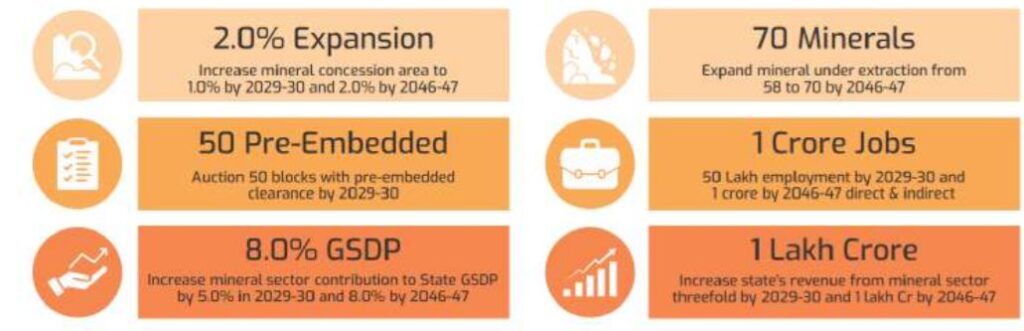
- Expand existing 0.68% mineral concession area to 1.0% by 2029-30 and to 2.0% by 2046-47.
- Expand the number of minerals under extraction from 58 to 70 by 2047.
- Auction 50 major mineral blocks with pre – embedded clearances by 2029–30, starting with 5 blocks in 2025–26.
- Employ 50 Lakhs people by 2029-30 and over 1 Crore people (direct and indirect) by 2046 – 47.
- Enhance the mineral sector’s contribution to the State’s GSDP from 3.4% in 2023-24 to 5.0% by 2029 – 30 and to 8.0% by 2046-47.
- Increase the State’s revenue threefold by 2029-30 and to INR One Lakh Crores by 2046-47.
- Emphasis on exploration and auction of precious, Strategic and critical minerals in coordination with the Central Government.
- Designate areas as “Land Bank” to assist applicants and concessionaires with forest land diversion, ensuring the timely operationalisation of mineral concessions.
- Enhance ease of doing business by addressing regulatory and infrastructure challenges and reducing the time for approval.
- Assist the Central government in carving more Petroleum Exploration License (PEL) blocks for auctioning.
Rajasthan M-Sand Policy-II 2024
- 1st – M-Sand Policy – 2020
- Manufactured Sand (M-Sand) presents a sustainable alternative to river sand (Bajri). Produced through the crushing of rocks, M-Sand offers high – quality material for construction while mitigating the environmental impacts on river ecosystems.
- It aims to drive both economic growth and environmental protection, generating local employment opportunities while preserving our State’s natural heritage.
- Objective:
- Every year, targeting 30 million tonnes per annum by 2028-29.
- Utilise the existing overburden in mining areas to promote sustainable and eco -friendly mining practices.
- Promote recycling of the coarse and fine aggregates in construction and demolition waste of building/concrete structures in the State.
- Promote the M-Sand industry and simultaneously develop opportunities for employment at the local level.
- Features:-
- Minimum of 25% of the quantity of sand used in various construction works carried out by the State Government, Semi – Government, Local Bodies, Panchayati Raj Institutions and other organisations financed by the State Government will have to be M-Sand.
- It will be increased to 50% by 2028-29.