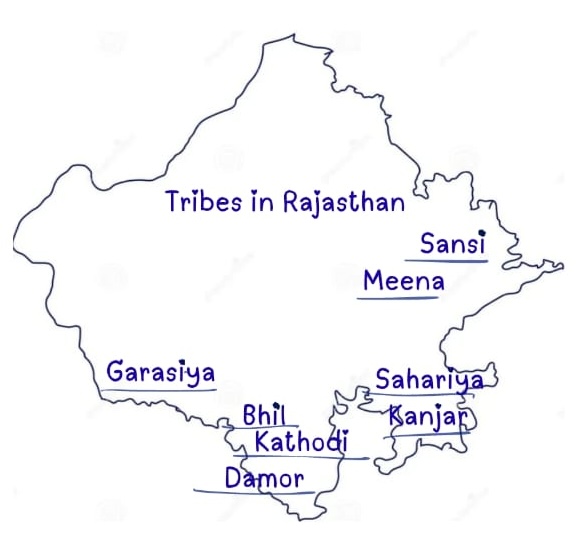

Rajasthan Tribes form an important socio-cultural component of Rajasthan Geography, representing the indigenous communities that are closely linked with the state’s forests, hills, and plateau regions. Major tribes such as Bhil, Meena, Garasia, Sahariya, and Damor are mainly concentrated in southern, south-eastern, and eastern Rajasthan. Their traditional livelihoods, settlement patterns, and cultural practices are deeply influenced by local geography and natural resources.
This post is written for the RAS Prelims examination; click here to read the detailed version for the RAS Mains exam.
Introduction
- According to the census 2011, the tribal population of Rajasthan is 92.39 lacs, which is 13.48 % of the total population.
- Rajasthan is in sixth place (Census – 2011) and Rank 4th at present in India after Madhya Pradesh, Maharashtra, and Odisha in terms of the number of tribal people.
- The state’s maximum tribal population of 15.25 lacs is in the Udaipur district. Rajasthan’s 95% tribes reside in rural areas
| Maximum Number of schedule tribe | Minimum Number of schedule tribe |
| Udaipur Banswara Dungarpur | Bikaner Nagore Churu |
| Districts with the highest % of scheduled tribes | Districts with Lowest % ofthe scheduled tribe |
| Banswara -76.4% Dungarpur- 70.8% | Bikaner -0.3% Nagaur-0.3% |
| Sex ratio in scheduled tribe – 948 | |
Total Schedule tribe in Rajasthan is – 13.48 %
- More than 50% schedule tribe resides in 3 Districts
- Banswara
- Dungarpur
- Pratapgarh
- More than 28%, schedule tribe reside in 5 districts
- Banswara
- Dungarpur
- Pratapgarh
- Sirohi
- Udaipur
- The population of Scheduled Tribes increased to 9,238,534 in 2011, which is 13.48% (or 13.5%) of the state’s total population. During the decade 2001–2011, the Scheduled Tribe population grew by 30.2%.
Major Tribes of Rajasthan
Bhil Tribe
- Bhils rank second in Rajasthan’s tribal population, concentrated mainly in Banswara, Dungarpur, Salumber, and Udaipur districts.
- The word Bhil is a modified form of the Dravidian word ‘Bil’, meaning ‘bow and arrow’.
- Bhils were called “Nishadh” in the Mahabharat.
- They are among India’s oldest tribes, speaking Bhili and Vagri dialects.
Habitat and Housing
- Regional Distinctions:
- Paalvi Bhils: Bhils residing on the higher hills are known as ‘Paalvi.
- Vagri Bhils: Bhils residing in the plains are referred to as ‘Vagri’.
- Houses of Bhills are called “Tapara” and “koo”, and the porch in front of houses is called “Dhaliya”.
Social Life
- Patrilineal Gotras: Bhils have several patrilineal gotras known as ‘Atak’.
- Marriage Practices: Monogamy is prevalent in Bhills.
- Various types – Mor Bandhiya marriage, marriage by capture, child marriage, marriage by exchange, marriage by service, and marriage by purchase (Dapa).
- Other types of Marriages in Bhill tribes- Haai rakhni, aai peshvu, Nakhet, Khibo Jhelavano, Phaleku, Haath Ghalnu, Padlu, Ghati bhanna.
- The divorce system in Bhills is called “Chheda phadhna”.
- Family Structure: In comparison to joint families, nuclear families are more common among the Bhils.
- Totam sing was related to the Gotra system.
- Village Structure: The head of the village is referred to as ‘Gameti’. Smaller villages are called “Fala”, and larger ones are called ‘Paal’.
Cultural Practices:
- Dances: Gawri and Ghoomar are the main dances of the Bhil community.
- Other – Hathimana, Yudh, Davichakri, Bhageria
Fair and Festivals:
- The worship of goddess Parvati, known as the ‘Gavri’ festival in the month of Shrawan, is a significant festival among the Bhils.
- Beneshwar Fair: The famous Beneshwar fair of the Bhil community takes place annually on the full moon day (Poornima) of the month of Maagh at the confluence of the rivers Mahi, Som, and Jakham.
Traditional Attire and Ornaments:
- Bhil males wear a kameez or ‘Angrakhi’, a tight-fitted dhoti called ‘hepada’, and a turban called ‘Potya’.
- Other male attire is – Fenta, Phalu, Khoyatu.
- Females wear ghagra, lugdi, and choli as their traditional outfits. Ornaments made up of metals like silver, brass, and nickel are common among both males and females, along with tattoos.
- Other female attire is – Kachhabu, Piriya, parijani
- An unmarried girl wears two types of Odhani –
- Chiram Bhant ki odhani
- Paavali Bhant ki odhani
- Other types of odhani of bhil women are- Hadala, Gavan, Malkapuri, Anguchhu.
Religious Practices:
- Besides Hindu gods and goddesses, the Bhils also worship local deities such as Dharal, Birsa Munda, Kalaji Goraji, Mataji, Govind Guru, and Lasodia Maharaj.
Economic Status of Bhils
- Transition to Farming and Animal Husbandry: Many Bhils have now transitioned to farming activities in various places.
- Farming on hill slopes is known as ‘Chimata’, while farming in plain areas is called ‘Dajiya’.
- They also perform shifting agriculture locally called ‘Vaalra’
- Forest-based Livelihood: The Mahua tree holds significant importance among the Bhils.
Meena Tribe
- According to the 2011 census, Rajasthan has the maximum population (43.46%) of the Meena tribe.
- Highest 1. Jaipur and a minimum of 1. Jaisalmer and 2. Barmer.
- Mainly – Udaipur, Swai-Madhopur, Jaipur, Dausa, Sikar, Jhunjhunu, Kota, Bundi, Baran, Karauli.
- It is considered to be the most educated tribe of Rajasthan and is considered to be a primitive tribe of the state.
- The name “Meena” is derived from the Sanskrit word “Matsya”, meaning fish, symbolising their water connection.
- There are two types of meenas –Jamindaar and Chowkidar Meena.
- Jamindaar Meena– These are located mainly in Udaipur, Hadoti, Dungarpur, Banswara, Chittorgarh and nearby areas.
- Chowkidar Meena– These are located mainly in Jaipur, Dausa, Ajmer, Karauli, Sawai Madhopur and nearby areas.
- The Meena community is divided into several sub-groups, such as:
- Chauhan Meena
- Bhadauria Meena
- Pardeshi Meena
- Raghuvanshi Meena
- Rawat Meena
Social Life
- Patrilineal– Meena families have a patriarchal system. Family Structure– Both joint and nuclear families are seen.
- Marriage Practices – Their society is organised around gotras (clans), and marriages within the same gotra are prohibited. They practice exogamous marriage rules and have a strong sense of community.
- The Meena tribe practises Brahma, Gandharva, & Rakshas types of marriages. Divorce, Widow remarriage, Nata System, Ata-sata (exchange marriage)are also practised.
- Village Structure– The head of the panchayat is called the Patel. The panchayat is called Chaurasi, and the head of the five panchayats is called Panch Patel, who is responsible for almost all social decisions.
Cultural Practices
- The Meena tribe is famous for tattoos.
- The Meenas primarily speak Rajasthani dialects like Dhundhari, Mewari, and Hadoti.
Traditional Attire and Ornaments
- Men typically wear a dhoti, a kurta, and a safa (turban), while women wear ghagra-choli with an odhani (veil). Jewellery is an essential part of their attire, with women adorning silver ornaments and men wearing traditional earrings.
Religious Beliefs
- The Meenas are predominantly Hindus and worship a variety of deities, including Matsya Avatara (fish incarnation of Lord Vishnu), Shiva, and local deities like Kali Mata and Bhagwati.
Economic life of Meenas
- The Meenas are traditionally an agrarian community, with farming being their primary livelihood.
Garasiya
- This is the third-largest tribal group of Rajasthan, in terms of population
- The Garasiya tribe is believed to have descended from Rajput ancestry, with the term “Garasiya” derived from “Garas”, meaning “land” or “a small holding of land.”
- The Garasiya tribe is predominantly found in the southern districts of Rajasthan, especially Abu Road and Pindwara tehsil of Sirohi, Bali of Pali district, and Gogunda and Kotra tehsil of Udaipur in Rajasthan.
- The Garasiya tribe has several sub-groups based on geographical and cultural variations. These include:
- Rajput Garasiya: Claim descent from Rajputs.
- Bhopa Garasiya: Known for their priestly roles in community rituals.
- Tribe is divided into two sections-
- Bhil Garasiya
- Gameti Garasiya
- Village and Housing: Houses are called ‘Gher’ and villages ‘Faliya.’ A group of 5-6 houses is called ‘Falaa’, and a group of 4-6 falaa is called ‘Paal’
Social and Cultural Life:
- Marriage Types: Mor Badhiya, Peharawana, Tadana marriage (Bride price is paid by the groom’s family-12 calves and 12 rolls of fabric cloth “DAAPA”). Widow marriage and love marriage are also prevalent in them. Their community is divided into clans, and marriage within the same clan is strictly prohibited.
- Family Structure: Live in nuclear families with the father as the head. Polygamy and the Nata system are prevalent among them.
- Social Divisions: Divided into three sections: Moti Nyat, Nenki Nyat, and Nichli Nyat.
- Fairs: Koteshwar fair near Ambaji, Chetar Vichitar fair near Devla, Mankha ro melo in Sirohi (the largest fair of Garasiya) and Gangaur fair of Gogunda.
- Dances: Main dances include Valar (Ghoomar of Garasiyas), Gair, Moriya, and Gaur.
- Dialect: A mix of Gujarati, Bhili, Mewari, and Marwari.
- Dress and Appearance: Males wear a dhoti, kameez, and a head towel. Tradition of tattoo making, with tattoos on females’ foreheads and chins (Mandaliyan).
Religion:
- Worship Shiva, Bhairav, and Durga. The Garasiyas practice Hinduism, with a strong inclination toward nature worship and animistic beliefs. They revere local deities such as Dev Narayan, Bhavani Mata, and Shiva. Bhakhar Baavji and Ghoda Baavji are also worshipped. Nakki Lake (Mt. Abu) is their major pilgrimage site. Festivals like Holi, Diwali, Ganagour, Akshay tritiya and local fairs are celebrated with great enthusiasm. Rituals often involve animal sacrifices and offerings to appease spirits and deities.
Economic status of Garasiyas
- Based on agriculture (shifting agriculture), animal husbandry, wood-cutting, and forest product collection.
- Increasingly involved in labour work in towns and cities.
- Practice ‘Hari Bhawri’, a form of community farming.
- Store food grains in ‘Sohri’ (Kothi).
Sahariya
- The Sahariya Tribe is one of the most marginalised and impoverished tribal communities in Rajasthan. Known for their rich cultural traditions, the Sahariyas are classified as a Particularly Vulnerable Tribal Group (PVTG) due to their low socio-economic development.
- The name “Sahariya” is derived from the Sanskrit word “Shahar”, meaning people associated with the jungle, as they traditionally lived in forested regions.
- They are believed to have Dravidian origins and were historically forest dwellers dependent on hunting, gathering, and primitive agriculture.
- Over time, deforestation and socio-political changes forced them to adapt to settled agriculture and labour work.
- The Sahariya tribe is primarily found in the Baran district (SHAHBAD). Smaller populations are also present in Kota, Jhalawar, and Sawai Madhopur districts.
Social Structure
- The Sahariya tribe practices a patriarchal system, with decision-making typically in the hands of male elders.
- Women play a significant role in the family, especially in agricultural and domestic activities.
- They follow strict exogamous marriage rules based on clan affiliation. Chouhan and Dodiya gotras are commonly found. These also practise endogamy, and the groom’s side has to pay Daapa to the bride’s father
- Naata practice and Mrityu bhoj are very common.
Language and Culture
- The Sahariyas speak a dialect of Hadoti. Their culture is deeply rooted in nature and revolves around seasonal changes, agricultural cycles, and local festivals.
- Folk songs, dances, and ritualistic practices are integral to their community life, often centred on nature worship and ancestral reverence.
- Women often adorn themselves with silver jewellery, bangles, and anklets, which reflect their tribal identity.
Religious Beliefs
- The Sahariyas are predominantly Hindus, with a strong inclination toward nature worship.
- They revere local deities and spirits like Kher Baba, Bhavani Mata, and Durga Mata.
- Sitabari fair (Baran) is their holy place.
Economic status of Sahariya
- Traditionally, the Sahariyas were dependent on forest produce like honey, medicinal herbs, and firewood for their livelihood.
- In modern times, they primarily engage in agriculture and daily wage labour.
Damor
- The Damor tribe has preserved its distinct identity despite being marginalised in the mainstream socio-economic framework.
- Historically, they were forest dwellers and subsistence farmers, depending on agriculture, forest produce, and animal husbandry for their livelihood.
- The Damor tribe primarily resides in the southern and southeastern districts of Rajasthan, including Dungarpur, Banswara, Udaipur and Pratapgarh
Social Structure
- The Damors live in small, dispersed villages or hamlets in forested or hilly regions.
- Their houses are typically Kutcha (mud) structures with thatched roofs, reflecting their connection to natural resources.
- Naata practice is seen, devar-batta (marrying the deceased husband’s younger brother), and mrityu bhoj are also practised
- DAAPA tradition is also prevalent in the Damor tribe.
Language and Culture
- The Damors predominantly speak Wagdi, a dialect of the Bhili language family, which is influenced by Rajasthani and Gujarati.
- Festivals: Traditional festivals like Holi, Diwali, and local fairs are celebrated with great enthusiasm.
- Their unique festivals include rituals specific to agricultural cycles and nature worship.
- Beneshwar fair is also celebrated by them.
- Art and Music: Folk music and dances are central to their cultural life.
- Ghoomar and Bhavai are popular dances, often performed during festivals and social gatherings.
- Traditional Attire:
- Men wear a dhoti, a kurta, and a safa (turban).
- Women: Adorn themselves in ghagra-choli and odhani, often decorated with traditional patterns.
- Jewellery, particularly silver ornaments, is an integral part.
Religious Beliefs
- Religion: The Damors practice Hinduism, but their religious practices are often infused with tribal customs and animistic beliefs.
- They worship local deities such as Bhavani Mata, Kali, and Dev Narayan.
- Nature worship and ancestral veneration are common.
Economic status of Damor
- Agriculture:
- The Damors rely heavily on subsistence farming, cultivating crops such as maize, sugarcane, wheat, millets, and pulses.
- Agricultural productivity is often limited due to reliance on monsoons and a lack of modern farming techniques.
- Forest Produce:
- They collect forest products like firewood, honey, and medicinal herbs, which serve as supplementary sources of income.
- Animal Husbandry:
- Livestock rearing, especially cattle and goats, is an essential part of their livelihood.
- At times, hunting is also done by them.
Sansi
- Historically, the Sansis were engaged in cattle rearing, hunting, and trading. However, during the colonial era, they were classified as a “criminal tribe” under the Criminal Tribes Act of 1871, which stigmatised them and led to their socio-economic decline.
- Post-independence, they were denotified in 1952 and classified under the Scheduled Castes (SC) category in Rajasthan.
- The Sansis are predominantly found in the Eastern regions of Rajasthan, including Jaipur, Ajmer, Sikar, Alwar, Bharatpur
- two types
- Mala
- Beeja
Cultural Practices
- Clothing
- Men: Wear dhoti, kurta, and turbans, often in earthy tones.
- Women: Wear a colourful ghagra-choli
- Housing and Settlements
- The Sansis live in temporary or semi-permanent structures in rural and peri-urban areas.
- Their settlements, known as tandas, often lack basic infrastructure such as electricity, water, and sanitation.
- Religion and Beliefs:
- The Sansis practice Hinduism with a blend of animistic and tribal traditions.
- Main deities – Sikodari Mata and Bhakari Babji.
- Festivals:
- Common Hindu festivals like Holi, Diwali, and Navratri are celebrated with zeal.
- Community-specific rituals and fairs are observed, reflecting their traditional beliefs.
- Art and Music:
- Folk music, dance, and storytelling are central to the Sansi culture.
- They are skilled performers of Kalbelia-style dances and other tribal art forms.
Social Structure and Economic Activities of the Sansi Tribe
- The Sansi society is patriarchal and follows a clan-based structure.
- Marriage within the same clan is prohibited, and alliances are formed within the tribe but across clans (exogamy).
- Kukadi tradition is prevalent in the Sansi tribe.
- Traditional councils, known as panchayats, handle disputes and maintain social norms.
- Widow remarriage is not popular amongst the sansis.
- Economic Activities
- Historically, the Sansis were pastoralists and hunters. However, with the loss of their nomadic lifestyle, their economic activities have diversified:
- Daily Wage Labour: A significant portion of the community works in unorganised sectors as construction workers, porters, and agricultural labourers.
- Cattle Rearing: Some Sansis still engage in livestock farming, primarily goats and cows.
- Small-scale Trading: Selling traditional handicrafts and forest produce.
- Performing Arts: Some members are involved in traditional entertainment, performing folk dances and songs at local fairs.
Kanjar
- The name “Kanjar” is believed to have derived from the Persian word for “wanderer” or “gypsy, ” reflecting their historically itinerant lifestyle.
- During British rule, the Kanjars were stigmatised under the Criminal Tribes Act of 1871, branding them as a “criminal tribe”, a label that deeply affected their socio-economic status. This categorisation forced them into a life of marginalisation.
- After independence, the tribe was “denotified” in 1952, but the stigma of their past classification continues to impact their societal perception.
- In Rajasthan, the Kanjar tribe is primarily concentrated in Kota, Bundi, Jhalawar, Bharatpur, and Ajmer.
Cultural Practices
- Housing and Settlements
- The Kanjars traditionally lived in temporary or semi-permanent settlements, and houses are often simple, made of mud and thatch, with minimal infrastructure.
- Religion and Beliefs:
- Deities like Kali Mata, Bhavani Mata, Chouth Mata and Hanuman ji are central to their religious practices.
- Panti Mangna tradition – They seek blessings from god before going to practice crimes.
- Festivals:
- Major Hindu festivals such as Holi, Diwali, and Navratri are celebrated with enthusiasm.
- Handicrafts:
- Known for making intricate ornaments, pottery, and baskets using locally available materials.
- Labor:
- Many Kanjars work as daily wage labourers in agriculture, construction, and other unskilled sectors.
- Small-scale Trade:
- Selling handcrafted goods and forest produce in local markets.
- Traditional Entertainment:
- Some members still engage in performances like dance, music, and storytelling.
Kathordi
Housing and Settlements
- Highest population – Udaipur
- Houses are called ‘kholara’, and the head of the tribe is called ‘Namak’.
Religious Beliefs
- Kasaari Mata and Dungar Dev are mainly worshipped.
- Society – Tattoo-making tradition is prevalent in kathodi tribes.
- Milk consumption is prohibited, but liquor consumption is prevalent.
Economic status of Kathodi
- Agriculture and cattle rearing.
Special Provisions by the Rajasthan Government
- Sahariya Vikas Karyakram
- Special welfare schemes targeting the Sahariya tribe, one of the most vulnerable tribal groups in Rajasthan.
- Rajasthan Tribal Area Development Programme (TADP):
- Focuses on the integrated development of tribal areas, including education, health and infrastructure.
- Rajasthan Skill Development Programme:
- Provides skill training and employment opportunities to tribal youth in Rajasthan.
- Rajasthan Tribal Cultural Heritage Conservation Programme:
- Dedicated efforts to preserve and promote the rich cultural traditions of the tribes of Rajasthan.
- Rajas Sangh – Rajasthan Janjati Kshetriya Vikas Sahakari Sangh: Objective: To save the tribals from the clutches of money lenders and to provide consumer protection.
- Anuja Nigam: Rajasthan SC/ST Finance and Development Cooperative Corporation Limited. Provide loans and grants
- Improvement in living standards
- Manikya Lal Verma Tribal Research and Training Institute: Bringing tribals into the mainstream, training tribals, Promoting research and study of tribal life.
- Tribal Advisory Council (TAC): Under Article 244(1) of the Fifth Schedule of the Constitution of India.
- To advise the State Government on matters relating to tribal welfare, development and protection.
- Rajasthan Scheduled Tribes Commission-2016 Tribal Area Development Department
- Established for the upliftment of tribals
- Removal of existing backwardness under Article 46 of the Constitution of India
- Rajasthan State SC, ST Development Fund Act, 2022
- Allocation of funds in proportion to population
- 14.82 per cent of the state budget for STs.
- Scheduled Tribes Development Fund (STDF).
- For skill development – Samarth Yojana
- Udaipur + Jodhpur – Pilot Project > Mission
- Sickle Cell Anaemia Program
- TB Mukt Banswara: For TB elimination
- Poshan Swaraj Abhiyan – First screening of children – Focus on local cuisine – Balance their nutrition in diet like Lapsi, Chikki, Dal, etc.
- Anuprati Coaching Yojana.
- Babasaheb Ambedkar Integrated Village Development Scheme: ₹200 crore allocated to develop rural infrastructure, education, and healthcare facilities in ST-dominated areas.
- SCS and TSP Funds: ₹1,500 crore reserved for SC/ST communities, offering financial aid, employment, and educational benefits.
- Women Entrepreneur Scheme: ST women can avail loans up to ₹5 lakh for businesses, targeting 5 lakh beneficiaries over five years.
- Mukhyamantri Rajshri Yojana: Provides ₹50,000 in instalments to ST girls from birth until Class 12, including health checkups and skill development.
- The name of this scheme has changed by Cm Lado Protsahan scheme with financial assistance of 1,50,000.
- Kalibai Bhil Medhavi Chhatra Scooty Yojana: Offers scooties to meritorious ST girls to encourage education.
- Ayushman Model Health Centres: ₹125 crore allocated to strengthen healthcare in tribal areas.
- Dang, Magra, and Mewat Regional Development Schemes: ₹50 crore each for infrastructure and welfare in ST-majority regions.