

World Plains & Desert is an important topic in World Geography, focusing on the distribution, formation, and characteristics of major plains and desert regions across the globe. Plains support agriculture, dense population, and economic activities, while deserts are shaped by extreme climatic conditions and sparse vegetation. Understanding these landforms helps in analyzing physical geography patterns and human-environment interaction.
World Plains
- Plains are the simplest second-order relief features of the Earth.
- They cover about 55% of the Earth’s surface.
- Plains are low-lying, nearly flat areas with gentle slopes.
- Their elevation varies—from below sea level (Polder plains, Holland) to high plains (Kashmir ~1700 m; Northern Plains of India from 8 m to 200 m).
- Most plains are formed by river deposition, while some are also formed by volcanoes, glaciers, and wind.
Classification of plains
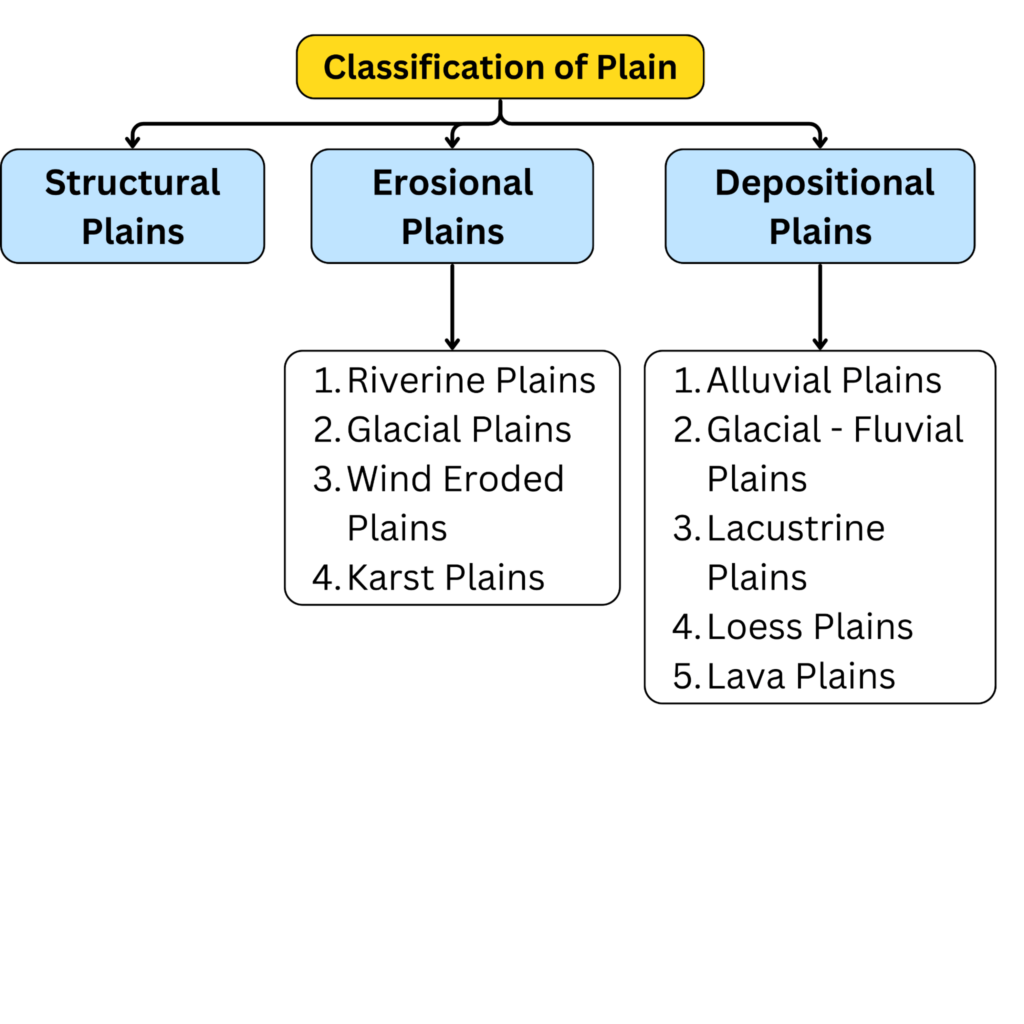
Constructive /Structural/Diastrophic plain-
- Constructive plains are formed due to uplift or subsidence of continental landmasses caused by plate movements.
- When land emerges from the sea, it forms structural plains, e.g., Great Plains (USA) and Russian Platform (Russia).
- Erosion and deposition by rivers and glaciers further modify these plains.
- Coastal plains form when the lithosphere rises near the sea coast, e.g., Atlantic Coastal Plain (USA).
- When the sea coast submerges, plains are formed by marine deposition, e.g., Karnataka and Eastern Coastal Plains of India.
Erosional plain–
- Through the process of erosion, over a long period of time, mountains and plateaus are disintegrated by factors like rivers, winds, glaciers and sea waves and take the form of plains:
- Riverine plains-
- Riverine plains are formed by river erosion, which flattens an undulating surface.
- When rivers erode highlands and reach their base level, a peneplain (riverine plain) is formed.
- Hard, resistant rocks remain as small ridges called Monadnocks.
- Examples: Paris Basin and London Basin.
- Glaciated plain-
- Glaciated plains are formed by glacial erosion through abrasion and attrition beneath snow-covered regions.
- They have rounded peaks, wide valleys, and depressions that often form lakes when filled with water.
- Found mainly in high latitudes and mountainous regions.
- Examples: Canada, Sweden, Finland.
- Wind-eroded plains: Formed in arid regions where rocks are broken by mechanical weathering and eroded by wind abrasion, resulting in a pediplain.
- Calcareous / Karst plains: Formed in limestone regions due to long-term underground water erosion, producing a karst plain.
- Examples: Nainital and Almora (India), Yugoslavia, France.
Depositional plain
Plains formed by deposition are large and small. Plains deposited by various factors of erosion can be divided into the following parts-
- River formed plains: When rivers bring deposits from the highest regions to lower regions, they form the most extensive plains.
(i) Alluvial plains – These plains are formed by the deposition of debris brought down by the rivers from higher elevations to the lower regions. These plains are called Piedmont plain or Deltaic plain on the basis of their locations. The Deltaic plains of Ganga Brahmaputra and Nile rivers are very fertile and thickly populated.
(ii) Floodplains-During floods, the plain formed up to the distance where the river water spreads and deposits fine particles is called flood plain. Flood plains are formed by alluvium/ sand/ alkaline soil which is very fertile for agriculture. Alluvial plains are usually divided into the following parts-
- Khadar Plain – The area where flood water reaches every year and new alluvial soil keeps getting deposited is called Khadar Plain.
- Bangar Plains- The areas where flood water does not reach are called Bangar Plains.
The flood plains formed by rivers like Nile, Ganga, Sutlej, Mississippi etc. form Khadar and Bangar plains.
(iii) Delta Plains – When rivers fall into seas or lakes, they accumulate deposits near the mouth which is called ‘delta’. Deltas are usually triangular in shape. It appears in the form of the Greek letter ∆. Hence, this plain is called ‘delta’. The plains formed at the mouths of rivers like Indus, Mississippi, Ganga etc. are deltaic plains.
II. Lacustrine/Lake-formed plains:
- Formed either by sediment filling of lakes by rivers or by uplift of lake beds due to earth movements.
Examples: Hungary Plain, parts of Canada, Western Europe, USA.
III. Lava plains:
- Formed by the spread of thin lava sheets or erosion of lava plateaus.
- Examples: Iceland, Argentina, USA.
IV. Wind-deposited plains:
- Desert plains: Formed by sand and silt deposition in arid areas.
- Examples: Thar Desert (India), Sahara Desert (Africa).
- Loess plains: Formed by fine dust carried by wind.
- Example: Shensi Loess Plain (China).
V. Glacial-Fluvial plains: Formed by glacial debris deposition; uneven and marshy, including till plains and outwash (sediment) plains.
North America
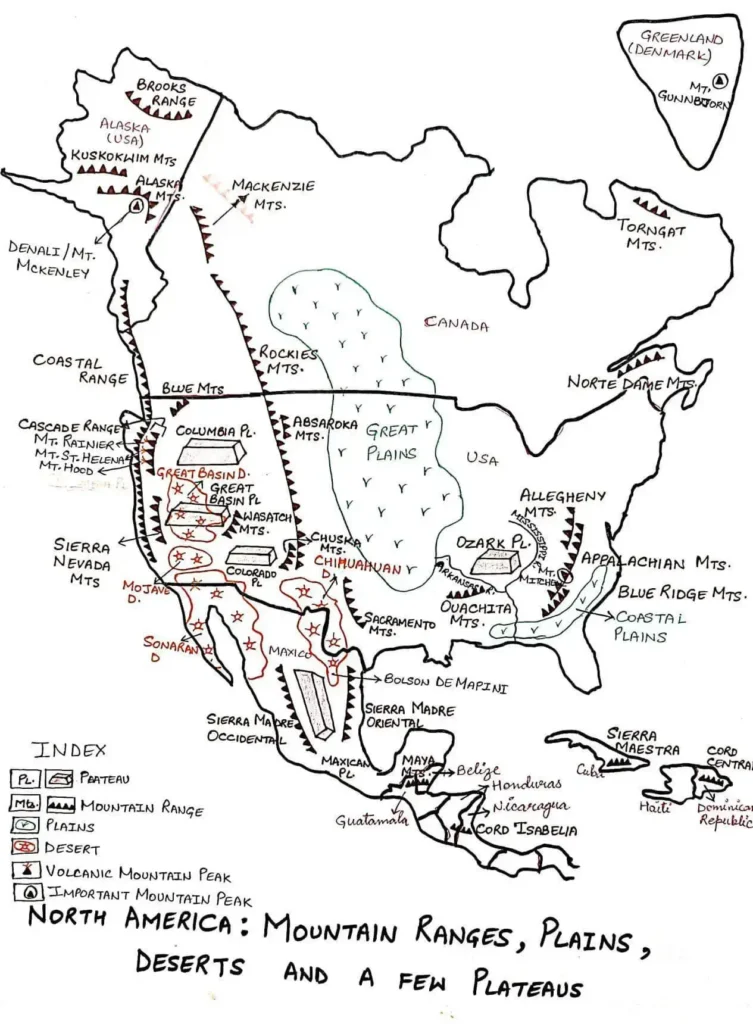
Plains | Location | Features |
Great Plains | Canada (Alberta, Saskatchewan, Manitoba)central USA (Montana, North Dakota, South Dakota, Nebraska, Kansas, Oklahoma, Texas) |
|
Coastal Plains | Eastern and southeastern USA, bordering the Atlantic Ocean and Gulf of Mexico |
|
South America
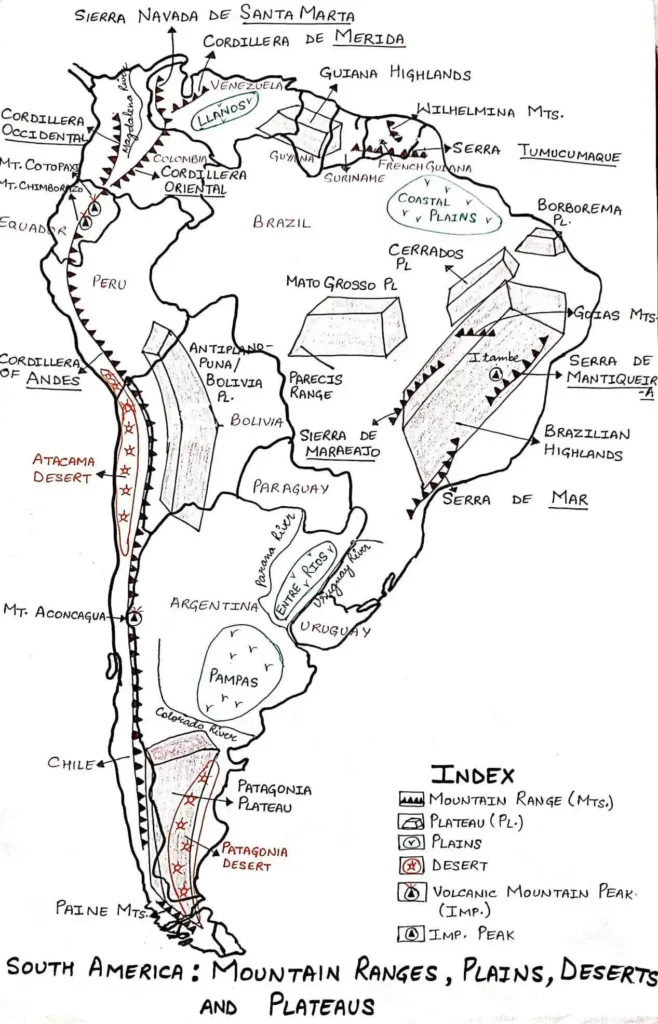
Plains | Location | Features |
Llanos Plains | Venezuela and Colombia |
|
Coastal Plains | Eastern Brazil |
|
Entre Ríos Plains | Argentina and Uruguay |
|
Pampas Plains | Central Argentina, parts of Uruguay, and southern Brazil |
|
Europe
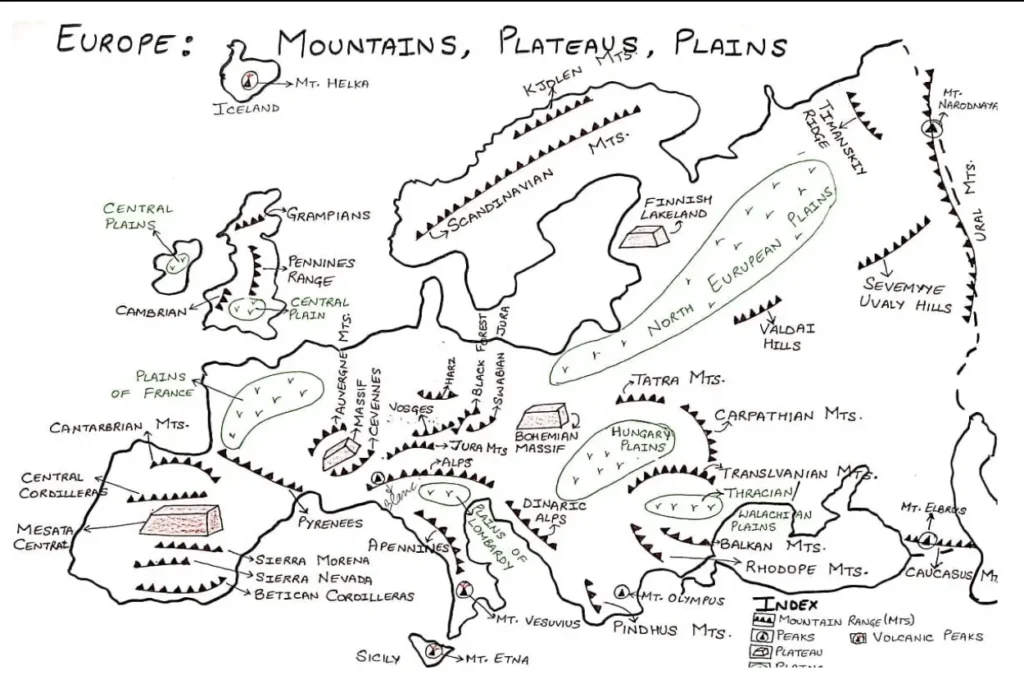
Plains | Location | Features |
Central Plain | Ireland |
|
Central Plain | Great Britain | |
Plains of France | Northern and western France |
|
Plains of Lombardy | Northern Italy |
|
Hungary Plains | Central Europe (Hungary and parts of Serbia, Romania, Croatia) |
|
Thracian / Wallachian Plains | Bulgaria (Thracian) and southern Romania (Wallachian) |
|
North European Plain | Parts of France, Belgium, the Netherlands, Germany, Denmark, Poland, and Belarus. |
Africa
Plains | Location | Features |
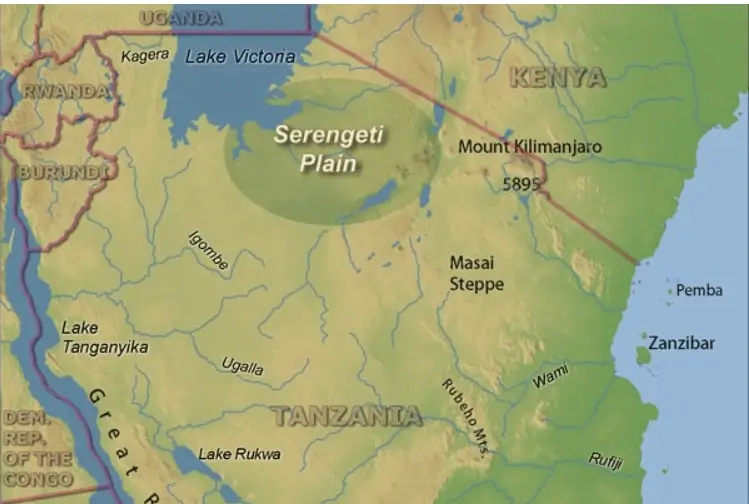
Serengeti Plains | Northern Tanzania and Southwestern Kenya |
|
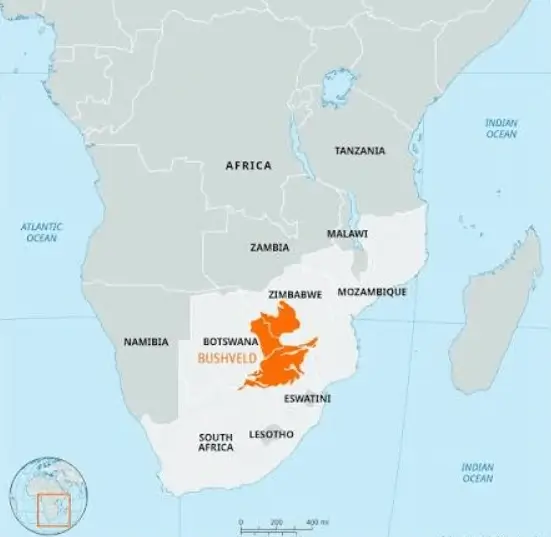
Bushveld Plains | Northern South Africa and Southeastern Botswana, Southern Zimbabwe |
|
Asia
Plains | Location |
|
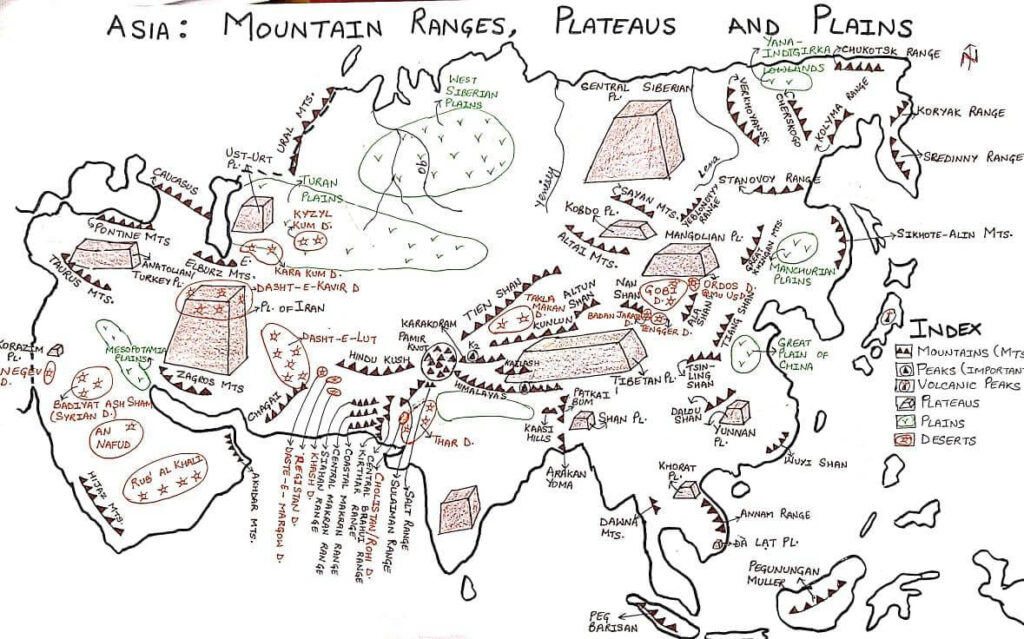
West Siberian Plain | Russia | Between Ural Mountains (west) and Yenisei River (east) |
Yana– Indigirka Lowlands | North Eastern Siberia (Russia) |
|
Manchurian Plain | North Eastern China |
|
Great Plain of China | Eastern China |
|
Turan Plain | Kazakhstan, Turkmenistan, Uzbekistan |
|
Mesopotamian Plain | Iraq, parts of Syria, Kuwait |
|
Indo-Gangetic Plain | From Punjab (Pakistan) to Assam (India) along Ganga and Indus systems |
Australia
Plains | Location | Features |
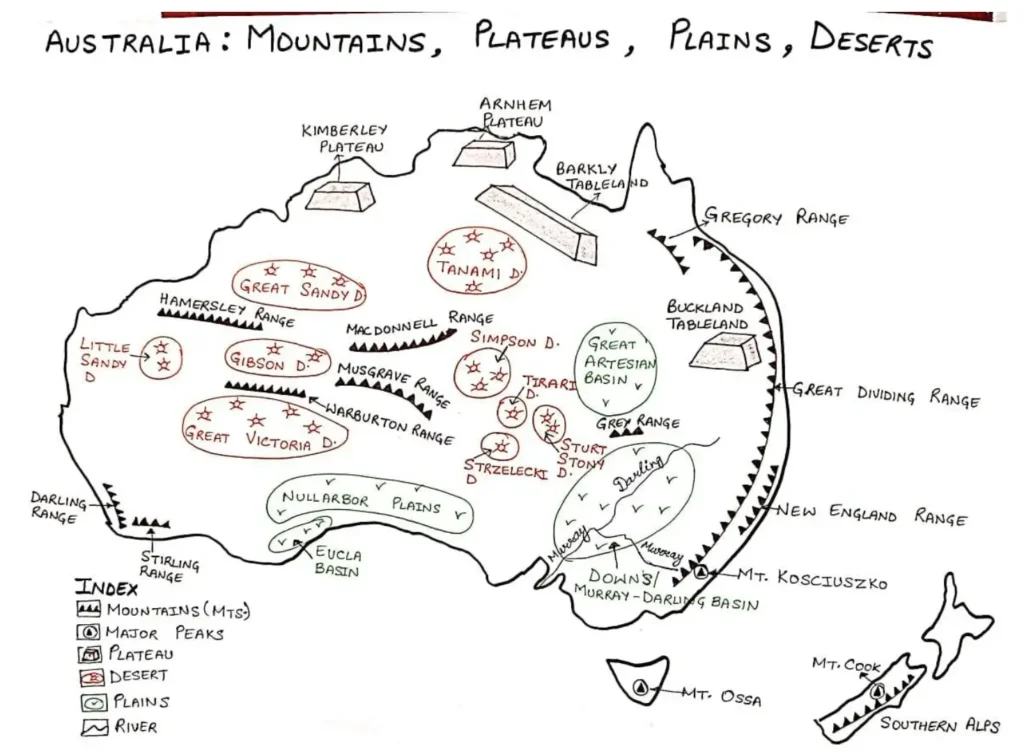
Nullarbor Plain | Southern coast of Australia |
|
Murray– Darling Basin | Southeastern Australia |
|
Great Artesian Basin | Queensland, New South Wales, South Australia, and Northern Territory |
|
World Deserts
- Deserts are extremely dry regions where annual rainfall is less than 25 cm.
- They are mainly located in subtropical high-pressure areas, where descending air, thermal inversion, and stable atmospheric conditions prevail.
- Continentality is an important factor, as rainfall decreases towards the interior parts of continents.
- Cold ocean currents along western continental margins reduce evaporation and cloud formation, leading to arid conditions.
- Most of the world’s dry and semi-arid deserts are found in the western and central parts of continents.
- Major deserts include Sahara, Arabian, Thar, Libyan, Kalahari, Atacama, Western Australian, Arizona–Colorado, Gobi, Sikyang, Taklamakan, Karakum, and Kizil Kum.
- Subtropical (hot) deserts are located between 15°–30° latitudes, characterized by high temperatures, low humidity, and very scanty rainfall (e.g., Sahara, Thar, Atacama, Australian Desert).
- High-latitude (cold) deserts are found in mid and high latitudes or continental interiors, marked by low temperatures, long winters, and precipitation mainly in the form of snow (e.g., Gobi, Taklamakan, Karakum, Kizilkum, Sikyang).
The reason for most of the world’s deserts being in the west of the continents is–
- These regions lie under the influence of trade winds, which blow from east to west; they shed most of their moisture on the eastern coasts and reach the western parts in a dry condition.
- Western continental margins largely fall within subtropical high-pressure belts, where descending air (counter trade winds) suppresses cloud formation and rainfall.
- Many deserts are surrounded by mountain ranges, which act as barriers and create rain-shadow regions, preventing moist winds from reaching the interior (e.g., Andes–Atacama, Great Dividing Range–Australian Desert).
- Cold ocean currents along western coasts cool the air, reduce evaporation, and make winds moisture-deficient, resulting in aridity (e.g., Canary Current–Sahara, Humboldt Current–Atacama, West Australian Current).
- These areas are also influenced by dry continental winds or winds blowing from cold to warm latitudes, which further enhance dryness.
- In some regions, persistently low temperatures limit water vapour content in the atmosphere, producing cold desert conditions, as seen in tundra regions.
Continental configuration of deserts–
- Arid and semi-arid conditions are found on about 30% of the Earth’s surface, which does not include cold deserts.
- Desert conditions are found in 43% of the area in Australia, 40% in Africa, 29% in Asia and up to 10% in the New World.
- The Sahara Desert is larger than the total area of the United States. In Europe, aridity is found only near the Caspian Sea.
Types of deserts-
Rocky desert or hamada –
- In such deserts, bare rocks are seen spread widely. At some places, heaps of sand and rock fragments are also seen. These areas are known as Hamada in the Sahara.
Rocky desert or reg –
- In such deserts, angular pebbles and stones are visible in transverse position and sand is rarely seen. In Algeria, they are called ‘Reg’ and in Libya and Egypt, they are called Serire.
Sandy desert or erg –
- In such deserts, abundance of sand and absence of rocky surface is mainly observed. From the point of view of common people, these are considered to be the real deserts.
- In the Sahara, they are called Erg and in Turkey, they are called Koum. The Thar desert is mostly of this type.
Mountain desert –
- In these deserts, hilly peaks with pointed tops, sharp slopes and deep cut ravines are found. Kyotic of the Sinnerd Desert, Tiwasi of Central Sahara, northern end of Taklamakan etc. are such deserts.
Cold desert–
- Due to the prevalence of aridity and lack of water, humans have not yet been able to reside in the North Pole and South Pole of the Earth. These areas fall in the category of deserts due to lack of rainfall, vegetation etc. and temperature difference, but due to extreme lack of heat and temperature, they are always covered with snow or remain cold, so they are called cold deserts.
- Antarctica, Greenland, Baffinland, Lapland, Iceland, Alaska, Northern Canada, Novaya Zemlya and other parts which are located from 66.5 degrees latitude towards the poles are known as cold deserts.
North America
Desert | Location | Features |
Great Basin Desert | Western United States, mainly in Nevada, parts of Utah, Oregon, and Idaho |
|
Mojave Desert | Southeastern California, southern Nevada, and parts of Arizona and Utah |
|
Sonoran Desert | Southwestern United States (Arizona, California) and northwestern Mexico (Sonora, Baja California) |
|
Chihuahuan Desert | Northern Mexico (states of Chihuahua, Coahuila) and south western USA (Texas, New Mexico) |
|
South America
Desert | Location | Features |
Atacama Desert | Northern Chile |
|
Patagonian Desert (Monte Desert) | Southern Argentina |
|
Sechura Desert | North western coast of Peru |
|
La Guajira Desert | Northeastern Colombia and northwestern Venezuela |
|
Africa
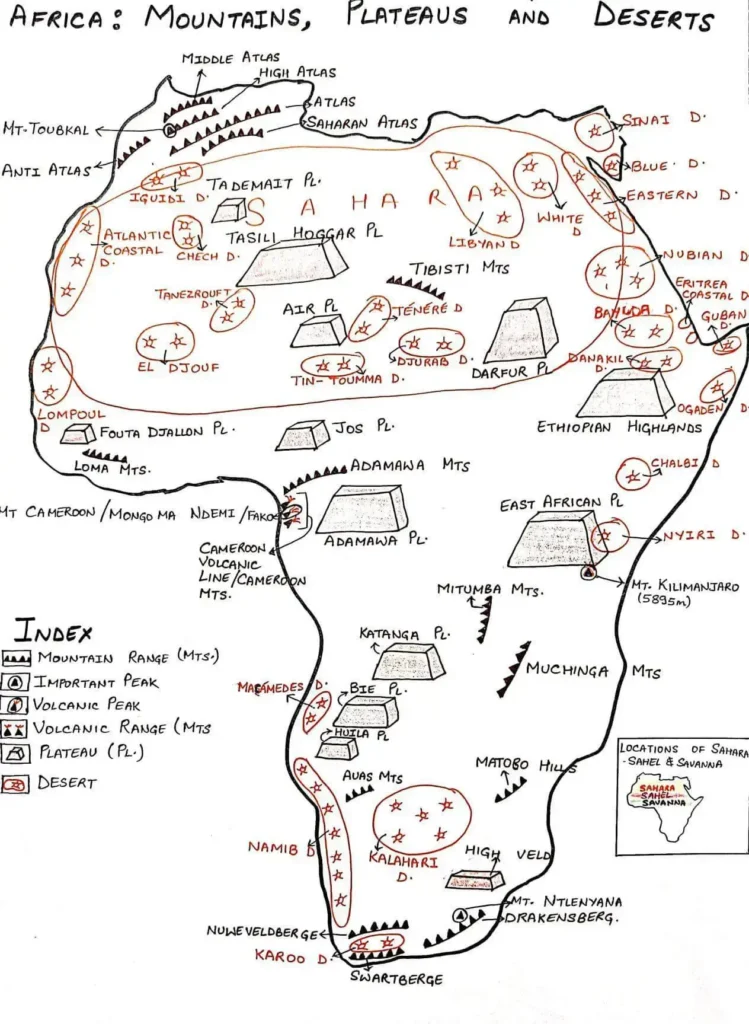
Desert | Location | Main Features |
Sahara Desert | Northern Africa (from the Atlantic Ocean to the Red Sea; covering Morocco, Algeria, Tunisia, Libya, Egypt, Mauritania, Mali, Niger, Chad, Sudan) |
|
Libyan Desert | Eastern part of the Sahara (Libya and Western Egypt) |
|
Nubian Desert | Eastern Sahara (northeastern Sudan) |
|
Eastern Desert | Located to the east of Nile river |
|
Tenere Desert | South-central Sahara (Niger & Chad) |
|
Tanezrouft Desert | Western-central Sahara (Algeria, Mali) |
|
Danakil Desert | Ethiopia, Eritrea, Djibouti (Afar region) |
|
Ogaden Desert | Eastern Ethiopia (Somaliland–Somalia border) |
|
Chalbi Desert | Northern Kenya | |
Nyiri Desert | Southern Kenya | |
Lompoul Desert | Northwestern Senegal (near Atlantic coast) |
|
Namib Desert | Southwestern Africa (Namibia & Angolan coast) |
|
Kalahari Desert | Botswana, Namibia, South Africa |
|
Karoo Desert | Southern South Africa |
|
Asia
Desert | Location | Features |
Rub’ al Khali | Southern Arabian Peninsula |
|
An Nafud | Northern Saudi Arabia |
|
Badayat Ash Shamal | Northern Saudi Arabia and Iraq |
|
Negev | Southern Israel |
|
Dasht-e-Lut | Southeast Iran |
|
Dasht-e-Kavir | Central Iran |
|
Karakum | Turkmenistan |
|
Kyzylkum | Uzbekistan and Kazakhstan |
|
Dasht-e-Margo | Southwestern Afghanistan |
|
Registan | Southern Afghanistan |
|
Khash | Southwestern Afghanistan |
|
Cholistan/Rohi | Southeastern Pakistan |
|
Thar | India and Pakistan | |
Taklamakan | Xinjiang region of China (Tarim Basin) |
|
Gobi | Mongolia and Northern China |
|
Ordos / Mu Us | Northern Shaanxi Province of China |
|
Tengger | Inner Mongolia | |
Badan Jaran | Western Inner Mongolia |
Australia
Desert | Location | Features |
Great Victoria Desert | Extends across Western Australia and South Australia |
|
Great Sandy Desert | Northern Western Australia |
|
Little Sandy Desert | Central Western Australia (South of Great Sandy Desert) |
|
Gibson Desert | Central Western Australia |
|
Tanami Desert | Across Northern Territory and Northern Western Australia | |
Simpson Desert | Northern Territory, South Australia, and Queensland |
|
Tirari Desert | Central South Australia |
|
Sturt Stony Desert | Northeast South Australia and southwest Queensland | |
Strzelecki Desert | Northeast South Australia, bordering Queensland and New South Wales |



