

Greenhouse Effect, Global Warming, and Climate Change are critical topics in World Geography, as they explain how human activities and natural processes influence the Earth’s climate. The greenhouse effect traps heat in the atmosphere, leading to global warming, which in turn drives long-term climate change. Understanding their causes, impacts, and mitigation strategies is essential for environmental awareness and sustainable development.
Greenhouse Effect, Global warming and Climate Change
Greenhouse Effect
- A natural process that keeps the Earth’s atmosphere warm and makes it suitable for life.
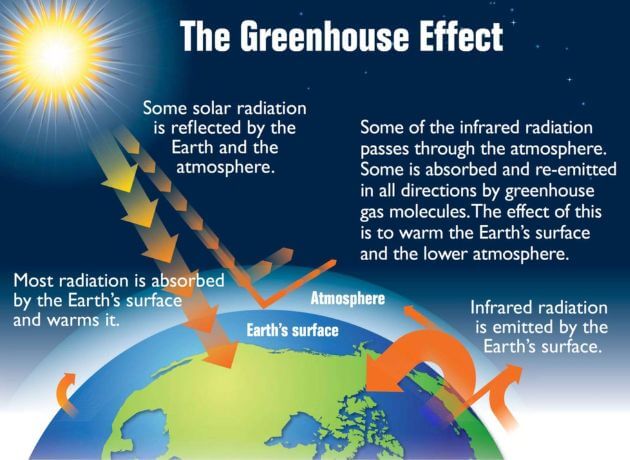
- This effect occurs when the energy coming from the Sun (solar radiation) reaches the Earth’s surface, where it is absorbed and then re-emitted as infrared radiation. This infrared radiation is then emitted back into space.
- The greenhouse gases present in the atmosphere absorb this infrared radiation and re-emit it toward the Earth’s surface and lower atmosphere.
- The Earth maintains a certain temperature range, allowing life to exist [ Natural Greenhouse Effect]. However, due to human activities, the Earth’s temperature is continuously increasing [Human-Induced Greenhouse Effect].
Global warming definition
- This is the long-term increase in the average temperature of the Earth’s atmosphere and surface, primarily caused by the rising emissions of greenhouse gases due to human activities.
- The term Global Warming was first used by scientist Wallace Broecker in 1975.
- It refers to the balance between the thermal energy reaching the Earth and the thermal energy reflected back into space.
- Before the Industrial Revolution (1850-1900), the global average temperature was approximately 13.7°C. By 2024, this average temperature has increased to about 14.8°C, indicating a rise of 1.1°C.
- According to the IPCC report, the temperature is increasing by an average of 0.2°C every decade.
- Note – Global Cooling
- It is the opposite of global warming. In the 1970s, scientist Gerald Stanhill referred to the continuous decline in temperature after 1950 as Global Cooling. However, this concept is not true because the Earth’s temperature is actually increasing.
GHG
Carbon dioxide (CO₂), Methane (CH4), Nitrous oxide (N₂O), Water vapour, Ozone (O3), F-gases [Chloro-fluoro-carbons (CFCs), Hydrofluorocarbons (HFCs), Perfluorocarbons (PFCs), Sulphur hexafluoride (SF6), Nitrogen trifluoride].
The effect of greenhouse gases depends on their quantity, concentration, lifespan, and Global Warming Potential (GWP), where CO₂ serves as the baseline with a GWP of 1.
GWP (Global Warming Potential) – It indicates the ability of greenhouse gases to trap heat in the atmosphere compared to CO₂. The GWP is typically calculated over a 100-year timeframe.CO₂ – It is the standard reference gas,so its GWP is 1.
| GHG | Contribution | Sources | Mitigation |
| CO₂ | 75% of anthropogenic (human-induced) GHG emissionsPrimary GHGGWP: 1Lifetime: 50 – 200 years | Natural Sources: Respiration, combustion process, volcanic eruptions; Human Activities: Deforestation, industrialization, fossil fuel burning | Energy conservationCarbon sinks (Forests/Oceans), renewable energy |
Before industrialization, the concentration of CO₂ was around 280 parts per million (ppm), around the 1950s and 1960s, it was around 330 ppm. In June 2024, it reached 426.91 ppm.
GHG | Contribution | Sources | Mitigation |
CH₄ | About 16%GWP: 29.8, Lifespan: 12 years. | Wetlands, paddy crops, ruminant animals, termites, coal mines, gas drilling, and the ocean. | Natural processes, chemical reactions |
N₂O | About 6%GWP: 273, Lifespan: 120 years. | Fertilizer industry, fossil fuel combustion, leather industry, industrial activities, seawater, volcanic eruptions. | Absorption by bacteria, destruction by UV radiation |
F-gases | About 2%Higher GWP: upto 23,500 Lifespan: upto 50,000 years | Refrigeration, air conditioning, industrial processes. |
CFC
- Used as a coolant (refrigerator, AC)
- Apart from global warming, it causes the most damage to the ozone gas.
HFCS
- Produced from waste materials from industrial activities.
- Used in refrigerants, aerosols, solvents and fire extinguishers.
PFCS
- Produced in aluminium-containing electronics materials or aluminium industries.
SF6
- Produced from the combustion of sulfur-containing fuels.
- Mainly used in the electrical industry as an insulating gas, especially in high-voltage switchgear and circuit breakers.
- GWP is 25,184, and its lifespan is 3,200 years.
Water vapour |
|
Ozone |
|
Carbon monoxide
- Short-lived greenhouse gas.
Note-
- Black carbon – is produced mainly by burning coal, hence it is also called soot carbon.
- Brown carbon – is produced by burning crop residues.
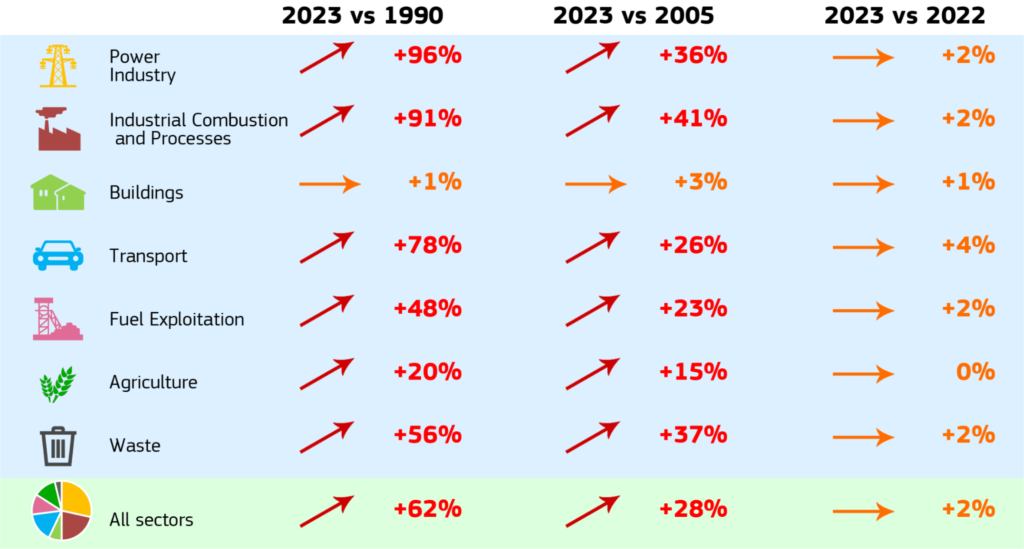
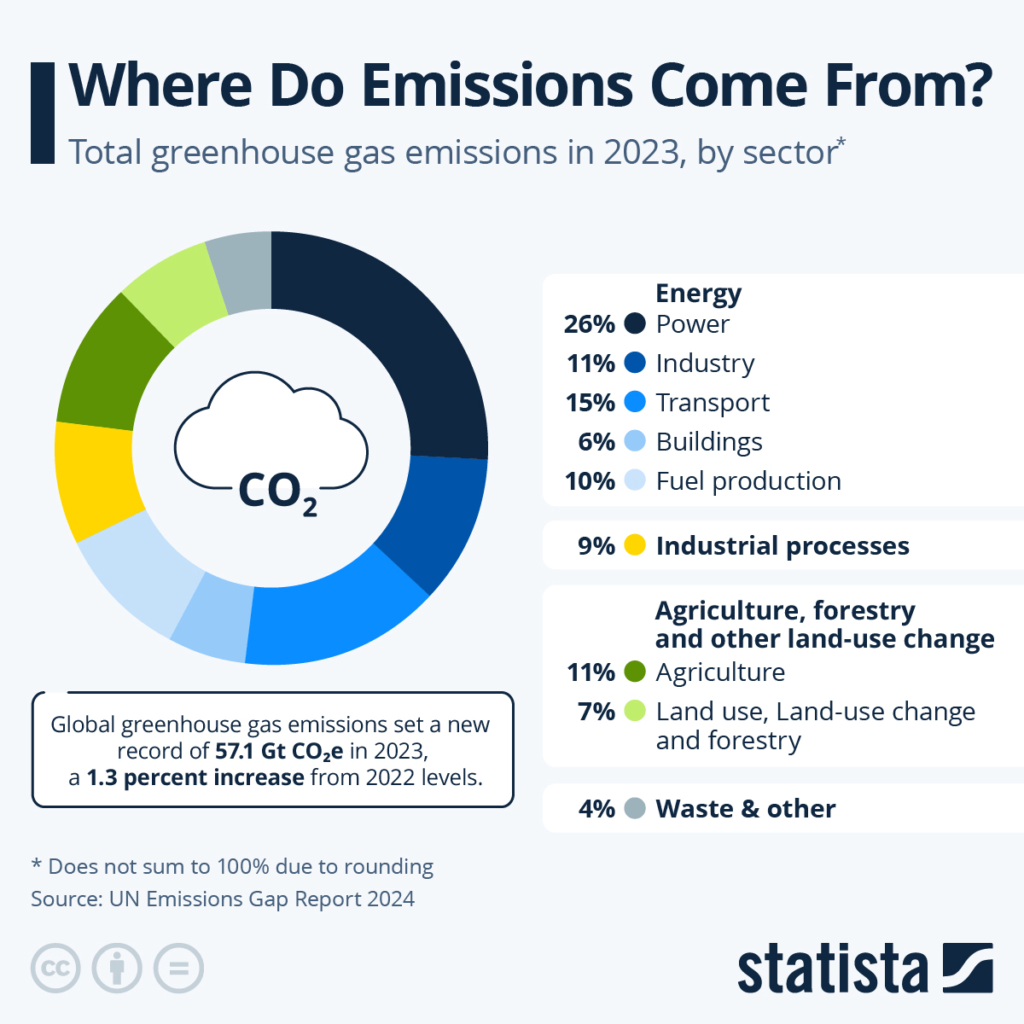
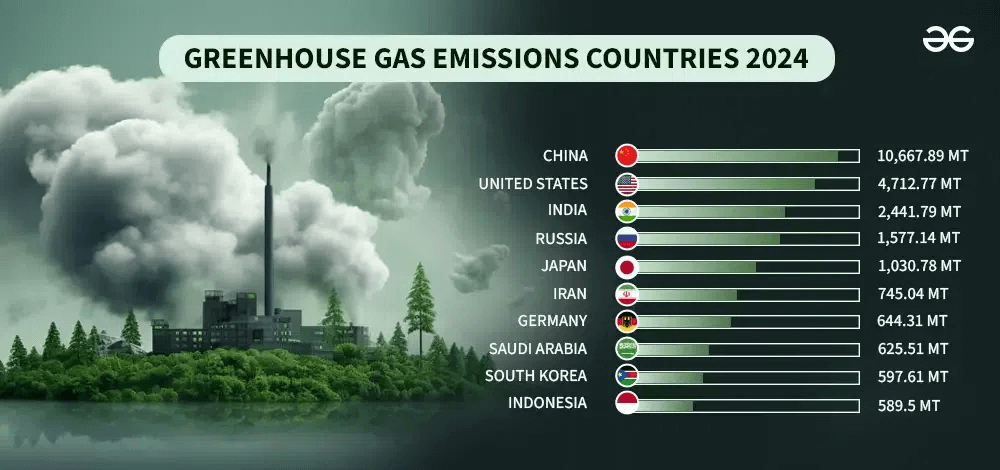
Highest contribution to global carbon emissions –
(i) China [31.8 % (ii) USA [14.4 %] (iii) India [9.5 %].
Causes of greenhouse effect
- Industrialization (due to the use of coal, petroleum in industries).
- Deforestation – Carbon dioxide is a very useful gas because it is very essential for photosynthesis in plants but due to continuous deforestation and reduction in trees, the amount of CO2 in the atmosphere is continuously increasing. It is harmful in excess.
- About 80% of CO2 is released into the atmosphere by the combustion of fossil fuels (wood and coal).
- Use of refrigerators and air conditioners – The manufacturing and use of refrigerators and air conditioners produce CFC (chlorofluorocarbon) gas which increases the amount of greenhouse gases.
Effects
- The concentration of CO2 has increased by 30%.
- The level of methane and nitrous oxide gases has increased significantly in the last 100 years.
- The amount of methane in the atmosphere has increased by about 145% since the time of the Industrial Revolution.
Effects :
- Increase in temperature
- Change in rainfall pattern- The cycle of rainfall will change, rainfall will increase, but in some countries the opposite situation will lead to desertification.
- Rise in sea level – A temperature increase of just 0.5°C to 1.5°C will result in the melting of glaciers and polar ice caps, leading to flooding in coastal plains. Possibly, several islands will submerge, and sea levels will rise. For example, Tuvalu and the Carteret Islands in the Pacific Ocean have already submerged, and there is a risk of Maldives sinking as well.
- Changes in vegetation areas – There will be changes in the boundaries of grassland and forest areas, there may be a possibility of famine in the sandy areas of Africa.
- Increase in Disease Levels – Changes in vegetation zones may lead to variations in insect populations, increasing the risk of diseases. A 3-5°C rise in temperature could result in a 45-60% increase in malaria cases.
- Threat to biodiversity – As a result of temperature increase, 80% of biodiversity will be threatened.
Climate Change
- Climate change refers to long-term changes in the Earth’s climate system, caused mainly by human activities, such as greenhouse gas emissions, but also by natural causes such as volcanic eruptions and solar activity.
- Climate change can cause problems such as global warming, increase in natural disasters, loss of biodiversity and adverse effects on agriculture.
Factors affecting climate change-
(A) Natural factors (B) Human factors
A. Natural factors
- Continental drift – The continents present on the earth are mobile. Due to which there is a change in the distribution of sea currents, water and land. As a result, there is a change in the amount of humidity and rainfall, which changes the climate.
- Change in the Earth’s orbit – The Earth’s orbit around the sun is elliptical, due to which the distance between the Earth and the Sun varies during the year. Long term change in the Earth’s orbit can influence the amount of solar energy received by the earth leading to slight changes in temperature and contributing to climate change.
- Earth’s Axial Tilt – The Earth is tilted at 23.5° on its axis, causing warmer temperatures in the Northern Hemisphere for half the year and in the Southern Hemisphere for the other half, while the opposite hemisphere experiences colder conditions. An increase in axial tilt would lead to variations in solar radiation, contributing to climate change.
- Volcano – Volcanic eruptions release gases that form cloud cover, reducing the amount of sunlight reaching the Earth’s surface and lowering temperatures. For example, the 1991 eruption of Mount Pinatubo in the Philippines caused a 0.5°C decrease in global temperature.
- Variation in Solar Radiation – The Sun occasionally experiences magnetic storms, leading to temporary drop in solar temperature, known as sunspots. Additionally, explosions in the Sun’s outermost layer (corona) can cause solar storms, increasing solar radiation and temperature on Earth.
B. Human factor –
- Fossil fuel combustion,
- Industrial processes,
- Biomass combustion,
- Deforestation,
- Land-use change
Evidence/Proof of Climate Change
- Rise in sea level
- Increase in global warming
- Warming of sea water
- Shrinking of ice sheets or reduction in the amount of ice at the poles.
- Reduction in the number of glaciers
- Increase in sea salinity
Effects of Climate Change
(i) Due to climate change, there will be an increase in extreme heat waves, heavy rainfall, rising sea levels, ocean acidification, and forest fires. This will lead to-
- Threats to biodiversity
- Challenges in agriculture
- Increased sensitivity of human health to diseases
- Rising social and economic problems.
(ii) Effect on agriculture – While global warming and increased CO₂ levels may benefit certain crops and regions, the overall challenges outweigh the benefits. These challenges include –
- Nutrient depletion,
- Reduced soil moisture,
- Decreased water availability,
- Excessive rainfall causing floods, and
- Low rainfall leading to droughts.
Additionally, rising water temperatures will force fish and other aquatic organisms to migrate in search of suitable habitats.
Effects of climate change
- Increase in Temperature
- Melting of Glaciers
- Rise in Sea Levels
- Extreme Weather Conditions
- Ocean Acidification
- Changes in Rainfall Patterns
- Loss of Wildlife
- Severe Droughts and Forest Fires
- Submersion of Island Nations
- Increase in Frequency of Tropical Cyclones
- Agricultural and Food Crisis
- Threat to Biodiversity
- Increase in Pathogens and Diseases
Intergovernmental Panel on Climate Change [IPCC]
- Official panel of the United Nations
- Founded: 1988
- Founded by World Meteorological Organization + United Nations Environment Programme
- Headquarters: Geneva (Switzerland)
- The President is elected by all 195 countries through a democratic process.
- Indian-origin Rajendra Pachauri was elected as the chairman of IPCC from 2002 to 2015. Pachauri prepared a report on environmental studies which is called IVth report. In 2007, this organization was awarded the Nobel Prize which was received by Rajendra Pachauri and the US President.
- Nobel Peace Prize in 2007
- 195 members
IPCC report on climate change
- Since its inception in 1988, IPCC has produced six reports
- The most comprehensive scientific report on climate change
- IPCC 1st Report on Climate Change [1990]
- Global temperature increased by 0.3 – 0.6°C over the past 100 years.
- By 2025, global temperature is expected to rise by 2°C compared to pre-industrial levels, and by 2100, it may increase by 4°C. Additionally, sea levels are projected to rise by 65 cm.
- In 1992, this report became the basis for the United Nations Framework Convention on Climate Change (UNFCCC).
- 2nd Report [1995] – Scientific basis for the Kyoto Protocol in 1997.
- 3rd Report [2001]
- 4th Report [2007] – Nobel Peace Prize 2007 for IPCC
- 5th Report [2014] – Scientific basis for the Paris Agreement in 2015.
- IPCC Sixth Report on Climate Change [2023]
- More than 45% of the global population resides in areas that are highly vulnerable to climate change.
- Multiple climate hazards will occur simultaneously, and climate and non-climate risks will interact with each other.
- Climate change is likely to increase malnutrition, hunger, and the spread of diseases.
- Global temperature has already increased by 1.1°C compared to pre-industrial levels.
- Main causes include fossil fuel consumption, energy usage, and unsustainable land exploitation.
- Despite progress in climate mitigation policies and laws, temperatures are likely to rise beyond 1.5°C by the end of the 21st century.
- To limit warming to 1.5°C, emissions must be reduced by 43% by 2030 and 60% by 2035, compared to 2019 levels.
Climate Change Solutions
Scientists have proposed geoengineering techniques to reduce global warming, but their feasibility remains uncertain.
- Volcanic Eruption Affect – Active volcanoes release sulfur dioxide into the atmosphere, increasing cloud formation. This reduces sunlight reaching the Earth’s surface, leading to lower temperatures.
- Use of Large Mirrors – Deploying large mirrors in space to reflect sunlight away from Earth, reducing heat absorption.
- Artificial Trees – Artificial trees can absorb carbon dioxide from the air and store it in deep ocean layers.
- Solar Radiation Management (SRM) – Aerosol injection: Spreading sulfur dioxide particles in the atmosphere to reflect sunlight back into space.
- Use of white surfaces: Increasing Earth’s reflectivity by painting surfaces white.
- Marine cloud brightening: Spraying sea salt into clouds to make them more reflective.
- Space-based solar shields to block sunlight from reaching Earth.
Recommendations made in the IPCC Sixth Report:
- Increasing renewable energy and phasing out fossil fuels.
- Financing is the most important and fundamental need for action in developing countries.
- Increasing private sector participation.
- Involve people most affected by climate impacts in creating solutions.
Global efforts
Stockholm Conference – 1972
- Known as the “Magna Carta of the Environment”.
- Aimed at reducing conflicts between human development and environmental conservation.
- It was the first global environmental summit, leading to the establishment of the United Nations Environment Programme (UNEP).
- Headquarters: Nairobi, Kenya
- Objective: To provide technical and financial support for environmental conservation.
- Decision to observe World Environment Day on June 5.
- Under this conference, India launched the “Project Tiger” initiative for tiger conservation.
United Nations Conference on Environment and Development (UNCED)
First Earth Summit
- When: 3-14 June, 1992
- Where: Rio de Janeiro, Brazil
- Participants: Representatives from 178 countries
- Main objectives –
- Balancing environmental protection and economic development.
- Integrating sustainable development into the global agenda.
- Addressing issues like greenhouse gas emissions, biodiversity loss, deforestation, and pollution.
- Promoting economic growth without harming the environment.
- Main results
- UNFCCC: United Nations Framework Convention on Climate Change
- Aim: To control greenhouse gas emissions and combat climate change.
- United Nations Convention on Biological Diversity (CBD): A treaty for biodiversity conservation, sustainable use of biological resources, and equitable sharing of benefits.
- United Nations Convention to Combat Desertification (UNCCD) Established to prevent desertification and land degradation.
- Agenda 21: A global action plan for sustainable development in the 21st century, covering local, national, and global levels.
- Forest Principles: Non-binding guidelines for the conservation and sustainable management of forests.
- Commission on Sustainable Development (CSD): Established to monitor the implementation of Agenda 21.
- Global Environment Facility: A fund created to support climate action, biodiversity conservation, ozone layer protection, and international water pollution control
- UNFCCC: United Nations Framework Convention on Climate Change
United nations agreement on climate change (UNFCCC)
- First multilateral international agreement on climate change
- Effective since March 1994
- Legally non-binding
- Goal: Reduce GHGs emissions to combat global warming
- Action: Hold annual conference on climate change
COP-1
- In 1995, in Berlin, the capital of Germany, there was agreement on making joint efforts to tackle climate change.
Kyoto Protocol COP-3
- An international agreement linked to the UNFCCC signed in December 1997 in Kyoto, Japan. Detailed rules related to the internationally binding protocol – Marrakesh Accord.
- Effective 16 February 2005 [with signing by Canada]
- 192 countries are parties to the Kyoto Protocol [Only UNFCCC members are parties to the Kyoto Protocol]
- 84 countries are signatories to the Kyoto Protocol
- Canada, Andorra, USA, South Sudan are not parties to the Kyoto Protocol
- In this conference, it was accepted that developed countries are mainly responsible for climate change as a result of industrialization.
- First commitment – 5.2% reduction in the emission of 6 greenhouse gases from 1990 levels between 2008 to 2012.
- Second commitment – 18% reduction in the emission of 6 greenhouse gases from 1990 levels from 2013 to 2020.
- 6 GHGS: CO2, Methane, Nitrous Oxide, Hydro Fluorocarbons, Perfluorocarbons PFCs, Sulphur Hexa-fluoride
- Each country in Europe [EU-15] is targeted to reduce 8% of current greenhouse gas emissions, USA 7%, Japan 6%.
- International shipping and international aviation are not included in meeting Kyoto Protocol targets.
- Countries can use Land Use (LU), Land-Use Change (LUC) and Forestry to meet their Kyoto targets.
- The principle of Common But Differentiated Responsibility [CBDR] was adopted under this protocol, based on past actions by industrially developed countries.
- The meetings of the parties to the Kyoto Protocol are called CMPs.
Classification of member countries under the Kyoto Protocol
Annex-I | Annex-II |
|
|
- To ensure that the above emission reduction does not have an adverse effect on industries, the concept of Clean Development Mechanism (CDM) was adopted.
Clean Development Mechanism
- Established under Article 12 of the Kyoto Protocol.
- Based on the concept of Carbon Credits / Carbon Market.
- Developed countries committed to emission reduction are allowed to implement emission reduction projects in developing countries.
- These projects focus on sustainable and green development, allowing developed nations to earn carbon credits by investing in such initiatives.
- Carbon credit buyers can use these credits to demonstrate their emission reductions and meet their own emission targets.
This mechanism serves dual purposes:
- Helps developed nations fulfill their emission reduction commitments.
- Encourages sustainable development in developing countries.
Note
- New Zealand implemented carbon tax in May 2005, followed by Australia on July 1, 2012.
- A solar power plant was set up in the Mojave Desert (California, USA).
- Sweden is the only country in the world where trains are powered by biogas.
Johannesburg Conference-2002
- Held in Johannesburg, South Africa from August 26 to September 4, 2002.
- Also known as “Rio+10” Summit, as it was another Earth Summit.
- Key issue: Global warming.
- Indian Prime Minister Atal Bihari Vajpayee emphasized: Development should be sustainable, ensuring that economic progress does not harm human civilization and protects essential life-supporting systems.
CoP-11/CMP-1
- Held in Montreal, Canada, in 2005.
- With Canada’s signing, the Kyoto Protocol officially came into effect.
CoP-13/CMP-3
- In 2007, at a summit in Bali, Indonesia, the Bali Roadmap or Bali Action Plan was adopted, under which 5 commitments were agreed upon.
- Shared vision: Collaboration among stakeholders to achieve long-term emission reduction goals
- Mitigation: Increasing national and international efforts to reduce the adverse effects of climate change
- Adaptation
- Technology
- Financing
CoP-16/CMP-6
- Developed countries agreed to provide $100 billion per year to developing nations from 2012 to 2020 for climate change mitigation and adaptation.
- Establishment of the Green Climate Fund (GCF).
- Objective of GCF – To support developing and least developed countries in addressing climate change challenges.
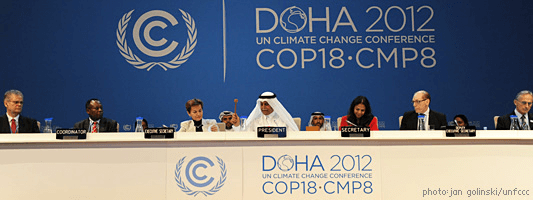
COP 18/CMP 8
- Held in November 2012 in Doha, Qatar.
- Main Objective: To extend the Kyoto Protocol beyond its first commitment period (2008-2012) into a second phase (2013-2020) – Known as the Doha Amendment.
- First-time recognition of “Loss and Damage” due to climate change as a formal issue.
- To enhance climate-related programs in developing nations, the United Nations Green Climate Fund (GCF) was officially established on November 18, 2012.
- Headquarters: Incheon, South Korea (Songdo City).
CoP-21/CMP-11/CMA-1
- Held in 2015 in Paris, France.
- Paris Agreement – Aimed at: Limiting global temperature rise to well below 2°C above pre-industrial levels.
- Striving to keep temperature increase within 1.5°C to mitigate severe climate impacts.
- Under the agreement, all countries were expected to set their own emission reduction targets through Nationally Determined Contributions (NDCs).
- Impact of 1.5°C+ warming: Would have devastating effects on small island nations and highly vulnerable regions, leading to stronger storms, droughts, and floods.
- 55% Rule for Implementation: The agreement would be legally binding only if two conditions were met:
- At least 55 countries had to ratify the agreement.
- These countries had to account for at least 55% of global GHG emissions.
- The Paris Agreement formally entered into force on Nov 4, 2016.
Intended Nationally Determined Contribution (INDC)
- India pledged to reduce its emission intensity by 33-35% by 2030 compared to 2005 levels (later updated in CoP-26).
- India estimated a need for $2.5 trillion in financial support for its climate action plans by 2030.
- Energy efficiency initiatives:
- Perform, Achieve, and Trade (PAT) Scheme.
- National Action Plan on Energy Efficiency (NAPEE).
- Forestation target: India aims to restore 10 million hectares of forest land by 2030.
Paris Agreement vs Kyoto Protocol
| Kyoto Protocol | Paris agreement |
| Binding emission reduction targets for developed countries | Voluntary emissions reduction targets for all countries |
| Attributed to developed countries and transitional countries | All countries (developed, developing, underdeveloped) were given equal responsibility |
| Provision of punishment for countries not achieving targets | There is no provision for any punitive action |
| Limited flexibility, especially for developing countries | Voluntary implementation, monitoring and transparency |
CoP26
- CoP-26 (2021) – Glasgow, Scotland
- “Glasgow Declaration” – Signed by 105 countries, representing 85% of the world’s forests.
- This declaration commits signatory nations to end deforestation and land degradation by 2030.
- India did not sign this declaration.
- India’s Updated INDCs (Presented in August 2022 to UNFCCC)
- India’s revised commitments align with the “Panchamrit” strategy, announced at CoP-26:
- Increase non-fossil fuel energy capacity to 500 GW by 2030
- Meet 50% of energy needs from renewable sources by 2030.
- Reduce carbon intensity (carbon emissions per unit of GDP) by 45% by 2030 (compared to 2005 levels).
- Cut estimated carbon emissions by 1 billion tons by 2030.
- Achieve net-zero carbon emissions by 2070.
Note
- Additional Key Notes on India’s Progress (As of October 2023):
- 43.81% of India’s total electricity generation capacity now comes from non-fossil fuel sources.
- India has already reduced its GDP emission intensity by 33% (2005-2019).
CoP-27 – in Sharm-el-Sheikh, Egypt
United Nations Climate Change Conference,2023 / CoP-28 – Dubai, UAE
- Held from November 30 to December 12, 2023, under the presidency of Sultan Ahmed Al Jaber (UAE).
- Objective – To address the urgent challenges of climate change; including reducing greenhouse gas emissions, adapting to the impacts of climate change and mobilizing financial resources for climate action
- First COP to discuss impact of climate change on public health
- Global Stocktake (GST): Nearly 200 countries assessed global efforts under the Paris Agreement to limit global warming to 1.5°C.
- Agreed to set up a fund for loss and damage Fund.
- 4 outputs of the conference/India’s stand in the conference
- Green Credit Initiative
- Triple Nuclear Energy Manifesto
- Global River Cities Alliance(GRCA)
- LeadIT Summit, 2023
Green Credit Initiative
- Links environmental conservation with personal and corporate development.
- A database of degraded land for afforestation projects.
- Individuals and organizations engaged in eco-positive activities will receive tradable green credits.
- India announced a global portal to collect ideas and experiences on afforestation and environmental conservation.
Triple Nuclear Energy Manifesto
- Over 20 countries committed to tripling global nuclear energy capacity by 2050.
- Objective: Achieve net-zero emissions and limit warming to 1.5°C.
- Plans to hold the first-ever Global Nuclear Energy Summit in Brussels (March 2024).
Global River Cities Alliance (GRCA)
- Launched by India, Denmark, Cambodia, Japan, Bhutan, Australia, Netherlands, Ghana, and Oman.
- A platform for knowledge-sharing and collaboration on river-centric urban development.
- Supported by: World Bank, Asian Development Bank, and Asian Infrastructure Investment Bank.
- Inspired by India’s “River Cities Alliance” initiative.
LeadIT Summit, 2023
- Leadership for Industry Transition (LeadIT) is a global initiative to help high-emission sectors like steel, cement, chemicals, aviation, and shipping move toward low-carbon pathways.
- 38 member countries aim to decarbonize energy-intensive industries by 2050.
- Brings together committed nations and companies under the Paris Agreement goals.
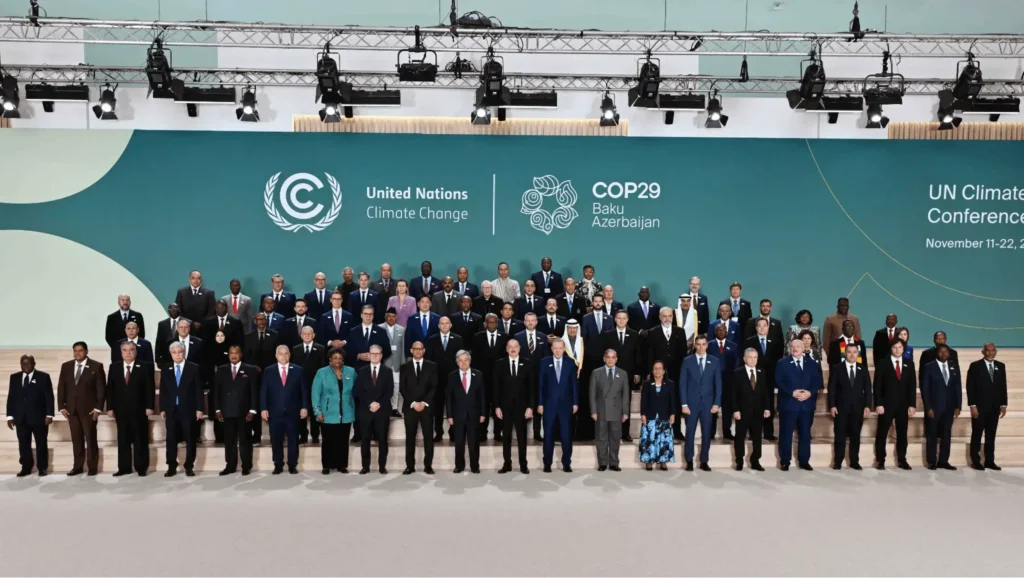
CoP29
- In Baku, Azerbaijan in November 2024.
- The conference discussed important issues such as climate finance, carbon credit trading, and energy transition.
- Main results:
- Increased climate finance: Developed nations pledged to provide $300 billion per year to developing countries by 2035 to tackle climate change.
- New rules for international carbon credit trading were established to enhance financial support for climate projects.
- Global Emission Reduction Commitment: Countries pledged to cut carbon emissions by 50% by 2035.
- Limited progress on energy transition: No major steps were taken to phase out fossil fuels or significantly expand renewable energy adoption.
CoP30
- In Belem, Brazil in November 2025.
- Represented a shift from ambition to implementation through the Belém Package and Global Mutirão framework.
- Key Outcomes:
- Belém Package
- Adopted a set of 29 negotiated decisions.
- Focus areas: Climate finance, Just transition, Adaptation tracking, Gender inclusion, Enhanced international cooperation.
- Global Mutirão Agreement
- Prioritised cooperation and implementation over new binding targets.
- Global Mutirão Platform
- Digital platform launched by Brazil.
- Aims to bridge the gap between commitments and delivery & accelerate progress in energy, finance and trade.
- Just Transition Mechanism (Belém Action Mechanism – BAM):
- Supports capacity-building and cooperation for fossil-fuel-dependent workers and economies. No guaranteed or new financial commitments.
- Global Implementation Tracker & Belém Mission to 1.5°C :
- Introduced to monitor alignment of NDCs with the 1.5°C pathway.
- Shift global focus towards delivery and accountability
- National Adaptation Plan (NAP) Implementation Alliance: Created to fast-track national adaptation planning. Countries agreed to triple adaptation finance by 2030 from 2025 levels.
- Tropical Forests Forever Facility (TFFF)
- Performance-based financing for tropical forest protection.
- Uses satellite-based monitoring.
- Target mobilisation: USD 125 billion.
- Brazil contributed USD 1 billion initially.
- Belém 4× Pledge
- Quadrupling use of sustainable fuels by 2035 (from 2024 levels).
- Fuels include hydrogen, biofuels, biogas, e-fuels.
- Progress monitored annually by the IEA.
- India’s Position at COP-30
- Climate finance as a legal obligation under Article 9.1 of the Paris Agreement.
- Demand for grant-based, predictable and scaled-up finance, not loans.
- Highlighted adaptation finance gap: Developing countries need USD 310–365 billion annually by 2035.
- Reaffirmed CBDR-RC (Common But Differentiated Responsibilities and Respective Capabilities).
- Opposed EU’s CBAM, calling it a disguised trade barrier.
- Emphasised equal priority to adaptation and mitigation.
- Major Shortcomings of COP-30
- No clear fossil-fuel phase-out roadmap.
- Weak climate finance commitments under Article 9.1.
- Delay in updated NDC submissions by major emitters, widening the ambition gap.
- Implementation gap remains due to lack of:
- Clear timelines
- Enforcement mechanisms
- Accountability frameworks
- Just Transition Mechanism lacks dedicated funding.
- Belém Package
Greenhouse Gas Protocol
- An international framework for measuring, managing, and reducing greenhouse gas emissions for governments and businesses.
- Developed by World Resources Institute (WRI) & World Business Council for Sustainable Development (WBCSD).
20/20/20 target [introduced by the European Union (EU) in 2008]
- 20% reduction in CO₂ emissions.
- 20% increase in renewable energy share in the market.
- 20% improvement in energy efficiency.



