

Acid Rain & Loss of Biodiversity are important environmental topics in World Geography, covering key areas such as acid rain, its causes, effects, and global conventions and efforts to tackle acid rain. The topic also explains loss of biodiversity, causes of biodiversity loss, conservation measures, and international initiatives like COP16 (Cali + Rome). Understanding these concepts helps in analyzing global environmental challenges and sustainable development strategies.
Acid Rain
Acid rain occurs when gases released from industries, such as sulfur dioxide (SO₂) and nitrogen oxides (NO₂) react with atmospheric moisture to form acidic compounds.
- Key Facts:
- 60-90% of acidity in the atmosphere is due to H₂SO₄ (sulfuric acid), and 30-40% is due to HNO₃ (nitric acid).
- Chemical reactions:
- SO₂ + H₂O → H₂SO₄ (Sulfuric Acid)
- NO₂ + H₂O → HNO₃ (nitric acid)
- The pH of acid rain ranges from 5 to 2.5, which is lower than the neutral pH 7, indicating high acidity.
- In this process, the hydrogen ion (H⁺) concentration increases.
Note- Normal rain has a pH of around 5.6. Acid rain generally has a pH between 4.2 and 4.4 (US EPA, 2019).
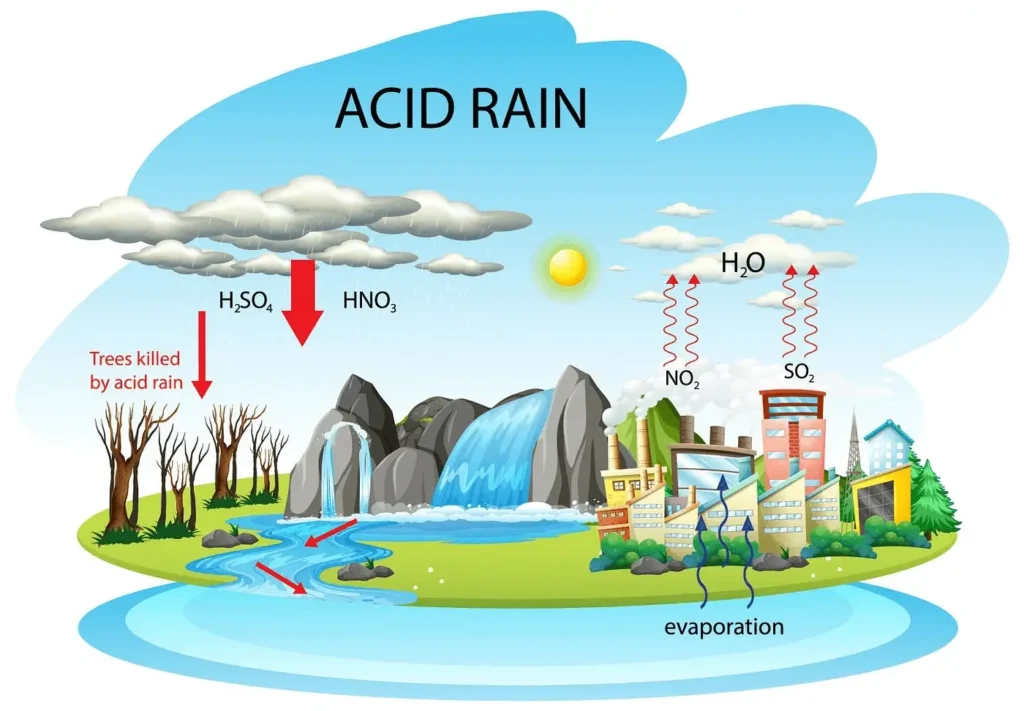
Causes of Acid Rain
- The main causes of acid rain are NO₂, SO₂, NO, and CO.
- Major Sources of SO₂ and NO₂
Man made Causes of Acid Rain:
- Automobiles, coal, and thermal power plants.
- Thermal power stations where coal is burned in large quantities for electricity generation.
- Petroleum refining industries.
- Motor vehicles.
- Burning of fossil fuels
Natural Causes of Acid Rain:
- Forest fires and volcanic activities
Effects of Acid Rain:
- Decline in Soil Productivity: High acidity leads to the depletion of minerals and nutrients in the soil.
- Large affected Areas: Acid rain can spread over long distances, affecting regions far from industrial and transportation sources.
- Contamination of Drinking Water: Acid rain increases solubility of metals in water sources, leading to health problems.
- Impact on Forests: Acid rain damages the natural protective waxy coating on leaves, reducing photosynthesis and biological processes. About 8% of forests have been destroyed due to acid rain.
- Effect on Water Bodies: Lakes and rivers become more acidic, harming aquatic life and vegetation.
- Increased Soil Acidity: Acid rain damages plants and microorganisms, slowing down biological processes.
- Damage to Buildings: Acid rain causes corrosion of marble and stone structures, affecting monuments like the Taj Mahal and European sculptures.
Possible solutions:
- Control of SO₂ and NO₂: Industries should use scrubbers, bag filters, and colloidal tanks to reduce emissions.
- Renewable Energy: Promotion of solar and wind energy to minimize fossil fuel usage.
- Reduced Vehicle Usage: Limit the number of personal vehicles and ensure regular pollution checks.
- Water and Soil Treatment: Lime (CaCO₃) should be added to acidic water sources and soil to neutralize acidity.
- Industrial Regulations: Effective prevention of harmful gas concentration from increasing industrial activities.
Global conventions and efforts to tackle acid rain –
- Convention on Long-Range Transboundary Air Pollution (LRTAP) – 1979
- Organized under the United Nations Economic Commission for Europe (UNECE), this is an umbrella agreement for air pollution control among member countries.
- Eight protocols have been developed under this convention to identify specific measures for reducing emissions of air pollutants.
- US-Canada Air Quality Agreement (1986) and Ozone Annex (2000) – These agreements are crucial for acid rain control and commit both countries to reduce nitrogen oxides (NOₓ) and volatile organic compounds (VOCs), which contribute to ozone formation.
Loss of biodiversity
Definition – The number and variety of organisms found in a particular geographical area is called biodiversity. It is a natural asset which is essential for human existence.
Classification – Biodiversity is mainly classified on three basis:
- Species diversity
- Genetic diversity
- Ecosystem diversity
Causes of Biodiversity Loss
- Destruction of natural habitats
- Destruction of forests due to population growth, industry, agriculture, dams, settlements etc.
- This destabilizes the species of plants and animals and affects the ecosystem.
- Pollution
- Air, water, soil and chemical pollution causes habitat changes.
- Species with slow adaptability become extinct.
- Overexploitation
- Indiscriminate felling of trees, overgrazing, fuel collection and hunting of animals like tigers and elephants.
- Invasion of exotic species
- Entry of exotic species affects local biodiversity.
- Example: Parthenium, Argemone and Lontana (weeds).
- Environmental Degradation
- Causes: Global warming, CO₂ increase, nuclear radiation, UV-rays, oil spills etc.
- Existence of many species is in danger due to these.
Measures to conserve biodiversity
- Convention on Biological Diversity (CBD) 1992
- It is a legally binding international treaty.
- Its objective is to conserve biodiversity, promote its sustainable use and ensure equitable distribution of benefits.
- Biological Diversity Act, 2002
- The Government of India enacted it to conserve biological resources.
- The National Biodiversity Authority (NBA) was established in 2003 under this Act.
- Nagoya Protocol (2010)
- Adopted to ensure access to genetic resources and the fair and equitable sharing of benefits arising from their use.
- Supplementary agreement to the Convention on Biological Diversity (CBD).
COP16 (Cali + Rome)
- COP16 (CBD – Convention on Biodiversity): 21 October – 1 November 2024 in Cali, Colombia.
- Aim: Review of the Kunming–Montreal Global Biodiversity Framework (KMGBF) and setting national targets.
- It is reconvened in Rome (25–27 February 2025).
Key achievements
- Resource Mobilization Strategy
- By 2030: Mobilize US$200 billion annually.
- For underfunded countries, US$20 billion by 2025, US$30 billion per year by 2030.
- Sustainable Finance Mechanism
- Monitoring and Review (PMRR Framework)
- Planning, Monitoring, Reporting & Review (PMRR) format adopted.
- Ensures participation of youth, women, Indigenous groups and the private sector.
- Cali Fund launched (Digital Sequence Information)
- Officially launched on 25 February 2025.
- A landmark agreement to create a multilateral fund where companies using genetic data (DSI) contribute revenue with 50% embarked for IPLCs, women and youth.



