

Pollution in the World is an important topic in World Geography, covering various forms such as air pollution, water pollution, noise pollution, land pollution, and radioactive pollution. It includes key concepts like suspended particulate matter, problems and harmful effects of pollution, air pollution control laws, and measures for domestic, industrial, and vehicular pollution control. The topic also explains sources and parameters of water pollution, bio-magnification, eutrophication, world water quality initiatives, and the major causes and disadvantages of soil and land pollution, helping students understand environmental protection in a comprehensive way.
Pollution
Meaning and definition of pollution
- Pollution which is originally derived from the Latin word Pollutus which means to make unclean.
- According to E.P. Odum: “An undesirable change in the physical, chemical, or biological properties of air, water, and soil that harms humans as well as the natural and cultural elements of the entire environment is called pollution.”
- General Definition: “Harmful and undesirable changes in the quantity or quality of environmental components are called pollution.”
- Pollutants: “Undesirable substances that alter or pollute any fundamental element of the environment are called pollutants.”
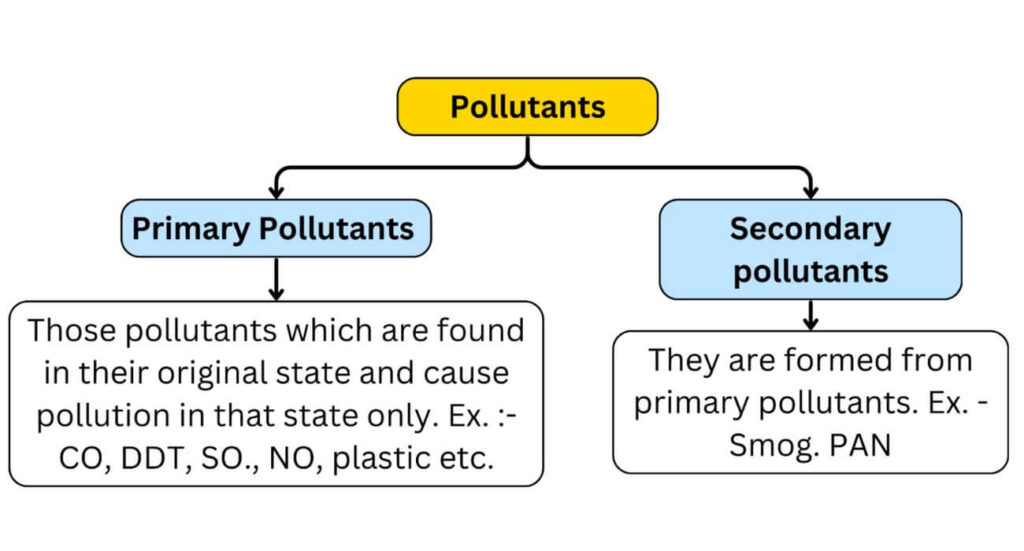
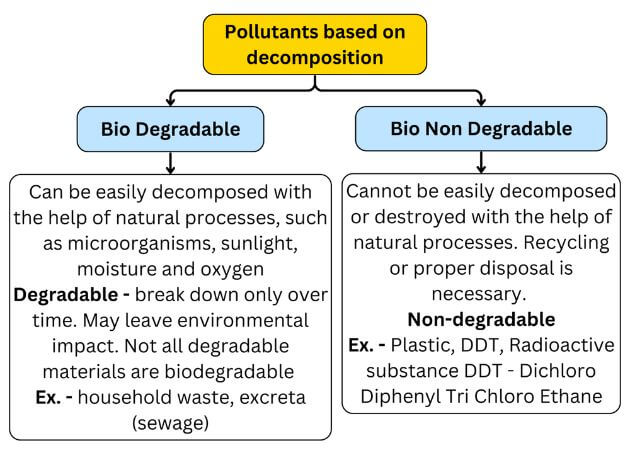
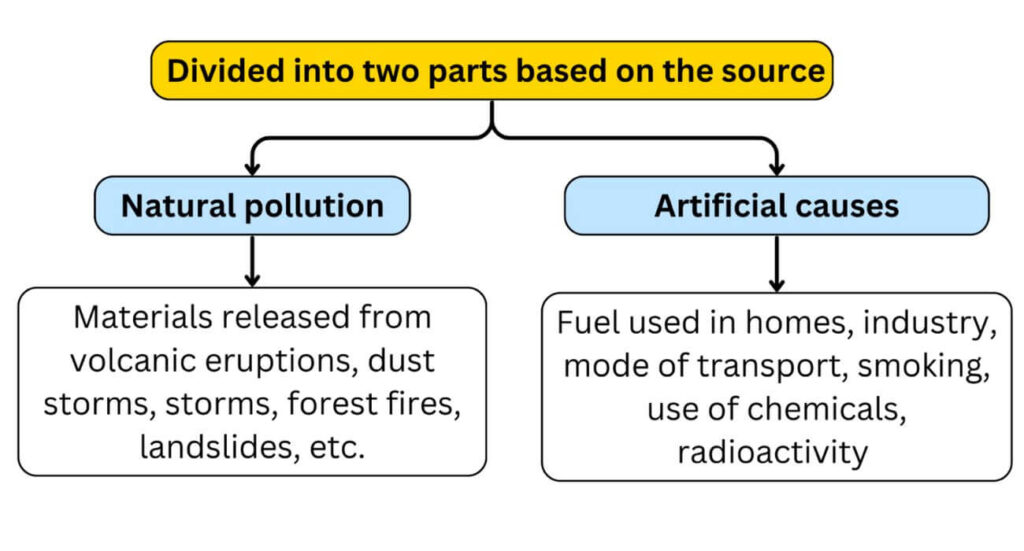
Types of pollution based on the nature of pollutants – (i) Air pollution, (ii) Water pollution, (iii) Noise pollution, (iv) Soil pollution (Land pollution), (v) Vehicular pollution, (vi) Radioactive pollution, (vii) Thermal pollution, (viii) Industrial pollution, (ix) Pollution due to garbage, (x) Marine pollution, (xi) Pollution due to domestic waste, (xii) Pollution due to other causes.
Air Pollution
All the gases present in the atmosphere are found in a fixed ratio such as nitrogen 78.08 percent, oxygen 20.94 percent, argon 0.93 percent, carbon dioxide 0.04 percent and others 0.02 percent. Even a slight change in this ratio affects the entire system of the atmosphere.
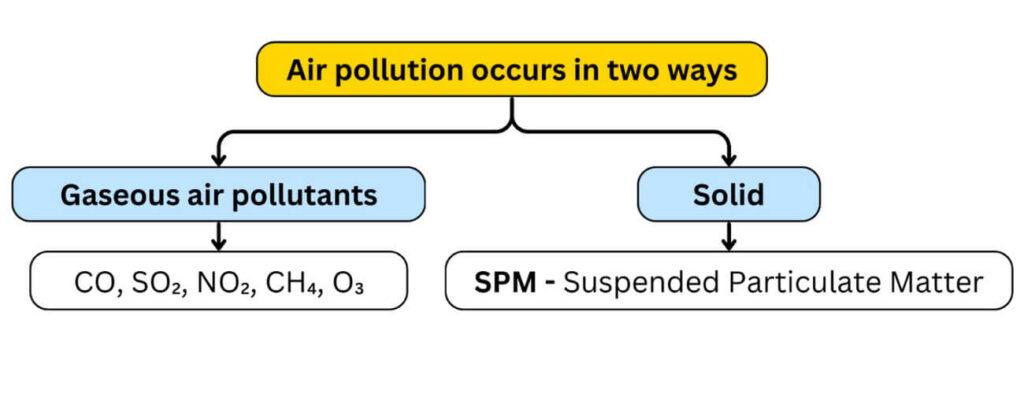
| Pollutant Gas | Characteristics & Impact |
| Carbon Monoxide (CO) | It is mainly found in vehicle smoke.CO and CO₂ are also the main polluting gases in cigarette smoke.Incomplete combustion of hydrocarbons produces CO gas, while complete combustion produces CO₂.CO is called ‘Silent Suicide Gas,’ as it can cause death in sweet sleep.”Hb combined with CO to form carboxyhemoglobin, which obstructs the transport of O₂ may lead to death.The risk increases when a person sleeps in a closed room with a burning brazier. |
| Carbon Dioxide (CO₂) | Gas is a product of the respiration process.Acts as an essential reactant in photosynthesis.Solid CO₂ – Dry Ice [Used by firefighters].CO₂ is useful as a fire-extinguishing gas.Sleeping under large trees at night may cause suffocation due to CO₂.Hb + CO₂: Forms Carbaminohemoglobin |
| Methane (CH₄) | Swamp Gas (Marsh Gas).Found in deep wells, drains, sewage lines, deep mines, paddy fields, dung, and the bodies of ruminant animals.Methane is the main component of biogas (gobar gas), CNG, and LNG. |
| Sulfur Dioxide (SO₂) | Gases emitted from volcanoes and lava.One of the most toxic air pollutants.Gas released from factories – SO₂.SO₂ combines with rainwater to form sulfuric acid, causing acid rain. |
| Chloro Fluoro Carbon (CFC) | This gas comes out from ACs, refrigerators, and jet engine exhausts.CFCs deplete the ozone layer in the stratosphere. |
| Nitrous Oxide (N₂O) | Laughing Gas.This gas contributes to increasing global warming. |
| Nitrogen dioxide (NO₂) | Toxic gas emitted from industrial units.Reacts with water to form nitric acid (HNO₃), which causes acid rain.Chemical reaction: NO₂ + H₂O → HNO₃ |
Suspended Particulate Matter:
- Particles larger than 1000 nanometres that remain suspended in the air.
- PM 10: Particles smaller than 10 micrometers.
- PM 2.5: Particles smaller than 2.5 micrometers.
- SAFAR–AIR (System for Air Quality Weather Forecasting and Research):
- Mobile app launched in 2015, which measures the air quality of an area.
Problems caused by air pollution:
- Smoking – Emphysema: This disease is caused by smoking too many cigarettes, which reduces the capacity of the lungs.
- Pneumoconiosis: A disease caused by exposure to dust particles.
- Brown Lung: Due to cotton dust, also known as Byssinosis.
- White Lung: Disease caused by asbestos dust.
- Black Lung: This disease occurs in people working in coal mines.
Harmful effects of air pollution
- Adversely affects human health.
- Negatively impacts vegetation. It has become a threat to the existence of animals and insects.
- Adversely affects climate and atmospheric conditions, leading to climate change, ozone layer depletion, greenhouse effect, and weather disturbances.
- Forms smog domes over metropolitan and urban areas.
Air Pollution Control Act:
- Passed: 29 March 1981
- Commenced: 16 May 1981
- Initially focused on air pollution, but was amended in 1987 to include noise pollution, which was later separated in 2000 with the enactment of the Noise Pollution (Regulation and Control) Rules.
Measures to control air pollution
A multi-dimensional policy must be adopted for air pollution control. This includes controlling past environmental damage and preventing future pollution through the development and use of new technologies.
(i) Domestic Pollution Control
- Use of biogas and CNG in kitchens and household activities.
- Preference for charcoal as an alternative fuel.
(ii) Industrial Pollution Control
- Adoption of clean fuels in power and fertilizer plants.
- Use of pollution-reducing devices:
- Filters – to separate solid particles from gases.
- ESP (Electrostatic Precipitator) – to trap dust particles using electric charge.
- Inertial Collector (Cyclone) – to collect heavy particulate matter.
- Scrubber – to remove aerosol particles from the gas stream.
- Establishment of polluting industries away from densely populated areas.
- Development of green belts.
(iii) Vehicular Pollution Control
- Setting and enforcing standards for vehicular emissions.
- Use of catalytic converters in vehicles.
The Indian government has taken several steps to curb air pollution. Here are some of these steps:
- Air (Prevention and Control of Pollution) Act, 1981.
- The Central Pollution Control Board (CPCB) took up work related to air quality.
- National Air Monitoring Programme (NAMP) established.
- Regulations were placed on industries to meet air quality standards.
- National Clean Air Programme (NCAP) launched in January 2019 – Targets 20-30% reduction in particulate matter (PM) concentrations in 131 cities across 24 States/UTs by 2024. Target revised to 40% reduction in PM10 levels or achieving national standards (60 μg/m3) by 2025-26.
- National Air Quality Index launched.
- Use of clean and alternative fuels increased.
- Ethanol blending promoted.
- Jump from BS-IV to BS-VI fuel standards. From April 2020, BS-VI compliant vehicles were introduced across the country.
- Note – BS standards are Indian pollution control standards, based on European emission standards (Euro Standards) .
- Objective: To gradually control vehicle emissions in a phased manner.
- Construction and Demolition Waste Management Rules were formulated.
- Graded Response Action Plan (GRAP) notification for Delhi and the National Capital Region (NCR).
Water pollution
Undesirable changes in the physical, chemical and biological characteristics of water which have an adverse effect on humans and all living beings is called water pollution.
Sources of Water Pollution:
- Domestic sewage: Water released from a sewage line.
- Industrial waste: Chemicals and solid wastes released from industries.
There are 5 main parameters of ambient water quality –
- SDG Indicator 6.3.2 – It monitors the proportion of water bodies with good ambient water quality concerning national and/or sub-national water quality standards.
- The five water quality parameters are:
- Dissolved Oxygen (Surface Water)
- Electrical Conductivity (Surface Water and Groundwater)
- Nitrogen/Nitrate (Surface Water and Groundwater)
- Phosphorus (Surface Water)
- pH (Surface Water and Groundwater)
Identification of polluted water:
- DO (Dissolved Oxygen): The amount of oxygen dissolved in a liter of water
- Less than 8 mg/L – polluted water.
- Less than 4 mg/L – highly polluted water.
- BOD (biological oxygen demand):
The amount of oxygen required by microorganisms to decompose organic matter in water.- High levels of BOD indicate water pollution.
- COD (Chemical Oxygen Demand) – Chemical Oxygen Demand:
- This is a key method for measuring water pollution.
- It indicates the amount of oxygen required for the complete oxidation of dissolved chemicals in water.
- If COD (Chemical Oxygen Demand) is high, the water is considered polluted.
- MPN (Most Probable Number):
- In this method the number of E. coli bacteria is measured.
Bio – Magnification
- Biomagnification is the progressive increase in the concentration of non-degradable toxic substances at successive trophic levels of a food chain.
Eutrophication –
- Eutrophication is the process by which a water body becomes excessively rich in nutrients, especially nitrates and phosphates, leading to excessive growth of algae and depletion of dissolved oxygen and deterioration of water quality.
Problems caused by water pollution:
- Excess of Mercury (Hg): Minamata disease: Numbness of limbs, lips, tongue, deafness.
- Excess of Cadmium (Cd): Itai-Itai disease: affects liver and lungs.
- Excess of Arsenic [As] – Black foot disease in animals.
- Excess of Fluoride: Fluorosis: Yellow and weak teeth.
- Excess of Lead (Pb): Pulmonism: affects nervous system.
- Excess copper (Cu): Wilson’s Disease: affects liver and brain.
- Excess iron (Fe): Siderosis: deposition of iron dust in lungs.
- Iron deficiency – Anaemia.
- Excess nitrate: Methemoglobinemia (Blue Baby Syndrome): Hole in the heart and lack of oxygen in children.
- According to a UNO report, 2300 people die every day worldwide due to lack of safe drinking water and diarrhea. Over the last 30 to 40 years, 40% of marine life has declined due to pollution of sea water.
- For example, in India, water used in tanning leather in Kanpur city is released into the Yamuna river. As a result, the water of Yamuna river is no longer fit for use in daily life.
World Water Quality Alliance (WWQA)
- The Joint Research Centre (JRC) of the United Nations Environment Programme (UNEP) and the European Commission launched in Ispra, Italy.
Measures to prevent water pollution
- Sewage treatment plants should be established in all cities for wastewater disposal.
- Organic farming should be promoted instead of chemical-based agriculture.
- Industrial wastewater should be treated and reused.
- Complete ban on disposing of dead animal carcasses in rivers; electric crematoriums should be established.
Noise Pollution
- Noise pollution occurs when the intensity and frequency of sound exceeds the audible level, causing discomfort and disturbance to humans.
- This problem has become serious due to rapidly increasing industrialization, urbanization and means of transportation.
- Noise pollution is measured in terms of its intensity and frequency, and its common unit is decibel (dB).
- Sounds exceeding 80-120 decibels fall under noise pollution.
Causes of noise pollution – From means of transport, speakers, noise emitted from industries, airplanes and jet planes.
Harms due to noise pollution – It has an adverse effect on the human brain. This causes irritability, deafness in humans, extremely loud noise causes permanent loss of hearing power of the person due to which the person starts behaving like a mad person.
Land pollution
The decline in the quality of soil due to natural and human activities is called land (soil) pollution. Soil pollution reduces the fertility of the land and adversely affects the organisms living in or on the soil.
Major causes of land pollution:
- Excessive use of chemical fertilizers: Due to overuse of chemical fertilizers in Punjab, soil pollution has become a major issue.
- Disposal of industrial waste.
- Accumulation of waste generated from cities and metropolitan areas.
Disadvantages of Soil Pollution:
- Reduction in arable land.
- Diseases caused: Dysentery, diarrhea, cholera, eye infections, tuberculosis.
- Emergence of other environmental pollutants.
- Increase the problem of land degradation.
Radioactive Pollution
Radioactive pollution is caused by emissions from various nuclear reactors, atomic power plants, and mines, which adversely affect our DNA, chromosomes, and cells. Due to mutations, its effects can be observed across several generations.
Effects of Radioactive Pollution
- Health Effects – Radioactive radiation can lead to cancer, leukemia, skin diseases, impaired vision, and congenital deformities.
- Genetic Effects – Radiation alters DNA and genes, resulting in diseases and deformities in future generations.
- Impact on Ecology – Deposition of radioactive elements in soil, water, and air affects plant and animal species.
- Impact on Food Chain – Through contaminated soil and water, radioactive elements enter the plants → animals → humans forming a cycle, causing long-term harmful effects.
- Environmental Imbalance – Radioactive pollution contaminates groundwater, rivers, and oceans, disrupting the equilibrium of ecosystems.
Major Incidents
- 1979 – Three Mile Island accident (U.S.A.)
- 1986 – Chernobyl power plant disaster (U.S.S.R.)
- 2011 – Fukushima nuclear disaster (Japan)



