
Physics in Everyday Life plays an important role in making our daily activities easier and more meaningful. The subject Physics explains the principles behind simple actions like switching on a fan, cooking food, driving a car, or even hearing sound, showing how science is deeply connected to our everyday lives.
Previous year Questions
| Year | Question | Marks |
| 2016 | What do you understand by total internal reflection ? Explain the brilliance of diamond on the basis of total internal reflection. | 5M |
| 2016 Special exam | A light and a heavy body have the same momentum. Which one will have greater kinetic energy ? | 2M |
| 2013 | Why are convex mirrors used as rear view mirrors in vehicles ? | 2M |
Thrust and Pressure
- Have you ever wondered why a camel can run in a desert easily?
- Why does an army tank weighing more than a thousand tonne rests upon a continuous chain?
- Why does a truck or a motorbus have much wider tyres?
- Why do cutting tools have sharp edges?
Pressure:
- Definition: Pressure is the force applied perpendicular to the unit area. It is a scalar quantity and is not dependent on direction.
- Unit: The standard unit of pressure is the pascal (Pa) in the SI system, which is equivalent to one newton per square meter (N/m²).
- Calculation: Pressure is calculated by dividing force by area. Mathematically,
P= F/A
Thrust :
- force acting on an object perpendicular to the surface is called thrust.
Pressure = Thrust/Area
You stand on loose sand. Your feet go deep into the sand. Now, lie down on the sand. You will find that your body will not go that deep in the sand. Why ?
- When standing on loose sand, the weight of your body, representing the force, acts on an area equivalent to the size of your feet. Conversely, when lying down, the same force applies to a larger area covering your entire body.
- This results in varying effects due to differences in the areas on which the force acts. Although the thrust remains constant in both scenarios, the impact differs, underscoring how the effect of thrust is contingent on the specific area it influences.
Same force acting on a smaller area exerts a larger pressure, and a smaller pressure on a larger area. This is the reason why a nail has a pointed tip, knives have sharp edges and buildings have wide foundations.
Fluids
PRESSURE IN FLUIDS : All liquids and gases are fluids. Fluids have weight, and they also exert pressure on the base and walls of the container in all directions.
BUOYANCY
- Have you ever had a swim in a pool and felt lighter?
- Have you ever drawn water from a well and felt that the bucket of water is heavier when it is out of the water?
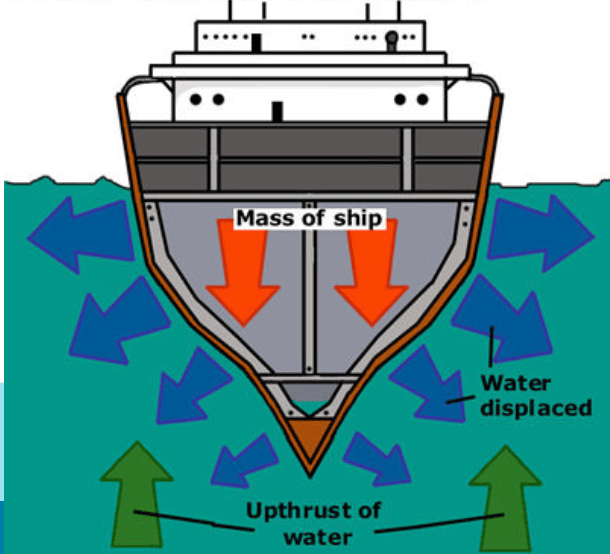
- Have you ever wondered why a ship made of iron and steel does not sink in sea water, but while the same amount of iron and steel in the form of a sheet would sink?
if the buoyant force is higher than the weight of the object, it will float. {if less -> Sink}
Buoyancy force:
- Buoyancy force is the upward force exerted by a fluid (liquid or gas) on an object placed in it. This force opposes the weight of the object and is responsible for the buoyant effect, causing objects to float.
- Principle: Archimedes’ principle states that an object submerged partially or fully in a fluid experiences an upward force equal to the weight of the fluid it displaces.
Determinants:
- The buoyancy force depends on the density of the fluid and the volume of the displaced fluid.
- If the object’s weight is less than the buoyancy force, it floats; if greater, it sinks.
Applications :
- used in designing ships and submarines.
- Lactometers, which are used to determine the purity of a sample of milk and
- hydrometers used for determining density of liquids, are based on this principle.
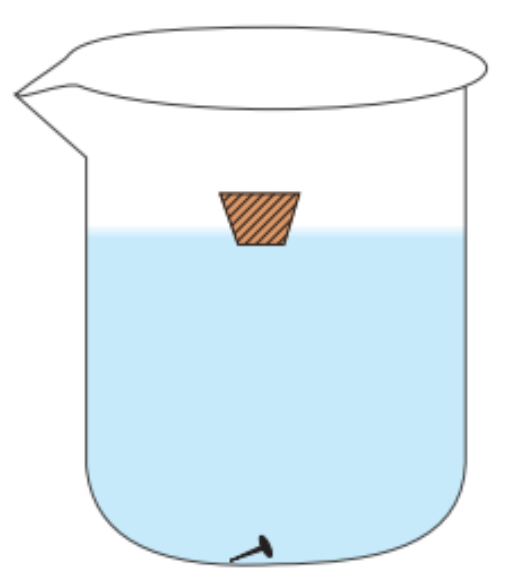
An iron nail sinks and a cork floats when placed on the surface of water:
Cork:
- Density of cork < Density of water.
- Upthrust (buoyant force) of water on the cork > Weight of the cork.
- Result: The cork floats because the buoyant force is greater than its weight.
Iron Nail:
- Density of iron nail > Density of water.
- Upthrust (buoyant force) of water on the iron nail < Weight of the nail.
- Result: The iron nail sinks because its weight is greater than the buoyant force.
WHY OBJECTS FLOAT OR SINK WHEN PLACED ON THE SURFACE OF WATER
Objects having density less than that of the liquid in which they are immersed, float on the surface of the liquid. If the density of the object is more than the density of the liquid in which it is immersed then it sinks in the liquid.
Ship Design:
- A ship is designed to displace a large volume of water, creating a buoyant force greater than its weight.
- The shape of the ship’s hull, which is hollow and designed to displace a significant volume of water, contributes to its buoyancy.
- When you have the same amount of iron and steel in the form of a sheet, the volume of water displaced is much smaller. The buoyant force may not be sufficient to counteract the weight of the material, causing the sheet to sink.
- Principle: Archimedes’ principle