

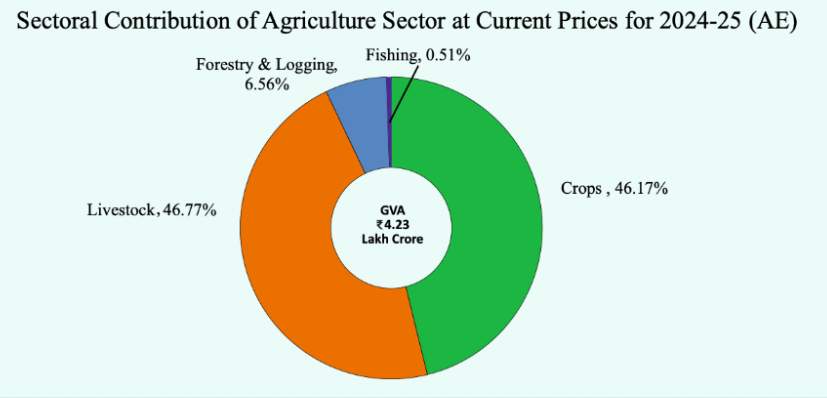
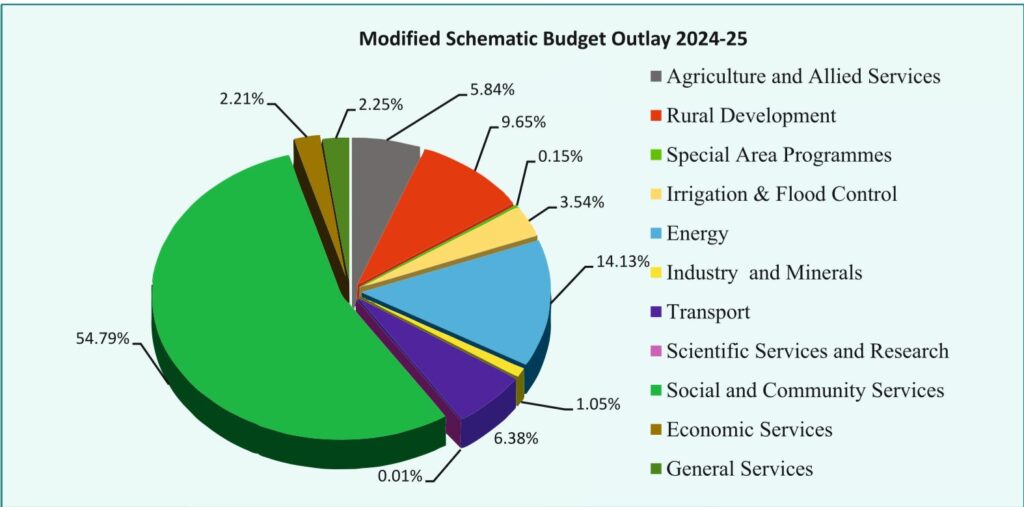
Agriculture is a core component of Rajasthan Geography, playing a decisive role in the state’s economy, employment structure, and rural livelihood. Despite constraints such as arid climate, low productivity, and limited irrigation facilities, agriculture contributes about one-fourth of Rajasthan’s Gross State Value Added (GSVA) and supports nearly two-thirds of the working population. The sector is characterised by diverse cropping patterns, multiple agricultural practices, and region-specific specialisation in food grains, oilseeds, and nutri-cereals.
Key Observation
- Contribution of Agriculture in GSVA (Gross State Value Added) – Rajasthan
- At Constant Prices (2011-12): 26.54%
- At Current Prices: 26.92% (Higher than the all – India contribution of 17.77% in this sector)
- The agricultural sector’s value has increased from ₹1.19 lakh crore in 2011 – 12 to ₹2.18 lakh crore in 2024 – 25.
- This reflects a Compound Annual Growth Rate (CAGR) of 4.76% at constant (2011 – 12) prices.
- 62% of the working population depends on agriculture
- The average landholding size is 2.73 hectares. The productivity of every crop is very low compared to that of India
- Total 11% of India’s cultivable land is in Rajasthan. Poor surface water, groundwater and irrigation facilities make it difficult to capitalise on the potential.
- Rajasthan stands first in the production of Bajra, Mustard, Total oilseeds and Nutri – cereals.
- Agriculture provides raw material for Industries: the sugar industry, the textile industry and provides a base for animal husbandry.
- Major Kharif crops are Groundnut, Bajra, Maize, Cotton, Sugarcane, and Sesame, which are sown between June and July and harvested around September – October
- Major Rabi crops are Wheat, Barley, Mustard, Chickpea, Fenugreek, and Cumin, which are sown from October to November and harvested around March – April
- Major crops of Zaid are Muskmelon, Cucumber, vegetables, etc., cultivated between March and June
Types of Agriculture in Rajasthan
- Mixed Farming - Animal Husbandry along with Agriculture.
- Baarani/Rainfed Agriculture - Agriculture done in an unirrigated area, completely dependent on rain, it is of two types:
- Dry Agriculture – Jaisalmer, Bikaner.
- Irrigation Agriculture – Baran, Jhalawar, Kota
- Monoculture- Getting one crop in a year in a particular area.
- Duoculture - Getting two crops in a year in a particular area.
- Oligo culture - Getting three crops in a year in a particular area.
- Relay culture - Getting four crops in a year in a Particular area, It is mostly famous in Jaisalmer.
- Shifting/Jhooming/slash Agriculture – This agriculture is called VAALRA in Rajasthan, most commonly done by tribes in Udaipur.
- Dajia – Shifting agriculture is done in the plains
- Chimata – Shifting agriculture done over mountains
- Arid Agriculture – The agriculture which depends less than 50 – 75 cm of rainfall.
- E.g. Millet, Moong, Moth, Guar, Gram
- Khadeen agriculture - The agriculture started by Paliwal Brahmins in western Rajasthan is called Khadeen agriculture.
- Humid Agriculture - Agriculture which depends on more than 75 cm of rainfall. E.g.- Sugarcane, Rice, Wheat, Cotton.
- It is mostly done in Banswara, Dungarpur and Udaipur in Rajasthan
Scientific names of various agricultural practises
| Type of Agriculture | Details / Definition |
| Oliviculture | Olive farming |
| Horticulture | Fruit, vegetables, flowers |
| Silviculture | Cultivation of plants & forest |
| Sericulture | Silk/silkworm-rearing |
| Pomoculture | Fruit cultivation |
| Apiculture | Honeybee rearing |
| Pisciculture | Fish rearing |
| Viticulture | Grapes cultivation |
| Floriculture | Flower cultivation |
| Vermiculture | Rearing of earthworms |
| Olericulture | Cultivation of creeping crops |
Major crops of Rajasthan
Rabi Crops
- Sowing – October, November and Harvested in March, April. Also called the Winter or Unalu Crop. Rainfall from the Western Disturbance is beneficial for Rabi crops (MAAVATH/GOLDEN DROPS)
- These require low temperature during sowing and maximum temperature for ripening. Example – Wheat, Barley, Gram, Peas, Mustard, Potato, Lentils, Linseed, Rye, Coriander, Fennel, Fenugreek, Isabgol, Opium, Taramira, etc
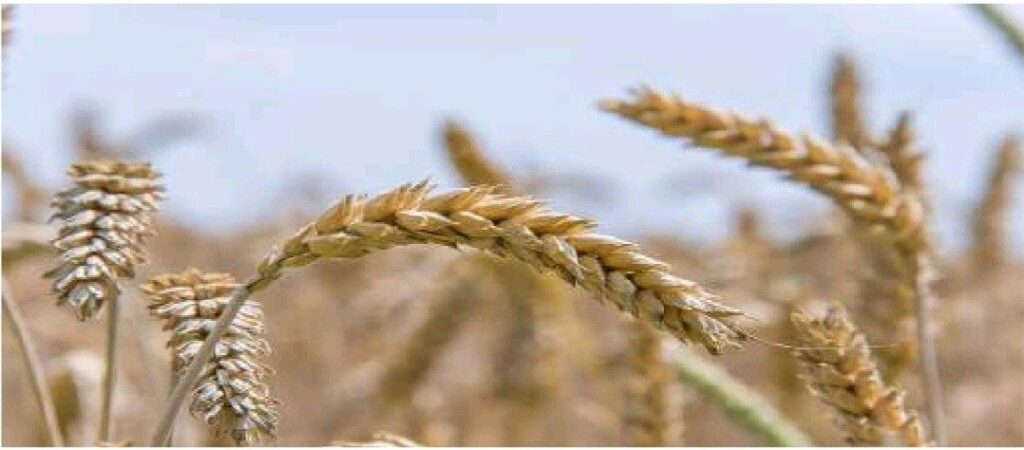
Wheat
- Scientific Name – (Triticum Asetivum)
- Requirements
- Temperature – 10 degrees at the time of sowing and 20 – 28 degrees at the time of harvesting.
- Rainfall :- 50 cm
- Soil – Loamy alluvial
- Rank of Rajasthan in India: 5th in total production of the country
- Production – First Ganganagar, second Hanumangarh.
- Varieties – Kalyan Sona, Sonalika, Larma, Arjun, Karan Vandana, Karan Narendra, Sharbati wheat, Kohinoor, Mangala, Ganga sunhari, Malvika, (Nabi MG blackwheat), Raj-3070, Raj-3077, Raj-911, Raj-821, Chambal-65, Durgapura-65, Kharchia 65 Durgapura– 65, Maxican, Lal Bahadur, Sharbati, HD – 3226, Heera.
- Disease:- Roli, Ratwa, Kandwa, Kitt, Kalastambh.
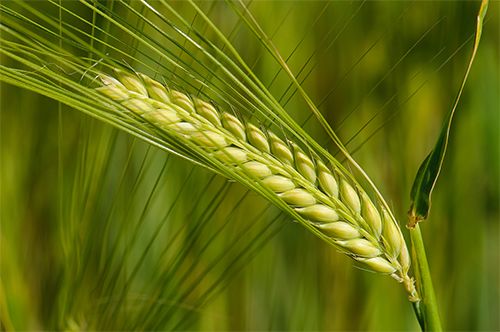
Barley/jou
- Scientific Name – (Hordeum Vulgare)
- It is a Rabi crop of the dry and semi-arid region
- Requirements-
- Temperature 10° at the time of sowing and 20-30 ° at the time of harvesting.
- Rainfall 50 cm to 80 cm
- Soil-Sandy/Alluvial soil
- Production – first -Jaipur, second – Ganganagar
- Rajasthan ranks 2nd in India.
- Varieties: Jyoti, Kiran, RD-2907, RD-2899, RS-6
- Disease – Maulya, Arrat, Khyndra
Kharif crop
- Require high temperature and humidity. Among Kharif, 60-65% food grains and 10-15% oilseeds, 4% cotton and sugarcane are sown.
- 80% of rainfed crops are sown(rainy season crop). Which are completely dependent on the South-West monsoon rain.
- Sowing time – during June & July; Harvesting time – September – October. Also called Rainy crops, Siyalu, Savani crop. Example – Paddy, soybean, sesame, green gram (moong), gram, cowpea, sorghum, millet (ragi, bajra), groundnut, cotton, castor, maize, moth.
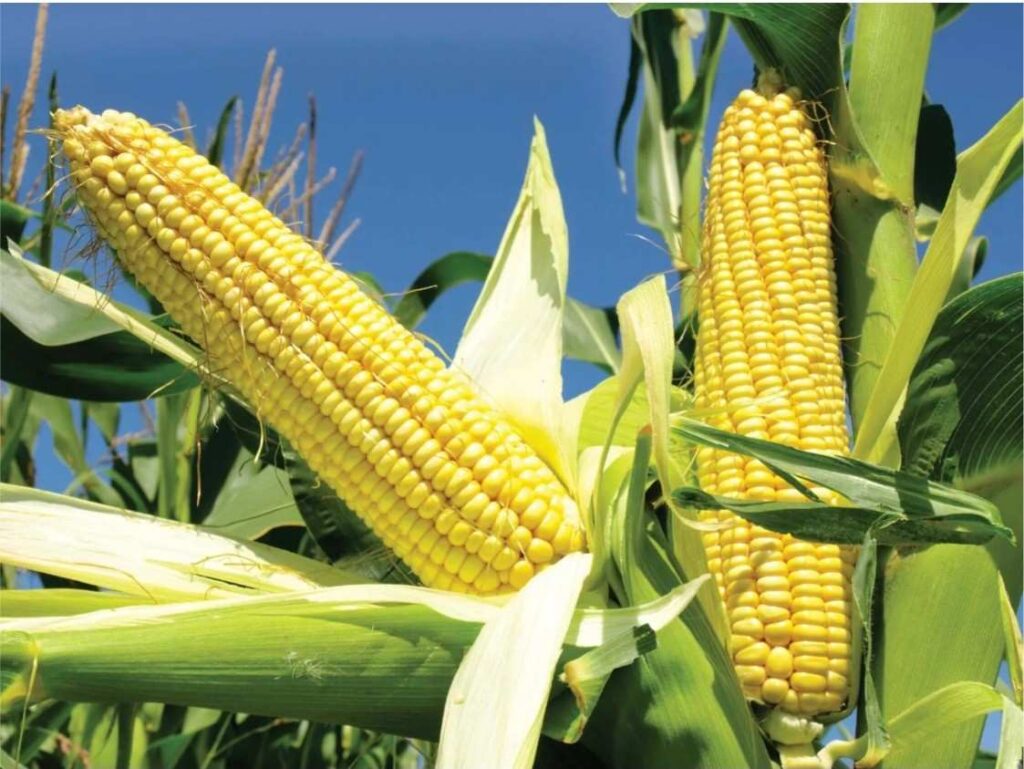
Maize
- (Zee Mays) (queen of Cereals)
- Variety – Mahi Kanchan, Mahi Dhawal (developed by Agricultural Research Centre), Megha, Navjot, Moti Composite. Ganga 11, W-126 Arun.
- Disease – Brown spot disease.
- Requirements
- Silage fodder is made from its leaves.
- Rajasthan stands in 10th position in production.
- Production – First Chittorgarh, Second – Bhilwara
- Note:- Maize research institution – Banswara.
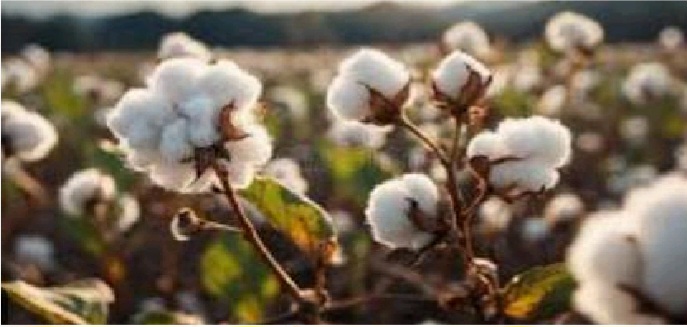
Cotton-Called “White Gold”
- It is a Kharif commercial crop
- Requirements
- Temperature – 20-30 degrees
- Rainfall- 50-100 cm + 90 Days Frost-free.
- Climate – Tropical climate
- Soil – Light black soil
- Rajasthan ranks FOURTH in the production of Cotton in India (7.95% Contribution in Total produce)
- Production: – First Hanumangarh, Second Sri Ganganagar
- Varieties – Bikaneri Narma (Long Fibre, American Cotton variety, R.S.T-9, R.S875, Raj H.H -16, P .S.T-9 Veernar, Varaha Lakshmi, PST-9, C.R.J -8
- Disease:- Ball weeril worm, Thawing, Blight or Black head
- Note:- Maximum – Bikaner Division
- Malvi cotton – Kota, Baran, Jhalawar, Bundi.
Rice
- It’s a Kharif crop.
- Requirements-
- Temperature – 20-30 degrees.
- Climate-Warm moist climate
- Soil- clay loamy soil.
- Production: First – Bundi, Second – Hanumangarh
- Institute– Rice Research Centre – Banswara
- Varieties: Karuna, Jaya, Padma, Kanchan, Krishna, Bala, Ratna, Pusa, Mahi-Sugandha (Developed by Agricultural Research Banswara), Basmati
- Golden Rice – A variety of rice rich in Vitamin A
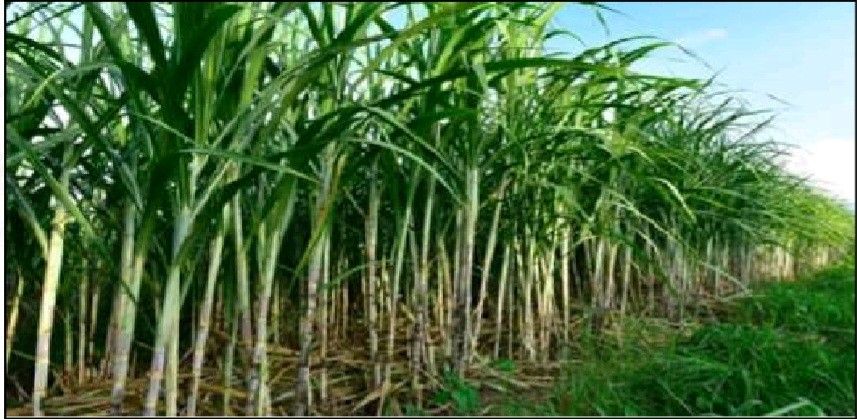
Sugarcane
- Requirement
- Temperature 20-35 degrees
- Rainfall:- 20 -35 degrees
- Climate – Tropical climate
- Soil- Loamy lava soil
- Production First – Ganganagar, second – Chittorgarh
- Varieties: Co-419, Co-449, Co-527, 1007, 1111, C.O.S -767, COLK -09204, IKSHU-3
- Disease – Red rot, Pyrilla worm
- Production – 1st Ganganagar ,2nd -Chittorgarh
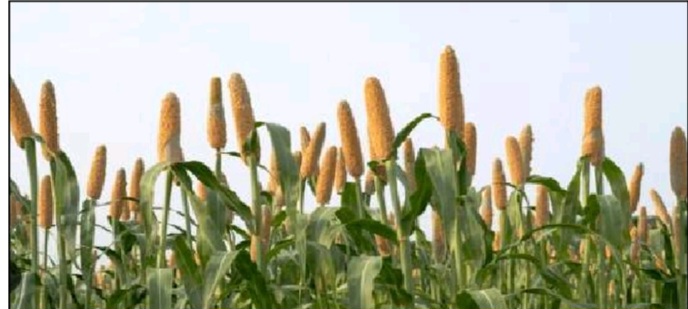
Bajara (Shri Anna)
- Requirements
- Temperature : – 30°C -50°C .
- Rainfall:- 25 – 50 cm.
- Soil :- Sandy Soil
- Varieties :-Raj 171, RCB-2, RHB-30, RCB-911, Bajara -Chari-2.
- Disease:- Gout Disease
- 1st – Alwar, 2nd – Jaipur are the highest pearl millet-producing districts.
- Maximum sown area – Barmer
- Rajasthan Ranks 1st in Bajara production in the country.
- Bajara Research Institute – Barmer
- Bajara Centre of Excellence – Jodhpur
Major crops of Zaid crops are muskmelon, cucumber, vegetables, etc., cultivated between March and June
Other crops of Rajasthan
Groundnut
- Temperature:- 25C -30°C
- Rainfall:- 50 – 100 cm
- Soil :-Sandy Soil
- 1st – Bikaner, 2nd – Jodhpur, and Churu are Groundnut – producing districts.
- Rajasthan ranks second after Gujarat.
Mustard
- Climate: – Dry and cold
- Soil:- Sandy and Loamy Soil
- 1st – Sri-Ganganagar, 2nd – Alwar and Bharatpur are Mustard -producing districts.
- Rajasthan ranks first in India (46.63% Contribution in total country’s production)
Gram
- Climate: – Dry and Cold
- Rainfall:- Medium
- Soil: Loamy Soil
- Varieties:- C-235, RSG- 44, Vardaan, Sangam, Arpan.
- 1st – Bikaner, 2nd – Hanumangarh, and Churu are Gram producing districts.
- Rajasthan ranks third after Maharashtra and Madhya Pradesh.
Soyabean
- Temperature: – 15°C – 35°C .
- Rainfall:- 75 – 125cm.
- Soil:- Deep Loamy Soil
- 1st – Jhalawar, 2nd – Baran, and Pratapgarh are
- Soybean-producing districts.
- Rajasthan ranks third after Maharashtra and Madhya Pradesh.
Jowar
- It is a kharif crop
- Requirements –
- Climate – Hot climate
- Temperature 25-30 degrees
- Varieties:- SPV-96, SPV-245, Rajasthan Chari.
- Production: First Ajmer, Second Bhilwara
- Rajasthan ranks THIRD in India (14.87% Contribution in Total produce). Institute – Sorghum Research Centre – Vallabhnagar (Udaipur)
Agricultural Production Highlights of Rajasthan
Total Oilseeds
|
Nutri – cereals
|
Guar
1. Hanumangarh 2. Bikaner |
Total pulses
|
Agriculture-related Research Centres
State Government
- Maize and Rice Research Centre – Banswara
- Isabgol Research Centre – Jodhpur
- Date Research Centre – Beechwal (Bikaner)
- Sorghum/Research Centre – Vallabhnagar (Udaipur)
- Rajasthan Agriculture Research Centre) – Durgapura (Jaipur-1943)
- Ber Research Centre – Bichwal (Bikaner)
Central Government (ICAR – Indian Council of Agriculture Research)
- CAZRI (Central Arid Zone Research Institute) – Jodhpur (1959) Sub Centres of CAZRI :
- Rajasthan – Bikaner, Jaisalmer, Pali
- Gujarat – Kutch (Bhuj)
- Ladakh – Leh
- Central Institute for Arid Horticulture- Bichhawal, Bikaner (1993)
- Mustard Research Centre – Sevar, Bharatpur (1993)
- National Research Centre on Seed Spices – Tabiji, Ajmer (2000)
- Swami Keshvananda Rajasthan Agriculture University – Bichhwal, Bikaner (1987)
- Maharana Pratap University of Agriculture and Technology – Udaipur (1999)
- Shri Karna Agriculture University – Jobner, Jaipur (2013)
- Agriculture University – Borkheda, Kota (2013)
- Jodhpur Agriculture University – Mandore (2013)
Agriculture-related Excellence Centres
- Citrus – Nanta, kota
- Pomegranate, Olive, Dragon fruit – Bassi, Jaipur
- Date – Sagar Bhojka, Jaisalmer
- Guava- Devdabaas, Tonk
- Orange – Jhalawar
- Mango – Khemri, Dholpur
- Vegetables – Bundi
- Flowers – Sawai – Madhopur
- Custard Apple – Chittorgarh
- Honey Bee – keeping – Bharatpur
- Fruit – vegetable – Beawar, Sirohi
- Garlic – Baran
Agriculture Census – 2015 -16
- Operational Land Holdings in the State is 76.55 lakh, whereas it was 68.88 lakh in 2010-11, showing a growth of 11.14 per cent.
- The ratio of classified land holdings to total land holdings of marginal, small, semi-medium, medium and large categories is 40.12 per cent, 21.90 per cent, 18.50 per cent, 14.79 per cent, and 4.69 per cent, respectively.
- Female Operational Land Holdings is 7.75 lakh, whereas it was 5.46 lakh in 2010-11, showing a growth of 41.94 per cent.
- The ratio of classified female land holdings of marginal, small, semi-medium, medium and large categories to total female land holdings is 49.55 per cent, 20.77 per cent, 14.97 per cent, 11.74 per cent and 2.97 per cent, respectively.
Landholding Size Class (In hectares)
| Landholding Size Class (In hectares) | |
| Marginal | Below 1.0 hectare |
| Small | 1.0 – 2.0 hectare |
| Semi-Medium | 2.0 – 4.0 hectare |
| Medium | 4.0 – 10.0 hectare |
| Large | Above 10.0 hectares |
Agriculture Related Program and Policies
Agriculture Infrastructure Fund (AIF) –
- Agricultural Infrastructure Fund of ₹1 lakh crore was constituted on 15th May, 2020, to create farm gate infrastructure for farmers. Under AIF, an interest subsidy of 3 per cent per annum is given on all loans up to the limit of ₹2.00 crore
Pradhan Mantri Fasal Bima Yojana (PMFBY)
- Implemented since Kharif 2016. The scheme covers food grain crops (cereals, millets and pulses), oilseeds and commercial/ horticultural crops.
- The Farmer premium for Kharif crops, Rabi crops and Commercial/Horticultural crops is 2 per cent, 1.5 per cent and 5 per cent, respectively.
Namo Drone Didi Yojana:
- Under this scheme, financial assistance, capacity building and hand-holding support will be provided to 1,000 women Self Help Groups (SHGs) for the purchase of a drone and accessories.
- Spraying Nano Urea and Pesticides through drone technology will enhance the precise application of fertilizers & pesticides, and transform traditional agricultural practices.
- Initiatives have been taken by the Government in the Agriculture Budget 2025.
- An increase in the amount of PM Kisan Samman Nidhi to ₹9,000 per year from the next year.
- The bonus amount per quintal has also been increased to ₹150 over and above the MSP (Minimum Support Price) of wheat.
Agriculture policies
- Agriculture Policy - 26 June 2013
- Organic Agriculture Policy - June,2017
- Agro processing, Agriculture Business and agri-export promotion policy – 2019
Agro-Climatic Zones
- According to ICAR, India is divided into 126 agro-climatic zones, out of which 10 fall under Rajasthan
- Factors considered are rainfall, temperature, topography, soil characteristics, cropping pattern, and irrigation facilities.
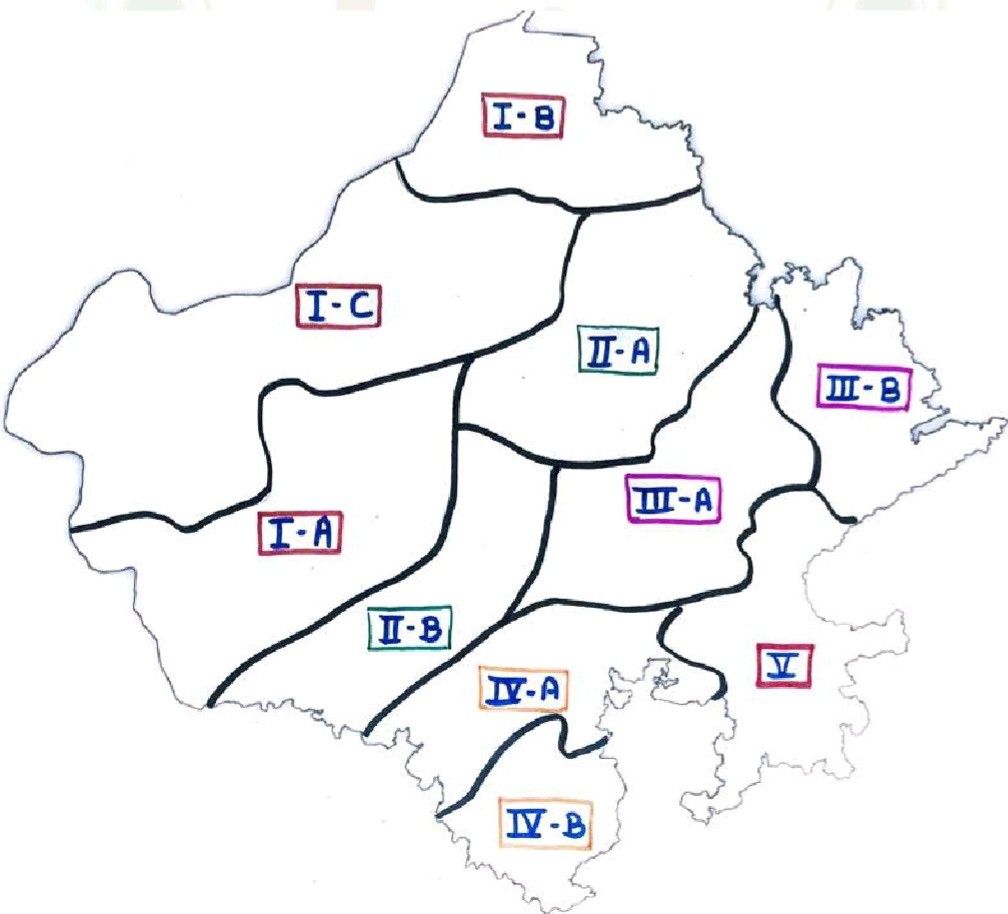
| Sr.No. | Zones | Area | Rainfall | Soil | Irrigation | Agriculture +Livelihood | Agriculture Research Center | Agriculture test centre | |
| 1. | (I-A) Arid Western Plain | Bajra, Moth, Sesame (Agriculture in packets) livestock rearing | 10-40 cms | Coarse desert soil (CaCO3 and Gypsum) Playa formation | Deepground water (saline) few tubewells | IGNP, Ghaggarbasin | Mandor, Jodhpur | Rampura, jodhpur | |
| 2. | I-B (Irrigated north – west plain) | Jodhpur, Phalodi, Barmer and Balotara | 10-40cms | Alluvial soil | Cotton, sugarcane, wheat Gram Mustard | Cotton, sugarcane, wheat, Gram Mustard | Ganga Nagar | Lunkaransar, Bikaner | |
| 3. | II-B (Transitional Plain of Lunibasin) | Bikaner,Jaisalmerand Part of Churu(Ratangarh,Sardarsahar,Bidasar & SujangarhTehsil) | 10-35 cms | Bajra Moth Gwar, Mustard, Wheat Gram | Beechwal, Bikaner | Loamy coarse desert, calcareous (pebbles &boulders) | I-C (Hyper arid-partially irrigated west zone) | Lunkaransar,Bikaner | |
| 4. | II-A (transitionalplain ofinlanddrainage) | Sikar, Churu(Exclusive of Ratangarh,Sardarsahar,Bidasar & SujangarhTehsil),Jhunjhunu, Nagaur and Deedwana Kuchaman | 30-50 cms | Jaipur, Ajmer, Dausa, Tonk, Khairthal, Tijara, Kotputli-Behror and Beawar (Exclusive of Jaitaran, Raipur Tehsil) | Fatehpur, Sikar | Bajra Gwar pulses Mustard Gram | In the land drainage example, Kantaliriver | – | |
| 5. | Sandy loamy red soil. Sand dunes are found | Jalore, Sirohi( Exclusive of Pindwara,Abu roadTehsil) and Part ofBeawar(Jaitaran & RaipurTehsil) | 40-50cms | red Loamy -Jodhpur Jalore serozem(loamy)- PaliSirohi, | Ephemeral streams salinewater (Balotra) | GwarwheatMustard Gramcash crops | Maize, Groundnut jowar Wheat, Mustard | Banswara, Dungarpur, Pratapgarh, Parts of Salumber(Badi Sadri Tehsil) and Chittorgarh | |
| 6. | III-A (semi-arideasternplain | III-B (flood-prone eastern plain) | 50-70cms | Brown alluvial soil | Banas and its tributaries | Bajra GwarJowar Wheat Mustard gram | Keshwana, Jalore | Tabiji, Ajmer | |
| 7. | Yellow clayey loam non-calcareous | Alwar, Deeg, Bharatpur, Dholpur, Karoli and Sawai Madhopur | 60-70cms | Sumerpur, Pali | Yamuna and its tributaries | Bajra Groundnut Wheat Mustard Gram | Mallikpur, Bharadpur | Ummed Ganj Kota | |
| 8. | Shri Karanpur, Bikaner | Udaipur,Chittorgarh(Exclusive of Badi Sadri Tehsil),Rajasamand,Bhilwara and Part of Sirohi(Pindwara &Abu road Tehsil) | 70-90cms | Medium fine alluvial soil | Bedach &Banas | Durgapura, Jaipur | Udaipur | Chittorgarh | |
| 9. | IV-B (Humidsouthernplain) | IV-A (Subhumid Southern Plains) | 90-100cms | Red Black Basaltic soil | Mahi, Som Jakham | Navgaon, Alwar | – | – | |
| 10. | V (Humidsouthern-Easternplain | Kota, Bundi, Baran, Jhalawar | 70-100cms | Maze, Rice, Wheat, Gram | Chambal and its tributaries | Jowar Soybean wheat mustard | Black clayey vast alluvial plane (ravines) | ChhatrapuraBundi | |



