

Natural Vegetation of Rajasthan is an important topic in Rajasthan Geography that reflects the close relationship between climate, soil, and relief of the state. Due to wide variations in rainfall and temperature, Rajasthan exhibits diverse vegetation types ranging from tropical thorn forests in the west to dry deciduous forests in the eastern and southern regions. This natural vegetation plays a crucial role in maintaining ecological balance and supporting rural livelihoods.
Geographical Classification Of Vegetation
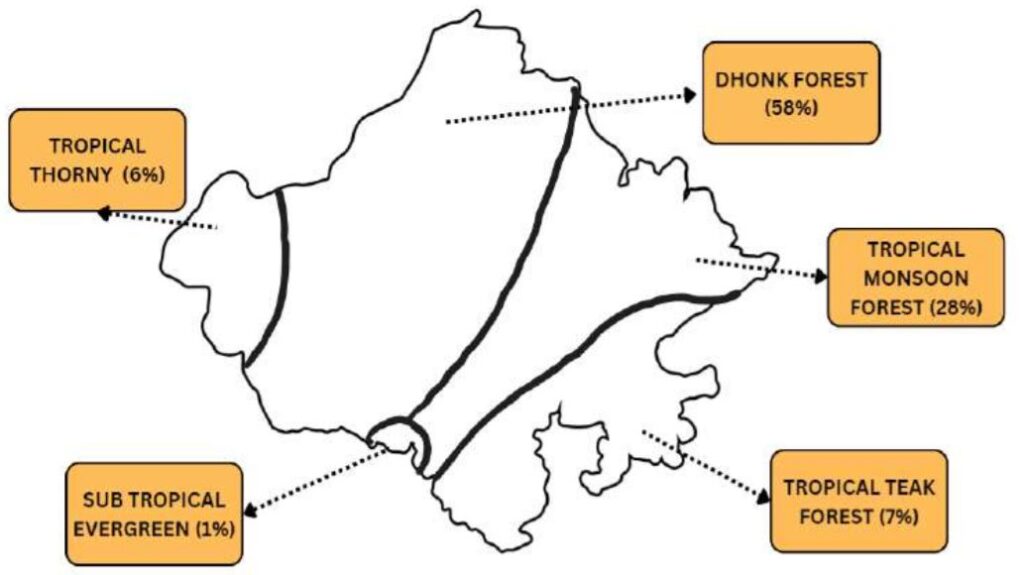
Tropical thorny/Xerophyte forest-
- 6% of Rajasthan area
- 0-30 cms rainfall.
- Arid desert area- Jaisalmer, Barmer (Balotara), Bikaner, Jodhpur (Phalodi).
- Thorny Bushes, Cactus, Bair, Khair, Aloe vera.
- prevents desertification.
Tropical dhonk forest
- 58% ofthe Rajasthan area.
- 30-60 cms rainfall
- Semi-arid areas
- Shekhawati, Nagaur, Luni basin, Sawai Madhopur, Karauli.
- Khejri, Rohida, Babool, Ber, Ker, Babool, Dhok tree
Tropical dry deciduous/Monsoon Forest
- 28% of the Rajasthan area.
- 50-80 cms rainfall
- Alwar, Bharatpur, Karauli, Dholpur, Jaipur, Tonk, Dausa, Udaipur, Salumber, Chittorgarh, Bhilwara, Rajsamand
- Sal, Teak, Mango, Rosewood, Sandalwood, Babool, Neem
- Timber of economic importance is supplied
Tropical teak forest
- 7% of the Rajasthan area.
- 75-110 cms rainfall
- Banswara, Dungarpur, Pratapgarh, Kota, Baran, Jhalawar
- Mahua, Gular, Tendu, Palash, Mango, Rosewood
Sub – tropical evergreen forest
- 1% of Rajasthan area
- About 150cms rainfall
- Mount Abu, Sirohi
- Jamun, Bamboo, Ambartari (Dicleptera Abuensis)
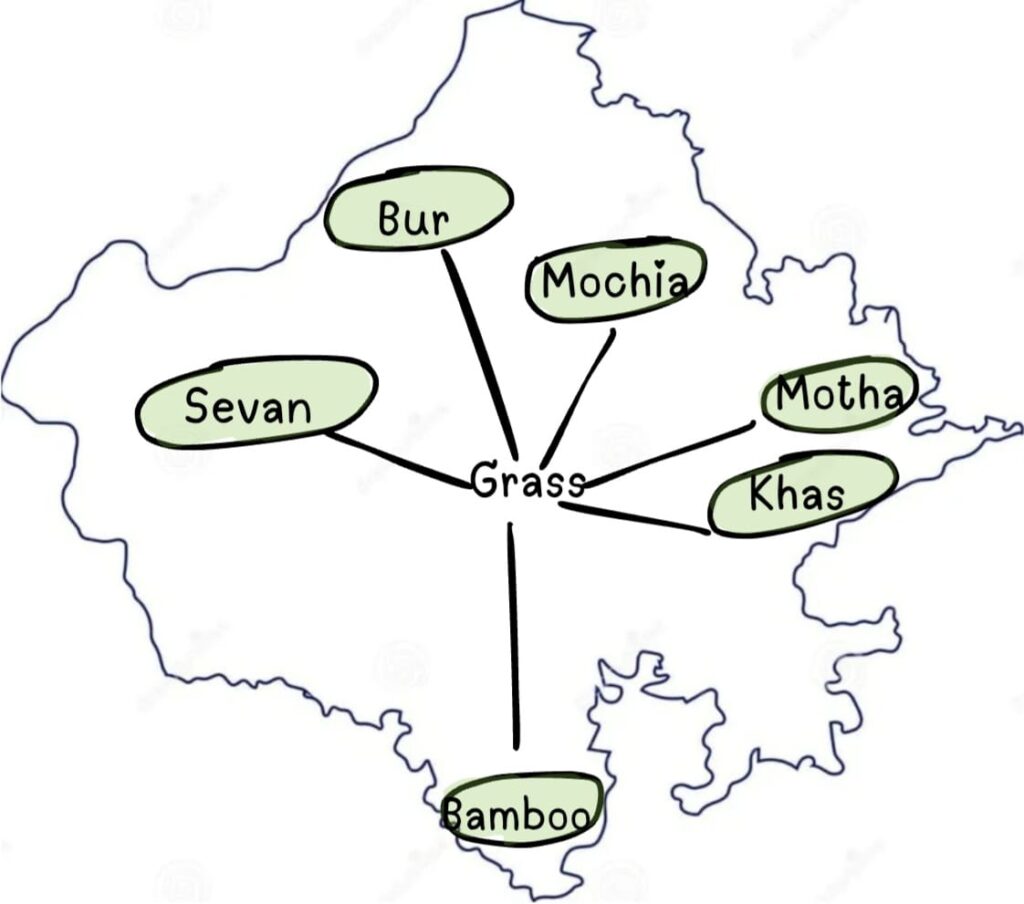
Important Grasses of Rajasthan
- Sevan/leelan (Lasiurus scindicus), western Rajasthan (Maximum in Jaisalmer); nutritious Grass; shelter of Godawan
- Bur– Bikaner and Churu, fragrance grass
- Mochia– Churu, Tal Chhapar; Black Buck feeds on it.
- Khas- Bharatpur, Sawai Madhopur, Tonk, Ajmer;
- Fragrances, Syrups and perfumes are made
- Bamboo – (Bambusa vulgaris) – Banswara, called green gold.
- Motha Grass – Mainly found in Bharatpur, used by Birds.
- Dhaman – (Cenchrus ciliaris ) – Maximum in Jaisalmer for milching animals.
Important Forest Wealth and Grass
- Khejri
- Scientific Name - Prosopis Cineraria (Maximum – Western Rajasthan)
- Other Names - State Tree (1983)/Pride of the State/Shami tree/Kalpvraksh of state/Jaanti
- Note:- Khejri is worshipped on the occasion of Vijayadashami/Dussehra.
- Rohida
- Scientific Name- Tecomella Undulata (Maximum – Western Rajasthan)
- Other Name - State flower (1983)/Teak of Desert.
- Mahua
- Scientific Name - Maduca longifolia (Maximum – Dungarpur)
- It is called the “Kalpavriksha of Tribes”.
- The mahua flower is used in making liquor.
- Palash/Dhak/Khakra
- Scientific Name - Butea monosperma (Maximum – Rajsamand)
- It is also known as ‘The Flame of Forest’
- Dicliptera Abu ensis/Ambertari - It is a medicinal plant found only in Mount Abu in the world.
- Khair
- (Maximim – Udaipur, Chittorgarh)
- “Kattha” is prepared in Udaipur and Chittorgarh by the Kathori tribe from the bark of this tree.
- Mulberry/Shahtoot – (Maximum – Udaipur)
- Silk is produced from the silkworm on this tree. This rearing is called Sericulture.
- Tendu (Maximum Pratapgrah, Chittorgarh and Hadoti)
- Tendu
- (Maximum Pratapgrah, Chittorgarh and Hadoti)
- Its leaves are used for making Beedi.
- Its fruits are called “Timru”.
- The Tendu tree was nationalised in 1974
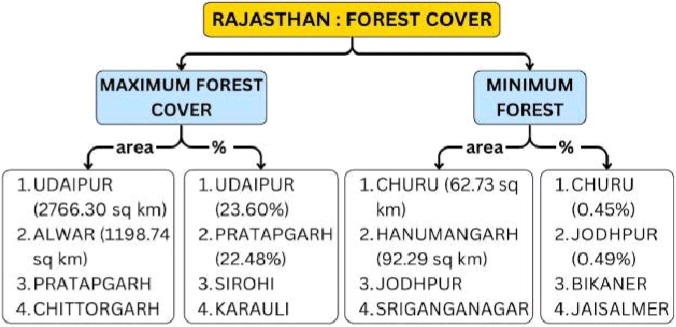
Rajasthan Forest Report
- Published by:- Forest Survey of India (Dehradun) and Forest Department of Rajasthan (Jaipur) from 1987 (Every two years)
- The 18th Report was published in 2023
- According to this report, around 330.14 sq. km., which is 9.6% of the total area of Rajasthan, is covered with forest cover.
- State forest policy 18 Feb, 2010- targets 20% of the state’s geographical area
- State ecotourism policy (1-4 Feb 2010) (2nd – 15 July 2021)
- In forest cover, Rajasthan‘s Rank is 15 th in India.
Administrative classification of Forest
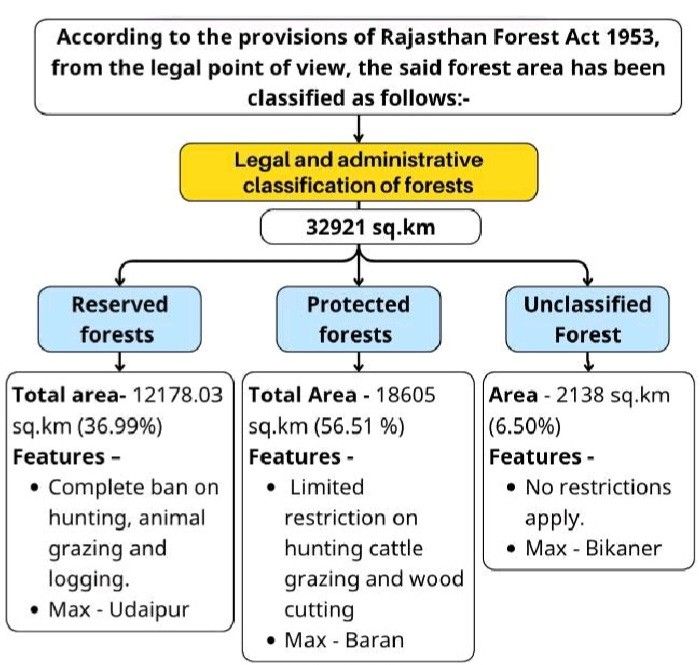
- According to the Indian state report 2023, the forest cover, in terms of vegetation cover, is approximately 16,548.21 km², which is 4.84% of the total geographical area of Rajasthan.
- Tree cover – According to the forest department-
- A group of trees that is 1 hectare or more with a canopy density of more than 10 %.
- Recorded forest area – 9.64% ( 33014 sq. km.)
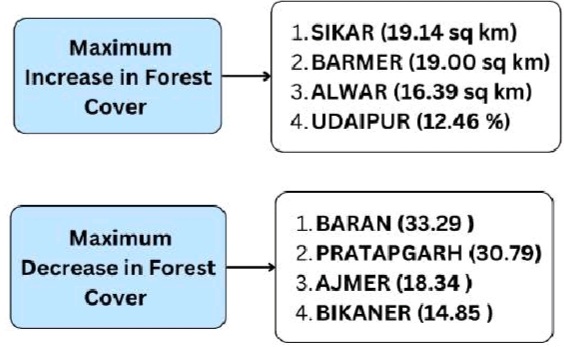
- Tree and Forest cover – 8.0% (27389.33 sq. km.) – 394.46 sq. km. Increase
- Forest cover- 4.84% (16548.21 sq. km.) – 83.80 sq .km. Decline
- Tree Cover– 3.16% (10841.12 sq. km.) – 478.26 sq. km. Increase
Area in sq km. | % of geographical area |
Very dense forest (<70% crop density) | (Alwar)Highest |
Moderately dense forests (40-70% crop density) |
|
Open forest (10-40% crop density) | Udaipur |
Total | 16548.21 |
Scrub(<10% crop Density) | 5476.75 sq.km |
Facts
| |
Highest scrub | |
Maximum
| |
Minimum
|
Forestry Award
Amrita Devi Bishnoi Award – Started in 1994
- Objectives – Tree plantation, Forest conservation, Wildlife conservation. 1st Award – Gangaram Bishnoi (Pali)
| Three Categories | ||
| Individual (Forest conservation )50,000 prize money | Individual(Wildlife conservation )50,000 price money | Organisation 1 Lakh |
Kailash Sankhala Award – (Tiger Man )
- For – Wildlife Conservation
- Prize Money – 1st – 5 Lakh, 2nd – 3 Lakh, 3rd – 2 lakh
Rajiv Gandhi Environment Protection Award
- Start – 2012 by the state government
- Objective – to protect the environment
- Given every year on World Environment Day, 5th June.
- Prize money – 5 Lakh,3 Lakh,2 Lakh
Indira Priyadarshini Vriksha Mitra Award
- Start – 1986
- Prize – 2.5 lakh (Individual /Organisational)
- Given by the Forest Department of India.
Van palak Award
- Employees /officers of the forest department
Major Forestry programs
Aravali Plantation Project
- Start – 1 April 1992, by a Japanese company
- Objective – To protect Biodiversity in the Aravali Region.
Social Forestry Programs
- Start – 1985 – 86
- Purpose – Tree plantation on Panchayat land, pasture land, and fallow land.
- Plantation on treeless hills or roadside.
Operation Kejari Program
- Start – 1991
- Purpose – Prevent desertification in Rajasthan
Rukh Bhayla Program
- Start – 1986 from Dungarpur
Desert Development Program
- Start – 1977-78 Fund Ratio – Centre (75%): State (25%)
Ghar -Ghar Aushadhi Yojana
- Start – 1 August 2021 by the Forest Department of Rajasthan
- Plant Distributed
- Tulsi
- Ashwagandha
- Giloy
- Kalmegh
Facts Related to India
- The forest and tree cover – 25.17% (82,357 sq km.) – increased by 1,445 sq. km.
- Forest cover – 21.76% (7,15,343 sq. km.) – Increase of 156 sq. km
- Tree cover – 3.41% (1,12,014 sq. km.) – Increase of 1289 sq. km
- In the current assessment, the total carbon stock in the country’s forests has been estimated at 7,285.5 million tonnes (an increase of 81.5 million tonnes as compared to the previous assessment)
- Rajasthan secured a place in the top four states showing maximum increase in forest and tree cover –
- Chhattisgarh (684 sq. km.)
- Uttar Pradesh (559 sq. km.)
- Odisha (559 sq. km.)
- Rajasthan (394 sq. km.)
The Japan International Corporation Agency Dx Lab helps in the development of Forest Stack. In their first stage, they develop forest stacks in Sirohi, Pali and Bhilwara.



